No Products in the Cart




A freezer alarm goes off at 6:10 a.m. In the rack are irreplaceable patient samples, research cell lines, or fertility materials that can't drift warm even briefly. Someone checks the vessel, sees a cloud of cold vapor, and asks the question that usually comes too late: was this the right container for the job in the first place?
That's where most cryogenic equipment decisions begin. Not with a catalog. With risk, workflow, and the simple fact that liquid nitrogen storage only works when temperature control, insulation, and handling all stay aligned.
In labs and hospitals, cryogenic equipment often looks deceptively simple. A dewar sits in a corner. A transport vessel rolls into a loading area. A freezer holds canisters and racks. But each one is doing a demanding job: keeping contents at extremely low temperatures while resisting constant heat entry from the room around it.
That matters far beyond research labs. The global cryogenic equipment market is already a large industrial category, with 2025 estimates ranging from about USD 23.7 billion to USD 26.6 billion, and projections rising to roughly USD 34.9 billion to USD 64.3 billion by the early 2030s or 2034, depending on the study, with reported growth rates of about 4.4% to 11.3% CAGR and Asia-Pacific identified as the largest regional market in 2025 across multiple studies (Fortune Business Insights on the cryogenic equipment market). That scale tells you something important. Cryogenic equipment isn't niche infrastructure. It supports healthcare, biotech, industrial gases, food processing, and energy systems.
For teams focused on liquid nitrogen, the practical question isn't “What is cryogenics?” It's usually one of these:
Those are different jobs. Buyers often mix them together because many vessels look similar from the outside.
The container that works well in a sample room may be the wrong choice for a courier route, and a vessel that survives road transport may be inefficient as a daily-access storage unit.
The rest of the guide treats cryogenic equipment the way working teams use it. First the basic physics. Then the equipment families. Then a practical way to spec for storage versus transport versus distribution, using hold time, boil-off, and ADR-related safety criteria that purchasing teams and users can verify.
Liquid nitrogen is central to many cryogenic workflows because it's cold enough to preserve biological materials and practical enough to store and transfer in routine operations. At 1 atmosphere, liquid nitrogen boils at about −195.8 °C, and when it warms to room conditions, its liquid-to-gas expansion is about 1:694 (USDA liquid nitrogen safety guidance).
That huge expansion ratio explains both its usefulness and its hazards. A small volume of liquid can produce a much larger volume of gas. In storage terms, that means evaporation and boil-off always matter. In safety terms, it means releases can quickly change the atmosphere in a room.
The easiest way to understand cryogenic storage is to think about a high-performance thermos flask. A normal bottle slows heat flow. A cryogenic vessel has to do that job much better, because the temperature gap between the liquid inside and the room outside is extreme.
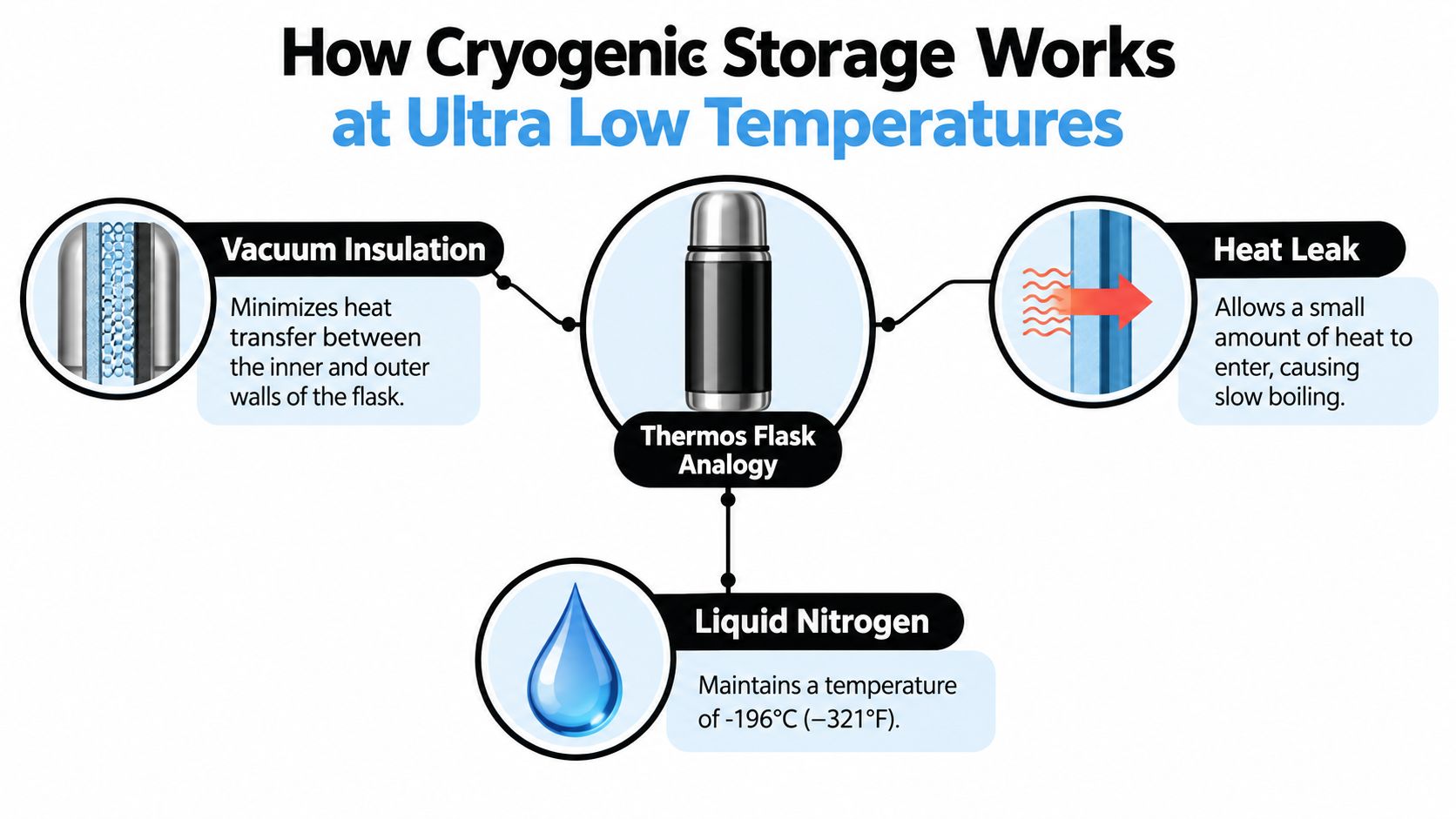
Most cryogenic vessels reduce heat transfer by using double walls with an evacuated space between them. That vacuum acts like a barrier against heat moving inward. If you want a plain-language refresher on vessel fundamentals, this overview of how cryogenic freezers work is useful before comparing models.
Three ideas drive performance:
NASA's cryogenic insulation data show how sharply thermal performance changes with insulation regime. Effective thermal conductivity is about 30 mW/m·K for ambient-pressure materials, roughly 1.5 mW/m·K for bulk fill materials at good vacuum, and below 0.1 mW/m·K for multilayer insulation at high vacuum. The same source notes that evacuated powders or fibers need vacuum better than 10^-3 torr, while superinsulation generally requires vacuum below 10^-4 torr to work effectively (NASA technical paper on cryogenic thermal insulation).
Practical rule: Maintaining annulus vacuum is the highest-leverage control for storage reliability. When vacuum degrades, residual gas carries more heat, boil-off rises, and hold time drops.
That's why an older vessel can look fine and still perform poorly. The outside shell may be intact, but if vacuum quality has slipped, the nitrogen won't last as long.
At its boiling point, liquid nitrogen has a density of about 0.808 kg/L, while nitrogen gas at 20 °C is about 1.16 g/L (Air Products liquid nitrogen safety information). You don't need to memorize the values. The point is the gap is enormous. A dense, cold liquid becomes a much less dense gas, and it does so readily when heat gets in.
For operators, that turns a physics lesson into a purchasing rule: every cryogenic storage spec is really a heat-management spec.
Public market reports often group cryogenic equipment into broad buckets, but buyers usually need a more practical map. Recent market data show that storage is the largest application at 44.60% of the global market in 2025, transportation and distribution is the fastest-growing segment at 7.69% CAGR through 2031, tanks hold 33.25% of the equipment mix in 2025, Asia-Pacific holds 42.30% share and is growing at 7.38% CAGR, and liquid hydrogen is projected to grow at 9.95% CAGR (Mordor Intelligence cryogenic equipment market analysis). For a lab or hospital team, the useful takeaway is simpler: the market is getting more specialized, not less.
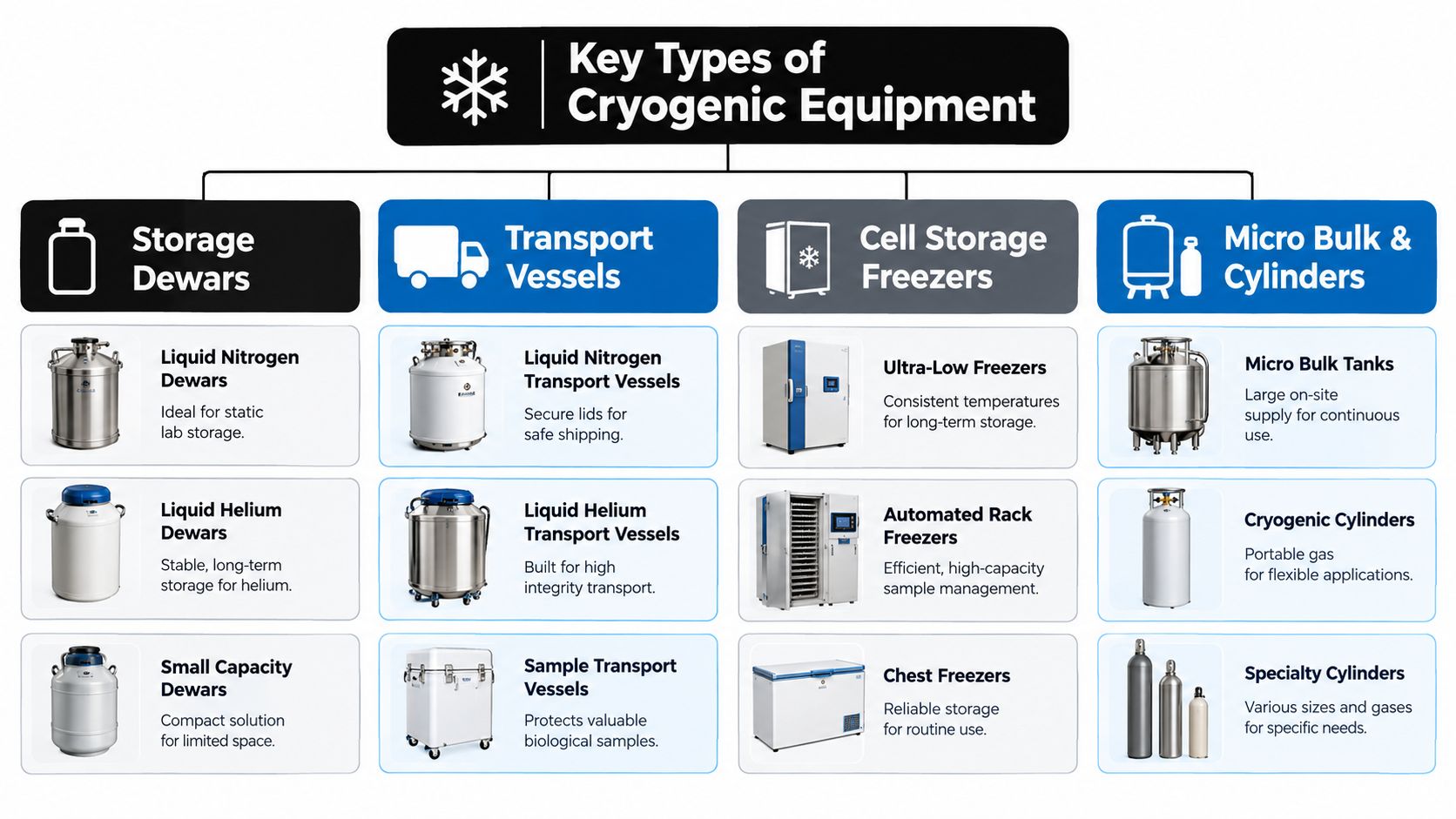
A storage dewar is the workhorse for static lab use. It's built to hold liquid nitrogen with low evaporation and stable access for canisters, racks, or inventory systems.
Choose this family when your main priority is sample protection in one location. A biobank storing vials for long periods usually cares more about hold time, neck design, rack compatibility, and access discipline than road mobility.
A transport vessel is for movement, not just cold retention. It has to tolerate handling, motion, and in many cases formal transport requirements.
Teams often get tripped up. A vessel that works nicely in a room may not be suitable for regular road movement. For couriers, satellite clinics, and collection networks, closure design, stability in transit, documentation, and pressure-relief behavior become more important than pure static storage efficiency.
A cell storage freezer organizes biological material, not just liquid. These systems are shaped around racks, canes, retrieval workflows, and traceability.
Model families such as AC FREEZER make sense when the requirement is controlled biological storage access. The vessel isn't just holding nitrogen. It's supporting repeatable sample handling by people who need to find, retrieve, and return material without avoidable exposure or confusion.
These support supply and distribution. A Micro Bulk installation is an on-site liquid source for facilities that consume enough nitrogen to make frequent small-container refill inefficient. Cryogenic cylinders are more portable and often fit local point-of-use or shorter-range supply tasks.
Model lines such as AC LIN fit users who need liquid nitrogen supply and handling rather than sample archiving. The key difference is operational role. A sample vessel protects contents from warming. A supply vessel supports transfer, fill, and distribution.
Buy by job to be done, not by silhouette. Many containers look alike until you compare access frequency, movement, refill method, and compliance needs.
A quick way to sort categories:
Specifying cryogenic equipment gets easier when you stop asking, “Which model is best?” and start asking, “What failure am I trying to prevent?” In sample storage, that failure is usually temperature drift. In transport, it may be pressure rise, spillage, or non-compliant movement. In distribution, it's often supply interruption and inefficient refill routines.
The same liquid nitrogen can serve very different workflows, so the first filter should be operational context.
| Application | Priority Criteria | What to Verify |
|---|---|---|
| Storage | Hold time, low boil-off, sample access, inventory fit, room footprint | Static evaporation behavior, rack/cane compatibility, refill routine, lid/neck usability |
| Transport | Secure mobility, pressure-relief design, compliant road use, handling stability | ADR suitability, tie-down or movement features, relief devices, documentation |
| Distribution | Usable supply volume, refill efficiency, transfer convenience, service access | Fill logistics, outlet/transfer arrangement, site layout fit, maintenance support |
Teams often treat hold time as a marketing number. It's more useful to see it as the operational effect of many design choices working together.
If heat leaks in slowly, less nitrogen boils away and the vessel holds longer. If heat leaks in faster, refill intervals shrink. That's why two vessels of similar size can behave differently in the same room.
Ask practical questions such as:
You don't need to become a vacuum physicist, but you do need to understand the cause-and-effect chain. The earlier thermal data show why vacuum quality changes performance so sharply. In plain terms, poor vacuum means more heat gets in, and that means more evaporation.
So when reviewing specifications or service history, focus on:
For transport use, buyers sometimes focus so hard on capacity that they miss legal and safety fit. A vessel can be cold enough yet still be the wrong choice if the route, vehicle handling, or transport documentation creates avoidable risk.
For storage inside a hospital or lab, quality expectations may also differ from pure industrial use. Medically licensed product quality, sample handling accessories, and traceability support can matter as much as the vessel shell.
Use this as a minimum spec screen before requesting quotations:
One market option in this space is Cryonos GmbH, which offers product families including AC FREEZER, AC LIN, liquid gas cylinders, and AC Micro Bulk, along with a product finder and service support suited to storage, transport, and handling workflows.
A good cryogenic spec doesn't just preserve temperature. It matches the realities of your room, staff, refill pattern, and transport path.
Liquid nitrogen safety starts with one fact many teams underestimate. A release doesn't need to be dramatic to become dangerous in the wrong room.
Guidance for liquid nitrogen handling warns that normal atmospheric oxygen is 20.9%, and that rapid nitrogen vaporization can reduce room oxygen concentration after a release (University of Glasgow oxygen-deficiency guidance). That's possible because nitrogen gas takes up so much more space than the liquid it came from.
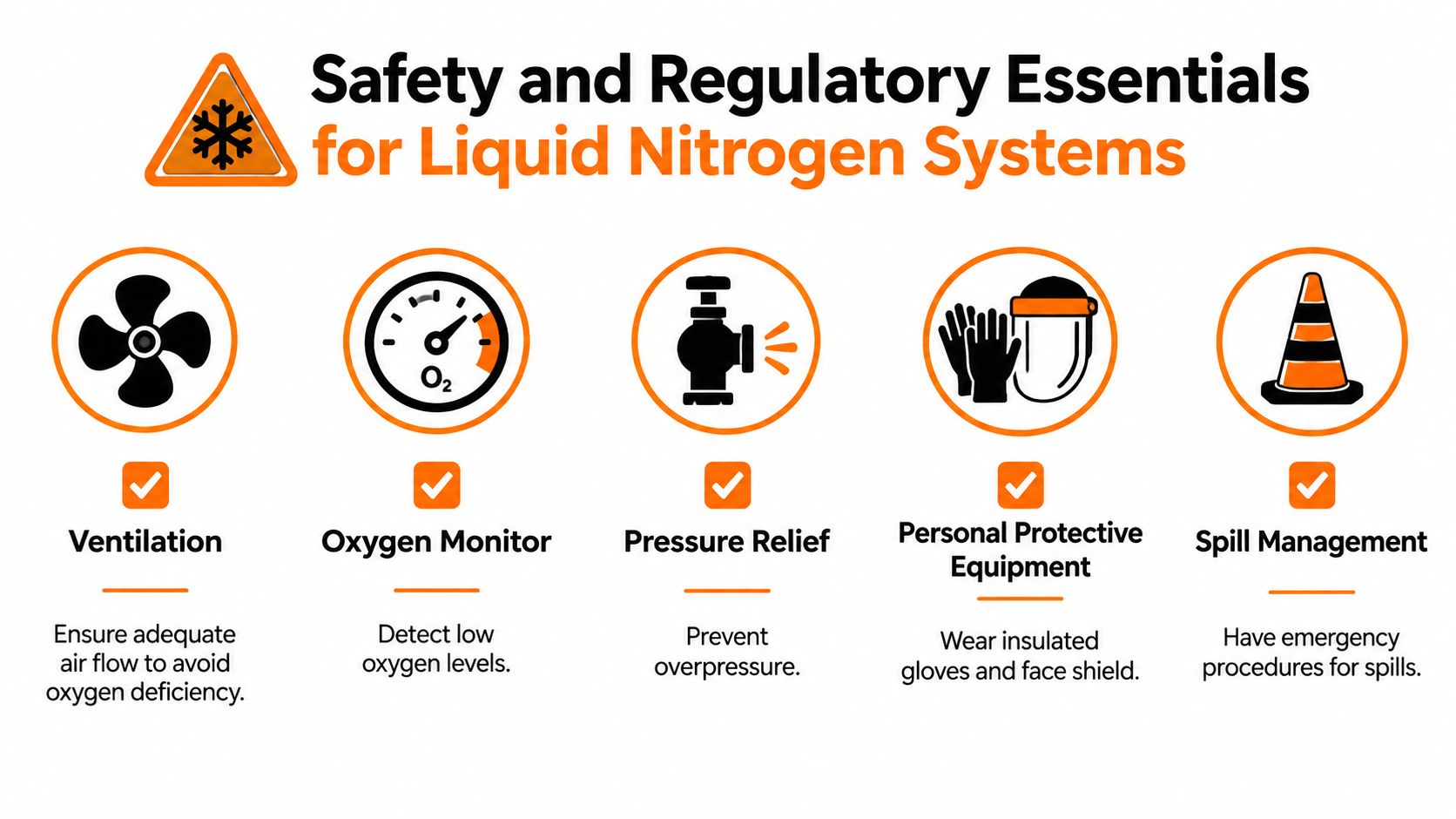
In a well-managed area, the controls are straightforward: ventilation, oxygen monitoring, trained staff, and disciplined handling. In a cramped or poorly ventilated room, even a modest release can create an oxygen-deficiency hazard before people fully register what's happening.
For day-to-day operations, this practical guide on safe work with cryogenic liquids is a good companion to formal site procedures.
A useful pre-use checklist includes:
Closed cryogenic systems must also manage pressure. Even under normal conditions, small heat leak creates vapor. If insulation performance changes abruptly, the pressure load can rise much faster.
ADR guidance states that cryogenic receptacles must have pressure-relief devices. For vacuum-insulated closed receptacles, combined relief capacity must keep internal pressure below 120% of MAWP during loss of vacuum, and relief valves should open at or above MAWP and be fully open at 110% of MAWP (UNECE ADR provisions for cryogenic receptacles).
If vacuum fails, the vessel stops behaving like a low-heat-leak system. Relief capacity becomes the backstop that prevents dangerous overpressure.
That's why pressure-relief hardware should never be treated as a minor accessory. It's central safety equipment.
Some mistakes repeat across sites because cold vapor makes systems feel passive. They aren't passive.
A fertility clinic, a biobank, and an industrial gas depot may all use liquid nitrogen, but they won't spec the same cryogenic equipment. Their risks are different, their access patterns are different, and their definition of downtime is different.
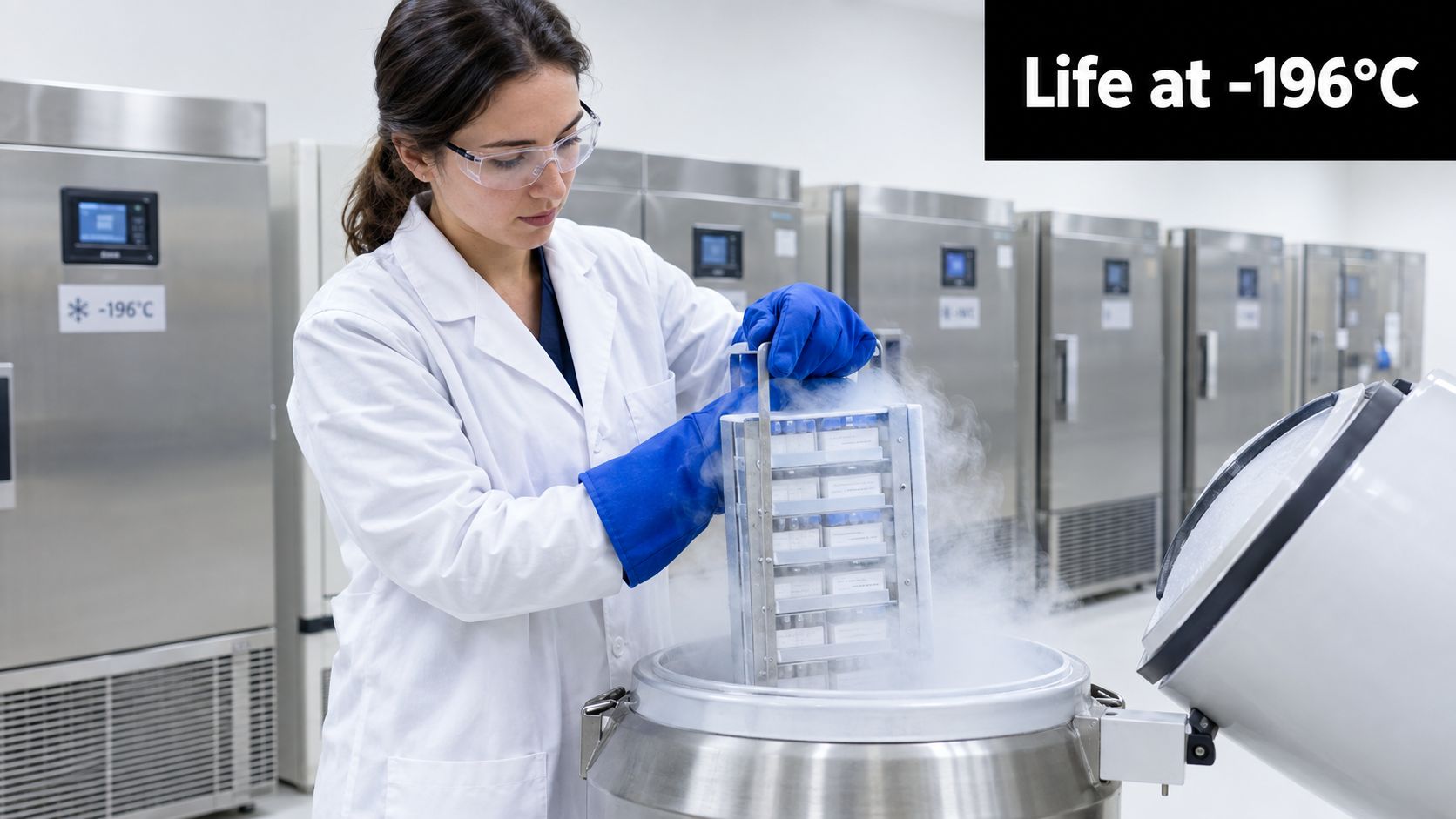
A biobank usually values long static hold time, organized racks, and predictable retrieval. Staff may open vessels often, but they still want to limit exposure of neighboring samples during each access cycle.
A cell therapy lab adds another layer. Material may need both secure storage and compliant movement between processing stages or facilities. In that case, the selection logic shifts from “Which dewar is cold enough?” to “Which storage unit and which transport unit belong in the same chain of custody?”
Hospitals and fertility clinics face a similar split. They need sample protection inside the facility, but they may also need movement between rooms, campuses, or partner sites without making the transport vessel do the job of a storage vessel.
Industrial gas suppliers think more in terms of supply continuity and distribution. A cylinder or Micro Bulk system may fit better than a sample-focused freezer because the job is repeated transfer and local availability, not archive-style storage.
University and government labs often sit in the middle. One group may need long-term biological storage, while another needs nitrogen for process cooling or general lab support. Shared sites often run better when teams stop trying to make one vessel type cover every use case.
This short video gives a useful visual sense of how cryogenic handling fits real workflows:
There's also a broader industry backdrop. One historical milestone often cited in cryogenic engineering is the launch of a hydrogen liquefier in the Soviet Union on March 23, 1931, an early step from laboratory experimentation toward industrial-scale cryogenic infrastructure (historical paper on cryogenic engineering development). Today's tanks, valves, vaporizers, and transport systems grew from that same core challenge: reaching and holding extremely low temperatures reliably enough for real operations.
Confident buyers usually follow the same pattern. They define the workflow first, then narrow equipment categories, then verify service and compliance details before they compare prices.
That sounds simple, but teams still skip key steps. They buy on nominal capacity without checking usable capacity. They compare vessel dimensions without checking access ergonomics. Or they approve a transport unit before confirming road-use documentation and handling procedures.
A solid implementation path looks like this:
In practice, good implementation reduces surprises. Refills happen on schedule. Staff know where PPE is. Sample retrieval follows a routine. Transport paperwork isn't assembled at the last minute. When a vessel behaves differently, someone notices early enough to act.
The best cryogenic equipment choice is the one your team can operate safely, refill reliably, and support over time without workarounds.
That's the standard to use when the catalog pages all start to look the same.
Cryonos GmbH provides cryogenic solutions for liquid nitrogen storage, transport, and handling, including product families for biological sample storage, transport vessels, cylinders, and Micro Bulk supply systems. If you're comparing options for a lab, hospital, or industrial site, visit Cryonos GmbH to review the available equipment and match it to your storage, transport, or distribution workflow.

