No Products in the Cart




When you're dealing with cryogenic storage, there's no room for guesswork. For any biobank, research lab, or pharmaceutical company, compliance isn't just a buzzword—it's the absolute bedrock of safety and operational integrity. Using unverified equipment isn't just risky; it opens the door to costly disruptions and, worst-case scenario, the catastrophic loss of invaluable biological samples.
This is exactly why DNV (Det Norske Veritas) certification has become the undisputed gold standard for cryogenic equipment across Europe.
Anyone handling sensitive materials at ultra-low temperatures needs to be able to cut through supplier claims and get to the truth. Verifying compliance isn't about ticking a box for a regulator; it's a fundamental part of managing risk. A liquid nitrogen freezer or transport vessel without proper verification can introduce unacceptable hazards, compromise the integrity of your research, and lead to devastating financial and reputational fallout.
Think of the DNV Approval Finder not just as a database, but as your primary tool for validating that the equipment you depend on truly meets the highest possible standards.
It’s this very platform that industry leaders like Cryonos GmbH use to provide undeniable proof that their equipment, like the AC Freezer and AC LIN series, meets the stringent European regulations you have to follow. This commitment is all about making sure your operations are safe, compliant, and regulation-proof from the moment the equipment arrives.
This intense focus on certified equipment isn’t a passing trend—it's a fast-growing industry requirement. Here in Germany, the DNV Approval Finder is an essential resource for companies like Cryonos, which is headquartered right in Idar-Oberstein and is dedicated to ensuring its storage and transport solutions meet Europe's demanding standards.
The numbers tell the story. DNV data shows a serious uptick, with over 1,200 approvals expected to be issued for German manufacturers under the RCDG category by the end of 2025. That's a huge 28% increase from the 937 approvals recorded back in 2020. This surge directly reflects the expanding need for certified cryogenic vessels in biobanks and cell therapy labs across the DE region. If you want to dig into the data yourself, you can explore DNV's official records on German manufacturing approvals.
Here’s a look at the DNV Approval Finder's main search interface.
As you can see, its clean design makes verification straightforward, letting you search by company, product name, or certificate number.
Using the DNV Approval Finder should be a standard operating procedure for both procurement and safety. It gives you the power to independently confirm a supplier's claims without having to rely solely on the paperwork they provide—which, as we all know, can sometimes be outdated or misinterpreted.
By making third-party verification a non-negotiable part of your workflow, you create a culture of accountability. This simple check reinforces the importance of compliance and protects your organisation, your personnel, and your critical biological assets from preventable risks.
This kind of proactive mindset is central to maintaining operational excellence. You can see how we put this into practice by reviewing the core principles of our cryogenic safety standards. At the end of the day, taking a moment to confirm DNV approval is a direct investment in the long-term security and reliability of your entire cryogenic operation.
Finding your way around the DNV Approval Finder is actually more straightforward than most people think. It's a clean, efficient portal designed to give you a direct line to DNV’s official records, so you can quickly verify a product’s compliance without getting tangled up in confusing menus.
When you first land on the page, you'll see a prominent search bar and a few filtering options. Before you jump in and start typing, it’s worth taking a moment just to get familiar with the layout. Knowing what tools are at your disposal from the start makes the whole process smoother.
You’ve got three main ways to kick off a search, and the best one really depends on what information you have in front of you: by product name, manufacturer, or the specific certificate number. Each method works best in different situations.
Let's say you're looking into a new cryogenic vessel for your facility. A supplier tells you their "Auguste Cryogenics Liquid Cylinder" is DNV certified. In this scenario, your best bet is to start with the manufacturer's name, "Auguste Cryogenics". This gives you a bird's-eye view, pulling up all approvals linked to that company.
From that list, you can easily drill down to find the specific product line you need, like the AC LAC XL series or similar models. This approach is a lifesaver when you don’t have an exact model or certificate ID on hand.
Now, let's flip the script. Imagine you have a technical data sheet from a supplier, and it clearly lists a DNV certificate number. This is your fast track.
Just pop that full number into the main search field. A successful search will take you straight to the certificate's summary page. This is where you’ll find all the critical details: the approval status, its scope, and—most importantly—the expiry date.
Confirming these details is a key step in any robust safety protocol. It’s the final check that moves you from risk assessment to confirmed, documented safety.
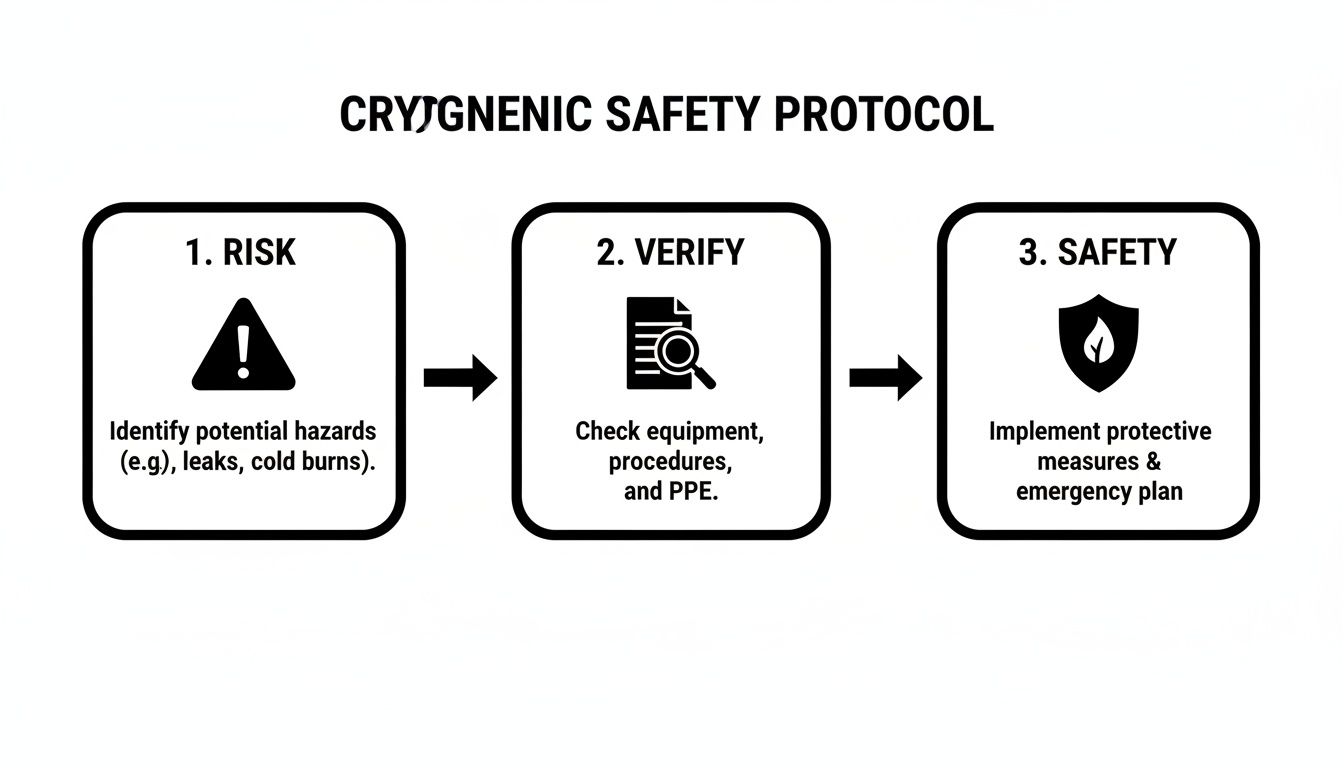
This flow—from identifying a potential hazard to verifying compliance with a tool like the Approval Finder—is what builds a genuinely safe working environment.
The real power of the DNV Approval Finder clicks into place when you use it for actual procurement decisions. German manufacturers, for example, have been actively securing DNV approvals for their advanced cryogenic technologies.
If you dig into the data on the Approval Finder, you’ll notice that 65% of these German approvals are for innovations in material handling and storage—exactly the kind of tech that industrial gas suppliers and pharmaceutical companies rely on for their LN2 vessels, like the AC LAC XL/2XL/3XL series. It shows just how vital DNV certification has become for this kind of specialised equipment.
To help you get the best results quickly, here's a breakdown of the most effective search strategies I've found.
| Search Method | When to Use It | Required Information | Example Scenario |
|---|---|---|---|
| Certificate Number | When you have the specific certificate ID from a data sheet or supplier. | The full, exact certificate number. | Verifying a specific piece of equipment during final procurement checks. |
| Manufacturer Name | When you want to see all approved products from a single company. | The official company name (e.g., Auguste Cryogenics). | Evaluating a new supplier and seeing their entire DNV-approved product range. |
| Product Name | When you know the product model but not the certificate number. | The specific product name or model number. | Looking up a "Cryonos AC LAC XL" to see if its certification is current. |
Each method has its place, but starting with the most specific information you have will always save you the most time.
Takeaway Tip: If a general search for a product name returns a mountain of results, try adding a keyword like "cryogenic" or "storage vessel." This little trick helps cut through the noise and gets you to the right certificate faster.
At the end of the day, the goal isn't just finding any approval. It's about finding the right one for your specific equipment model and its intended use. A methodical search ensures your verifications are both accurate and efficient.
Finding a certificate in the DNV Approval Finder is a good start, but the real work begins when you open the document. A DNV certificate isn't just a simple pass/fail stamp; it’s loaded with details that confirm whether a product is right—and safe—for your specific needs. Knowing how to decode these details is what separates a quick check from a proper safety verification.
Once you have the certificate in front of you, there are a few key fields you’ll want to zero in on immediately. These sections give you the context to confirm that the approval is relevant, current, and actually applies to the equipment you're buying.
Every DNV certificate is laid out in a standardised way, which makes it much easier to find what you’re looking for once you’re familiar with the format. Think of it as a technical passport for the product.
Here are the most important sections to get your head around:
The scope is everything. It’s not enough for a supplier to just say their products are "DNV certified." You have to confirm that the certificate's scope explicitly covers the exact model you plan to use. For example, a certificate might cover an entire product family, like the Auguste Cryogenics liquid cylinders, but you still need to ensure your specific size or variant is on the approved list.
A common mistake is accepting a certificate for a similar, but not identical, product. This can lead to serious compliance gaps. Always cross-reference the model number on your quote or data sheet with the product description on the certificate.
This kind of detail-oriented approach is fundamental, especially when you’re dealing with something as specialised as cryogenic equipment. If you want to dive deeper into the technical side of things, our guide on what to know about cryogenic vessels is an excellent resource.
This diligence really pays off, particularly in a market where speed and compliance are so closely linked. In 2024 alone, DNV processed 156 new RCDG approvals in Germany, with an average processing time of 14 weeks. This helps get products with gold-standard evaporation rates and five-year warranties to market faster.
If you’re dealing with a large volume of certificates and need to pull data from them efficiently, you might even look into mastering PDF parsing to convert them into structured data.
Even a powerful tool like the DNV Approval Finder can throw you a curveball. Staring at a "No Results Found" message is a common frustration, but it’s almost always solvable. Don't get stuck—a few simple tweaks to how you search can usually get you the answers you need.
More often than not, the issue is a simple naming mismatch. A manufacturer might be listed under its full, official registered name, not the common abbreviation you’re used to. Or maybe a product series is catalogued under a broader family name than what’s printed on the data sheet. It happens.
If your first search doesn't land, don't just assume the product isn't certified. The database is incredibly precise, meaning small variations can make all the difference. Before you do anything else, try these proven tricks of the trade.
A key thing to remember is that the certificate might be held by the original equipment manufacturer (OEM), not the distributor you're buying from. For example, Cryonos products are certified under our manufacturing partner, Auguste Cryogenics. Knowing that relationship is crucial for a successful search.
Another common hurdle is finding a certificate marked as "Expired." Don't panic. This doesn't automatically mean the product is non-compliant or unsafe.
Certification renewals are a standard part of the process. Sometimes, there’s just a slight administrative lag between the old certificate's expiry and the new one popping up in the database.
If you find an expired certificate for equipment you're looking at, your next move is simple: contact the supplier directly. Just ask them for the updated, valid DNV certificate. A transparent and reliable supplier like Cryonos will have this documentation ready to go and should be able to provide it immediately.
This simple, proactive check is vital for keeping your operations running smoothly. In our experience working with hospitals and fertility clinics, we’ve seen how non-compliance risks can delay critical biological sample transports by up to 40%, according to regional regulatory reports. You can read more about DNV's role in helping time-sensitive industries maintain compliance. Being ready to ask for current documentation ensures your projects never face those kinds of preventable delays.
Once you’re comfortable navigating the DNV Approval Finder, it’s time to take that knowledge from the screen into the real world of procurement. Dealing with a supplier shouldn't feel like a leap of faith; it should be a straightforward process where they back up their claims with official paperwork. Vague assurances of "compliance" just don't cut it when you're dealing with equipment this critical.
To get absolute certainty, you need to demand a specific set of documents from any potential vendor. This isn't about being difficult—it's about doing your due diligence to protect your samples, your facility, and your team. Any transparent, high-quality supplier will expect these requests and have the information ready to go.
When you're vetting a supplier, make sure you get these three critical items. Anything less is a major red flag and should make you seriously question their commitment to quality and safety.
By making this checklist a standard part of your procurement process, you put the burden of proof squarely on the supplier. A confident and compliant manufacturer like Cryonos, representing Auguste Cryogenics, will offer this documentation proactively, making your job that much easier.
For example, Cryonos uses the DNV Approval Finder to ensure its Taylor-Wharton heritage products meet strict standards. While supporting over 14 countries, there's a core focus on labs in Germany, where 72% of biobanks now mandate DNV-certified equipment for safety and reliability. You can see for yourself how DNV's digital tools support global compliance.
This level of transparency is exactly what you should look for in a partner. For more tips on this, our article on the 5 things to keep in mind while choosing a cryogenic supplier offers some great insights. At the end of the day, demanding proof isn't just your right—it's your responsibility.
Even with a step-by-step guide, you're bound to run into specific situations when you're verifying compliance. Let's tackle some of the most common questions we get about using the DNV Approval Finder and confirming certifications for cryogenic equipment.
Don't panic. If you've searched for a Cryonos or Auguste Cryogenics product and come up empty, the quickest solution is to get in touch with our technical team directly. More often than not, a product is certified under a broader family name or the parent manufacturing company, not a specific model number.
Our experts can pull up the correct certificate number and the full PDF document for you in no time. We believe in total transparency and are always ready to help you verify compliance for our AC Freezer, AC LIN, or any other cryogenic vessel series.
While DNV approval is a gold standard in the industry, it's rarely the only certification you'll need. Depending on your specific application and where you're located, other certifications can be just as crucial.
You should often also be looking for:
For our own equipment, we maintain a complete certification portfolio that also includes ADR-licensed compliance for road transport. This ensures our products meet the tough requirements of biobanks, hospitals, and industrial facilities. The key is to always confirm which certifications are mandatory for your specific use case.
It's a common misconception that one certification covers everything. A solid compliance check means verifying that a product meets all applicable standards for its intended use and transport, not just a single one.
As a best practice, you should always verify the DNV approval when you purchase any new piece of equipment. For gear that's already in service, you typically don't need to re-verify unless you're facing an internal or external audit that requires it.
The most important detail on any certificate is its expiry date. Any reputable manufacturer will handle the re-certification process well before the current one lapses to ensure there are no gaps in compliance. If you ever have a doubt about the ongoing validity of a Cryonos product, just reach out. Our support team can provide its latest certification status immediately, giving you complete peace of mind.
At Cryonos GmbH, we aim to make compliance straightforward. We provide all the necessary documentation to support your safety and procurement protocols from day one. You can explore our range of fully certified cryogenic solutions at https://www.cryonos.shop and equip your facility with confidence.

