No Products in the Cart




At its heart, oxygen is simply element number 8 on the periodic table. It's a nonmetal from the chalcogen group and, most famously, the reason we can take a deep breath. The core eigenschaften des sauerstoffs (properties of oxygen) all circle back to its atomic structure and its natural habit of pairing up to form the stable O₂ molecule we know so well. This simple pairing defines its massive role in chemistry, biology, and industry.
Before we get into its more dramatic behaviours, it’s worth understanding what makes oxygen, well, oxygen. Every element's identity starts with its atomic makeup, and for oxygen, the magic number is eight protons in its nucleus. This atomic number (8) is what gives oxygen its unique spot on the periodic table and dictates how it plays with other elements.
A single, lone oxygen atom is actually highly reactive. Why? Its outer electron shell is incomplete, holding six electrons when it really wants a full, stable set of eight. To find that stability, oxygen atoms are always looking to bond with others.
This brings us to the most common form of oxygen on Earth: the O₂ molecule, often called diatomic oxygen. This stable arrangement is created when two oxygen atoms share electrons through a strong covalent bond.
You can think of this bond like two business partners pooling their resources to build a more stable company. By sharing two pairs of electrons, each atom feels like it has a complete outer shell. The result is the relatively stable gas that makes up about 21% of our atmosphere.
This molecular structure is the launchpad for almost all of oxygen's important properties, from its role in breathing to its power in industrial processes. The strength of this bond also explains why it takes a kick of energy—like heat from a match—to break it apart during chemical reactions like combustion. If you're curious about how gases are transformed into liquids at super-low temperatures, you can learn more about what is cryogenics.
Oxygen’s identity is really a story of partnership. A single, unstable atom finds stability by teaming up with another, creating the O₂ molecule that's absolutely essential for life. This fundamental pairing dictates everything from how we breathe to how steel is made.
To give you a quick cheat sheet, the table below summarises oxygen's most important atomic and physical data.
This information is the foundation for understanding the more complex behaviours we’ll dive into next.
| Property | Value |
|---|---|
| Symbol | O |
| Atomic Number | 8 |
| Atomic Weight | 15.999 u |
| Group in Periodic Table | 16 (Chalcogens) |
| Electron Configuration | [He] 2s²2p⁴ |
| Common Physical State | Gas (at Standard Temperature and Pressure) |
| Classification | Nonmetal |
| Molecular Formula | O₂ |
Think of this table as oxygen's basic stat sheet. With these fundamentals covered, we can start exploring what happens when oxygen gets to work in the real world.
We experience oxygen every day as an invisible, odourless, and tasteless gas, but its physical nature is far more dynamic than we might think. These tangible eigenschaften des sauerstoffs (properties of oxygen) really come to life when conditions change, transforming this essential gas into states with incredible industrial and scientific uses.
At standard atmospheric pressure, oxygen stays a gas until it's cooled to an extremely low temperature.
This transformation isn’t just a scientific party trick; it's the very key to storing and transporting huge amounts of oxygen efficiently. Think about trying to move a million balloons versus one small, manageable tank. Condensing oxygen into its liquid state shrinks its volume dramatically, making it practical for everything from hospitals and steel mills to rocket propulsion.
The journey from a gas to a liquid kicks off at a frigid -183°C (-297.4°F). At this point, oxygen gas condenses into a beautiful, pale blue liquid, often called LOX (liquid oxygen). This temperature is quite a bit warmer than nitrogen's condensation point of -195.8°C, a crucial difference that allows us to separate the two gases from the air using fractional distillation.
The physical properties of oxygen in its gaseous and liquid states are worlds apart:
These extreme temperature thresholds are the heart of cryogenics, the science of handling gases in their liquid states. Storing and managing LOX requires highly specialised, super-insulated containers called dewars to keep it from simply boiling away.
Beyond its states of matter, oxygen has a few other key physical traits. One of the most vital for life on Earth is its limited solubility in water. It doesn't dissolve easily, but the small amount that does is exactly what allows fish, invertebrates, and aquatic plants to "breathe" and support entire underwater ecosystems.
But perhaps the most astonishing physical property of oxygen is its paramagnetism. Most elements are either repelled by or don't care about magnetic fields, but liquid oxygen is actually weakly attracted to them.
If you were to pour liquid oxygen between the poles of a powerful magnet, you'd see something amazing. Instead of falling straight through, it would actually hang suspended in the magnetic field. This bizarre behaviour is all down to two unpaired electrons in the O₂ molecule's outer orbitals, which behave like tiny magnets.
This magnetic quirk is a brilliant demonstration of how oxygen's electron configuration directly shapes its real-world physical behaviour. From its invisible gaseous form to its magnetic liquid state, the physical eigenschaften des sauerstoffs prove just how unique and complex this element truly is.
If oxygen had a personality, you could describe it as intensely reactive. This isn't just a quirk; it’s baked right into its atomic structure. The reason behind many key eigenschaften des sauerstoffs (properties of oxygen) comes down to its high electronegativity—a powerful urge to pull electrons away from other elements.
Think of it like a chemical magnet. With six electrons in its outer shell, oxygen is just two shy of a full, stable set of eight. This near-completeness creates a strong "pull," making it constantly hunt for electrons from other atoms to fill the gap. This act of stealing or sharing electrons is what chemists call oxidation, and oxygen is one of the absolute best in the business.
This fundamental drive is why oxygen is known as a powerful oxidising agent. It kicks off chemical changes by interacting with other substances, often with dramatic results. You can see the evidence of this chemical persuasion all around you, every single day.
Oxidation isn't some abstract concept locked away in a chemistry textbook. It's a real, tangible process that shapes the world we live in. Some of these transformations are slow and almost unnoticeable, while others are rapid and spectacular. But every single one is driven by oxygen’s relentless quest for electrons.
Here are a few familiar examples of oxidation in action:
At its heart, oxidation is simply the transfer of electrons, and oxygen is the ultimate electron thief. Whether it’s slowly corroding a piece of metal or rapidly fuelling a fire, oxygen’s high electronegativity makes it one of the primary catalysts for chemical change on our planet.
While rust is oxidation happening in slow motion, fire is oxidation hitting the fast-forward button. Combustion is a rapid oxidation process that unleashes energy as heat and light, and it's the most dramatic display of oxygen's reactive power.
To get your head around combustion, you just need to recall the classic "fire triangle." It shows the three things a fire absolutely must have to get started and keep going. Take away any one of them, and the fire goes out.
A simple campfire is a perfect illustration. The wood is the fuel, the match provides the initial heat, and the 21% oxygen in the air around it serves as the constant oxidiser. As long as all three elements are present, the fire will burn, putting one of the most powerful eigenschaften des sauerstoffs on full display.
Moving from the world of pure chemistry to the very essence of life, oxygen is the undisputed fuel for almost every complex organism on Earth. The same reactive, oxidising properties that make it so useful in industry are precisely what living things have learned to harness. This process, known as cellular respiration, is the absolute cornerstone of biology.
Think of the mitochondria inside your cells as microscopic engines. Just as a car engine burns petrol with oxygen to release energy, your cells meticulously "burn" glucose (sugar from your food) with the oxygen you breathe. This controlled reaction unleashes the energy that powers every single thing you do—from thinking and moving to healing and growing.
This life-giving cycle hinges on a remarkably efficient delivery system. It all starts with a single breath, but from there it becomes a complex, beautifully coordinated operation.
The image below gives a simple visual of how oxygen interacts with and changes an organic object, like an apple.
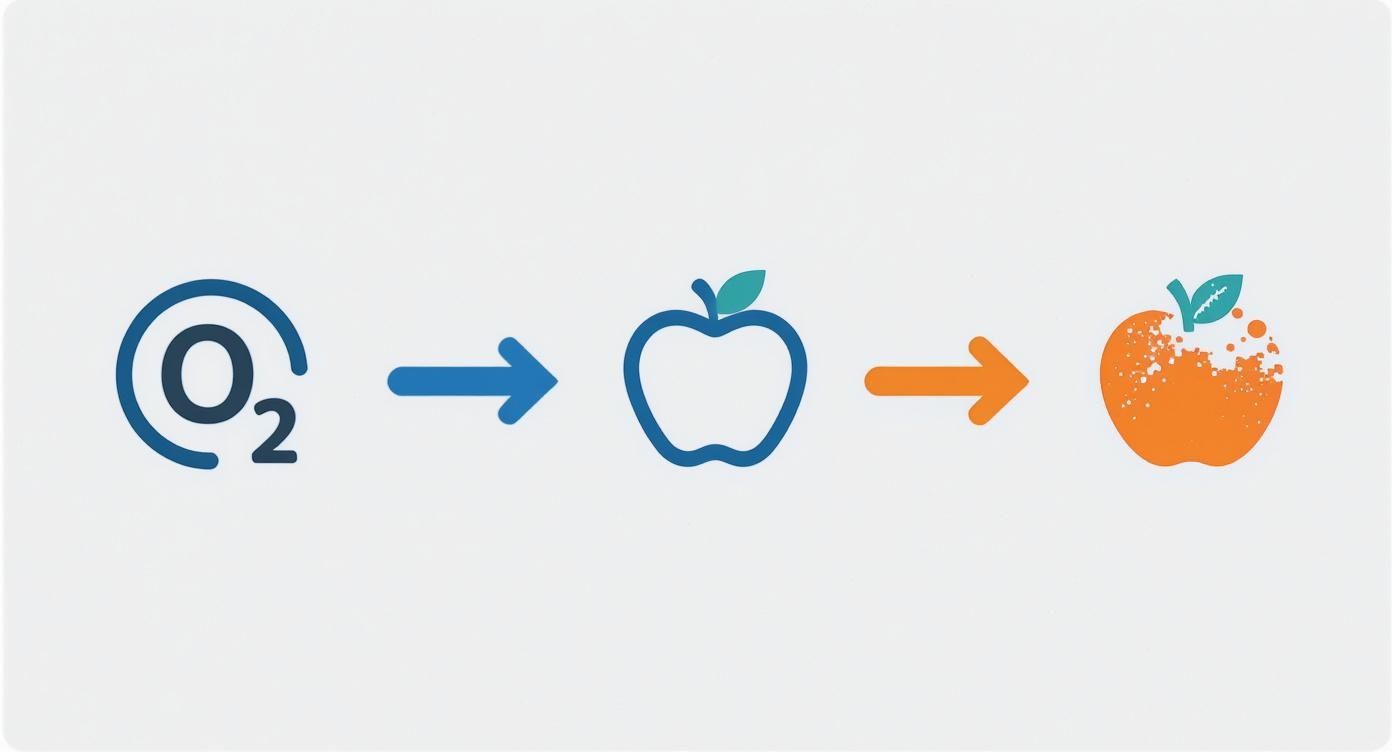
This browning process is a raw form of oxidation. It’s a great visual for what happens inside our cells, only our bodies manage this reaction with incredible precision to release energy, not just cause decay.
For life to flourish, the concentration of oxygen has to be just right. This is true for individual creatures and for entire ecosystems. The small amount of dissolved oxygen in rivers, lakes, and oceans, for instance, is what sustains all aquatic life, from the smallest plankton to the largest fish. If those levels drop, it can create ecological dead zones.
But the relationship between life and oxygen is a true balancing act. Too little oxygen is just as dangerous as too much.
Life exists on an oxygen knife-edge. We have evolved to function within a very specific range of oxygen availability. Deviating from this range, in either direction, quickly disrupts the delicate biological machinery that sustains us.
Here’s a look at what happens when that balance is lost:
This vital, precise relationship perfectly illustrates oxygen's dual nature. It is both the indispensable giver of life and a potent, highly reactive element that all biological systems must manage with extreme care.
Oxygen's reactive and life-sustaining qualities are far more than just interesting scientific facts; they form the very backbone of countless industrial processes and medical treatments. By isolating and concentrating oxygen, we can dramatically amplify its natural effects, turning this invisible gas into a powerful tool for manufacturing, healthcare, and technology.
It's this powerful oxidising nature, in particular, that makes it a true workhorse in heavy industry.
In Germany, a global leader in advanced manufacturing, these applications are deeply woven into the economic fabric. The steel industry, for example, is heavily reliant on a process known as basic oxygen steelmaking. In this method, huge quantities of high-purity oxygen are blasted into molten iron. This rapidly strips away impurities like carbon and silicon, leaving behind strong, high-quality steel.
This same reactivity makes oxygen an indispensable ingredient in the chemical sector. It’s a primary reactant used to synthesise a whole host of essential compounds, from ethylene oxide to nitric acid, which are the building blocks for everyday materials like plastics, fertilisers, and pharmaceuticals.
In the medical world, oxygen is nothing short of vital. Its role extends far beyond just helping patients breathe a little easier; it is a prescribed medical gas used in a variety of controlled therapeutic treatments.
These critical uses really bring home the immense value we get from understanding the core eigenschaften des sauerstoffs.
The widespread use of oxygen across these vital sectors has a significant economic impact. In Germany, the industrial gas manufacturing sector, led by oxygen production, has shown consistent and robust growth. Between 2020 and 2025, the turnover for German industrial gas manufacturers increased by an average of 5.6% per year, a surge driven largely by demand from the steel, chemical, and healthcare industries. This data, which you can find more about on ibisworld.com, shows just how fundamental oxygen is to the nation's economic health and technological progress.
The table below illustrates just how diverse oxygen's applications are across key sectors in Germany, showcasing its role as a versatile and essential resource.
| Sector | Primary Use | Property Utilised |
|---|---|---|
| Steel Production | Basic Oxygen Steelmaking (BOS) to purify iron into steel. | High Reactivity (Oxidising Agent) |
| Chemicals | Synthesis of ethylene oxide, nitric acid, and other foundational chemicals. | High Reactivity (Oxidising Agent) |
| Medical/Healthcare | Respiratory therapy, anaesthesia, and hyperbaric oxygen therapy (HBOT). | Life-Sustaining Biological Role |
| Welding & Cutting | Oxy-acetylene torches for high-temperature metal fabrication. | Combustion-Supporting |
| Water Treatment | Aeration and ozone generation for disinfection and impurity removal. | Reactivity & Biological Support |
| Aerospace | As an oxidiser for liquid rocket propellant (LOX). | High Reactivity (Combustion) |
| Glassmaking | Enhancing furnace combustion to achieve higher temperatures and reduce NOx. | Combustion-Supporting |
This broad utility underscores oxygen's importance not just as an element, but as a critical commodity driving innovation and economic activity.
Oxygen is a prime example of how a fundamental element, when properly managed, becomes an engine for innovation and economic stability. Its applications are so diverse that its demand serves as a reliable indicator of industrial and healthcare activity.
Many of these applications, especially those involving liquid oxygen (LOX), rely on sophisticated cryogenic technologies for storage and transport. If you're interested in this fascinating field, you might want to explore our guide on 10 different cryogenic applications. From fuelling rockets to preserving biological samples, the ability to handle gases at extremely low temperatures opens up a world of possibilities.

While the powerful eigenschaften des sauerstoffs (properties of oxygen) make it an absolute workhorse in industry and medicine, its liquid form presents some serious safety challenges. We store oxygen as a cryogenic liquid, or LOX, for one simple reason: efficiency. It’s far denser as a liquid than a gas, which means we can transport and store huge amounts in a surprisingly small space.
But that efficiency comes with a trade-off. Liquid oxygen is incredibly cold, sitting at a bone-chilling -183°C (-297°F). Handling something at that temperature requires meticulous procedures and specialised gear to keep everyone safe. The risks are very real and demand a solid understanding of how LOX behaves.
Working with liquid oxygen isn't like handling any other industrial fluid. The dangers are threefold, springing directly from its cryogenic nature and its role as a powerful oxidiser. Anyone handling LOX needs to be trained to spot and manage these specific risks without a second thought.
Here are the main hazards to watch out for:
To manage these risks, strict safety protocols are completely non-negotiable. Your first line of defence is always proper personal protective equipment (PPE). This means cryogenic gloves, safety goggles, a full face shield, and closed-toe shoes to guard against any accidental splashes.
Safe handling isn't just about avoiding spills; it's about respecting the immense energy stored in cryogenic liquids. A small amount of liquid oxygen can expand to 860 times its volume when it turns into a gas, making proper ventilation an absolute necessity to prevent dangerous oxygen enrichment.
Beyond PPE, your choice of materials is crucial. Many common materials—think carbon steel, plastic, and rubber—become incredibly brittle at cryogenic temperatures and can shatter like glass. You must use materials specifically rated for cryogenic service, such as certain stainless steel or aluminium alloys, for all storage and transfer equipment. Following these rules is vital, and you can dive deeper into our guide covering 7 important rules for safe work with cryogenic liquids.
This very commitment to safety and advanced infrastructure allows countries like Germany to maintain a strong oxygen export market. In 2023, Germany exported $14.4 million worth of oxygen, mainly to neighbouring European nations like Austria and Switzerland, highlighting its role as a key industrial supplier.
To wrap things up on the essential eigenschaften des sauerstoffs (properties of oxygen), let's tackle a few of the most common questions we hear. Think of this as a quick-fire round to clear up some key concepts and solidify your understanding of this incredible element.
While they're both built from the same atoms, the way those atoms are arranged makes all the difference. The oxygen we need to live is diatomic (O₂), meaning it's a stable molecule made of two oxygen atoms bonded together. It's the life-giving gas in our atmosphere.
Ozone (O₃), however, is a different beast entirely. It’s a triatomic molecule, with three oxygen atoms linked up. This structure makes it highly reactive and unstable. Up in the stratosphere, this reactivity is a good thing—it forms a protective shield that absorbs harmful UV rays. But down here at ground level, that same reactivity makes it a dangerous pollutant.
That beautiful, subtle blue hue you see in liquid oxygen isn't just a random quirk; it's a fascinating glimpse into its molecular world. When oxygen is chilled into its liquid state, the molecules get packed so closely together that they can form temporary pairs, known as dimers (O₂-O₂).
These little pairs have a unique interaction with light. They absorb light from the red end of the visible spectrum. When red light is soaked up, what's left for our eyes to see is its opposite on the colour wheel—blue. It’s a stunning visual reminder of oxygen's unique electronic structure.
This is a great question. While supplemental oxygen is a cornerstone of modern medicine, breathing 100% pure oxygen for long periods, especially under pressure, can actually be quite harmful. The condition is known as oxygen toxicity.
Here's why: an overabundance of oxygen in the body leads to the creation of highly reactive molecules called free radicals. These can wreak havoc on a cellular level, damaging proteins, DNA, and tissues, which can lead to serious lung damage or neurological problems. That’s why medical oxygen is always administered carefully under controlled conditions.
You can think of oxygen as a "Goldilocks" element for life. Too little is fatal, but too much can be toxic. Our bodies are perfectly adapted to the 21% concentration in the atmosphere, which really highlights the delicate balance nature has struck to sustain us.
The demand for oxygen, both in medicine and heavy industry, is only getting bigger. In Germany alone, the oxygen market pulled in USD 2,287.1 million in 2022 and is on track to hit USD 4,193.2 million by 2030. This kind of growth really drives home how vital it is to Germany's economic backbone. You can dive deeper into these market growth findings on grandviewresearch.com.
At Cryonos GmbH, we live and breathe cryogenic solutions. We provide top-tier equipment for the safe storage and transport of industrial gases and critical biological materials. If you’re a lab, biobank, or industrial user in need of reliable, high-performance gear, come see what we have to offer at https://www.cryonos.shop.

