No Products in the Cart




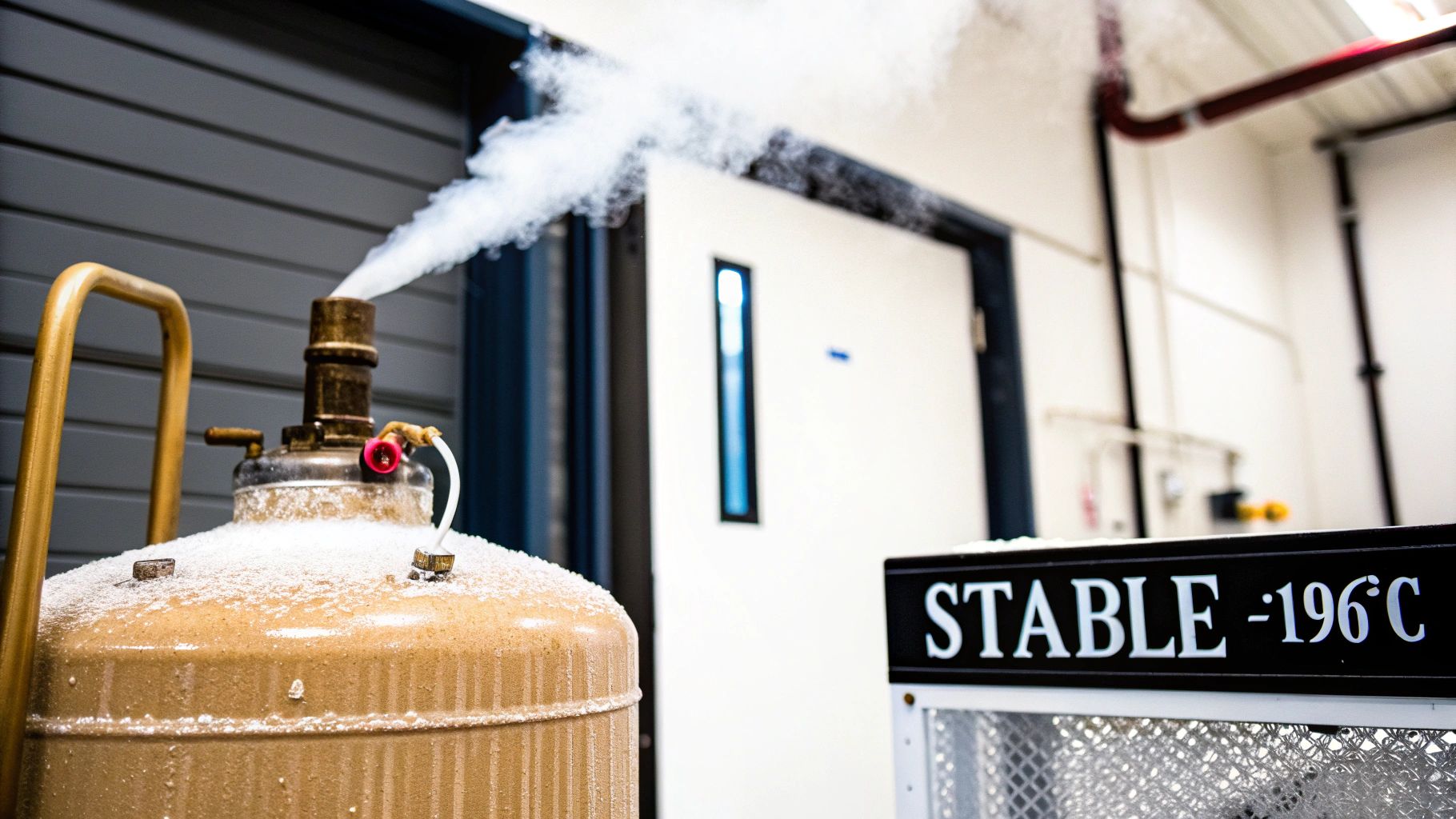
The temperature of liquid nitrogen (flüssig stickstoff temperatur) isn't just a number; it's a physical constant: -196°C (-321°F). This precise, incredibly cold temperature isn't a random value—it's the boiling point of nitrogen at standard atmospheric pressure. It’s this exact property that makes it the gold standard for virtually all modern cryogenic work.
Think about water boiling on a stove at 100°C. No matter how much you turn up the heat, the water stays at 100°C while it furiously absorbs energy to turn into steam. Liquid nitrogen works the exact same way, just at the extreme opposite end of the thermometer.
At -196°C, it constantly boils by absorbing heat from everything around it, turning back into harmless nitrogen gas. This non-stop boiling process makes it a uniquely powerful and stable coolant. It isn't just "cold"; it's a fixed thermal state that defines the boundary between liquid and gas for nitrogen, and we've built entire industries around it.
This unwavering temperature is the bedrock of cryopreservation. For incredibly sensitive biological materials like cells, tissues, and embryos, holding that precise flüssig stickstoff temperatur is absolutely non-negotiable.
At -196°C, all metabolic and biological activity essentially grinds to a halt. This state, known as cryostasis, prevents decay without causing the kind of cellular damage that happens at warmer freezing temperatures.
It's the closest thing we have to "suspended animation," allowing us to safely store invaluable biological assets for the long term—from preserving fertility options to pushing forward with cell-based therapies. It's the key to stopping the biological clock without breaking it.
In Germany, the adoption of liquid nitrogen systems in biobanks and cell therapy labs has been a game-changer. Maintaining this frigid -196°C (77 K) environment has slashed sample viability loss by an astonishing 95% in German biobanks since 2010, with over 500 institutions now relying on these systems. This highlights just how vital precise temperature control is. Solutions like the Cryonos AC FREEZER series achieve best-in-class evaporation rates, which is crucial for protecting sensitive biological samples. Discover more insights about the liquid nitrogen market on dimensionmarketresearch.com
The reliability of the -196°C mark goes far beyond biology. Its consistency is the secret sauce in countless fields, each one depending on that exact temperature to get the job done right.
In every case, the predictable and stable flüssig stickstoff temperatur delivers repeatable results and dependable performance. Of course, managing this extreme cold requires specialised equipment designed for maximum thermal efficiency. Experts like Cryonos GmbH engineer solutions that don't just hold liquid nitrogen—they are built to maintain that critical -196°C temperature with minimal loss, protecting the priceless materials stored inside.
To really get why the -196°C flüssig stickstoff temperatur is so incredibly reliable, we need to dip our toes into the physics of phase change. This isn't just some random cold number; it's the boiling point of nitrogen at normal atmospheric pressure. It’s the precise thermal line where nitrogen flips from a liquid into a gas.
Think of it like water turning to steam at 100°C at sea level. Liquid nitrogen (LN2) is always in a state of a gentle, constant boil at -196°C. It's constantly soaking up heat from its much warmer surroundings, and it uses that energy to transform into nitrogen gas. This non-stop energy absorption is exactly what makes it such a powerful and steady cooling agent.
Have you ever seen a drop of water dance and skitter across a scorching hot frying pan? It seems to float on a cushion of its own steam, lasting way longer than you'd expect. That’s the Leidenfrost effect, and it's the perfect way to understand how liquid nitrogen behaves.
When liquid nitrogen hits a surface at room temperature—which, from its point of view, is incredibly hot—it boils instantly. This rapid boiling creates a protective blanket of insulating nitrogen gas that sits between the liquid and the warmer surface.
This vapour barrier dramatically slows down heat transfer, which allows the bulk of the liquid nitrogen to hold its core temperature of -196°C for much longer. It's this clever self-insulating trick that makes its cooling power so efficient and manageable in the real world.
Without this effect, the liquid would flash-boil and disappear almost instantly, making it far less practical. Instead, this natural phenomenon helps keep the cryogenic environment stable.
In the world of cryogenics, pressure and temperature are joined at the hip. That magic number of -196°C is only true at normal atmospheric pressure. If you crank up the pressure inside a sealed container of liquid nitrogen, its boiling point will actually rise. On the flip side, lowering the pressure would make it boil at an even colder temperature.
This is precisely why professional cryogenic storage vessels are so essential. They aren't just fancy insulated flasks; they are sophisticated, engineered systems built to manage pressure.
High-quality vessels, like those from Cryonos, are designed with advanced venting systems that safely release the nitrogen gas produced during the boiling process. This serves two critical purposes:
This constant, controlled venting is the secret to holding a stable flüssig stickstoff temperatur. Without it, the temperature would wobble, and the entire system's safety would be at risk. The design of the vessel directly dictates its ability to maintain this critical temperature, which is why choosing top-quality, properly engineered equipment is non-negotiable for protecting valuable samples and ensuring everyone's safety.
Understanding the physics behind liquid nitrogen temperature is one thing, but actually measuring and managing it is another challenge altogether. A standard mercury or alcohol thermometer? Forget it. It would freeze solid in a heartbeat. Working at -196°C requires specialised tools built to perform in one of the coldest environments on Earth.
Ordinary thermometers are useless because the liquids inside them have freezing points far above that of liquid nitrogen. Instead, cryogenic work relies on electronic sensors that translate temperature into predictable electrical signals. These are the workhorses of any modern cryogenic setup.
Not all cryogenic sensors are created equal. For monitoring liquid nitrogen, the decision usually comes down to two main types: thermocouples and resistance thermometers. Each has its own strengths depending on what you need to do.
Just as important as the type of sensor is where you put it. A sensor sitting in the vapour phase near the top of a tank will always read warmer than one submerged in the liquid at the bottom. For meaningful data, you have to place sensors where they reflect the true conditions your samples are actually experiencing.
The diagram below shows the core relationship between pressure, the liquid phase, and the resulting gas in a cryogenic system—precisely what these sensors are designed to monitor.
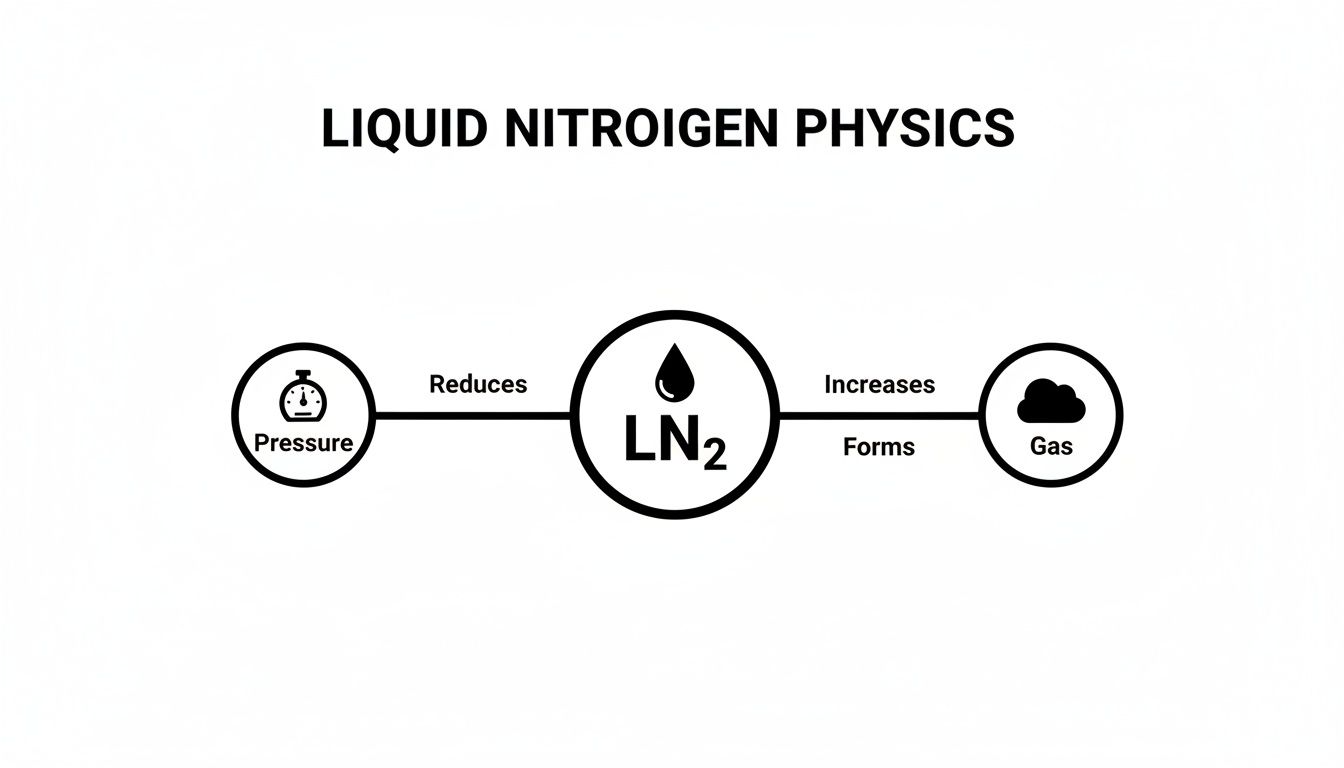
As you can see, stable pressure is key to keeping liquid nitrogen at its constant boiling point, which in turn ensures a steady, predictable rate of gas venting.
For high-value biological samples in biobanks and research labs, a single temperature check just won't cut it. The constant risk of equipment failure or an unexpected temperature spike makes continuous monitoring an absolute necessity. Modern systems don't just read the temperature; they actively guard the precious assets stored inside.
In Europe's cryogenic equipment market, led by Germany, even tiny temperature deviations can be catastrophic. A shift of just 2°C from the target -196°C can risk 100% sample death, making precision monitoring non-negotiable.
This is exactly why advanced monitoring systems are so vital. In 2023, German biobanks conducted over 15,000 cold shock tests at -196°C to validate their equipment, an effort that helped boost regulatory compliance by 28%. It’s a clear sign of the industry’s intense focus on maintaining temperature integrity. Furthermore, choosing reliable equipment with long-term spare parts availability has been shown to slash replacement costs by up to 35%.
These systems integrate sensors with alarms and data logging. If the temperature starts to climb, the system can automatically sound an alarm, send out alerts via text or email, and keep a detailed log of the event. This allows for immediate action to prevent a disastrous thaw. For anyone managing sample transport, an AC data logger for dry shipper series adds a crucial layer of security, ensuring an unbroken cold chain from point A to point B.
The intense cold of liquid nitrogen isn't just for keeping things cold; it's a dynamic tool that fundamentally changes materials and biological samples. At the precise -196°C flüssig stickstoff temperatur, everyday substances start behaving in extraordinary ways. This opens up a world of possibilities across science, medicine, and industry, from stopping the biological clock in its tracks to reshaping solid steel.
This power is most dramatically seen in biology. Anyone who has ever frozen a strawberry knows the main challenge: ice crystals. When water freezes slowly, it forms sharp, jagged crystals that act like microscopic daggers, easily puncturing and shredding delicate cell walls. This is exactly why tossing biological samples into a standard freezer is a recipe for disaster.
Liquid nitrogen's profound cold offers a way to completely sidestep this destructive process.
Instead of a slow, damaging freeze, the rapid plunge to -196°C triggers a process known as vitrification. The water inside cells simply doesn't have time to organise itself into those destructive ice crystals. It instantaneously solidifies into a glass-like, amorphous state, locking all the cellular machinery safely in place.
Vitrification is the secret to modern cryopreservation. By turning cellular water into a stable, solid glass, it effectively presses 'pause' on all biological activity without the physical damage of ice formation. It’s like creating a perfect, frozen snapshot of life.
This process is the bedrock of successful long-term storage for critical biological materials, including:
The reliability of vitrification at this specific temperature has made it a non-negotiable part of modern medicine. In Germany, the demand for cryogenic systems that can hold a steady -196°C is climbing, with healthcare and biotech making up a 38.9% share of the market. Tellingly, German fertility clinics saw a 22% jump in cryopreserved embryo storage from 2020 to 2024, now holding over 1.5 million units at -196°C. This method has helped halve failure rates, aligning with strict DIN EN ISO 15189 standards and proving just how vital this temperature is. You can find more insights on the cryogenic systems market at futuremarketinsights.com.
The impact of the -196°C flüssig stickstoff temperatur is just as profound in the industrial sector, where it’s used to manipulate the physical properties of materials with surgical precision. One of the classic techniques is shrink-fitting.
Imagine you need to fit a metal shaft into a gear with an incredibly tight tolerance. By bathing the shaft in liquid nitrogen, it contracts just enough. The shrunken shaft can then be slipped into place with ease. As it warms back up to room temperature, it expands, creating a powerful, uniform pressure-fit that is often stronger and more reliable than a welded joint.
This same principle of embrittlement and contraction finds its way into other clever applications:
From preserving the building blocks of life to shaping the tools of industry, the constant, reliable temperature of liquid nitrogen is a uniquely powerful resource. This versatility demands equipment that's just as adaptable. For instance, safely moving vitrified samples or industrial components from one place to another requires robust transport vessels, like the Cryonos AC LAC XL series, which are engineered to maintain that critical -196°C temperature while on the move.
The specific temperature of -196°C is not arbitrary; it's the key that unlocks a vast range of applications across different sectors. This table summarises how this extreme cold is put to work and why it's so essential.
| Sector | Application | Why -196°C is Essential | Relevant Cryonos Equipment |
|---|---|---|---|
| Biotechnology & Healthcare | Cryopreservation of cells, tissues, embryos, and stem cells | Achieves vitrification, preventing ice crystal damage and preserving biological viability for long-term storage. | Bio-storage Systems, Dewars |
| Food & Beverage | Flash-freezing of premium foods (e.g., seafood, berries) | Rapid freezing preserves texture, flavour, and nutritional value by creating tiny ice crystals that don't damage cell structure. | Tunnels, Immersion Freezers |
| Industrial & Manufacturing | Shrink-fitting of mechanical parts, cryogrinding, deflashing | Causes predictable thermal contraction in metals for a tight fit and makes soft materials brittle for easy processing. | Specialised Immersion Tanks, Nozzles |
| Dermatology | Cryosurgery to remove skin lesions (e.g., warts, skin tags) | The extreme cold instantly freezes and destroys targeted tissue with high precision and minimal scarring. | Handheld Cryo Guns, Small Dewars |
As you can see, maintaining this exact temperature is crucial for success, whether the goal is preserving life or perfecting an industrial process. Having the right equipment to reliably store and handle liquid nitrogen is therefore fundamental to all these operations.
Working with the extreme -196°C flüssig stickstoff temperatur is not a task to take lightly. While incredibly useful, liquid nitrogen (LN2) comes with significant hazards if you don't handle it with respect. Understanding these risks is the first and most critical step toward keeping everyone safe.
The two biggest dangers are severe cold burns and asphyxiation. Even a brief splash on the skin can cause immediate, deep tissue damage much like a severe heat burn. Splashes are especially dangerous to the eyes. The other hazard is invisible but just as deadly: as LN2 boils, it expands into a massive volume of nitrogen gas. Just one litre of liquid creates nearly 700 litres of gas, which can quickly push all the oxygen out of a poorly ventilated room and lead to suffocation without any warning.
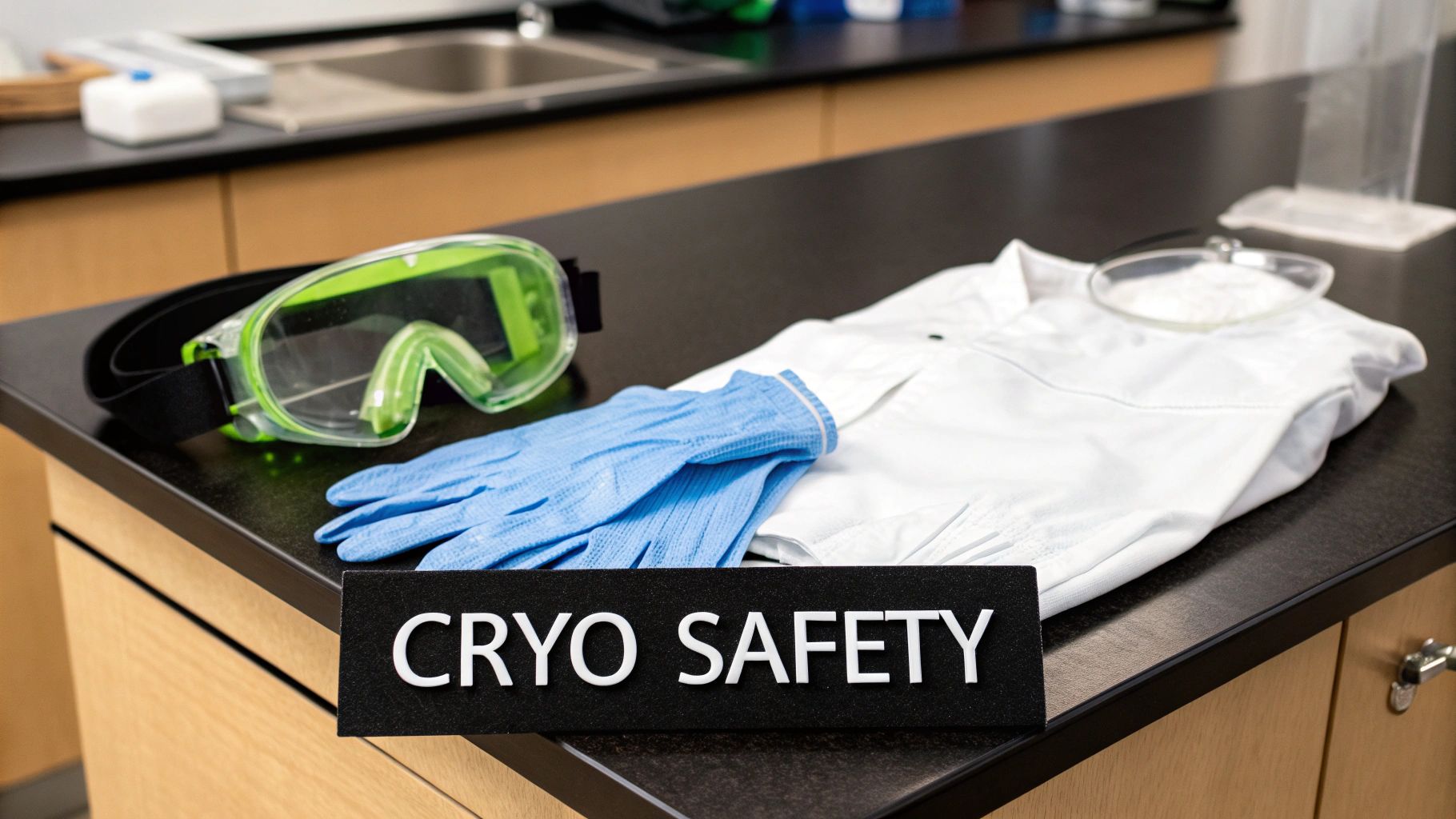
Proper PPE is non-negotiable when you're working with liquid nitrogen. Your standard lab gear just won't cut it against this level of cold. Anyone decanting, moving, or directly handling LN2 needs a complete cryogenic safety outfit.
Here’s what your essential PPE checklist must always include:
Always remember that safety is an active process, not just a set of equipment. It involves constant awareness of your surroundings, the state of your equipment, and the procedures you are following. Complacency is the greatest risk in any cryogenic environment.
Beyond protecting yourself, you need to ensure your equipment and workspace can handle cryogenic temperatures. The extreme cold of the flüssig stickstoff temperatur makes many everyday materials dangerously brittle. Common plastics and rubber can shatter like glass on contact, which could lead to spills and equipment failure.
Because of this, you should only ever use containers and tools specifically designed for cryogenic use. Materials like stainless steel and aluminium are perfect because they maintain their structural integrity at -196°C. All storage vessels, like those from Cryonos, are built from these tough materials to ensure everything is contained safely.
Good ventilation is just as important. Always handle liquid nitrogen in a well-ventilated area to stop nitrogen gas from building up. If you're in a smaller room or an enclosed space, an oxygen monitoring system with an alarm isn't just a good idea—it's a mandatory safety feature. For a more detailed look at this, you can review the 7 important rules for safe work with cryogenic liquids to reinforce best practices in your lab or facility.
Picking the right cryogenic equipment is about so much more than just finding a container. You're really investing in a complete system designed to lock in that critical -196°C flüssig stickstoff temperatur. This decision has a direct ripple effect across your entire operation, influencing everything from daily efficiency and long-term costs to the safety of your priceless biological samples or industrial materials.
To make a smart choice, you need to look past the marketing and get to grips with a few key technical specs. These aren't just random numbers on a data sheet; they're the true story of a vessel's performance and quality. Getting this wrong can lead to serious product loss and a lot of unnecessary expense down the line.
When you're comparing cryogenic vessels, two numbers matter more than anything else: static holding time and evaporation rate. They're related, but each one tells you something slightly different about the equipment's thermal efficiency.
These figures are the real measure of a vessel’s build quality. They show you how well the vacuum insulation works and how effective the overall engineering is at keeping the outside world's heat at bay.
A "gold-standard" evaporation rate isn't just a fancy phrase. It translates into real-world savings: less liquid nitrogen used, lower operational costs over time, and the peace of mind that your samples are safely held at the correct flüssig stickstoff temperatur.
Think of it this way: a well-insulated vessel might only need a refill every few months. A poorly made one could need a top-up every single week, which dramatically drives up your costs and labour.
Different jobs call for different tools, and cryogenics is no exception. A long-term biobank has completely different requirements than a lab that moves samples around every day. This is why it’s so important to understand what a supplier’s product lines are actually designed for.
For example, our Cryonos AC FREEZER series is built from the ground up for the demands of long-term biobanking. These units offer massive capacities and incredibly long static holding times to protect samples for years on end. On the other hand, the AC LAC XL series is designed specifically for transport, mixing rugged construction with top-tier thermal efficiency to keep that -196°C temperature locked in while on the move.
While the performance numbers are your starting point, a truly dependable cryogenic solution is about more than just the vessel itself. You should always look for equipment that meets recognised industry standards and is backed by solid support.
Key considerations include:
Choosing a partner like Cryonos GmbH means you're not just buying equipment; you're getting a complete support system. With on-site maintenance, expert technical help, and a deep understanding of cryogenics, you can be sure your operations are in safe hands. To get a better handle on the mechanics, you might find it helpful to learn more about how cryogenic freezers work in our detailed guide.
When you work with a substance as extreme as liquid nitrogen, a few practical questions always come up. Whether you're in a high-tech lab or an industrial workshop, getting a good handle on its temperature is vital for safety, efficiency, and getting the right results. Let's clear up some of the most common queries.
The intense cold of liquid nitrogen isn’t something added to it; it's just a fundamental part of its physical state. Nitrogen gas makes up 78% of the air we breathe, but it only decides to become a liquid at an incredibly low temperature.
That magic number, -196°C (flüssig stickstoff temperatur), is simply its boiling point at normal atmospheric pressure. To stay in its liquid form, it has to remain at or below this temperature. It's in a constant state of boiling, pulling heat from its surroundings to turn back into a gas—which is precisely what makes it such a powerful coolant.
It can, but only when you start playing with pressure. The standard -196°C boiling point holds true at sea-level atmospheric pressure. If you were to increase the pressure inside a sealed container, the boiling point would actually go up, meaning the liquid would stabilise at a slightly "warmer" temperature.
On the flip side, if you decrease the pressure, it will boil at an even colder temperature. This is exactly why properly vented storage vessels are non-negotiable—they keep the pressure stable and lock the temperature at that reliable -196°C point.
Understanding this relationship is absolutely critical for safe handling. A container that can't vent is a serious explosion hazard because as the liquid boils, the pressure just builds and builds. Always use equipment specifically designed for cryogenic liquids.
This all comes down to the quality of the storage container, which is known as a dewar or cryogenic vessel. High-quality dewars use a vacuum jacket between two walls—much like a high-tech thermos flask—to provide incredible insulation.
The two key numbers to look at are a vessel’s static holding time and its daily evaporation rate.
There are also specialised transport dewars, often called dry shippers, that are engineered to maintain cryogenic temperatures below -150°C for over ten days, making sure biological samples stay viable even when they're on the move.
At Cryonos GmbH, we provide state-of-the-art cryogenic solutions engineered for maximum thermal efficiency and safety, ensuring your materials are held at the precise flüssig stickstoff temperatur required. Explore our portfolio of storage and transport vessels at https://www.cryonos.shop.

