No Products in the Cart




You're often standing at the balance with something far more valuable than a powder boat. It might be a scarce reference standard, a stabiliser for a frozen cell product, or a vial set that has just come out of a controlled cold chain workflow. The screen shows a number, then another, then it drifts again. At that moment, the question isn't “What does this model's brochure say?” It's “Can I trust this reading enough to release material, repeat a method, or defend the record in an audit?”
That's why laboratory analytical balances deserve more attention than they usually get. In a routine chemistry lab, a poor weighing setup wastes reagents and time. In a biobank, fertility clinic, cell therapy workflow, or pharmaceutical QC area, the same mistake can disrupt traceability, delay batch release, or create doubt around a sample that can't be replaced.
The basics matter. So do the details people usually skip. Precision weighing depends on the instrument, the room, the operator, the sample condition, and increasingly the digital record that sits behind the final value. If you work around cryogenic storage, shared lab space, or tightly managed energy policies, those practical issues matter just as much as nominal readability on a datasheet.
A tiny weighing error rarely stays tiny.
If you prepare a master mix, compound a reference solution, or make a buffer that feeds a downstream assay, the initial mass sets the quality of everything that follows. One wrong value at the start can shift concentration, alter pH after adjustment, distort dilution logic, or force you to repeat the full run. By the time the error becomes visible, the balance is no longer in front of you. The damage is already in the data.
That's why experienced technicians don't treat weighing as a clerical step. They treat it as a metrology step. The balance reading is the first hard number in the chain.
In regulated work, “close enough” doesn't protect anyone. If a QC analyst weighs the wrong amount of a standard, the instrument that follows may perform perfectly and still report the wrong answer. If a biobank technician weighs a stabilising additive into a limited sample preparation workflow, there may be no practical way to recreate the original material condition.
A balance doesn't just measure mass. It anchors reproducibility.
Practical rule: If a result depends on concentration, ratio, or mass by difference, the weighing step deserves the same discipline as the final analytical method.
The stakes get higher in high-throughput environments. When staff handle many samples in sequence, they naturally try to move faster. That's where poor habits appear: doors left open, warm containers placed straight on the pan, tare skipped because “it's only one vial”. Each shortcut saves seconds and risks hours.
Most early mistakes come from one of three assumptions:
Once you understand that, the balance stops being a simple bench device and becomes what it really is: a controlled measurement system.
A laboratory analytical balance isn't just a nicer version of a kitchen scale. It belongs in a different category of measurement.
A kitchen scale answers a broad question: roughly how much does this weigh? A top-pan laboratory balance answers a more careful version of that question for general prep work. An analytical balance answers a stricter question: what is the mass of this sample when even very small variation matters?
One useful analogy is this. A measuring jug is fine for filling a wash bottle. A micropipette is what you use when the exact liquid volume affects the outcome. Analytical balances play the same role for mass.
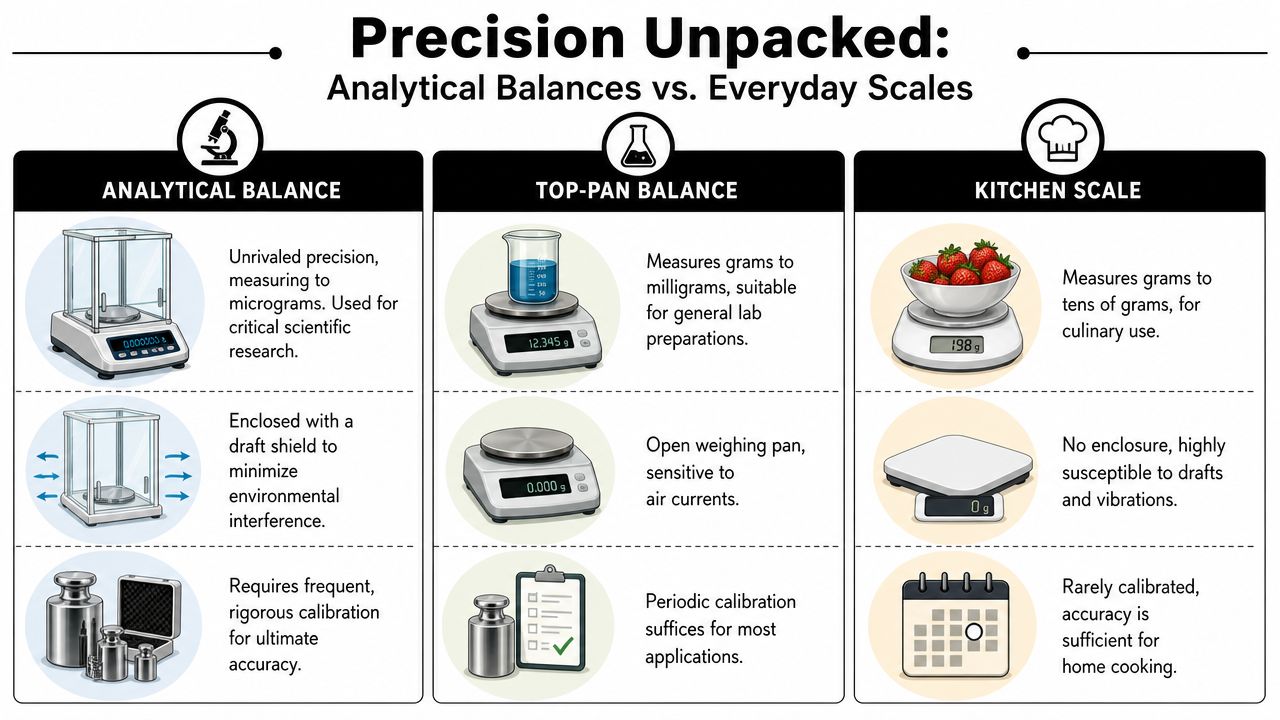
The most obvious feature is the draft shield, the enclosed chamber around the pan. That enclosure exists because ordinary room air is enough to disturb the reading. A person walking past, a vent switching on, or a warm hand near the chamber can all affect stability.
Inside, the instrument uses a highly sensitive weighing mechanism rather than a crude spring arrangement. In practical terms, that means the balance is designed to detect and compensate for very small force changes and present them as a mass reading. That sensitivity is useful only when the rest of the setup supports it.
Typical users get confused because they compare balances by a single line on a quotation. They see readability and assume that's the whole story. It isn't. An analytical balance is a package of sensitivity, environmental control, routine testing, and disciplined use.
Modern laboratory analytical balances didn't appear overnight. The path started long before digital displays. The Smithsonian account of Allan Pollock's 1815 balance patent and Frank Aronson's 1906 triple-beam milestone shows the broader move from early balance engineering to more standardised, reliable laboratory weighing. That progression matters because it explains why today's analytical instruments focus so heavily on repeatability, controlled conditions, and practical usability.
Reliable laboratory weighing became more accessible when instrument design shifted from simple balancing hardware to purpose-built precision tools.
Choose an analytical balance when the weighing result directly affects:
If your job is routine bulk prep, an analytical balance may be unnecessary. If your result depends on exact mass, it usually isn't optional.
Spec sheets can be misleading because they look precise even when the buyer doesn't yet know what the terms mean in practice. The safest way to read one is to translate every specification into a workflow question.
Here's the quick reference commonly needed.
| Specification | Definition | What It Means for Your Workflow |
|---|---|---|
| Readability | The smallest change the display can show | Tells you the last digit you can see, not whether the result is correct |
| Capacity | The maximum load the balance is designed to weigh | Determines whether your vessel plus sample can be handled comfortably |
| Repeatability | How consistently the balance reproduces the same reading under the same conditions | Shows whether repeated weighings of the same item stay tightly grouped |
| Linearity | How well the balance performs across its weighing range | Matters if you weigh both small and larger loads on the same instrument |
| Minimum weight | The lowest sample mass that can be weighed with acceptable confidence under defined conditions | Warns you when the sample is too small for reliable routine work |
This is the most common misunderstanding.
If a balance displays more decimal places, users often assume it is automatically “more accurate”. What readability really tells you is the smallest displayed increment. It is about what the screen can show. It doesn't guarantee that the measurement is correct under your bench conditions.
Think of readability like the markings on a ruler. Finer markings help only if the ruler is straight and you're measuring properly.
For a procurement manager, the practical question is: do we need this level of display resolution for the actual SOP, or are we paying for sensitivity that the environment and workflow won't support?
Capacity sounds simple, but people often underestimate the total load.
You're not just weighing the sample. You're weighing the weigh boat, vial, watch glass, filter, cryovial rack adaptor, or temporary containment used to avoid condensation and contamination. If the instrument is always operated near its upper limit, routine use becomes awkward and error-prone.
A good buying habit is to review the heaviest realistic combination used in the lab, not just the nominal sample size.
Repeatability is one of the most useful specifications because it reflects what users experience. If you place the same stable item on the pan repeatedly under the same conditions, a good balance should return closely matching values.
In the lab, poor repeatability shows up as hesitation and rework. The technician weighs the item again “just to check”. Then again. Soon nobody trusts the instrument, even if it passes a superficial startup check.
If your team often reweighs the same item out of doubt, you probably have a repeatability problem, a technique problem, or an environmental problem.
Some labs mostly weigh similar loads all day. Others alternate between very small additions and larger containers. Linearity describes how well the instrument stays accurate across that range.
This matters in real procurement because a balance can feel fine at one point in its range and become less dependable elsewhere. If your workflow includes light tare vessels and heavier loaded containers, you should ask how the instrument is assessed across the operating span used in your SOPs.
Minimum weight deserves more attention than it usually gets, especially in biobanking and cryogenic support workflows where sample mass may be tiny and the material may be costly.
A balance may be able to display a value for a very small sample, but that doesn't mean the value is suitable for controlled decision-making. Below a certain point, environmental effects and instrument variability become too large relative to the sample mass. The number is visible, but the confidence isn't there.
For technicians, the practical lesson is simple. If you're trying to weigh a tiny amount and the reading seems alive, unstable, or highly sensitive to tiny disturbances, the issue may not be operator skill alone. The sample may be approaching or below what the setup can support reliably.
Cold-chain adjacent workflows add a further layer of complexity:
That's why the most useful spec sheet isn't the one with the longest feature list. It's the one you can map directly to the job your team does.
Most bad weighing results are blamed on the balance when the room is the main culprit.
An analytical balance can only perform as well as its surroundings allow. In ordinary lab language, there are four repeat offenders: vibration, air currents, temperature differences, and static. If you control those, weighing becomes calmer, faster, and far more defensible.
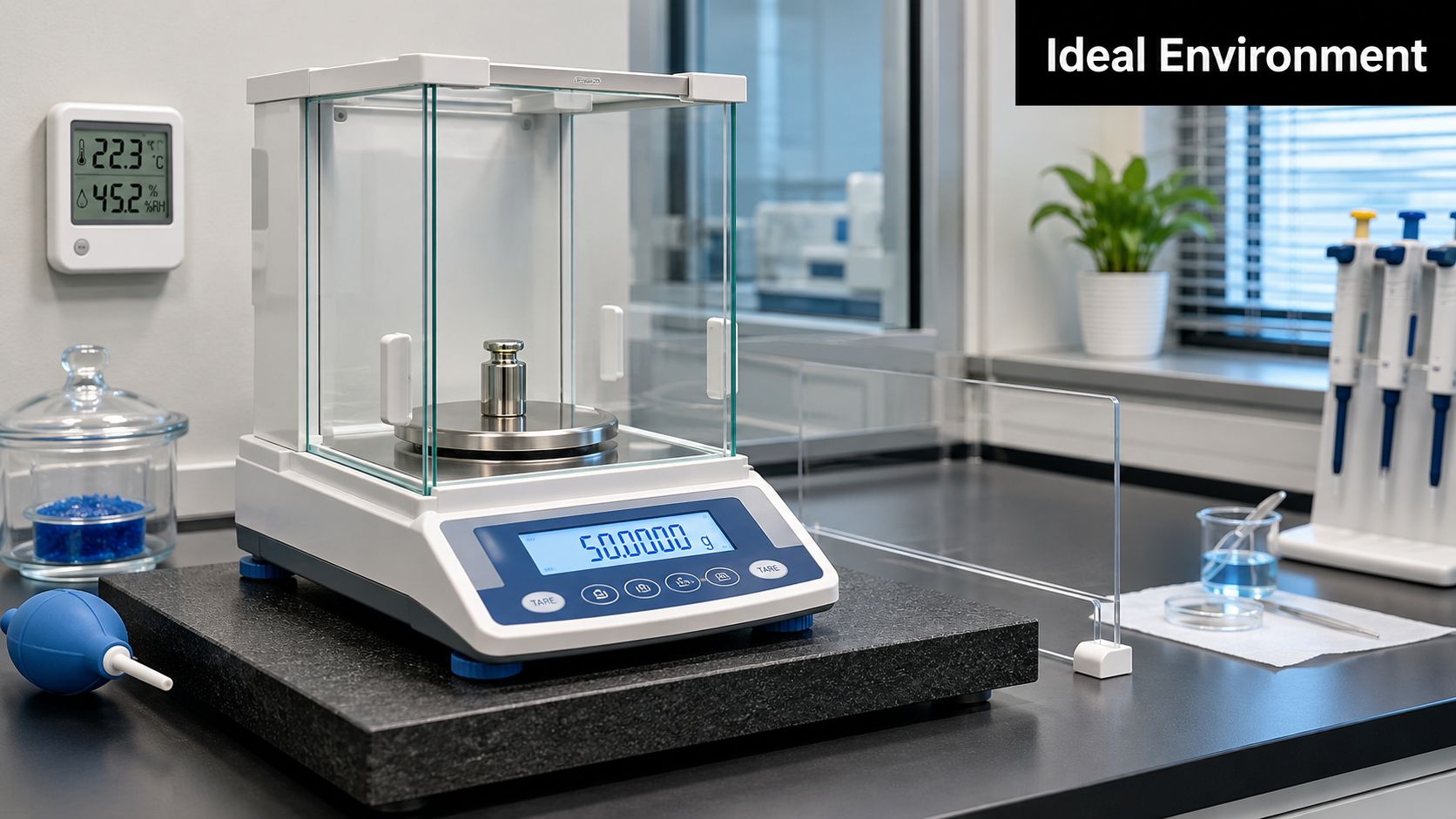
Vibration doesn't have to be dramatic. Foot traffic, a centrifuge on the next bench, a fridge door closing, or a shared trolley rolling past can all disturb the reading. That's why a sturdy bench and, where needed, a dedicated anti-vibration setup make such a difference.
Air currents are just as disruptive. Draft shields help, but they can't compensate for a poor room location. Keep the balance away from doors, busy walkways, and HVAC discharge points. If your facility is reviewing airflow quality and room control, it's worth understanding how broader environmental hardware influences local conditions. A useful example is this guide to HEPA air filter machines in controlled laboratory settings.
Temperature catches out cryogenic users more than almost anyone else. A cool weigh vessel, recently handled cryovial, or tool brought from a cold room can create local convection inside the chamber. The balance appears to drift, but the instrument may be reacting to moving air and thermal imbalance.
Static is quieter but equally annoying. Plastic vessels, disposable weigh boats, gloves, and dry-room conditions can all create electrostatic attraction. The display then behaves as if the mass is changing without explanation.
Try these practical controls:
A stable balance reading usually comes from a stable room, not from pressing the tare key more often.
A useful operational point from discussion of balance validation under sustainability and energy constraints is that real laboratories increasingly work under tighter energy-management policies, shared spaces, and altered HVAC schedules. In that setting, a balance that behaved well during a quiet qualification exercise may become less stable during daily operation. For German labs working within documented environmental and quality frameworks, the setup should be judged under real use conditions, not ideal ones.
People often use calibration, verification, and routine testing as if they mean the same thing. They don't.
Calibration is the formal metrological activity. It's usually carried out by qualified service personnel or under a tightly controlled procedure. Verification and routine testing are the checks your team performs between formal calibration events to confirm that the balance is still behaving as expected in daily use.
If you mix those terms up, your records become weak. If you keep them separate, your weighing process becomes much easier to defend.
Calibration answers a formal question: how does the instrument perform against known standards, and does it need adjustment?
Verification answers the working question: is this balance fit for today's use in this location, for this method?
In practice, a technician doesn't recalibrate the balance every time confidence is needed. The technician verifies performance with suitable reference weights and checks that the result falls within the laboratory's acceptance criteria.
For labs that need documented traceability around supporting equipment and records, it also helps to align weighing checks with the same mindset used for other controlled devices, such as data logger calibration certification for auditable cold-chain documentation.
A simple schedule is often better than a complicated one nobody follows.
Daily checks
Weekly checks
Monthly or SOP-defined checks
Good records are simple, complete, and boring. That's a compliment.
They include the balance ID, date, operator, reference weight used, result obtained, acceptance decision, and any action taken. What matters most is consistency. A perfect isolated record is less useful than a routine record set that shows the balance remained in control over time.
If a balance only “passes” because nobody writes down the awkward readings, it hasn't passed. The paperwork has.
In cryogenic and biobank environments, where staffing may rotate and benches may be shared, this discipline matters even more. You want the next person on shift to know whether they inherited a reliable instrument or a problem in disguise.
Good maintenance on an analytical balance is mostly about restraint. Clean gently, disturb as little as possible, and don't improvise with harsh tools or hurried fixes.
The aim isn't to make the balance look tidy. The aim is to keep residue, mechanical obstruction, and unnoticed drift from turning into bad measurements.
Daily
Weekly
Monthly
Some problems are not user-fixable. If the balance suddenly behaves differently after relocation, cleaning, bench changes, service interruption, or power issues, escalate quickly. Repeated ad hoc adjustments by multiple users usually make the situation harder to diagnose.
A good rule is this: if the same fault returns after the obvious environmental cause has been removed, stop guessing and call for qualified support.
In regulated work, the number on the screen is only half the job. The rest is proving who generated it, when they generated it, under what conditions, and whether anyone could alter the record afterwards.
That's where many buying decisions go wrong. Teams focus heavily on readability, capacity, and footprint, then discover too late that the digital trail around the measurement is weak. In a modern lab, the balance is part of the quality system, not a standalone tool.
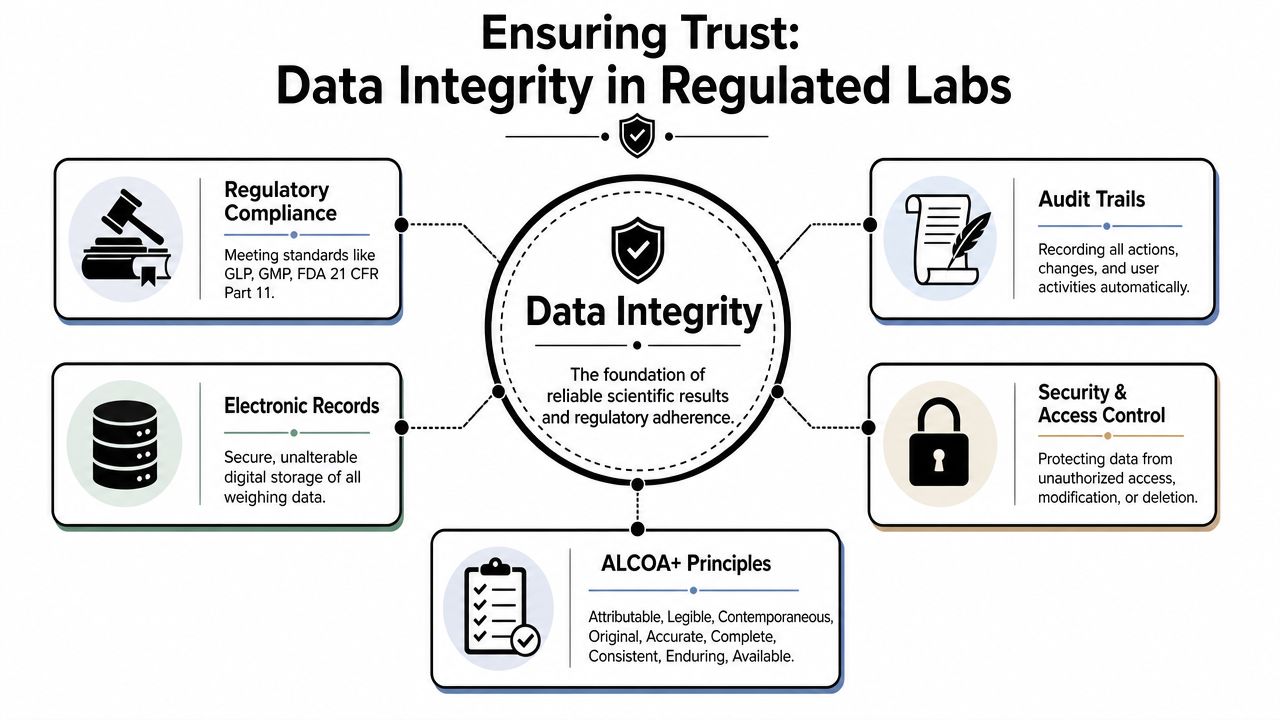
A trustworthy weighing record should answer basic audit questions without reconstruction from memory. Who used the balance? Was the method followed? Was the result transferred manually or automatically? Were changes logged? Can the record still be retrieved later?
These questions matter in GMP-style environments, clinical support workflows, and any laboratory where sample identity and chain of custody matter. They matter even more in cryogenic settings, where a weighing step may sit inside a larger process involving controlled storage, thaw timing, and batch-linked documentation.
The useful insight here is not “more digital is better”. According to guidance on caring for laboratory balances and digital traceability concerns, additional digital features can introduce new failure modes. User-profile misconfiguration, missing audit records, and validation gaps can create as much risk as handwritten transcription errors. Procurement should focus on documented trustworthiness, not feature count.
When reviewing laboratory analytical balances for regulated use, ask practical questions such as:
A connected balance reduces risk only when the connection is validated, understood, and consistently used.
German laboratories often work in an environment where documentation discipline is expected, not optional. That affects purchasing. A balance that is impressive on paper but awkward to validate, awkward to review, or awkward to reconcile with digital record-keeping may create more work than it saves.
For procurement managers, the key shift is this: don't ask only “How precise is it?” Ask “How well can we prove that each reported mass is attributable, controlled, and retained within our quality process?” That's the standard that holds up under inspection and internal review.
A balance that works well in a calm chemistry room may struggle in a biobank or cryogenic support area. The difference isn't just temperature. It's pace, sample value, shared space, operator rotation, and the pressure to keep both records and material condition under control.
This is why balance selection for these settings should go beyond headline sensitivity. Analytical balances are already a major part of the broader market. In the DE-region context, they are projected to hold a 33.5% share in 2025, and the wider laboratory balances and scales market is projected to grow from USD 1.4 billion in 2025 to USD 2.2 billion by 2035, a 4.7% CAGR, according to Future Market Insights on the laboratory balances and scales market. That projected growth reinforces a practical point: these instruments are foundational infrastructure, so buying the wrong one creates long-term friction.
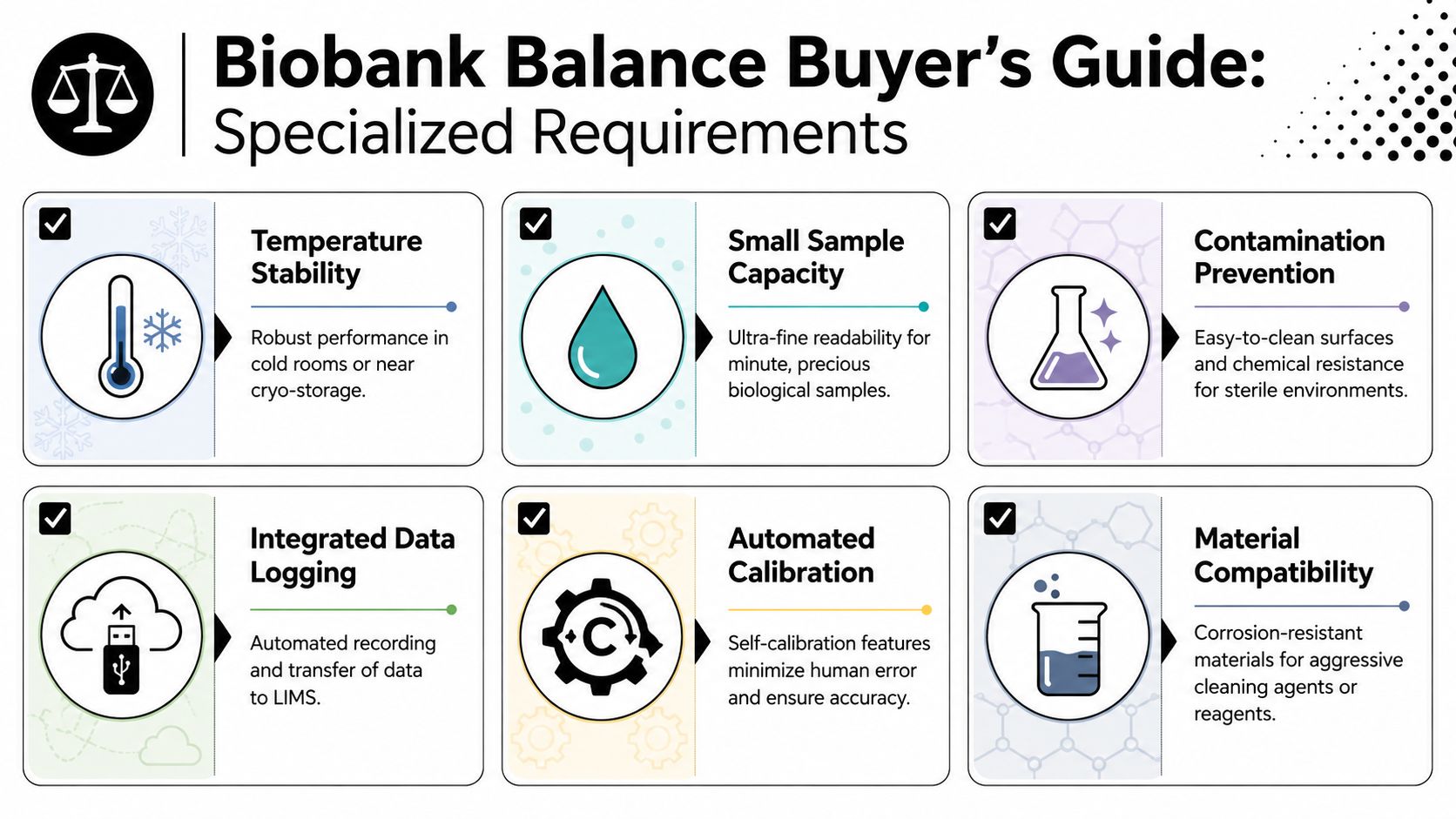
Ask these questions before approving a purchase:
Biobank teams often focus first on sample protection, as they should. But the weighing point must align with the storage model, retrieval pace, and handling strategy around it. If your wider process involves long-term preservation planning, this broader view of cryogenic storage for biobanking and stem cell research helps explain why bench instruments and storage systems can't be evaluated in isolation.
A good procurement decision also considers sustainability-related constraints. If the lab reduces HVAC runtime, reorganises benches, or introduces shared rooms, you need confidence that the balance remains practical under those operating conditions. The best instrument isn't the one with the most aggressive specification. It's the one your team can verify, clean, trust, and integrate into routine work without creating hesitation around valuable samples.
In cryogenic workflows, the right balance is the one that protects both the measurement and the process around the measurement.
Cryonos GmbH supports laboratories, biobanks, hospitals, fertility clinics, and industrial users with practical cryogenic infrastructure for storage, transport, and handling of sensitive materials. If your team is reviewing workflow fit across weighing, storage, transport, and sample protection, explore the specialist portfolio and support options at Cryonos GmbH.

