No Products in the Cart




As of 2026, liquid nitrogen dewars commonly range from about $180 for small 10L units in lower-cost regions to roughly $4,500 for a new 230L super-insulated tank in the US/EU, with most laboratory channels clustering around $1,050 to $3,000. The number on the quote tells you what the vessel costs, not what storing and replenishing liquid nitrogen will cost over five years.
A procurement officer usually discovers this after approval. The tank looks affordable, the specification appears complete, and the supplier's price fits the capital budget. Then the first delivery invoice arrives with charges nobody compared: freight, hazmat handling, rental, monitoring, refill minimums, or losses from nitrogen boiling away between deliveries. A sensible purchase decision starts with total landed cost, not the dewar's sticker price.
A buyer approves a clean $2,400 quote for a 230L LN2 dewar. The purchase order closes without drama. A short time later, the first delivery invoice adds a $180 fill charge, a $95 hazmat freight surcharge, and a 14-day demurrage clock that wasn't highlighted during the quote review.
That invoice doesn't necessarily mean the supplier acted improperly. Most quotes are honest. The problem is that buyers compare the vessel price while suppliers price the service around it. A dewar can be inexpensive to purchase and expensive to keep full, compliant, available, and serviced.
Procurement rule: Treat the quoted tank as the first line of a five-year operating model, not as the final purchase price.
The total cost of ownership approach for cryogenic equipment is the right frame. It forces the buyer to add refill logistics, evaporation, compliance, service, rental exposure, telemetry, and the spare-parts tail before selecting a model.
This guide covers price bands by capacity, the six main cost drivers, buy-versus-rent decisions, hidden operating line items, and a practical 2026 procurement checklist. It also explains why regional compliance and delivery arrangements can change the economics even when two vessels appear to have the same capacity.
It deliberately excludes bulk microbulk tanks above 500L and on-site cryogenic freezers. Those systems involve different installation, supply, monitoring, and site-infrastructure decisions. A liquid nitrogen dewar is the focus here, particularly the portable and laboratory-scale vessels used by biobanks, clinics, research teams, fertility services, and industrial users.
The key conclusion is simple. “Dewar price” means very little without delivery terms, evaporation performance, compliance documents, refill pricing, warranty coverage, and service availability. If a quote omits those items, it isn't comparable with a quote that includes them.
A liquid nitrogen dewar is a vacuum-insulated, low-pressure cryogenic container designed to store liquid nitrogen while limiting heat transfer. It isn't a pressurised gas cylinder, and it isn't a bulk storage tank. That distinction affects handling procedures, transport classification, fittings, withdrawal method, and purchase price.
A conventional pour-fill dewar generally uses a loose-fitting stopper or vented closure so nitrogen vapour can escape as liquid slowly boils off. A pressurised vessel or auto-fill system follows a different design path, with pressure-building, relief, and withdrawal components that add complexity and cost. Before looking at a catalogue, identify whether your team needs manual pouring, controlled withdrawal, or automated level maintenance.
Capacity means liquid volume, not the vessel's external height or gross footprint. For planning, usable liquid nitrogen is roughly 85% to 90% of nominal capacity, so a vessel labelled 50L shouldn't be treated as a full 50L working reserve. Your supplier should confirm the usable fill level and the static hold time under the conditions relevant to your site.
| Capacity Range | Typical User | Primary Use Case |
|---|---|---|
| 3L to 10L | Mobile laboratory teams, small clinics, teaching and research users | Pour-fill work, short-duration handling, manual transfers |
| 20L to 50L | Research laboratories, cell culture teams and smaller clinical operations | Bench-top storage, regular sample work and scheduled replenishment |
| 120L to 230L | Biobanks, fertility and IVF services, animal breeders and industrial sites | Longer-duration cryogenic storage, higher inventory and fewer refill events |
A 3L to 10L portable vessel suits a team that moves small quantities and can arrange replenishment when needed. It's the wrong choice when daily use is high, because frequent filling, handling, and delivery coordination will overwhelm the apparent savings.
A 20L to 50L laboratory dewar is the practical middle ground for many cell culture and research environments. Larger storage vessels, from 120L to 230L, make more sense when inventory must remain available for longer periods or when refill interruptions create operational risk.
For a more detailed equipment orientation, review this guide to liquid nitrogen dewars and their applications. Treat auto-fill and pressurised variants as separate procurement forks. They may solve a real continuity problem, but they shouldn't be compared with a basic pour-fill dewar as if they were interchangeable products.
Published prices vary sharply by capacity and purchasing region. A market comparison places Chinese pricing at roughly $180 to $220 for 10L units, $600 to $700 for 50L units, and $1,800 to $2,200 for 230L units. Comparable estimates for the US and EU are $280 to $350, $950 to $1,200, and $3,000 to $3,800. Review the published liquid nitrogen dewar price breakdown by capacity and region for the underlying comparison.
Established laboratory channels often sit in four-figure territory. SPI Supplies lists dewars from about $1,045.88, with individual products at $1,127.37, $1,462.00, $1,610.18, $1,668.21, and $2,247.34. VWR's CryoPro L liquid dewars appear at approximately $1,617.91 to $3,012.91, as shown in the SPI Supplies dewar listings.
| Capacity Tier | North America (USD) | Western Europe (USD) | UK (USD) | Lower-Cost Markets (USD) |
|---|---|---|---|---|
| Small portable, 3L to 10L | $280 to $350 | $280 to $350 before local differences | Qualitatively similar to established European channels, subject to delivery and compliance | $180 to $220 for 10L units |
| Mid-range, 20L to 50L | About $950 to $1,200 for 50L units | About $950 to $1,200 before duty, documentation and freight effects | Comparable established-channel pricing, with transport paperwork affecting landed cost | $600 to $700 for 50L units |
| Large cryo, 120L to 230L | About $3,000 to $3,800 for 230L units | About $3,000 to $3,800 before final delivered adjustments | Comparable to Western European pricing, with road compliance and service affecting the invoice | $1,800 to $2,200 for 230L units |
Treat these ranges as planning benchmarks, not delivered quotations. A new 230L dewar may cost about $4,500 in the US market when it uses super-insulation and includes application-specific features. That example appears in the US liquid nitrogen price analysis.
Do not place one “average dewar price” in the budget. Capacity, insulation, manufacturer, regional sales channel, transport status, finish, valve package, and service terms can shift the list price by several multiples. Compare same capacity, same evaporation specification, same compliance status, same delivery basis, and same warranty.
The tank price is only the starting point for a five-year decision. Refill frequency, delivery charges, compliance paperwork, evaporation losses, and rental terms can determine the operating cost. Use this liquid nitrogen price guide to frame supply planning, then obtain a local delivered quotation.
A dewar quote needs a fixed audit. Start with the physical requirement, then check thermal performance, materials, compliance, and support. The sticker price matters, but the refill and service burden determines what the vessel costs to run over five years.
A larger vessel uses more material and insulation, requires different handling, and usually costs more to transport. Compare working capacity with the nominal label. A 50L unit with a strong hold-time specification can be a better purchase than a cheaper vessel that requires frequent refilling.
Ask for the footprint, loaded weight, access requirements, and handling equipment before approving the capacity. A vessel that fits the laboratory but cannot be moved safely will create costs outside the original quote.
Basic vacuum insulation lowers the upfront price. Advanced multilayer vacuum insulation can reduce evaporation but adds about 20% to tank cost, according to this cryogenic buying guidance on insulation and liquid nitrogen cost. That premium makes sense for sites holding inventory for long periods, because lower boil-off reduces refill frequency, delivery exposure, and handling work.
Require the evaporation specification in writing. A quoted hold time without test conditions is not enough to compare two vessels.
Aluminium inner vessels are lighter and usually cheaper. Stainless-steel construction weighs more and costs more, but it can better suit rough transport and demanding handling environments. Do not approve a material upgrade until the supplier identifies the operating problem it solves.
A small daily loss becomes significant volume over several years. Ask for a certified static evaporation rate under a named test method, then compare it with the planned delivery schedule. A brochure's “long hold time” should not support a purchase order by itself.
Use the rate to estimate refill exposure, not just tank performance. A lower list price can disappear if the vessel needs more frequent deliveries.
For road transport in the UK and Europe, compliance is part of the purchase specification. The BCGA code of practice for transport states that only dewars meeting ADR P203 may be used to transport liquid nitrogen. U.S. PHMSA guidance says cryogenic Dewar flasks used in motor-vehicle transport must be designed so pressure does not exceed 25.3 psig under ambient transportation conditions, as detailed in this PHMSA interpretation on cryogenic Dewar flasks.
Confirm ADR or applicable U.S. transport status, pressure-relief configuration, UN markings, certificates, and delivery paperwork. Healthcare buyers should also account for the wider purchasing environment around public sector medical gases, where documentation and supplier performance can matter as much as unit price.
A long warranty has limited value unless vacuum failure, corrosion, valves, gauges, and labour are clearly covered. Service reach, response arrangements, and spare-parts availability explain why two same-capacity dewars can have a substantial price gap.
| Driver | Typical price impact | What to verify on the quote |
|---|---|---|
| Capacity | Larger vessels cost more | Nominal and usable volume, footprint and handling equipment |
| Insulation | Advanced multilayer insulation adds about 20% to tank cost | Certified evaporation rate and test conditions |
| Materials | Stainless construction carries a premium over lighter aluminium designs | Inner vessel material, weight and transport suitability |
| Evaporation rate | Higher losses increase refill and delivery costs | Static loss specification, hold time and warranty remedy |
| ADR and transport compliance | Adds documentation, certification and configuration cost | ADR P203 status, pressure relief, UN markings and certificates |
| Warranty and service | Better coverage raises purchase price but reduces exposure | Warranty exclusions, response arrangements and spare-parts lead times |
A dewar that looks cheaper to rent can cost more by the end of its contract. A purchased unit avoids recurring rental charges, but ownership still includes maintenance, testing, refill logistics, insurance, and eventual retirement. Renting preserves capital and may shift servicing to the supplier, yet recurring fees, telemetry, demurrage, and minimum-term conditions can change the result.
For a site consuming more than about 80 litres of LN2 per week, purchasing may repay its cost within approximately 18 to 30 months. Treat that range as a modelling prompt, not a contract promise. Calculate the volume, delivery pattern, and full operating cost before choosing the lower upfront commitment.
A low-volume pilot site, satellite clinic, or small research group may rationally rent. Rental terms commonly run 12 to 24 months, with possible loss-of-deposit charges or fees for late vessel returns. Confirm whether the rental fee is weekly, monthly, or linked to litres delivered. Add telemetry and emergency delivery charges before comparing offers.
For a 120L unit, create two cost columns:
Break-even litres per week is the consumption level at which cumulative rental cost equals cumulative ownership cost. Do not declare a break-even point until both suppliers provide written fees. A low purchase price can lose its advantage when evaporation and delivery costs are high. Rental can win at low usage because it avoids idle capital and transfers maintenance responsibility.
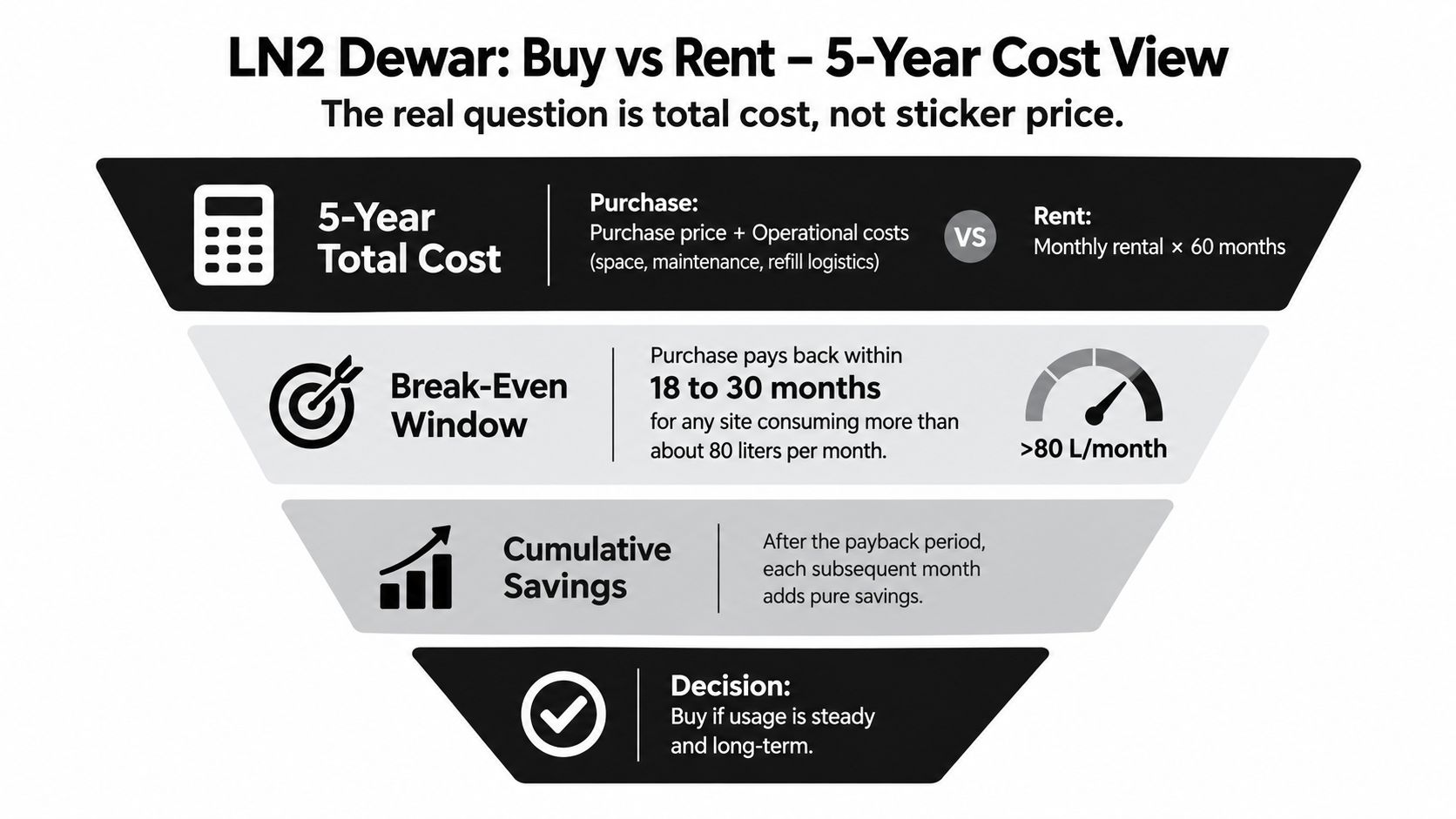
If the rental fleet grows enough to support a service contract and a group of purchased units, rerun the model. Base the decision on steady consumption, delivery reliability, and five-year landed cost, not on whether finance prefers capital or operating expenditure. A supplier quote that omits delivery, compliance, evaporation, or return costs is not a usable comparison.
A dewar can look inexpensive until the first delivery invoice arrives. The tank quote often excludes evaporated nitrogen, delivery minimums, emergency call-outs, compliance administration, and charges for equipment that remains on site. Price the operating lines before approving the vessel.
Use the published market figures as modeled ranges, not as a complete quote. Delivered liquid nitrogen may fall around $2 to $5 per litre. Small containers can carry far higher unit costs, with reported figures of roughly $18 to $22 per litre for 10L units and $8 to $10 per litre for 180L storage units. A new 230L dewar may cost about $4,500, but that purchase price says little about five-year operating cost. Include delivery and fuel surcharges, hazmat fees, monthly rental, demurrage, telemetry, monitoring, and boil-off losses of 5% to 15%. Model these ranges against written supplier terms rather than treating them as fixed prices.
Use this formula:
Five-year landed cost per litre = (dewar purchase or rental + delivery and surcharges + compliance and inspections + telemetry and maintenance + estimated boil-off volume × delivered LN2 price + retirement costs) ÷ usable litres consumed
Keep each component visible. A supplier can offer a low refill price while charging more for rental, delivery, monitoring, or emergency service. Combining everything into one quote total hides that trade-off and makes competing offers difficult to audit.
| Line item | Typical annual range (USD) | How to model it |
|---|---|---|
| Refill liquid | Variable | Multiply delivered price per litre by litres purchased |
| Boil-off | 5% to 15% loss is reported in market explanations | Add lost litres to purchased volume, using the supplier's certified evaporation rate |
| Delivery and fuel surcharge | Variable | Request standard, minimum-order, and emergency charges in writing |
| Hazmat handling | Variable | Add per-delivery or per-shipment fees |
| Rental and demurrage | Variable | Multiply recurring charges by active months and add late-return exposure |
| Telemetry and monitoring | Variable | Include hardware, installation, subscription, and support |
| Inspection and compliance | Variable | Add recurring valve, pressure-relief, and transport-document costs |
| Maintenance and spares | Variable | Price lids, gauges, O-rings, relief devices, and service labour |
| Retirement and insurance | Variable | Model end-of-life testing, disposal, contents insurance, and downtime risk |
Convert annual charges into monthly and per-litre figures in the finance model. Then compare the small dewar, larger storage vessel, and rental option using the same usable-volume assumption. A quote that omits delivery, evaporation, compliance, or retirement costs is incomplete, even when its tank price looks attractive.
Paste this list into the RFQ and require a written answer for every point:
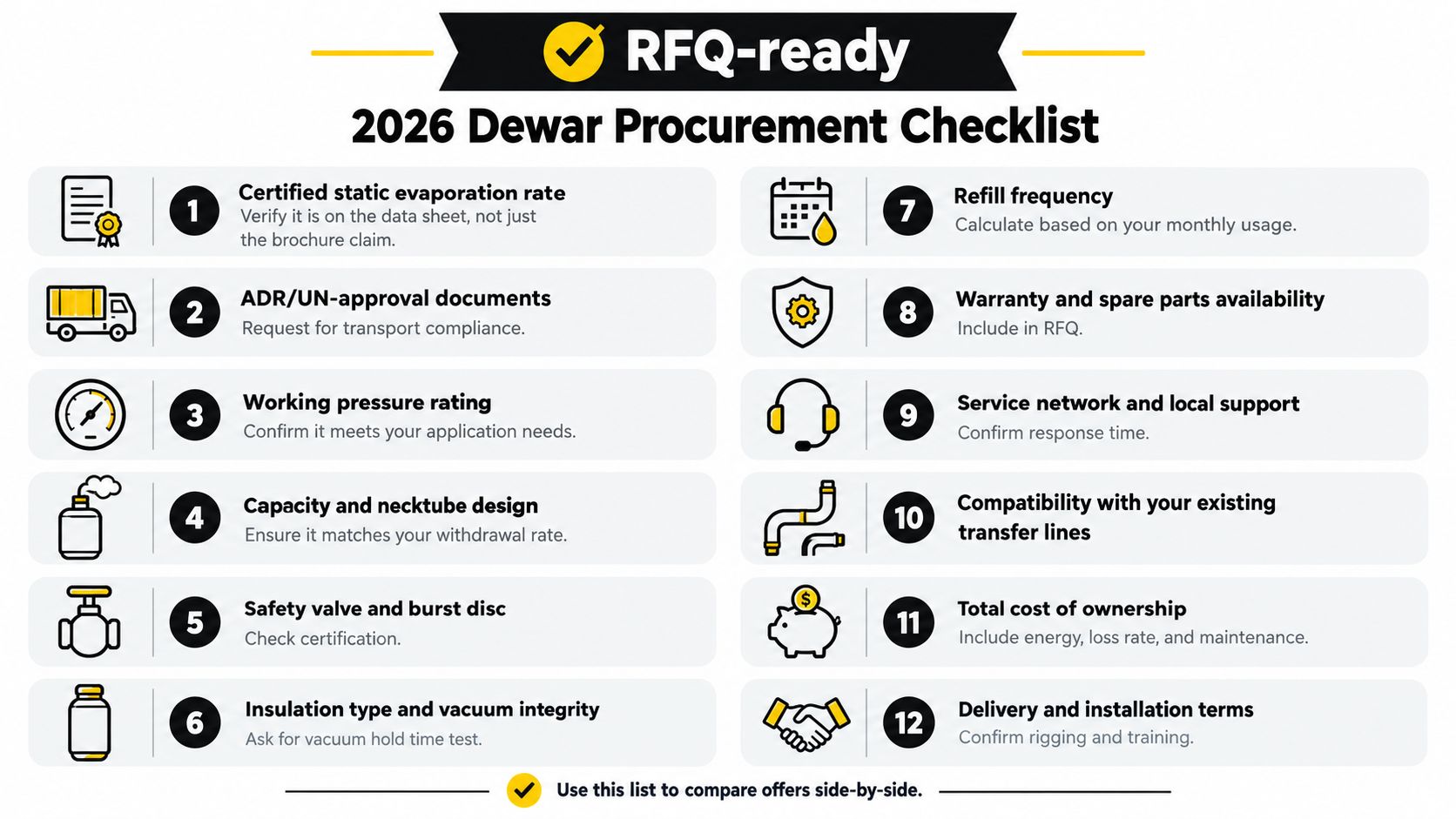
Teams that need to connect equipment purchasing with governance, reporting, and finance should also review guidance on procurement KPIs and loan readiness. The strongest RFQ compares delivered, commissioned, and supported equipment, not bare metal.
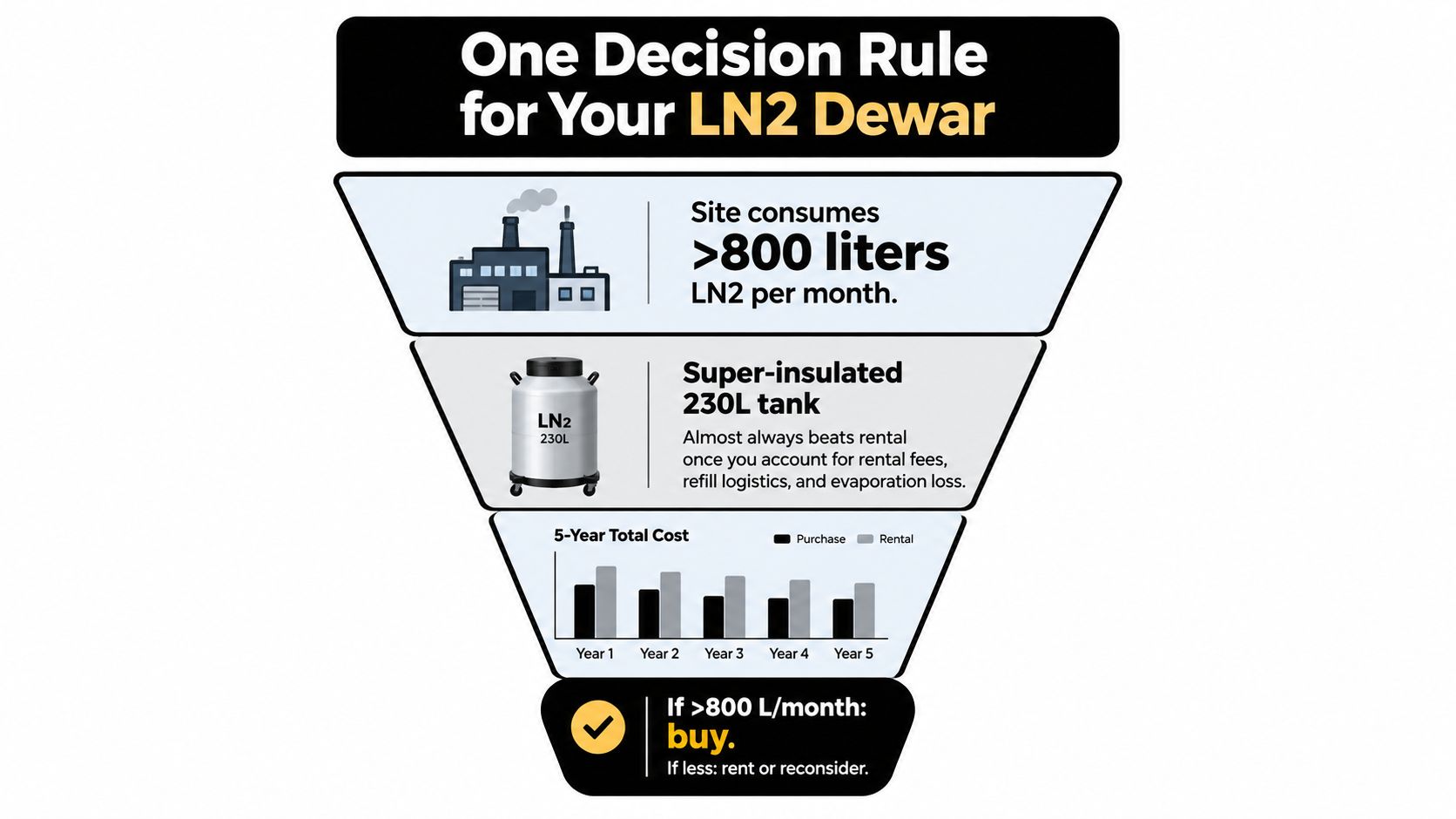
Use one figure: per-litre landed cost over 60 months. If consumption exceeds 800 litres of LN2 per month, a super-insulated 230L tank will usually beat rental once demurrage, delivery logistics, and evaporation are included. Between 100 and 800 litres per month, compare a purchased 50L to 120L unit with scheduled top-ups.
Below 100 litres per month, rental or a small 10L to 30L portable dewar is often the cleaner financial choice, particularly for trial sites that want to avoid owning equipment with ongoing compliance obligations. The final decision still depends on the delivered quote and the site's service requirements.
Cryonos GmbH supplies liquid nitrogen storage and transport vessels, including AC LIN models from 3L to 50L, alongside cryogenic handling equipment and compliance support. Visit Cryonos GmbH to compare suitable models and request a quote built around delivered cost, evaporation performance, transport requirements, service, and five-year ownership.

