No Products in the Cart




Liquid nitrogen tanks run from 1 L portable bench dewars to 1,800 L wide-neck storage vessels, while compressed nitrogen cylinders range from 5 L water capacity up to industrial bulk systems around 3,000 cubic feet. The right choice depends on whether you store samples, dispense supply, or transport materials across sites.
If you're choosing a tank right now, you're probably staring at a spec sheet full of liters, heights, neck openings, and daily evaporation numbers that don't seem to answer the question: what will work in your lab every day? That confusion is normal, because most nitrogen tank sizes are presented as a capacity problem when they're really an operations problem.
A tank can be technically large enough and still be wrong. It can fit the sample count but slow down retrieval, waste floor space, create refill headaches, or turn a simple transfer task into a handling risk. In labs, fertility clinics, biobanks, and production environments, the tank that works best is the one that matches the workflow, the room, and the refill pattern.
A common mistake is buying the largest vessel the room budget will tolerate, then discovering later that daily use got harder, not easier. That usually shows up in three places first: awkward access, poor placement, and refill behavior that didn't look obvious from the headline capacity number.
A fertility lab might choose a large vessel because the sample program is growing. On paper, that sounds sensible. In practice, the tank still has to move through doors, sit in a room with safe working clearance, and support repeated opening without disrupting the team.
The trouble starts when the vessel suits archive storage but the staff use it like a daily access freezer. Retrievals take longer. Cold loss adds up. The aisle around the tank gets crowded by carts and staging trays. People start working around the vessel instead of with it.
Practical rule: Buy for the way the tank is opened, moved, and refilled, not only for the way it is filled on day one.
Liquid nitrogen tanks span a broad practical range, from small static biological containers to large repository systems and transport-oriented supply vessels. Independent guidance shows biological containers in the 1 L to 175 L range, self-pressurizing supply tanks in the 50 L to 800 L range, and wide-neck storage systems up to 1,800 L effective capacity in published specifications for liquid nitrogen container classes (cryogenic liquid nitrogen tank ranges).
In day-to-day cryogenic work, four sizing variables matter more than most buyers expect:
If you want to control operating costs over the life of the vessel, tank size has to be treated as part of a broader equipment decision, not a one-line purchase comparison. That's the same logic behind any serious total cost of ownership analysis. Capacity is only one line on that worksheet.
Spec sheets use several “size” numbers, and they don't all mean the same thing. If you mix them up, you can compare two tanks that look equivalent but behave very differently once they are in service.
Effective capacity is the usable liquid nitrogen volume under normal operating conditions. That's the number tied to sample storage, hold time, and refill planning.
Water capacity is the total internal volume basis often used for pressure vessels and cylinders. It matters for classification and engineering context, but it doesn't automatically tell a lab manager how much working liquid is available in a biological storage application.
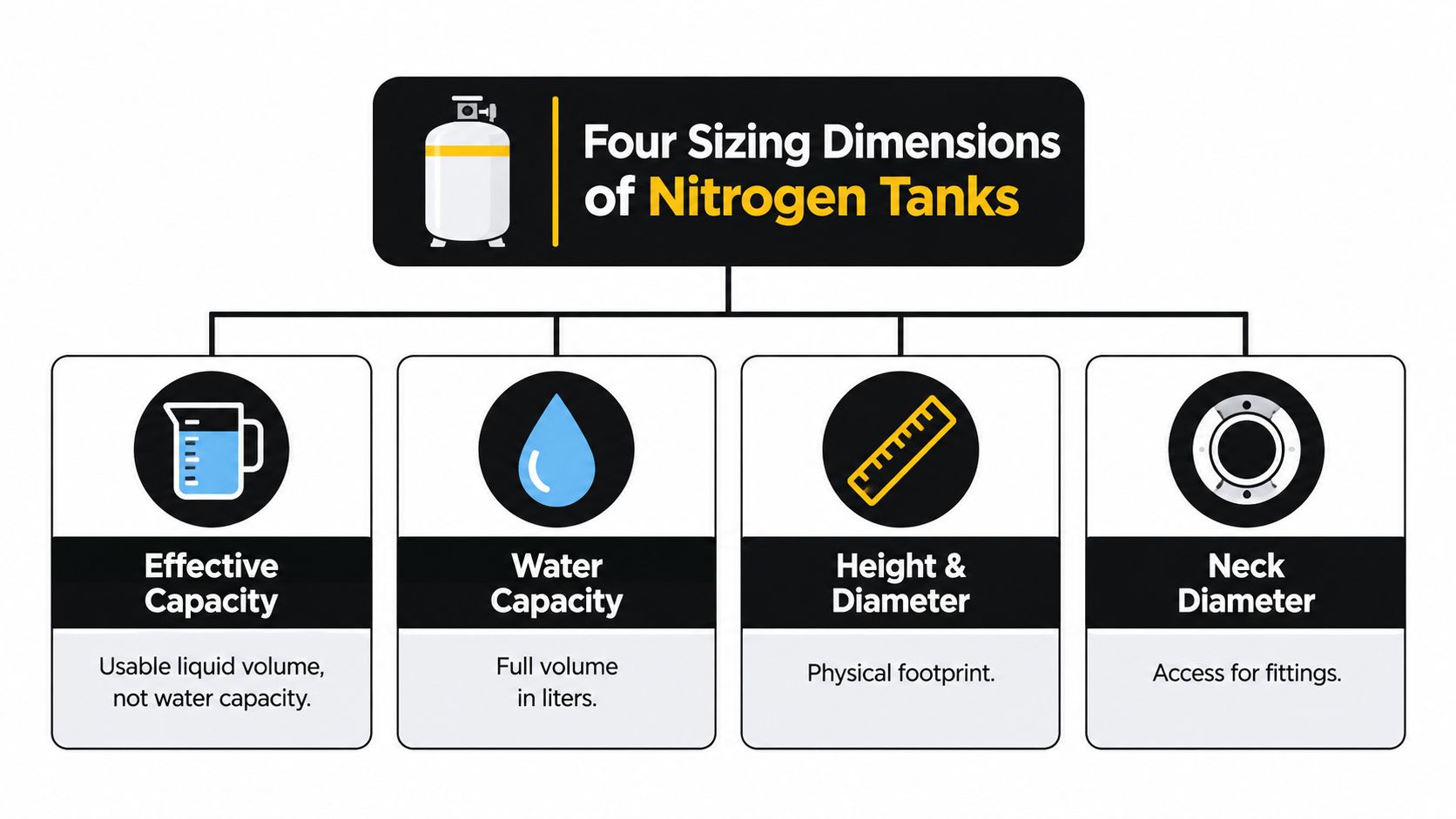
This is the hidden variable many buyers miss. Independent guidance points out that the same nominal tank size can perform very differently depending on neck diameter, access frequency, and container architecture, with examples ranging from 50 mm necks for canister-style access to 216 mm+ wide-neck formats for higher-density rack access and frequent retrieval workflows (liquid nitrogen cryogenic tank specs guide).
A narrow neck usually supports lower heat ingress and better hold characteristics for static storage. A wide neck gives staff faster access and better compatibility with rack-based handling, but you pay for that convenience in operating behavior and often in refill strategy.
Published specification sheets for stainless steel liquid nitrogen storage tanks list effective volumes from 350 L to 1,660 L, with diameters from 326 mm to 635 mm and total heights from 1,326 mm to 1,591 mm within one product family (stainless steel liquid nitrogen container specifications). That matters because “larger capacity” doesn't always scale in a simple, intuitive way at floor level.
Use this quick reading of the four dimensions before comparing models:
| Sizing Dimension | What it tells you | What it affects in practice |
|---|---|---|
| Effective capacity | Usable liquid volume | Refill interval, storage planning |
| Water capacity | Internal vessel basis | Vessel class, engineering context |
| Height and diameter | Physical size | Doors, floor space, clearance |
| Neck diameter | Access opening | Retrieval speed, rack style, heat ingress |
The best spec sheet is the one that tells you what the technician experiences at the opening, not just what purchasing sees in liters.
A lab can buy two vessels with similar liquid nitrogen capacity and still end up with opposite day-to-day results. One tank keeps samples stable with minimal opening losses. The other is built to push liquid out through a withdrawal device all day. If those jobs get mixed up, staff feel it immediately in refill frequency, transfer hassle, and sample handling.
The confusion usually starts with the label "nitrogen tank." In practice, labs are choosing between storage vessels, dispensing vessels, and gas cylinders. Capacity matters, but it does not answer the fit question. Access pattern, hardware layout, and whether the vessel stores product or supplies it matter just as much.
Biological storage dewars are designed around sample preservation. Standard classification material places these biological liquid nitrogen containers in the 1 L to 175 L range for storage use (container classifications in N2 doser documentation). These are the tanks used for canisters, inventory control, and long hold time under relatively static conditions. In real lab use, the neck and internal canister arrangement often matter more than the nominal liters.
Self-pressurizing supply tanks are built to dispense liquid nitrogen. They typically serve as the working source for filling smaller dewars, feeding equipment, or supporting routine transfers around the room. A supply tank can carry a lot of liquid and still be a poor choice for direct sample storage because the vessel is optimized for withdrawal hardware, pressure build, and delivery, not repeated hand access to stored material.
Wide-neck storage vessels sit between pure static storage and frequent retrieval. They are used where staff need faster access, rack handling, or larger archive formats. The trade-off is familiar to anyone who has run one. Better access usually comes with higher heat ingress and a refill plan that has to account for real opening frequency, not just catalog hold numbers.
| Tank Family | Effective Capacity | Typical Neck Diameter | Primary Use Case |
|---|---|---|---|
| Biological storage dewars | 1 L to 175 L | Usually narrow to moderate, depending on canister design | Static sample storage |
| Self-pressurizing supply tanks | 50 L to 800 L | Configured for dispensing hardware rather than sample access | Liquid nitrogen supply and transfer |
| Wide-neck storage vessels | Larger archive-style formats | Wide-neck formats for racks and higher-throughput retrieval | Archive storage with easier access |
Compressed nitrogen cylinders are a separate category. They supply gaseous nitrogen, not cryogenic liquid storage. Industrial cylinder listings commonly cover 5 L to 50 L water capacity classes at 150 bar to 300 bar, with examples and standards summarized in nitrogen cylinder specifications and standards. That is a utility gas decision, not a substitute for a liquid nitrogen storage vessel.
Labs get into trouble when they size only by liters. A 50 L vessel used as a sample freezer and a 50 L vessel used as a transfer source are not equivalent tools. One is chosen for hold behavior and access control. The other is chosen for supply duty, pressure handling, and dispensing convenience.
That distinction saves money, floor space, and a lot of technician frustration.
Two tanks can hold a similar amount of liquid and still impose very different refill routines. That's why evaporation rate deserves as much attention as capacity.
Independent catalog data show that very small portable liquid nitrogen tanks lose about 0.07 to 0.12 L/day, while larger storage tanks in the 10 L to 50 L class lose roughly 0.35 to 0.45 L/day. Another catalog lists 0.07 L/day for a small container class (liquid nitrogen container catalogue data).
That does not mean smaller vessels are inefficient and larger ones are always better. It means each vessel has a boil-off profile that has to fit the job.
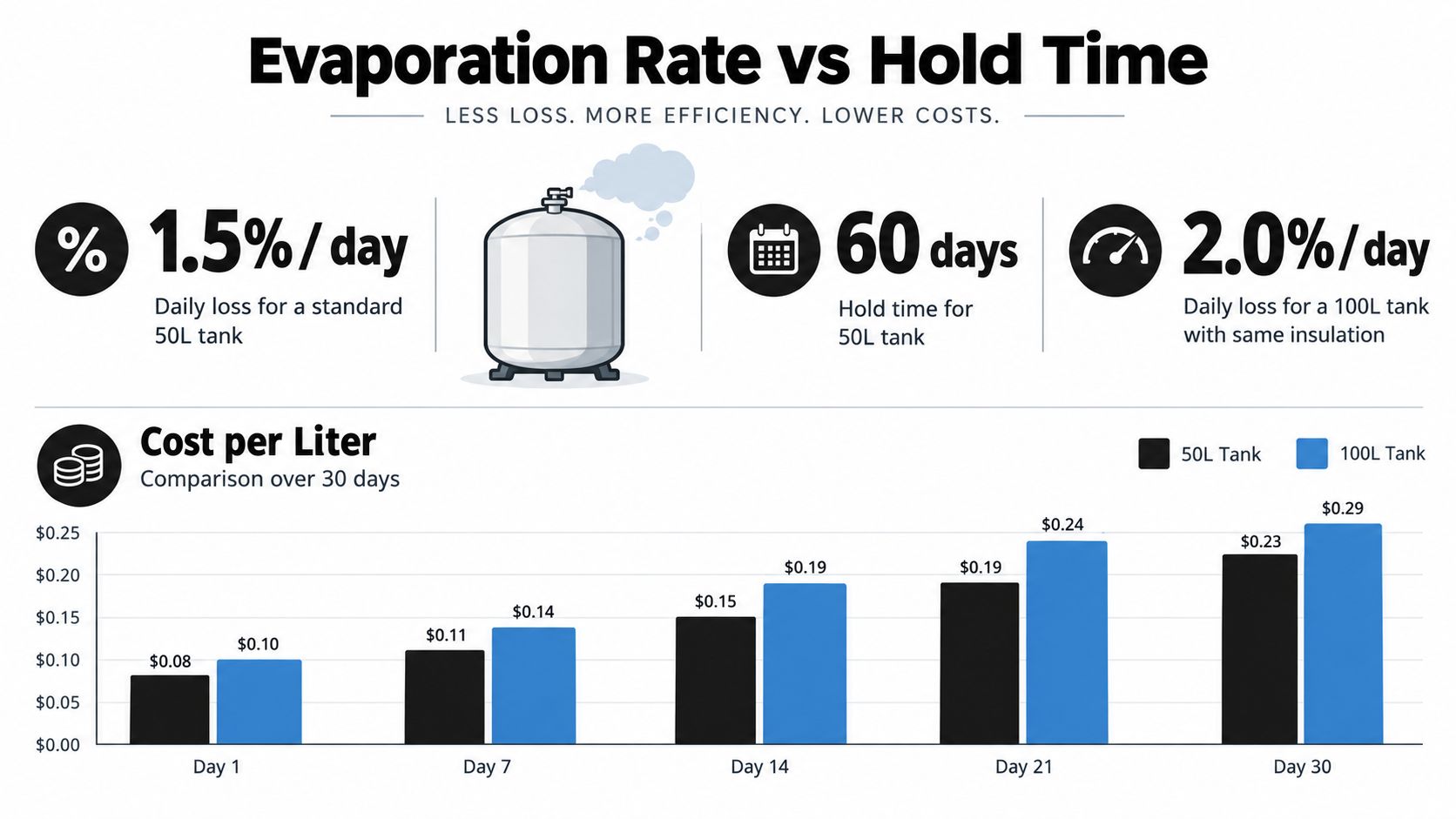
A useful way to think about hold time is simple:
That last step matters most. Catalog hold behavior is one thing. Open-tank reality is another.
As vessels get larger, the loss rate per unit of stored liquid usually improves. That makes larger tanks more efficient for bulk storage over time. But if the vessel is opened constantly, or if transfer paths are awkward, practical losses and staff time can erase the advantage.
A tank with a better static profile can still be the wrong tank if your team opens it all day.
A university handling guide makes the same point in a more operational way by listing practical dewar sizes of 30 L, 60 L, and 120 L together with evaporation rates in liters per day per dewar, treating boil-off as a planning metric rather than a side note (liquid nitrogen handling guidance).
Here is the practical takeaway:
If refill frequency is driving hidden operating cost, reducing unnecessary losses often matters as much as changing the vessel itself. For teams working through that problem, this guide on reducing evaporation losses in liquid nitrogen and minimizing operating costs is a useful companion to the sizing decision.
A short visual example helps when training operators or procurement teams:
By the time a tank reaches the loading bay, the wrong decision is expensive to reverse. The tank still has to fit your building, your handling routine, and your compliance obligations.
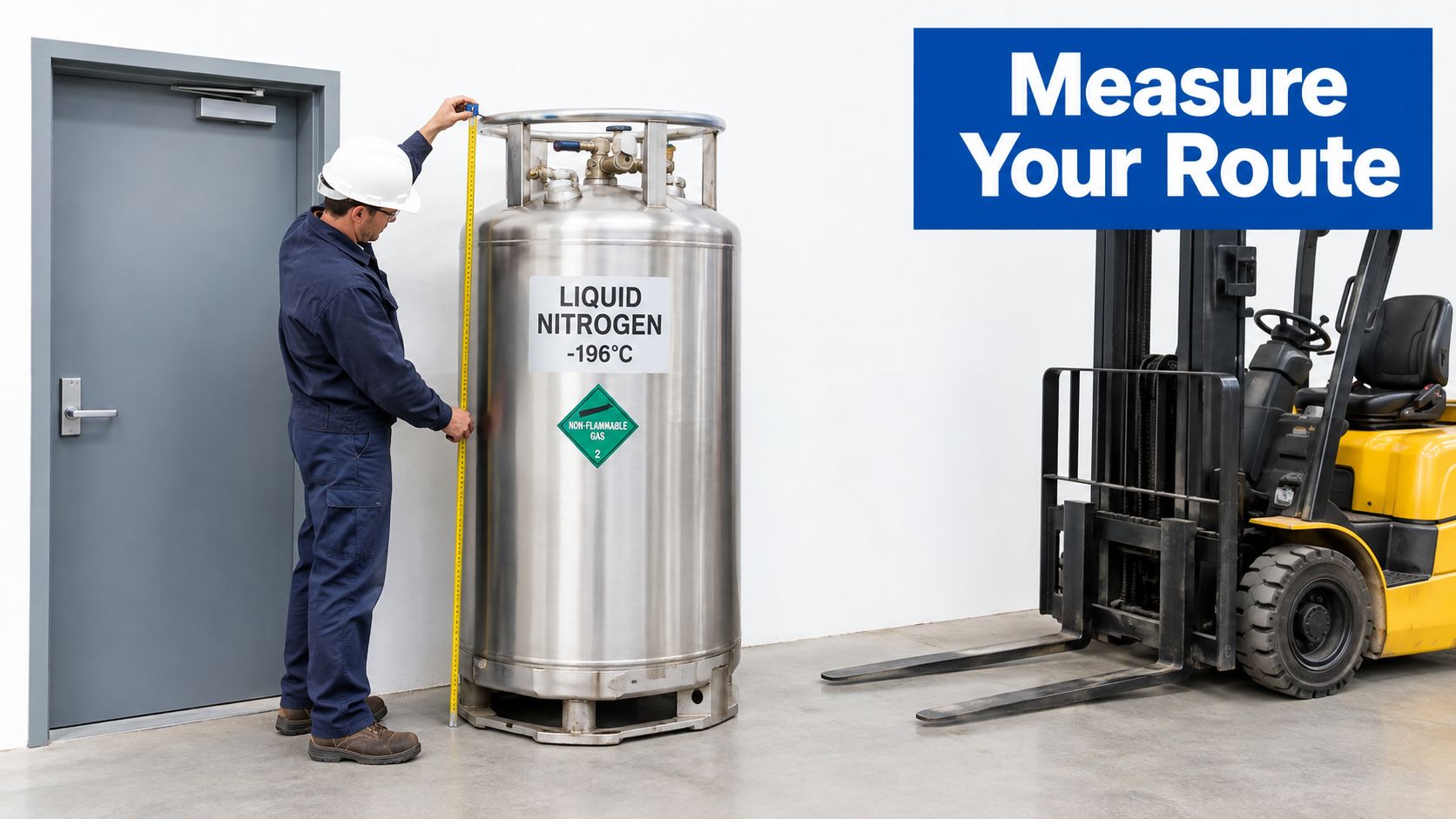
Before comparing model families, map the full route:
Labs that retrieve samples all day need an access-oriented vessel. Archive rooms usually don't. This sounds obvious, but many purchases still optimize for storage volume first and workflow second.
Use this simple matching logic:
| Workflow pattern | What to prioritize | What to avoid |
|---|---|---|
| Frequent retrieval | Wider access, clear rack handling, open working space | Narrow-neck archive vessels used like daily-access tanks |
| Long-term archive | Storage density, stable hold behavior, minimal disturbance | Oversized wide-neck systems without a throughput need |
| Routine LN2 supply | Dispensing hardware, transfer stability, placement near use points | Sample storage dewars used as supply tanks |
If you move liquid nitrogen between buildings or sites, transport rules become part of tank selection. ADR-related guidance states that requirements do not apply, except as specified in ADR 5.5.3, when nitrogen is transported in double-wall receptacles that comply with packing instruction P203 for open cryogenic receptacles (ADR FAQ on transport exception).
That exception is useful, but it doesn't remove the need to match the vessel to the transport case. A separate safety data sheet for liquid and gaseous nitrogen states that liquid nitrogen is transported by road in cryogenic vessels and tanks that comply with ADR requirements (nitrogen safety data sheet for transport). If your operation has a road leg, this is not optional.
Check the route, the room, and the regulatory path before you check the purchase price.
The same nitrogen tank sizes lead to different decisions once the workflow changes. Three common environments show why.
This operation usually needs controlled access more than maximum storage density. Staff may open the vessel often, remove material in small batches, and work in a room where every square meter matters.
The better fit is often a wide-neck storage vessel or a mid-range biological storage configuration that supports faster retrieval. A very large archive-style tank can become frustrating in this setting if it slows access or dominates the room. If samples also move between rooms or satellite locations, handling and transport features matter almost as much as nominal capacity.
A university archive tends to reward stability. The vessel may hold a large sample inventory, but daily access can be limited to selected retrieval windows. In that environment, storage density and hold behavior usually matter more than speed at the neck.
A biological storage dewar for smaller collections or a larger wide-neck repository vessel for scaled archives makes sense here, depending on sample organization. The key trade-off is simple. Staff can accept slower retrieval if the vessel protects inventory well and uses space efficiently.
If the main job is dispensing liquid nitrogen to other containers or feeding downstream use, a self-pressurizing supply tank is usually the proper class. The tank has to support transfer, placement, refill logistics, and road movement if distribution crosses sites.
One practical option in this category is to use product families built specifically around storage, transport, and handling roles rather than forcing one vessel to do everything. For example, Cryonos GmbH supplies model series including AC LIN, liquid gas cylinders, and AC Micro Bulk for different liquid nitrogen and cryogenic logistics use cases. That kind of separation usually produces a cleaner operating setup than trying to make a single vessel cover archive, supply, and transport roles.
Different workflows don't need different opinions about tank sizing. They need different vessel families.
The cleanest purchase decisions start with one question: what is the tank supposed to do every day? If that answer is vague, the spec comparison will stay vague too.
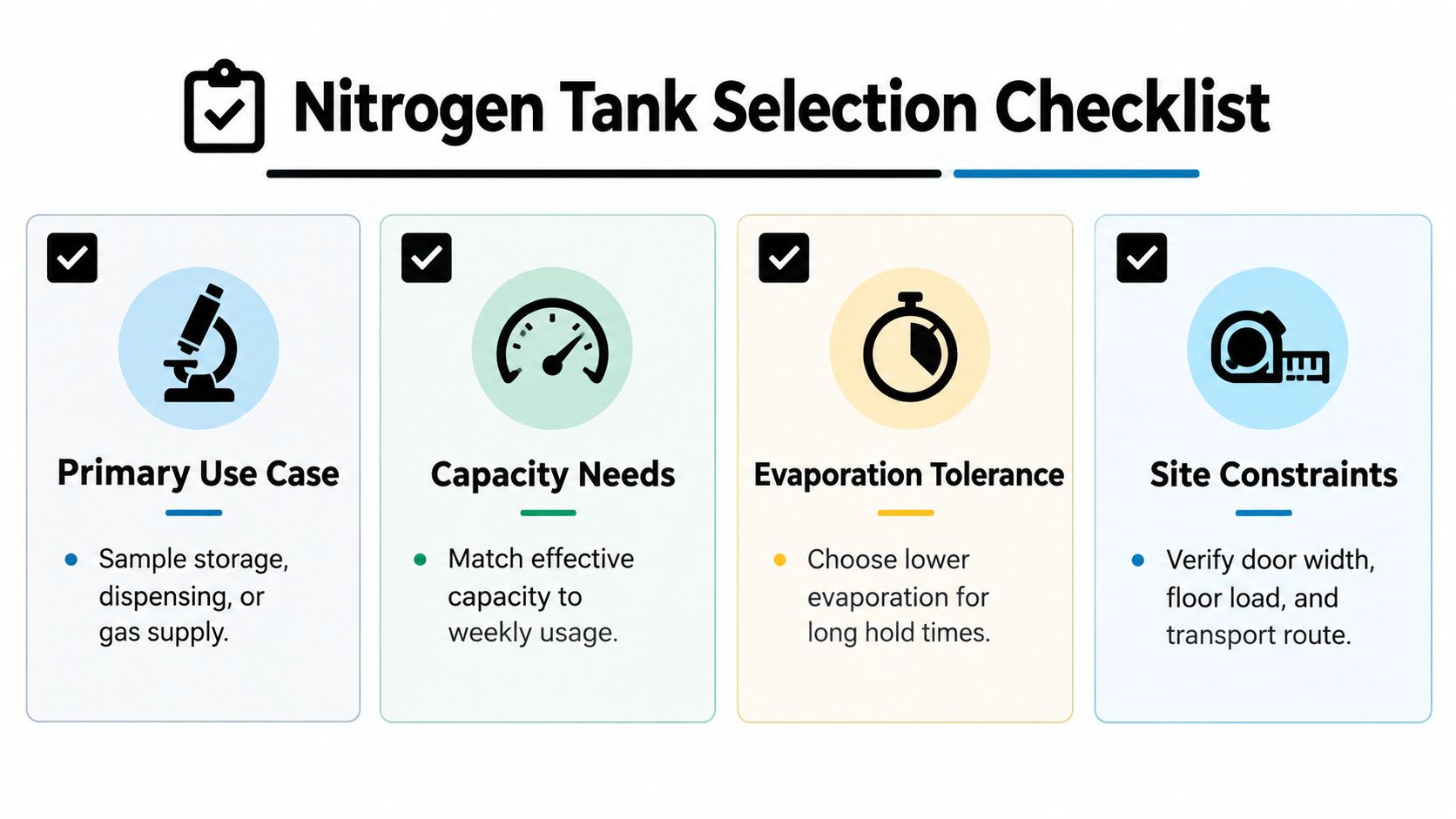
Is the vessel for sample storage, routine liquid nitrogen dispensing, or gaseous nitrogen supply? If you start by mixing those categories, every later comparison gets harder.
Match effective capacity to actual operating demand and refill rhythm. Oversizing often looks safe in procurement and awkward in service.
Frequent retrieval requires a different neck and internal arrangement than low-touch archive storage. The tank opening is part of the workflow, not just a dimension on paper.
Measure doors, turning space, final footprint, and service clearance. Confirm how the tank will be filled, cleaned around, and accessed during a busy shift.
If the vessel moves on public roads or between sites, confirm the transport case before ordering. If it stays in one room, concentrate on room suitability and operating routine.
Use this quick filter before approving any quote:
For buyers comparing models, a dedicated liquid nitrogen storage tank guide can help narrow the field once the role is clear.
The right tank size is the one your staff can use safely, refill predictably, and access without fighting the vessel.
Nitrogen tank sizes only look simple from a distance. Up close, the right decision comes from matching vessel class, access pattern, boil-off behavior, and site reality. Get those four aligned, and the rest of the purchase gets much easier.
Cryonos GmbH supplies cryogenic equipment for liquid nitrogen storage, transport, and handling, including storage vessels, transport units, liquid gas cylinders, safety equipment, and related accessories for labs, biobanks, and industrial users. If you're comparing nitrogen tank sizes and want equipment that matches your workflow rather than just a capacity number, visit Cryonos GmbH to review the available vessel types and model families.

