No Products in the Cart




You may be standing next to a semen tank right now, hand on the lid, wondering whether it still has enough nitrogen, whether the frost around the neck means trouble, or whether that larger model you've been eyeing would make life easier. That's a common place to be. A stickstoffbehälter für Rindersamen looks simple from the outside, but the right one protects years of breeding decisions, expensive genetics, and tightly timed insemination work.
Most problems don't begin with a dramatic failure. They begin with small habits. A canister stays too long in the neck. A stopper doesn't seat properly. Nitrogen levels are checked “soon” instead of on schedule. Then one warm-up event does damage you can't reverse. That's why tank choice isn't just about liters on a brochure. It's about hold time, handling geometry, refill reality, transport demands, and how disciplined your routine is when the day gets busy.
A breeder notices the tank lid feels different. There's a little extra frost around the top, and the usual refill interval seems shorter than it used to be. Nothing looks catastrophic. The semen straws are still inside. Work continues. But that's exactly how storage losses often begin. The danger isn't only empty tanks. The danger is unnoticed warming.
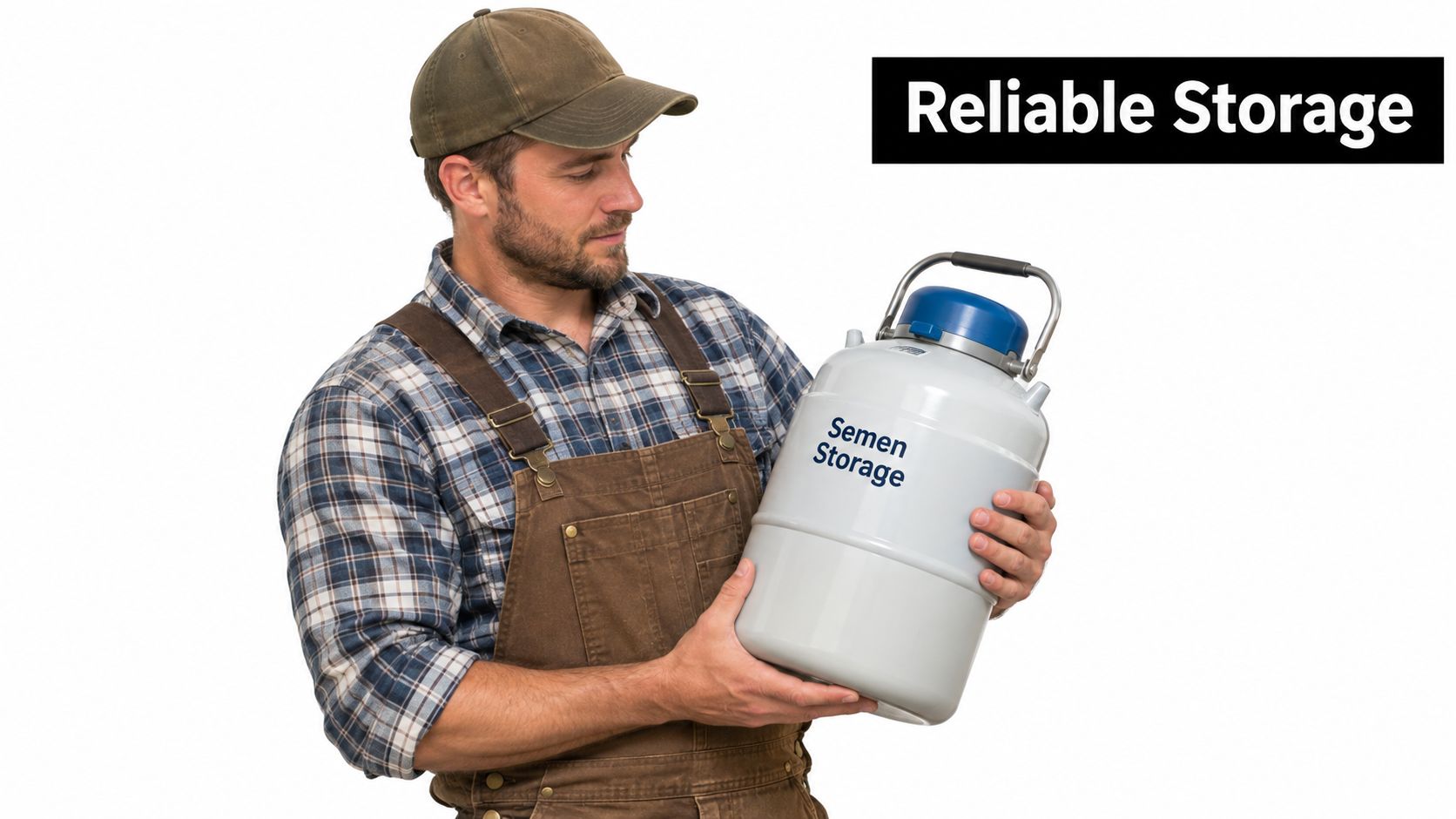
A semen tank is really a guardian of genetic value. Each straw holds a breeding plan. On a small farm, that might mean preserving access to a specific bull for a narrow calving window. In an AI center, it means protecting organized inventory that must stay stable through repeated retrieval, transport, and refilling. If the tank fails, you don't just lose product. You lose timing, confidence, and often the ability to repeat a mating decision exactly as planned.
Reliable storage matters because semen damage doesn't always announce itself clearly. You may not see a broken straw or a dramatic spill. Instead, sperm cells experience warming that harms viability before anyone realizes the tank has become unsafe. Once that happens, putting the straws back into cold conditions doesn't undo the injury.
Practical rule: Treat every unnecessary warm-up as permanent risk, not a temporary inconvenience.
The importance of dependable cryogenic storage became clear decades ago. Early field comparisons of semen stored in liquid nitrogen versus dry ice showed better nonreturn results for liquid nitrogen storage. One trial reported 70.6% for liquid nitrogen versus 67.8% for dry ice, another reported 73.2% versus 67.6%, and combined data from 9,742 first-service cows showed 71.1% nonreturn for liquid nitrogen compared with 68.4% for dry ice, according to a Journal of Dairy Science field comparison on semen storage performance90023-6/pdf).
Three things make semen storage emotionally and financially sensitive:
That's why experienced breeders stop thinking of a tank as a passive container. They treat it like a working part of the breeding system, just like synchronization protocols, thaw technique, and recordkeeping.
A straw can look perfectly normal and still be ruined by heat exposure you never saw. That is why experienced AI staff focus less on whether semen is physically present and more on whether it stayed continuously below the safe temperature line.
Liquid nitrogen protects semen by holding it at about -196°C, or -320°F. At that temperature, biological activity inside the sperm cell is effectively suspended, which is why long-term storage is possible, as described in an Ohio State semen stewardship poster.
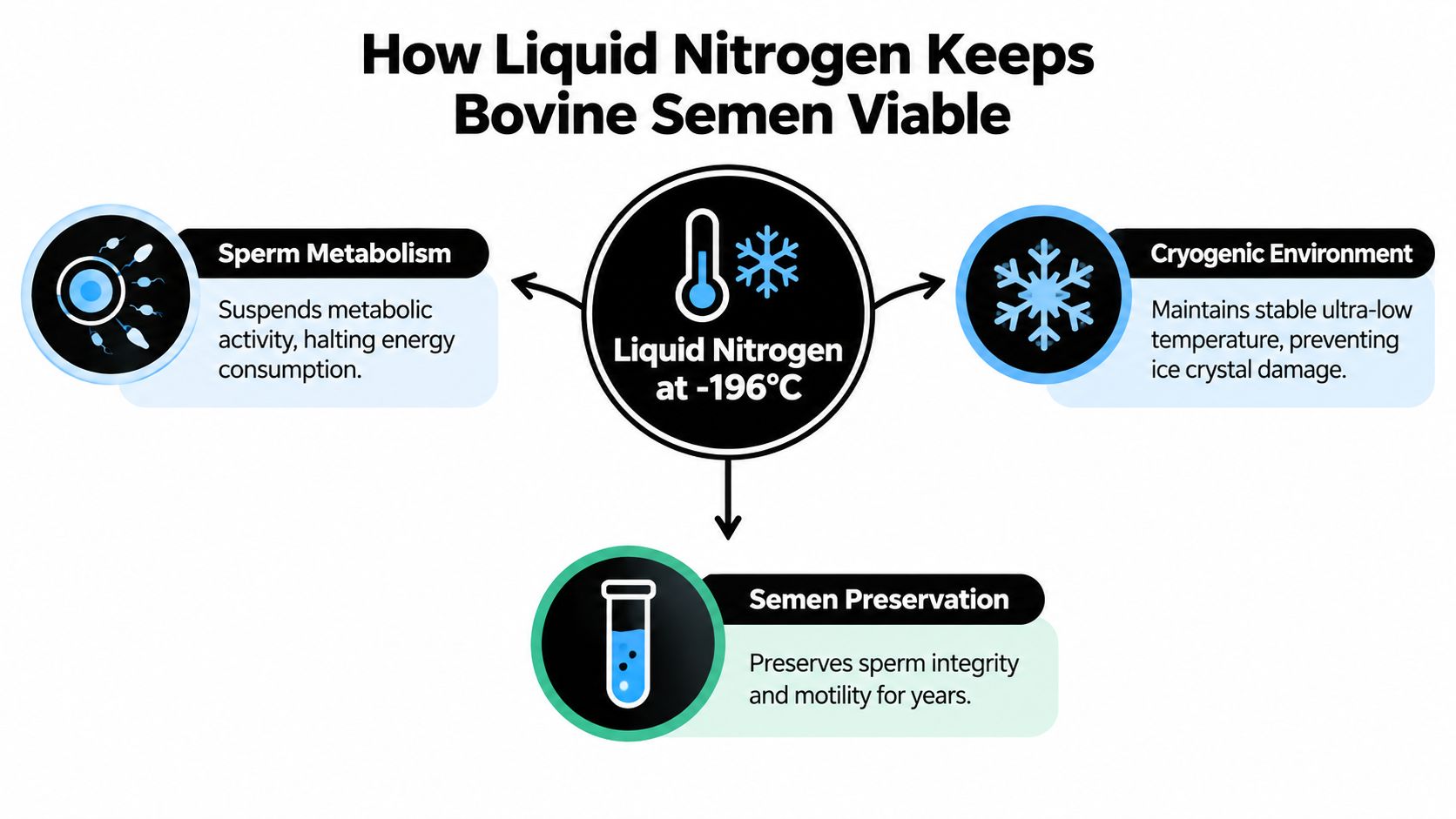
A useful way to picture this is a pause button. Ordinary freezer temperatures only slow damage. Cryogenic temperatures stop the clock well enough for storage over long periods.
Liquid nitrogen vessels work like a thermos built for far colder conditions. The inner chamber holds the nitrogen. Around it is an insulated space, usually under vacuum, that slows heat from the room before it reaches the cold interior.
That design explains an important buying point. Capacity is only half the story. Hold time depends on how well the vessel resists incoming heat, how often it is opened, and how much warm air enters through the neck during handling. A larger tank with higher evaporation can create more risk than a smaller one that keeps temperatures steadier and gives staff better control during retrieval.
Inside a healthy vessel, the liquid at the bottom stays near -196°C. The vapor above it is also extremely cold, but it is not equally cold from top to bottom. The closer you get to the neck, the faster temperature rises. That gradient matters for hygiene, access discipline, and inventory safety because repeated lifting of canisters into the warmer neck area can injure straws without any visible warning.
For semen and embryos, about -130°C is the danger threshold many handlers are taught to respect. Below that point, water inside the sample remains in a glass-like state. If the sample warms above -130°C and then goes back down, irreversible injury can occur, as explained in a Beef Reproduction task force presentation on cryobiology limits.
So the question is not only, “Is there nitrogen in the tank?” The better question is, “Did the straw stay below the damaging zone the entire time it was stored and handled?”
A practical mental map helps:
A short demonstration helps many teams understand the workflow better:
Freezing semen and storing semen are related, but they are not the same operation. During processing, straws are commonly exposed in the cold vapor above liquid nitrogen before final immersion. The exact setup depends on the protocol and equipment being used, but the principle is consistent. Controlled vapor exposure helps the straw pass into deep cryogenic temperature in a managed way instead of too abruptly.
That is one reason vapor behavior matters in tank selection. Staff often compare vessels by listed straw count alone. In practice, a useful stickstoffbehälter also needs predictable vapor conditions near the working area, enough neck access for clean retrieval, and handling routines that reduce contamination from ice, dust, and prolonged lid opening. Those trade-offs become more important as operations grow, more people access the tank, or future storage workflows begin to separate true cryogenic preservation from short-term 5°C holding steps used elsewhere in the semen chain.
Not all nitrogen vessels do the same job. Buyers often get stuck. A static storage tank and a transport dewar may both hold semen in liquid nitrogen, but their priorities differ. One is built to sit safely in place and protect inventory over time. The other is built to move, to be handled more often, and to fit the rhythm of field insemination.
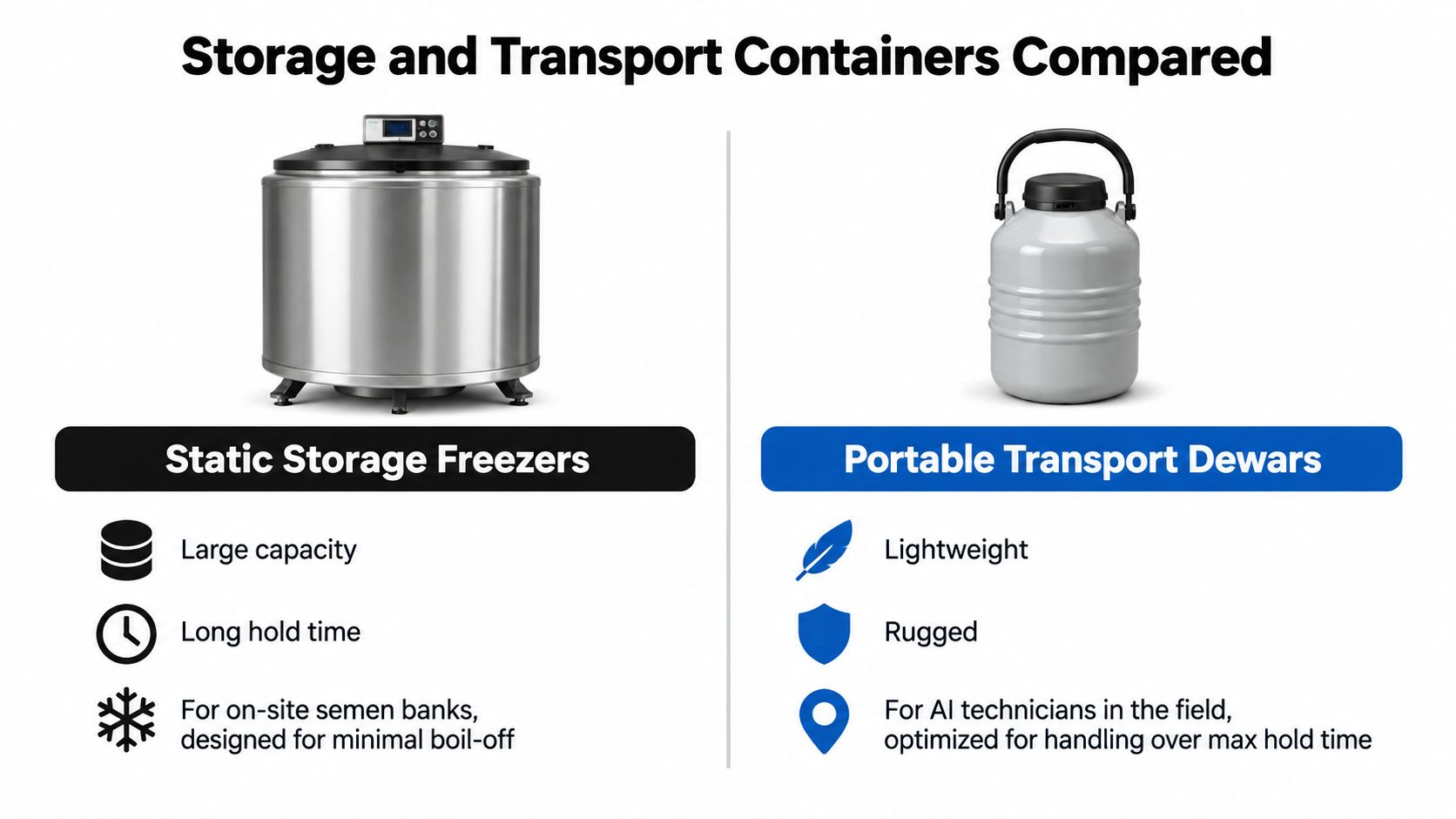
Static storage tanks usually favor inventory protection. They may offer internal rack and goblet systems that make long-term organization easier, especially when many straws are stored by bull, batch, or collection date. Portable transport dewars are different. They favor ruggedness, manageable size, and handling convenience during movement.
If you want a closer look at that mobile category, this overview of a liquid nitrogen transport dewar is useful for seeing how transport-focused vessels differ from storage-first designs.
| Feature | Static Storage Tank | Transport Dewar |
|---|---|---|
| Main job | Long-term on-site semen storage | Moving semen between sites or into the field |
| Design priority | Capacity, low boil-off, organized inventory | Portability, durability, secure transport |
| Neck and access | Often optimized for internal storage systems | Often optimized for repeated handling |
| Typical use | AI center, breeding facility, semen bank | Route work, satellite storage, delivery |
| Retrieval pattern | Planned and organized | Frequent and situational |
| Best fit | Higher inventory kept in one location | Smaller loads that need to travel |
Frozen bovine semen is commonly packaged in 0.25 mL or 0.5 mL straws and stored in liquid nitrogen below -130°C, with the source also noting that the tank should be checked so the liquid nitrogen level is monitored weekly, according to this artificial insemination quality control reference. Those straw formats affect much more than fill volume.
Smaller-format organization changes how fast staff can locate a sample, how clearly they label goblets, and how much time canisters stay in the neck during retrieval. That's one reason semen operations usually care about rack geometry and cane layout. The right arrangement reduces searching time, and reduced searching time reduces warm-up risk.
Monday morning at an AI unit, the inventory looks fine, but the refill log says something else. The tank is large, heavily loaded, and still running through nitrogen faster than the team expected. That usually comes from reading the biggest capacity number first, instead of reading the tank like a working tool.
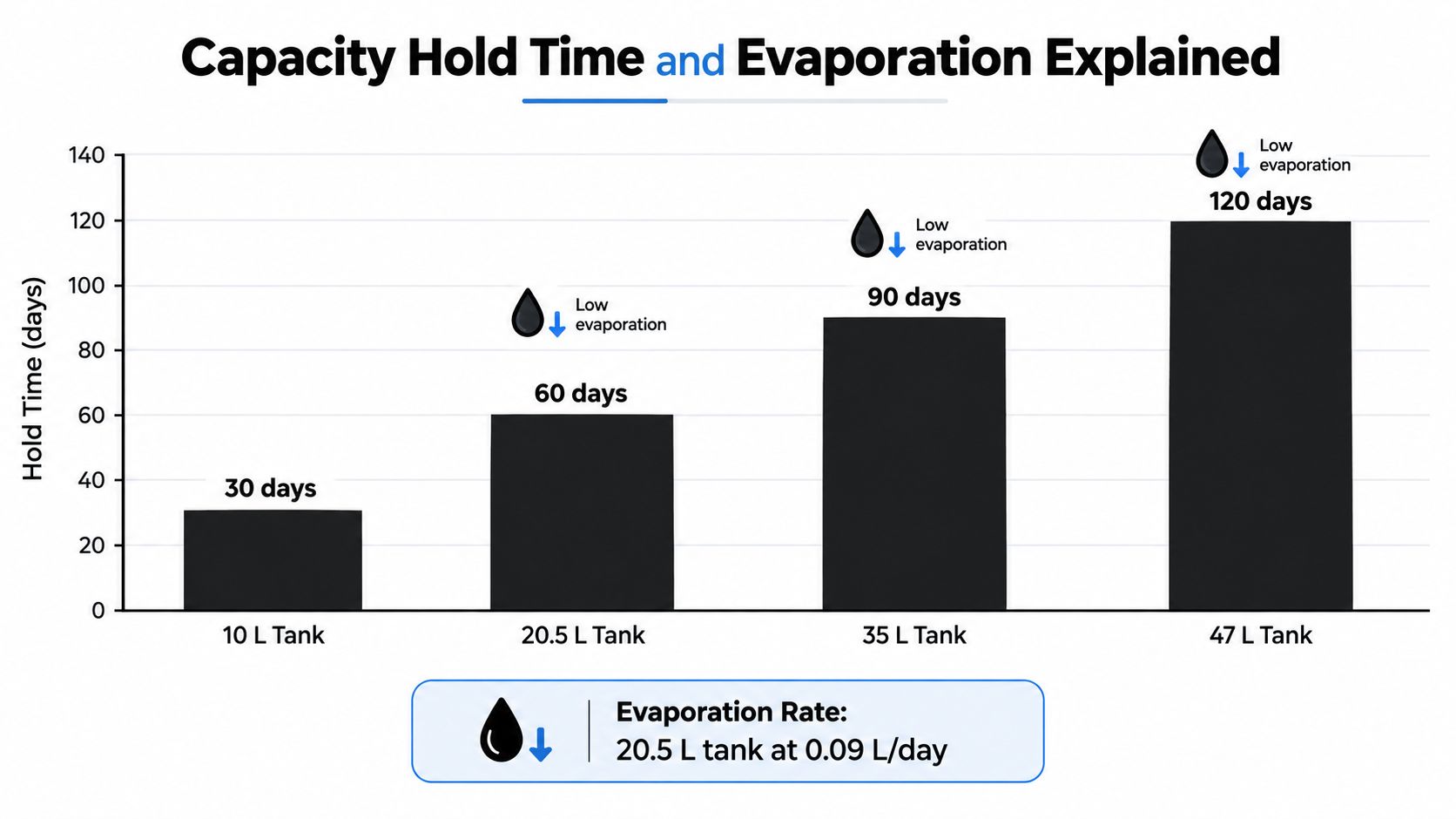
Three spec lines matter together. LN2 capacity tells you how much liquid the vessel holds. Static evaporation rate shows how quickly that liquid is lost under controlled conditions. Normal working duration is the more practical figure, because farms and AI centers open tanks, retrieve straws, and disturb the neck area during real use.
That trade-off shows up clearly in commercial specifications. Tanks around 20.5 L are listed with static evaporation rates near 0.09 to 0.115 L/day and normal working durations around 107 to 142 days, while some 47 L units are listed near 0.39 L/day with working duration around 76 days, according to semen and embryo tank specifications from Reproduction Provisions. More liters can give you more straw capacity, but not automatically more calendar days between refills.
A simple way to picture it is a chest freezer versus a walk-in cold room. The larger room holds more product, but every access event exposes more area, and the system has different heat-entry behavior. Liquid nitrogen tanks work under the same kind of trade-off. Neck size, vessel geometry, access pattern, and refill discipline all shape how long the contents stay protected.
For a high-throughput semen bank with dependable deliveries, a larger tank can make sense even if working duration is shorter. Capacity may reduce crowding, improve inventory separation, and support future growth.
For a remote breeding site, the safer choice is often the vessel that gives more margin between fills, even if total straw count is lower.
That is the selection question. Are you buying storage space, or are you buying time to absorb missed deliveries, weather delays, staff absence, or a weekend oversight? A technical guide to liquid nitrogen storage tank selection helps translate those brochure numbers into day-to-day operating decisions.
Read the tank data in this order:
Operator rule: Match the tank to the refill routine you can maintain during a bad month, not an ideal month.
Every unnecessary retrieval session adds heat load. Every prolonged search at the neck increases vapor exposure. Every poorly organized cane or goblet makes that problem worse. Evaporation is not only an engineering figure. It is partly a staff-behavior figure.
This matters for hygiene too. Repeated, slow handling raises the chances of contact errors, misplaced samples, and clutter around the neck opening. Cleaner retrieval practice usually means faster retrieval practice, and faster retrieval practice usually means less nitrogen loss.
Semen work is not only about the liquid pool at the bottom of the vessel. The vapor zone near the neck is the working zone during loading, lifting, and brief exposure. If staff regularly hold canisters too high or too long, they are operating in a temperature gradient, not in one uniform safe band.
That is one reason future storage discussions are starting to include more explicit temperature mapping and even early signals around controlled 5°C handling steps outside long-term cryogenic storage. Those are different stages of the chain, but they point to the same lesson. Good storage decisions come from managing temperature zones and handling risk, not from chasing the largest tank on the page.
Most semen losses don't come from one spectacular mistake. They come from routine shortcuts repeated often enough to create a weak point. Good handling is less about memorizing a warning poster and more about building a routine that catches problems early.
Start with visibility. Keep the tank upright, secure, and easy to inspect. If staff have to move feed bags, tools, or boxes to see the vessel, daily checks won't happen consistently. Existing extension guidance stresses daily visibility, regular liquid nitrogen checks, and secure upright storage, while also noting common warning signs such as frost or ice around the lid, damaged stoppers, or signs of vacuum loss in practical farm use, as discussed in a Mississippi State Extension guide on cattle AI programs.
A workable routine often looks like this:
Handling discipline matters most when retrieving semen. A 2026 research announcement discussing current handling guidance notes that canisters should not remain in the tank neck for more than 8 seconds, and that straws can crack if thermal shock occurs during topping-off. The same announcement highlights experimental work on bovine sperm storage at about 5°C, aimed at removing the need for liquid nitrogen in the future, while also pointing to a 2026 PubMed record that reported significant declines in motility, viability, and kinematics after only 7 days of storage in its study context. Because this is forward-looking material, it should be read as an emerging signal rather than settled replacement practice, as summarized in this EurekAlert research announcement on future bovine sperm storage.
That matters for today's tank buyers in two ways. First, the cheapest vessel isn't always the lowest-risk vessel if evaporation control is poor. Second, future storage methods may eventually simplify some field logistics, so buyers with long planning horizons should watch compatibility and system flexibility.
People often assume extreme cold solves contamination concerns. It doesn't. Current handling discussions note that microorganisms can survive in liquid-nitrogen storage environments, including sediment in storage containers used for deep-frozen bull semen. So maintenance isn't just about keeping samples cold. It's also about keeping the vessel clean, limiting avoidable debris, and controlling contact points during retrieval.
If sediment builds up in the bottom of a working semen tank, don't treat it as cosmetic. Treat it as a hygiene question.
Many farms want a simple answer, but a risk-based answer is safer. Retire a tank from semen duty when you see repeat boil-off abnormalities, persistent frost patterns that suggest vacuum trouble, damage that affects closure or safe handling, or a refill history that no longer matches the vessel's normal behavior. Some industrial cryogenic systems can be serviced, but for semen storage, reliability matters more than squeezing extra months from a doubtful vessel.
Transport adds another layer. If the vessel is used on the road, use a model intended for that purpose and make sure transport practices align with ADR requirements for secure, upright cryogenic movement. A good transport vessel protects both the sample and the people around it.
The right choice depends less on catalog language and more on the way your operation behaves. A small breeder with infrequent access needs a different vessel than an AI center retrieving straws throughout the week. If you buy by capacity alone, you'll often buy the wrong tank.
Ask four blunt questions:
Low purchase price can hide higher operating risk. A vessel with better evaporation control, clearer organization, and easier servicing may reduce avoidable handling stress over the life of the tank. For some buyers, spare parts availability and long maintenance intervals matter more than squeezing maximum nominal capacity into the budget.
A practical evaluation checklist looks like this:
One market option in this space is Cryonos GmbH, which offers liquid nitrogen storage and transport vessels, straw organization systems, model-series-based selection, and an online route for comparing vessel types through its liquid nitrogen dewar overview. Useful evaluation lenses include long maintenance intervals, controlled evaporation behavior, warranty terms, and spare parts availability.
Most semen storage today still depends on liquid nitrogen. That remains the practical standard. But the emerging research signal around roughly refrigerator-temperature storage tells buyers something important even now. Storage technology may become less infrastructure-heavy over time. That doesn't make current LN2 systems obsolete. It does mean you should think in systems, not just tanks.
The smartest buyers usually choose the vessel that fits today's handling discipline while leaving room for tomorrow's workflow changes.
Reliable bovine semen storage isn't a one-time purchase. It's a chain of decisions. The vessel, the refill plan, the neck handling discipline, the logging routine, the transport method, and the replacement threshold all work together. If one part is weak, the whole storage program becomes fragile.
History makes that clear. The modern foundation of semen storage shifted in 1954, when insulated liquid nitrogen tanks replaced earlier glass vacuum containers, and liquid nitrogen at -196°C provided far longer, lower-maintenance preservation than solid carbon dioxide at -79°C. Historical reviews also note that by 1995 world semen production exceeded 200 million doses, with 95% processed as frozen product, and by 2000 global cattle AI statistics reached 232 million frozen doses plus 11.6 million liquid doses, according to a historical review of bovine semen technology and global adoption31036-6/pdf).
That shift didn't happen because tanks looked impressive. It happened because liquid nitrogen storage proved itself in the field and scaled into the dominant preservation system. For breeders and AI centers today, the practical lesson is simple. Choose for reliability. Monitor like the contents matter, because they do. Replace doubtful equipment before it forces the decision for you.
If you're evaluating your current setup, audit three things this week: your real refill interval, your retrieval habits at the neck, and any sign that the vessel's behavior has changed. Those details tell you more than the label on the tank ever will.
Cryonos GmbH supplies cryogenic vessels and handling solutions for storing and transporting sensitive biological materials, including liquid nitrogen systems relevant to bovine semen workflows. If you're comparing storage and transport options, planning a tank upgrade, or tightening your handling routine, visit Cryonos GmbH to review the available equipment and selection paths.

