No Products in the Cart




An ultra low temperature freezer is a highly specialised piece of equipment built for one core purpose: preserving biological samples by bringing all cellular activity to a screeching halt. We’re talking about temperatures plummeting to between -40°C and -86°C. You can think of it as a biological time capsule, effectively pressing pause on life to protect invaluable materials like vaccines, tissues, and enzymes for years to come.
In the world of scientific research and medicine, time is often the enemy. Biological samples—from delicate cell lines to critical vaccine components—begin to degrade the moment they are collected. Enzymes go to work, cellular structures lose their integrity, and the very information they hold can be lost forever. This is the fundamental challenge that an ultra low temperature freezer is engineered to solve.
By plunging samples into a deep freeze, these units effectively stop biological time in its tracks. At temperatures as low as -86°C, nearly all metabolic and enzymatic activity ceases. This creates a state of suspended animation, preserving the sample's original condition with remarkable fidelity. The goal isn't just to keep things cold; it's to safeguard the future of research, diagnostics, and therapeutic development.
Every single vial stored within a ULT freezer represents a huge investment of time, money, and scientific effort. For a pharmaceutical company, these samples could be the foundation of a new life-saving drug. In a biobank, they are an irreplaceable library of genetic information for studying diseases. For a fertility clinic, they hold the potential for new life.
The consequences of a storage failure are therefore immense. It makes the reliability of an ultra low temperature freezer a completely non-negotiable priority. A single temperature fluctuation can compromise years of work, rendering entire research projects invalid.
The decision to invest in a high-quality ULT freezer is one of the most critical choices a laboratory can make. It's a commitment to protecting irreplaceable assets and ensuring the continuity of scientific discovery.
Before we dive deeper, here is a quick overview of what these freezers are all about.
| Key Feature | Description and Importance |
|---|---|
| Operating Temperature | Ranges from -40°C to -86°C, stopping nearly all biological activity. |
| Primary Function | Long-term preservation of sensitive biological materials like cells, tissues, and enzymes. |
| Key Applications | Biobanking, pharmaceutical research, hospitals, clinical trials, and vaccine storage. |
| Core Technology | Primarily mechanical cascade refrigeration systems, with cryogenic options for even lower temperatures. |
| Critical Requirement | Extreme temperature stability and reliability to prevent sample degradation. |
This table shows just how specialised these units are. They are purpose-built for high-stakes applications where sample integrity is everything.
This critical need for reliable preservation is driving significant growth in the field. The global market for ultra-low temperature freezers is expanding rapidly, fuelled by advancements in biotechnology and increasing investment in research worldwide.
As of 2025, the market's value was estimated to be somewhere between USD 495.2 million and USD 918.46 million. This growth is propelled by emerging fields like regenerative medicine, genetic analysis, and stem cell therapy. You can read the full research on this growing market and its key drivers to get the complete picture.
Ultimately, choosing the right freezer is about more than just specifications. It's about securing the integrity of your work and ensuring that the biological materials you store today remain viable for the breakthroughs of tomorrow.
When you get down to it, every ultra low temperature freezer relies on one of two core cooling technologies. Each has its own distinct personality, offering a different trade-off between convenience, temperature stability, and day-to-day operational demands. Getting a handle on these differences is the first real step in picking a system that genuinely fits your lab’s needs and protects your samples.
The most familiar of the two is the mechanical freezer. Imagine the freezer in your kitchen, but supercharged. It uses a clever process called cascade refrigeration, where two separate cooling circuits work together to methodically pull heat out of the insulated chamber, pushing temperatures all the way down to -86°C.
This design is appealingly straightforward—it's essentially plug-and-play. You connect it to a power outlet, dial in your temperature, and it gets to work. But that reliance on electricity and moving parts, like compressors, also creates potential weak spots. Over time, mechanical wear and tear will lead to maintenance calls and, in a worst-case scenario, a complete system failure that jeopardises everything you're storing.
Mechanical freezers are the workhorses in countless labs, largely because they're so easy to get up and running. The cascade system itself is a smart bit of engineering that gets around the limitations of a single refrigeration cycle.
This two-stage process lets the freezer hit its target temperature efficiently and hold it steady. The trade-off? The compressors are constantly cycling, which uses a lot of energy and throws off a good deal of heat that your lab's HVAC system has to deal with. It also means a power cut is an immediate, serious threat to your samples unless you have a rock-solid backup power plan.
The infographic below really gets to the heart of why these technologies exist: to preserve, halt, and ensure the integrity of biological materials.
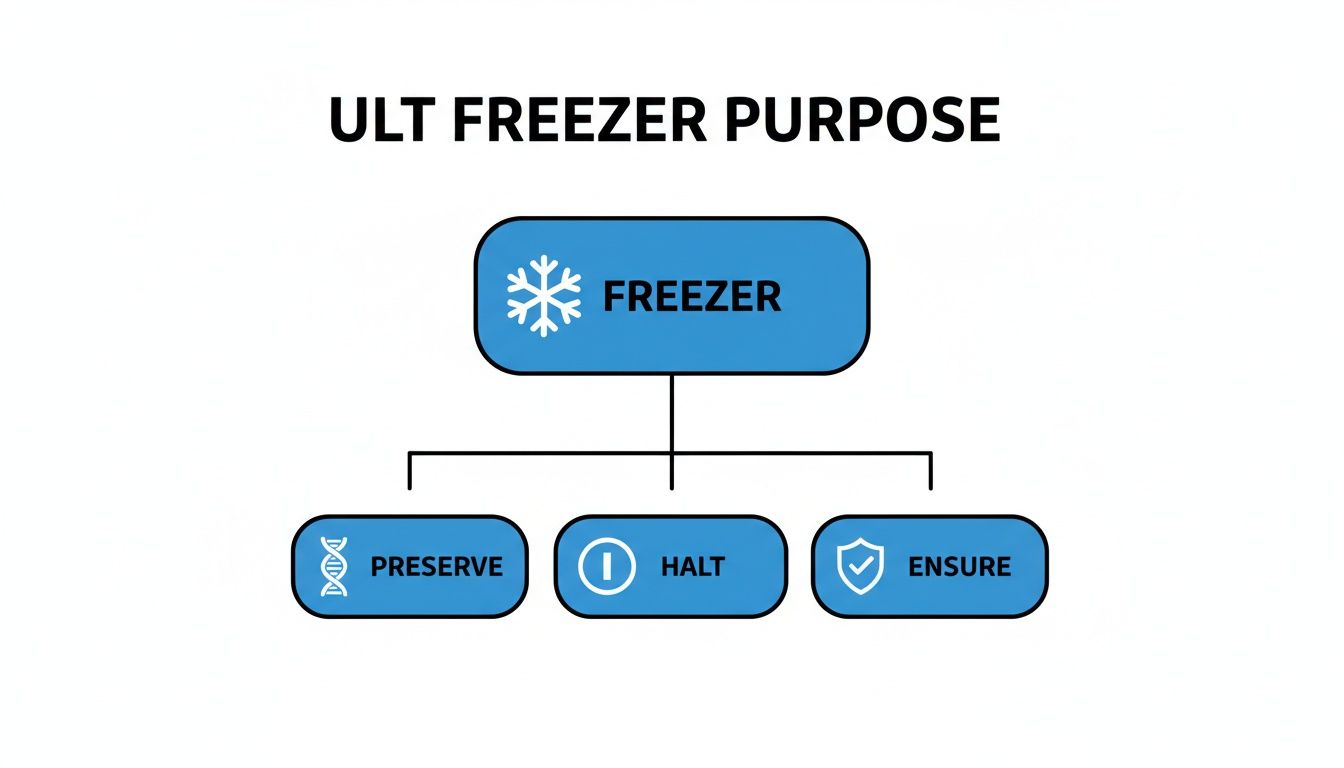
As you can see, a ULT freezer's job is about more than just being cold. It's about preservation at the molecular level, completely stopping biological processes in their tracks, and guaranteeing that samples are viable for years to come.
Cryogenic freezers, on the other hand, play by a completely different set of rules. These systems tap into the profound cold of liquid nitrogen (LN2), which holds a stable temperature of -196°C. Instead of using machinery to actively create cold, they are essentially hyper-insulated containers, known as dewars.
The LN2 naturally boils off at a slow, predictable rate, and the escaping nitrogen gas is what keeps the entire chamber at a constant cryogenic temperature. This approach delivers a level of temperature stability that mechanical systems just can't match. Better yet, with no compressors or moving parts, the risk of mechanical failure is practically zero, offering incredible reliability for the long-term storage of your most critical samples.
The real beauty of a cryogenic freezer is its independence from the power grid. It inherently protects samples from power outages, electrical surges, and mechanical breakdowns, offering the ultimate peace of mind.
This operational simplicity also means lower energy bills and minimal maintenance. The only real ongoing task is keeping a reliable supply of liquid nitrogen to top up what naturally evaporates. For a deeper dive into the science, you can explore our detailed guide on how cryogenic freezers work and what makes them so dependable. The entire design is built around passive safety and unwavering temperature control.
Beyond the core technology driving an ultra low temperature freezer, its real worth is measured by a few critical performance metrics. These aren't just abstract numbers on a spec sheet; they tell you exactly how well a unit will protect your irreplaceable samples, day in and day out. Understanding these metrics helps you cut through the technical jargon and see which freezer truly delivers on its promise of security and reliability.
The first, and arguably most important, is Temperature Stability and Uniformity. Think of your freezer as a perfectly still, frozen lake. Stability is the ability to keep that entire lake at an exact temperature over time—no ripples, no warm spots. Uniformity means the temperature in the top left corner is identical to the bottom right. Even tiny fluctuations can cause samples to repeatedly thaw and refreeze on a microscopic level, slowly degrading cellular structures and compromising their integrity.
A truly reliable freezer keeps these fluctuations to an absolute minimum, creating a consistently cold shield against thermal stress. This rock-solid consistency is the very foundation of long-term preservation.
Next up are the dynamic metrics: Cooldown and Recovery. Cooldown time is simple—it’s how quickly a new freezer hits its target temperature, like -80°C, after you first plug it in. What's often more critical in a working lab, though, is recovery time: how fast the freezer gets back to its setpoint after the door has been opened.
Every time you reach in for a sample, warm, moist air rushes in and causes an immediate temperature spike. A freezer with a swift recovery time pulls that heat out fast, minimising how long the other samples inside are exposed. This is absolutely vital in a busy lab where the door might be opened multiple times a day.
A fast recovery time isn't a luxury; it's a critical safety feature. It directly reduces the cumulative thermal stress on your samples, ensuring their long-term viability and the integrity of your research.
Poor recovery performance is a serious problem. It means your samples spend far too much time outside their ideal temperature range, accumulating damage with every single door opening.
Energy Efficiency has, quite rightly, become a major consideration. A ULT freezer is a power-hungry piece of equipment, often running 24/7. Choosing an efficient model not only cuts down your electricity bills but also reduces the heat it pumps into your lab, easing the load on your HVAC system and making for a more comfortable workplace. While modern mechanical freezers have made great strides, they still generate a fair amount of heat and noise from their compressors.
For cryogenic systems, the parallel metric is the Evaporation Rate. This simply measures how quickly the liquid nitrogen (LN2) naturally boils off.
Ultimately, whether you're measuring kilowatt-hours consumed or litres of LN2 evaporated, efficiency is a direct reflection of a freezer's design quality and its true long-term cost of ownership. For a deeper dive into this, you can learn more about the parameters of quality assessment for cryogenic storage equipment and how they influence overall performance.
Picking an ultra low temperature freezer isn't like buying any other piece of lab equipment. It’s a major strategic decision that has a direct impact on the safety and integrity of your most valuable assets. The best freezer isn't the one with the flashiest features, but the one that perfectly matches the demands of your specific work. After all, different fields have completely different priorities, from maximising storage space to satisfying strict regulatory bodies.
Think of it like choosing a vehicle. A logistics company needs a tough, reliable lorry built for thousands of kilometres. A family needs a safe, comfortable car with plenty of space. Both get you from A to B, but they’re engineered for entirely different jobs. The same logic holds true for ULT freezers; the right choice is always the one that’s built for the task at hand.
When you're running a biobank or a large-scale research lab, it all comes down to storage density and inventory management. These facilities are the modern libraries of biology, responsible for hundreds of thousands, sometimes millions, of individual samples. In that world, every square centimetre of freezer space is precious real estate.
The goal here is simple: fit the maximum number of vials into the smallest possible footprint. This means you need to look for freezers designed with smart interior layouts that work seamlessly with high-density racking systems. Just as important is easy integration with your inventory management software. When you have a million samples, you need to be able to find, track, and retrieve every single one without a hitch.
Step into the pharmaceutical industry, and the conversation shifts immediately to regulatory compliance and data integrity. Getting a new drug approved is a marathon of painstaking documentation and validation. Every piece of equipment involved in the process, especially for storing clinical trial materials, has to meet incredibly high standards.
A ULT freezer in a pharma setting has to do a lot more than just stay cold. It must provide an ironclad, unshakeable audit trail. That means you need features like:
For these users, the freezer isn't just a cold box; it's a critical, compliant piece of a highly regulated research and manufacturing puzzle.
In hospitals and fertility clinics, there is one priority that trumps all others: absolute sample security. The materials being stored—whether it’s patient tissues for diagnostics, blood products, or human embryos—are, quite literally, irreplaceable. There is absolutely no room for error.
This non-negotiable requirement puts a massive emphasis on powerful alarm systems that provide instant notifications for any issue, from a slight temperature change to a power cut. Redundancy is also critical. Many clinics lean towards cryogenic systems precisely because they don't depend on the electrical grid, offering a built-in defence against power outages. The peace of mind that comes from knowing these precious samples are safe is priceless.
In a clinical setting, an ultra low temperature freezer is more than just equipment; it's a cornerstone of patient trust. Its reliability directly reflects the institution's commitment to safeguarding human health and life.
This intense focus on security is a huge driver in the market. Germany’s ultra-low temperature freezer market, for example, is a major growth area in Europe. In 2025, it was valued at USD 44.93 million, with demand pushed by biobanks, labs, and pharma companies who all need rock-solid cryogenic storage for their sensitive materials. You can discover more insights about the European cryogenic storage sector to see how this trend is evolving.
Finally, let’s look at the companies that specialise in cryogenic logistics. Here, the keywords are durability, compliance, and holding time. These freezers are built for life on the move, engineered to handle the vibrations and knocks of transport while keeping the temperature perfectly stable. They must be certified for transporting hazardous materials, making compliance with regulations like ADR-licensed road transport a non-negotiable.
Beyond that, the maximum static holding time is a crucial performance metric. This figure tells the logistics team exactly how long the unit can maintain its cryogenic temperature without needing a liquid nitrogen top-up. It provides a vital safety buffer for long trips or unforeseen delays on the road. For these providers, a freezer is a mobile vault, guaranteeing that samples arrive at their destination in the exact same pristine condition they started in.
Running an ultra low temperature freezer is about more than just plugging it in and storing samples. It’s a serious commitment to a whole framework of safety protocols and regulatory standards. When you’re dealing with cryogenic liquids like liquid nitrogen (LN2), you introduce very specific workplace risks. On top of that, storing priceless biological materials means you have to play by a strict set of industry-specific rules.
Getting a handle on these requirements is absolutely essential. It’s how you protect both your people and your irreplaceable assets.
Working with cryogenic materials demands respect and proper training. The extreme cold can cause horrific burns on contact with skin, and as LN2 evaporates, it can quickly displace oxygen in a room, creating a deadly asphyxiation hazard. This isn’t something you can be casual about; comprehensive training and the right personal protective equipment (PPE) are completely non-negotiable.
When you see that a freezer has a ‘Medical License’ or is built to medical-grade standards, it's far more than just a sticker on the side. This certification is proof of a superior manufacturing process, one that’s governed by incredibly stringent quality control from start to finish. It means every single component—from the stainless steel in the chamber to the insulation foam—is fully traceable and meets precise specifications.
This level of quality assurance is vital for industries where the integrity of a sample is everything, like pharmaceuticals and clinical labs. A medical-licensed freezer gives you documented evidence that the equipment is built for unwavering reliability and performance. That simplifies your own validation processes and gives you the confidence that your storage solution meets the highest benchmarks in the business.
Choosing a medically licensed ultra low temperature freezer is not just about compliance; it's an investment in risk management. It guarantees the unit was built with the precision, material quality, and manufacturing discipline required for high-stakes applications.
When bringing in new ULT freezers, especially from international suppliers, labs need to be on top of the specific rules for importing such specialised equipment. For anyone navigating these complexities, it's a good idea to consult an essential guide to importing medical devices into Canada to get a clear picture of the process. And of course, handling everything safely is just as important. For a solid overview, you can explore these seven important rules for safe work with cryogenic liquids to make sure your team is fully prepared.
The need for compliance doesn’t stop at your laboratory doors. When biological samples have to be moved between facilities—whether it’s across town or across the country—they must be transported in units that meet specific legal standards. This is where ADR (Agreement concerning the International Carriage of Dangerous Goods by Road) compliance is absolutely essential.
An ADR-licensed transport vessel is designed, tested, and certified specifically to contain and move hazardous materials, including biological samples preserved in liquid nitrogen, without any issues. Using a compliant unit ensures your logistics are just as secure as your on-site storage. It's a critical piece of the puzzle that guarantees samples are protected throughout their journey, preventing potential loss and keeping you fully compliant with transport regulations. This transforms the freezer from a simple static storage unit into a complete, risk-managed solution for the entire sample lifecycle.
Buying an ultra low temperature freezer is a major investment, but the sticker price is only the beginning of the story. The real cost of ownership plays out over the freezer's entire life, and that’s where the quality of after-sales service and support proves just as crucial as the hardware itself. A great freezer protects your samples, but a great service partnership protects your entire operation.
This long-term view changes the conversation from a simple product purchase to a genuine operational partnership. You're not just buying a machine; you're evaluating a supplier's commitment to your success for the next decade, not just on the day it arrives. This covers everything from the warranty's fine print to the availability of an expert technician when you need one most.
A multi-year warranty is the clearest sign of a manufacturer's confidence in its own product. A standard one or two-year warranty is common enough, but a five-year warranty shows a deep-seated belief in the freezer's engineering and durability. That extended coverage offers huge peace of mind, assuring you that the manufacturer is standing right behind their equipment for the long haul.
Just as important is a guarantee that you can get spare parts down the line. An otherwise perfect freezer becomes a very expensive box if a critical component fails and a replacement is no longer made. Knowing that spare parts will be available for 10 years or more ensures your investment stays viable and serviceable, saving you from a premature and very costly replacement.
A robust warranty and guaranteed spare parts are not just features; they are foundational pillars of operational security. They transform a capital expense into a reliable, long-term asset you can count on.
This commitment to longevity is what truly separates the top-tier suppliers from the rest. It shows they understand that their responsibility extends far beyond the initial sale.
Exceptional support also means practical, hands-on services that make life easier. For international clients, navigating customs and import rules can be a real headache. A supplier who manages this entire process for you removes a significant operational burden, making sure your new ultra low temperature freezer shows up without delays or bureaucratic snags.
On top of that, on-site maintenance and readily available help from experienced technicians are invaluable. Having direct access to experts who can diagnose an issue over the phone or perform service in your facility minimises downtime and keeps your work on track. After all, proper maintenance is the key to a long life for your ULT freezer. To keep everything in top shape, it's worth looking into specialised freezer cleaning solutions designed for optimal hygiene and performance.
Ultimately, when you choose a freezer, you're also choosing the company behind it. A supplier that is dedicated to providing seamless shipping, expert maintenance, and long-term parts availability isn't just a vendor—they're a true partner invested in protecting your invaluable samples for years to come.
When you're looking into ultra-low temperature storage, a lot of practical questions come up about how these freezers work day-to-day and what you can expect in the long run. Getting clear, honest answers is the only way to feel confident in your choice and know your priceless samples are truly safe.
Here are a few of the most common questions we hear from labs, biobanks, and research teams.
That really comes down to the technology inside. The two main types of ULT freezers have completely different service needs.
Mechanical freezers are complex machines, a bit like a high-performance car. They rely on a cascade of compressors, refrigerants, and other moving parts that all need regular attention to keep running smoothly. You're looking at things like:
Cryogenic systems, on the other hand, are designed for extreme simplicity and reliability. With almost no moving parts, the maintenance schedule is incredibly light. The design itself gets rid of the most common failure points you see in mechanical units, like compressor burnout. This means you can expect much longer service intervals and a dramatically lower risk of a surprise shutdown—giving you real operational security for your most critical work.
That's a great question, and it’s one of the most important things to consider when you're relying on a cryogenic freezer. What happens if your liquid nitrogen (LN2) delivery gets delayed? The answer is all about a crucial performance metric: static holding time.
This number tells you exactly how long a freezer can hold its cryogenic temperature without any LN2 supply at all. It’s a direct measurement of the quality of the unit’s insulation. High-efficiency vacuum insulation works like a thermal fortress, dramatically slowing down the natural evaporation of the liquid nitrogen stored inside.
Think of static holding time as your built-in safety net. A well-designed cryogenic freezer can offer a holding time of several days, or even weeks. That gives you a huge window to sort out a new LN2 delivery without your samples ever being at risk.
This passive safety feature is one of the biggest advantages of cryogenic storage. It gives you a level of peace of mind that doesn’t depend on a power outlet or a delivery truck showing up on time.
This is a common point of confusion. The short answer is no—you can't just move any ultra-low temperature freezer. Transporting biological materials is a specialised task governed by strict regulations, and standard lab freezers are only built for stationary storage. They simply aren't designed to handle the bumps and vibrations of being on the move.
To move samples from one facility to another, you absolutely must use a mobile cryogenic freezer that is certified for ADR-licensed road transport. These are purpose-built units, engineered with reinforced construction to withstand transit while keeping the internal temperature perfectly stable. It's the only way to guarantee your samples are transported safely, securely, and in full compliance with the law.
At Cryonos GmbH, we focus on state-of-the-art cryogenic solutions built for maximum reliability and full regulatory compliance. You can explore our range of medically licensed storage and transport freezers, all backed by a five-year warranty and expert support. Visit us at https://www.cryonos.shop to find the right system for your needs.

