No Products in the Cart




You're probably dealing with one of two situations right now. Either water quality is drifting in a system that used to behave, or you're trying to choose an aeration setup and every option looks “efficient” until you ask what that means in practice.
That's where aeration in water gets interesting. On paper, it sounds simple: put air into water. In operation, it becomes a balancing act between oxygen transfer, mixing, maintenance, process stability, and electricity consumption. The engineering question usually isn't whether aeration works. It's which method fits the job, how real-world performance differs from brochure performance, and how much power you'll keep paying for every day.
A 10,000 gallon process-water holding tank can run for weeks, then start producing a rotten-egg smell over a weekend. By Monday, operators are fielding complaints, dosing chemicals to control odour, and trying to recover water quality that slipped because the tank sat with too little mixing and too little gas exchange. In many systems, aeration would have prevented that chain of events by keeping oxygen available and by helping unwanted gases leave the water before they became an operating problem.
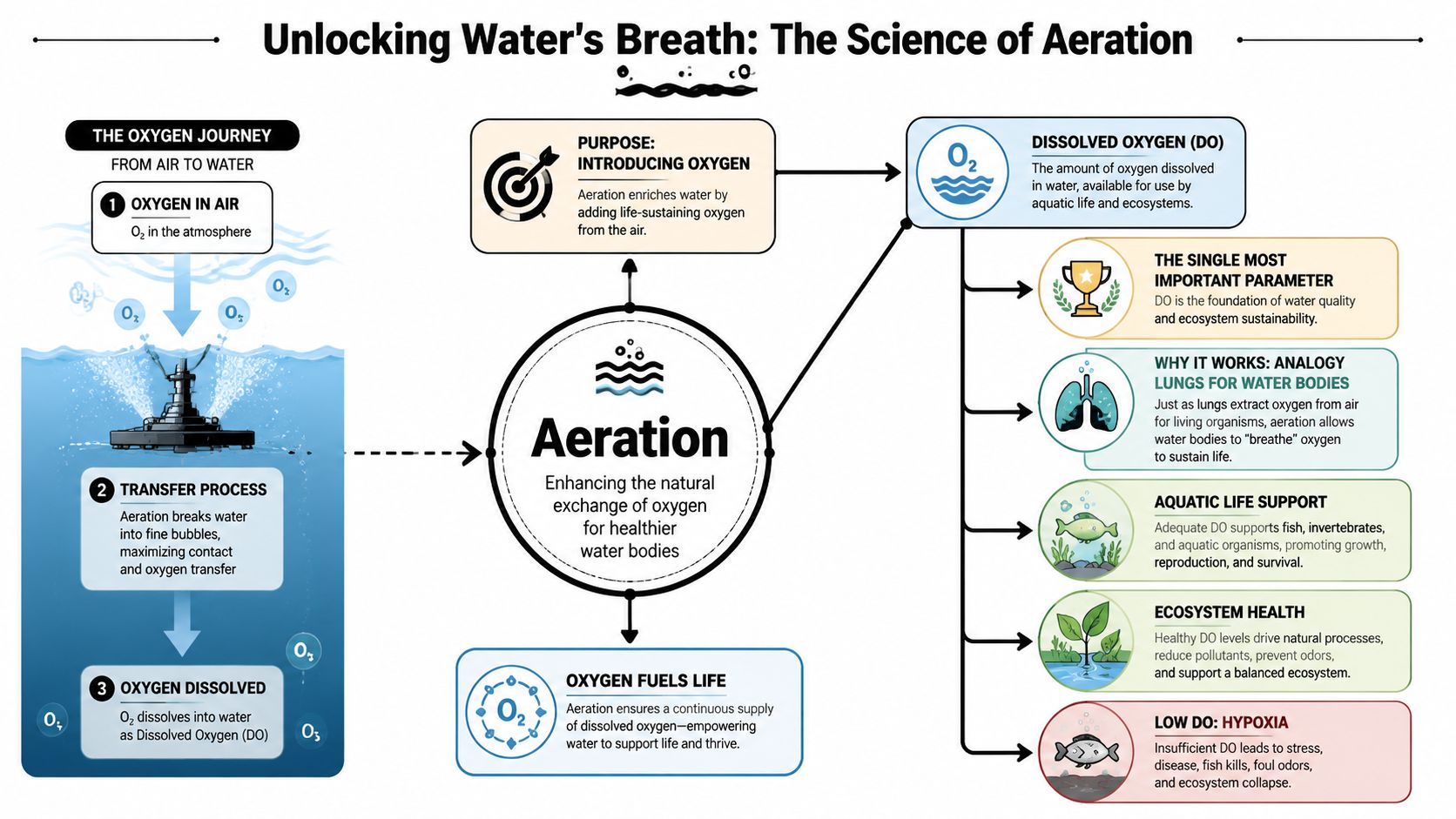
That example clarifies the definition. Water aeration is the deliberate increase of contact between air and water so gases can transfer across that boundary. In some cases the goal is to move oxygen into the water. In others, the goal is to strip gases such as carbon dioxide or hydrogen sulfide out of it. Many systems need both gas transfer and mixing at the same time.
The air-water surface works like a crowded border crossing. Molecules can move both ways, but the traffic rate depends on how much interfacial area you create, how well you keep fresh water exposed to that interface, and how far the water is from equilibrium. That is why a quiet basin behaves very differently from one with bubbles, sprays, or mechanical agitation.
A practical way to view aeration is as a tool with four jobs:
The coffee comparison still works here. Stirring cream into coffee does not change the chemistry of cream, but it increases contact and removes gradients faster. Aeration does something similar with gas and liquid. The difference is that the engineer also has to care about bubble size, water depth, residence time, fouling, and power draw.
That last point is why aeration matters so much in practice. Operators are rarely choosing between "aeration" and "no aeration" in the abstract. They are choosing between coarse bubbles, fine bubbles, surface aerators, spray systems, packed towers, aspirating pumps, or simple cascade steps, each with different oxygen transfer performance, maintenance burden, and electricity cost. A method that is excellent for stripping dissolved gas from groundwater may be a poor choice for keeping activated sludge suspended. A method that gives high transfer efficiency on paper may lose its advantage if diffusers foul or if the blower runs against high backpressure.
For readers who want a quick refresher on oxygen properties and how oxygen behaves in different conditions, that background helps explain why aeration decisions are never just about adding bubbles.
Practical rule: Aeration is often the unit operation that sets the stability, operating cost, and failure margin of the whole system.
That is why it shows up in fish culture, ponds, groundwater treatment, industrial tanks, and municipal wastewater basins. The objective changes, but the engineering question stays the same. How do you get enough gas transfer and enough mixing for the job, without paying for more equipment, more maintenance, or more energy than the process needs?
A basin can look violently mixed and still be short of oxygen. Another can appear calmer and hold a healthier dissolved oxygen level with less power. That gap between appearance and performance is where aeration becomes an engineering problem rather than a visual one.
The main variable is dissolved oxygen, or DO. It is the portion of oxygen dissolved in the water and available for biology and oxidation reactions. Oxygen in the air above the tank does nothing until it crosses the air-water boundary.
Gas transfer follows a simple rule. The farther the water is from oxygen saturation, the faster oxygen tends to dissolve. As the water approaches saturation, the driving force shrinks and transfer slows.
A good comparison is heat exchange. A hot surface cools quickly in cold air because the temperature difference is large. As the temperatures move closer together, the rate drops. Aeration behaves in much the same way, except the driving force is the concentration gap between the oxygen in the gas phase and the oxygen already dissolved in the water.
That is why test conditions matter. Engineers use standard reference conditions so one system is not judged in cool, clean water while another is judged in warmer or less favourable water. Without a common baseline, quoted oxygen transfer numbers can make weak equipment look strong or efficient equipment look mediocre.
For readers who work more often with gases than water systems, this overview of oxygen properties and behaviour during transfer and dissolution helps connect the gas-side physics to what operators see in tanks and basins.
Three mechanisms control most aeration performance:
These mechanisms do not contribute equally in every system. Fine-bubble diffusers usually win on surface area. Deep tanks help with contact time. Mechanical aerators often add strong mixing, which can help transfer and solids suspension at the same time, but they may pay for that benefit with higher power draw.
This trade-off matters in day-to-day operation. If the process only needs oxygen, a highly efficient diffuser system may be attractive. If the process also needs circulation, solids control, foam breakup, or ice prevention, a less transfer-efficient device can still be the better choice because it does more than one job.
Visual intensity can be misleading. A dramatic splash pattern often signals energy dissipation, not necessarily efficient oxygen absorption. By contrast, a field of small bubbles may look modest while delivering more transfer per kilowatt because it creates far more area for oxygen to enter the water.
Clean-water test data are useful, but only as a reference point. Real water changes the physics. Surfactants alter bubble behaviour. Suspended solids affect mixing. Fouling changes diffuser performance and raises backpressure. Temperature and salinity shift oxygen solubility. The result is that field transfer is often lower than the number printed on a brochure.
Operators who have lived with aeration systems for a few seasons know this already. The installed cost is only the first decision. The larger question is what the system will deliver after membranes foul, headers drift out of balance, or basin conditions move away from the laboratory case.
Water responds to the actual basin, actual fouling state, and actual operating load.
That is why experienced designers separate standard oxygen transfer from actual operating performance. The science of dissolution is straightforward. The harder part is accounting for how that science changes once maintenance limits, power costs, and process variability enter the picture.
A practical aeration choice usually starts with an uncomfortable trade-off. One option gives better oxygen transfer per kilowatt on paper. Another is easier to maintain, mixes better, or survives dirty service with less attention. Operators do not buy aeration for laboratory elegance. They buy it to meet a process target at an acceptable power and maintenance cost.
Most systems fall into three families: diffused aeration, mechanical aeration, and gravity aeration. They all rely on the same idea, increasing contact between air and water, but they create that contact in very different ways. The engineering question is simple: where does the interface form, and how much are you spending to keep forming it hour after hour?
Diffused systems push air into the basin below the surface through submerged devices. The bubbles rise through the water, and oxygen transfers across the bubble surface during that travel. In many basins, the same airflow also provides part of the mixing duty.
That makes diffused aeration attractive when oxygen delivery is the main job and mixing needs are moderate.
Fine-bubble diffusers produce many small bubbles. Small bubbles behave like finely divided reactant in a contactor. You get much more surface area for the same volume of air, and that usually improves oxygen transfer efficiency.
The catch is that efficiency depends on keeping the system close to its intended condition. Membranes foul. Pores scale. Header balance drifts. Backpressure rises. A fine-bubble grid can start life as an energy-saving system and slowly turn into a blower power penalty if cleaning and air distribution are neglected.
This is why fine-bubble systems often win the energy argument in steady, well-maintained basins, yet lose favour in services where fouling, solids, grease, or uneven operation are expected. If your team already tracks air distribution and pressure well, fine bubble can be a strong choice. If not, the theoretical gain may erode faster than the brochure suggests.
Coarse-bubble diffusers make larger bubbles with less total surface area, so oxygen transfer is usually lower for the same airflow. But coarse-bubble systems offer something many plants value more than peak efficiency. They are simpler to live with.
A coarse bubble works like a larger, blunter tool. It is less delicate, usually less sensitive to fouling, and often better at producing bulk circulation. That matters in equalisation tanks, grit-prone services, or basins where solids suspension and flow movement are nearly as important as dissolved oxygen.
If fine bubble is tuned for transfer, coarse bubble is often selected for tolerance.
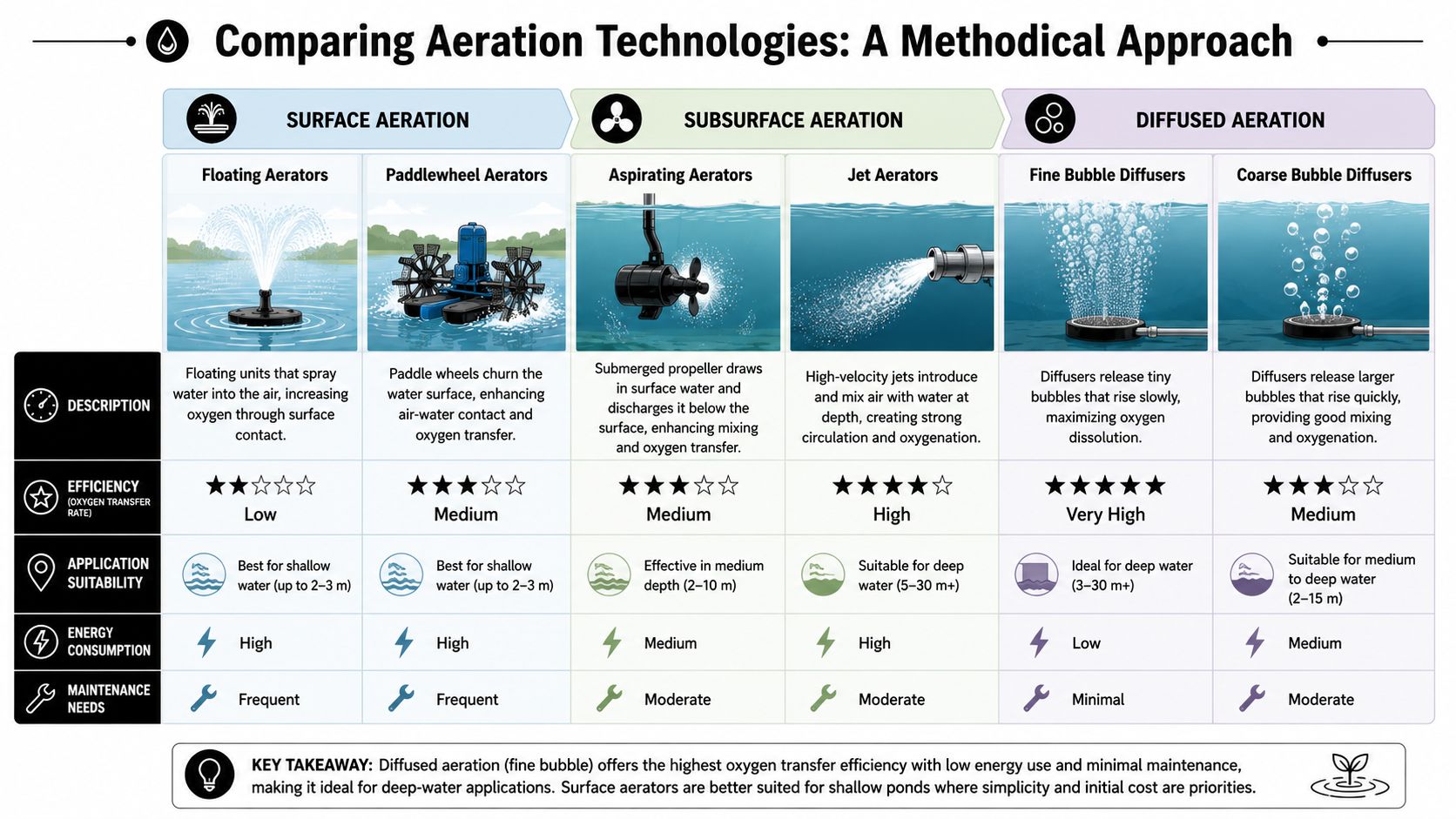
Mechanical aerators create air-water contact by moving the liquid itself. Surface impellers, paddlewheels, brush aerators, aspirators, and floating units all use motor power to renew the surface, throw droplets, or entrain air into the water.
The comparison with diffused systems is useful. Diffused aeration spends power mainly on air delivery. Mechanical aeration spends power mainly on water motion and surface renewal. In some processes, that is exactly what you want.
Mechanical units are often chosen when mixing is essential, basin geometry is awkward, or surface access matters more than top transfer efficiency. A lagoon operator may accept lower oxygen efficiency if the machine prevents dead zones and can be serviced from above without draining the basin.
They also give operators immediate visual feedback. You can see circulation, splash, and surface renewal. That visibility is helpful operationally, but it can also be misleading. A lively basin does not automatically mean low cost per kilogram of oxygen transferred.
For teams comparing blower systems with mechanically mixed ones, the discipline used in gas flow measurement and correction in real operating conditions is a useful parallel. The nameplate number is only the starting point. The actual process condition decides what you really get.
For a quick visual primer on common system layouts, this walkthrough is helpful:
Gravity aeration uses height and exposure instead of continuous blower or impeller power. Water falls over steps, trays, cascades, or packed sections, breaking into films and droplets that contact air.
Its economics are very site-specific. If elevation is already available, gravity can be an efficient way to add oxygen, strip unwanted gases, or oxidise iron and manganese before later treatment. If you have to build height, pumps, and structure just to create that drop, the apparent simplicity disappears quickly.
That is why gravity aeration is often less about maximum oxygen transfer and more about good use of existing hydraulics. In groundwater treatment and pre-treatment trains, it can be an elegant fit. In high-load biological basins, it usually cannot deliver the same degree of control or intensity as powered systems.
| Method | Best fit | Main advantage | Main compromise |
|---|---|---|---|
| Diffused fine bubble | Basins where oxygen efficiency matters most | High transfer efficiency in favourable conditions | Fouling sensitivity and need for consistent maintenance |
| Diffused coarse bubble | Rough service, added mixing | Durability and better tolerance of dirty conditions | Lower transfer efficiency |
| Mechanical surface | Systems needing visible agitation and mixing | Accessible equipment and strong circulation | More power can go into motion than oxygen transfer |
| Gravity aeration | Sites with elevation and stripping goals | Low ongoing mechanical power demand | Limited control and narrower application range |
Selection hint: Ask which method meets the process goal with the lowest total operating burden, not which one looks best in a clean-water comparison.
That wording changes the decision. A high-efficiency diffuser may still be the wrong answer if the actual problem is solids suspension, maintenance access, gas stripping, or operator time.
A blower can be drawing full power, the basin can look violently mixed, and the dissolved oxygen can still sag. That mismatch is why aeration performance has to be measured, not assumed. Operators are paying for gas transfer, not for bubbles or surface turbulence by themselves.
The first discipline is to separate standard clean-water performance from field performance in process water. Clean-water test data is useful because it gives a common reference. It does not tell you exactly what the basin will deliver once surfactants, solids, temperature shifts, fouling, and changing oxygen demand enter the picture.
One term appears in almost every aeration design discussion: kLa. It is the overall oxygen transfer rate constant, and in practice it works like a measure of how fast the system can push oxygen across the air-water boundary. A higher kLa means the system can deliver the same oxygen transfer in a smaller tank or in less contact time. That has direct consequences for basin volume, installed equipment size, and power cost.
A simple way to picture it is to compare two heat exchangers with the same duty. The one with better heat transfer needs less area or less time to do the job. kLa plays a similar role for oxygen transfer. It does not tell you oxygen demand by itself, but it tells you how quickly the equipment-and-basin combination can respond.
Engineers also separate:
That difference is where many economic mistakes start. A system can look efficient on a test stand and still become expensive in service if transfer falls off, mixing is poor, or the equipment has to run harder to maintain target DO.
Wastewater changes the transfer process. Some constituents suppress bubble-to-liquid transfer. Solids change hydraulics. Temperature alters solubility and reaction rates. Existing dissolved oxygen matters too, because the closer the water is to saturation, the smaller the driving force for oxygen to enter.
The practical consequence is simple. The last bit of oxygen is usually the most expensive to add.
That is why correction factors exist. They convert a vendor's clean-water number into a field estimate that is closer to operating reality. Operators already use the same logic in other process measurements. A flow device calibrated for one gas or one set of conditions needs correction before it is trustworthy in another service. The same idea shows up in this technical note on gas flow measurement. Measurement only becomes useful after you account for the actual fluid and operating condition.
For day-to-day engineering decisions, start with four questions before opening a detailed model:
Those questions keep the calculation tied to plant reality. Aeration is rarely a pure oxygen-transfer problem. Many systems are really balancing two jobs at once: getting oxygen into the water and keeping the basin mixed enough for the biology or chemistry to behave properly.
An operator does not need to treat kLa as an abstract research term. In practice, it answers a plain-language question: how hard does this system have to work, and for how long, to recover DO after a load increase?
If the basin recovers slowly, the process has less cushion. You may need more tank volume, more installed aeration capacity, or a higher operating setpoint. Each option costs money in a different way. More volume raises capital cost. More aeration hardware adds both capital and maintenance burden. Higher DO setpoints often increase power use because transfer gets less favourable as the water approaches saturation.
That trade-off is the essential calculation. It is not only "how much oxygen can this device transfer?" It is also "what will it cost to transfer that oxygen reliably over months and years of actual service?"
Field note: A stable dissolved oxygen trend during peak load is usually a better sign of adequate aeration than any catalogue rating by itself.
Clean-water ratings still matter. They are the starting line for comparison. Good design work turns that starting line into a field number, then checks whether the field number still works at the site's worst operating condition and acceptable energy cost.
At 2 a.m., an operator gets two very different alarms. In one plant, dissolved oxygen is falling in an activated-sludge basin and effluent risk is rising. In another, a fish tank is losing oxygen because feed demand and warm water have collided. Both sites need aeration, but the engineering decision is not the same. The job changes with the process, and so do the energy and maintenance penalties for getting it wrong.
Wastewater treatment is where aeration decisions become operating-cost decisions very quickly. The basin is not only asking for oxygen. It is also asking for enough mixing to keep solids suspended and the biology evenly exposed to food and air. Those two duties can pull equipment choice in different directions.
A useful way to view a municipal aeration system is as a large air delivery network attached to a biochemical reactor. Diffusers, headers, valves, blower control, basin depth, fouling rate, and process setpoint all affect the final electricity bill. Fine-bubble systems often win on transfer efficiency, especially in deeper tanks, but they also bring diffuser maintenance, air-side pressure losses, and sensitivity to fouling. Surface aerators can give stronger mixing and simpler visual confirmation that the basin is moving, but they often pay for that with higher power per kilogram of oxygen transferred.
That trade-off becomes clearer with a simple case. Suppose a plant must add oxygen continuously through most of the day, and aeration is its largest motor load. If operators lower blower discharge pressure by reducing diffuser fouling and avoid over-aerating the basin, they are doing the same kind of work as a pump engineer trimming head loss from a piping system. Small pressure penalties, carried hour after hour, turn into meaningful annual cost. Plants using centrifugal blower fans for wastewater aeration air supply feel this directly because blower power rises with airflow demand and system resistance, not just with the biological load on paper.
In drinking water and groundwater treatment, aeration is often a conditioning step ahead of something else. The goal may be to drive off dissolved gases, add oxygen so iron or manganese can oxidise into a filterable form, or reduce nuisance taste and odour compounds before downstream treatment.
The equipment choice follows that goal. A packed tower, tray aerator, or cascade uses contact area and residence time much like a cooling tower uses air-water contact to move heat. If the target is gas stripping, high interfacial area matters more than intense basin mixing. If the target is oxidation before filtration, the designer also has to ask whether aeration alone gives enough reaction time or whether detention and filtration are doing part of the work.
A practical reference from the U.S. EPA on small-system treatment applications outlines how aeration is used for oxidising and removing dissolved gases and for supporting iron and manganese treatment in groundwater systems: EPA guidance on aeration for small water systems.
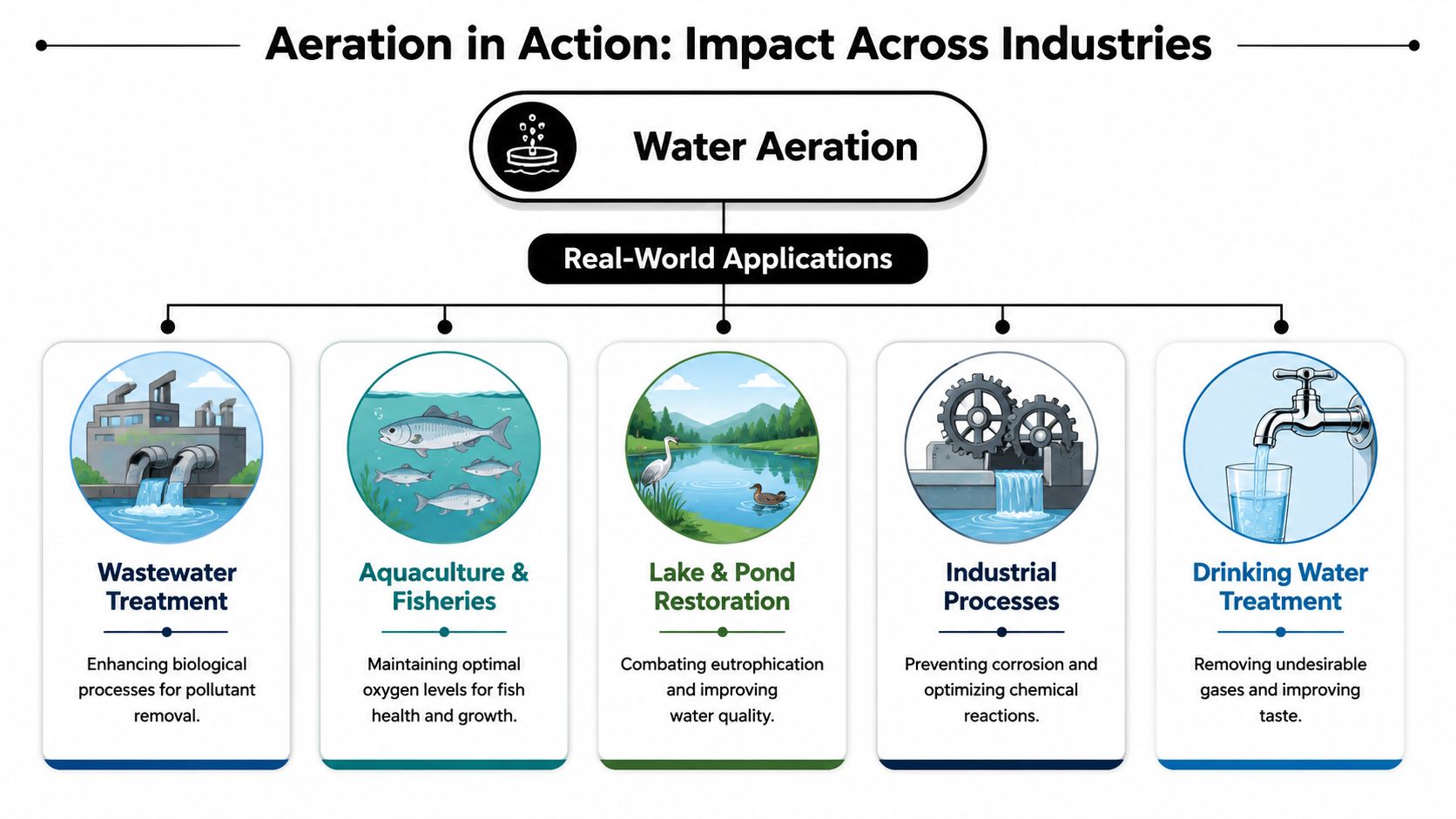
Aquaculture compresses the response time. A wastewater basin may tolerate a short upset before performance shows it. Fish do not give that grace period.
Aeration here is tied to stocking density, feeding schedule, water temperature, and hydraulic circulation. Equipment that looks efficient in a calm test can still fail operationally if it leaves corners unmixed or cannot respond fast enough during a feeding peak. Paddlewheels, aspirators, diffused air, and oxygen injection each fit a different operating philosophy. The decision is partly about oxygen transfer, but also about how much circulation, backup capacity, and fault tolerance the farm can afford.
The Food and Agriculture Organization discusses this in practical terms for aquaculture pond management, where aeration is used not only to raise dissolved oxygen but also to improve circulation and reduce localised stress in production ponds: FAO guidance on mechanical aeration in aquaculture ponds.
In lakes and reservoirs, aeration is often asked to solve a water-quality problem that may be a stratification problem, a nutrient problem, or both. That is why field context matters more here than catalogue language.
A deep reservoir with seasonal stratification may benefit from hypolimnetic aeration or destratification if the objective is to limit anoxic conditions near the bottom. A shallow pond with heavy nutrient loading may show little improvement because the main driver is external or sediment nutrient input, not oxygen transfer hardware. The U.S. Army Corps of Engineers review on destratification and aeration methods makes this point clearly. Performance depends on basin geometry, thermal structure, and the specific water-quality mechanism being targeted, not on the word "aeration" by itself: USACE technical review of lake and reservoir aeration and destratification.
That is the common lesson across applications. Aeration works best when the engineer defines the actual bottleneck first, then chooses the contact method, mixing pattern, and power draw that address that bottleneck at an acceptable operating cost.
A common selection mistake happens before anyone compares equipment. A plant needs more dissolved oxygen, someone asks for the "most efficient aerator," and the project starts drifting toward a hardware purchase instead of a process decision.
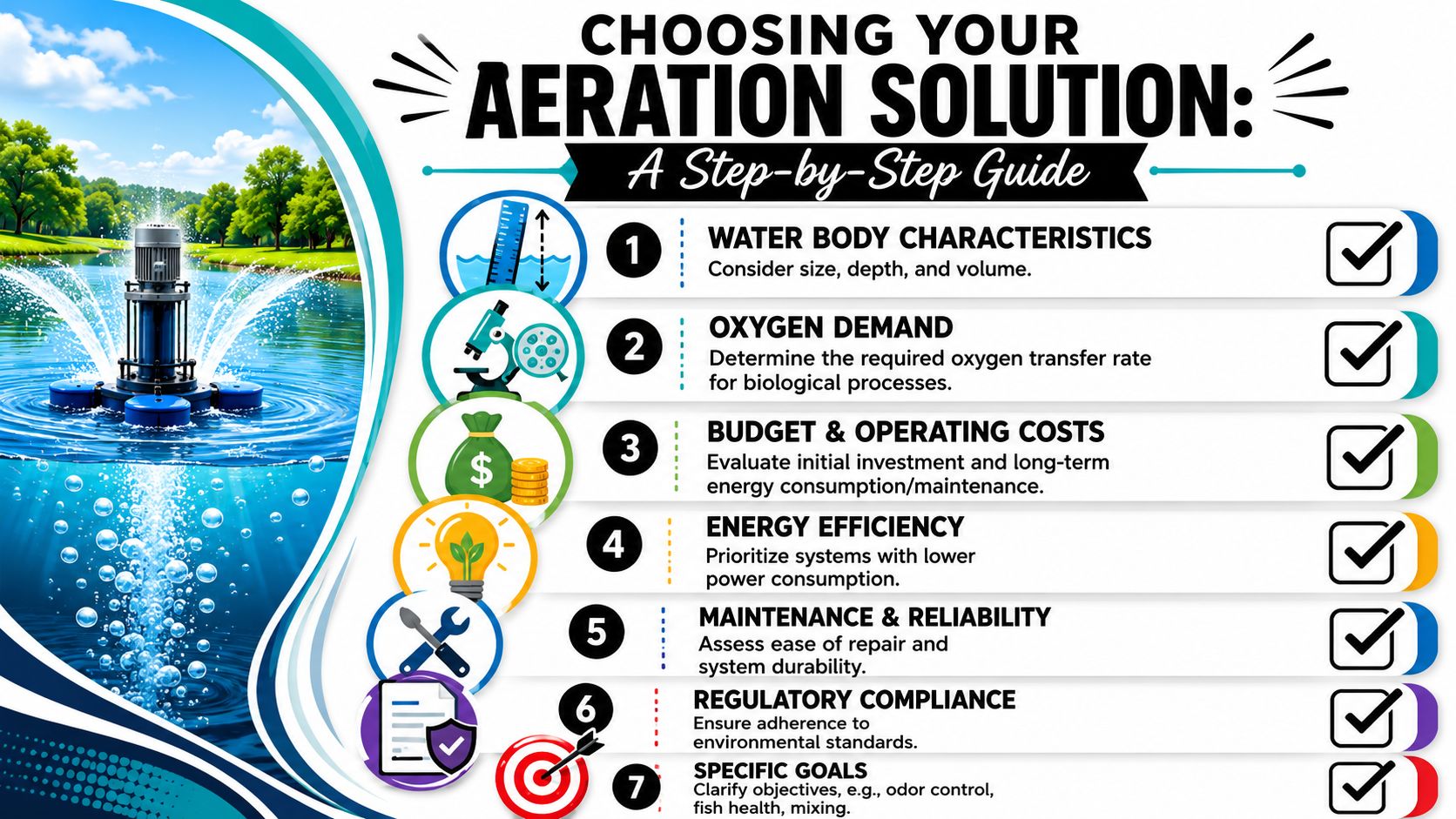
Aeration systems should be chosen the way you would choose a heat exchanger. You start with the duty, then check the fluid, the constraints, and the energy bill that follows the equipment for years.
Define what the water must do after aeration starts. That one decision removes a lot of bad options early.
Gas transfer and mixing are related, but they are not the same duty. Fine bubbles often give strong oxygen transfer per unit power, much like increasing heat-transfer area in a compact exchanger. Surface aerators often give stronger bulk mixing, but usually at a higher energy cost for the same oxygen delivered. Cascades and spray systems can be useful for stripping or simple oxidation when head is already available.
After the duty is clear, the basin sets the rules. Depth affects bubble contact time. Footprint affects circulation pattern. Power availability affects what kind of air supply is realistic. Fouling risk and maintenance access often decide whether a high-efficiency design stays efficient after a few months of operation.
Blower-based systems show this trade-off clearly. On paper, diffused aeration can look very attractive. In practice, the result depends on blower type, diffuser cleanliness, header losses, and the actual operating depth. If you are comparing air supply options, this guide to a centrifugal blower fan and how it works in practice gives useful background.
Many selections go wrong. The cheapest system to install is often not the cheapest system to own.
A low-CAPEX surface aerator can be the right answer for a shallow basin, a remote pond, or a site that needs simple installation and easy retrieval. But if the basin runs year-round and power is expensive, the higher OPEX can dominate total cost. A diffused-air system may require more piping, blower controls, and maintenance discipline up front, yet still win economically if it transfers oxygen with less power over long operating hours.
The reverse can also happen. A theoretically efficient fine-bubble system can become an expensive choice if the site has poor maintenance access, heavy fouling, or variable load that the blower and controls cannot handle well. Rated efficiency is only useful if the system can hold that performance in the actual basin.
| Question | Why it matters |
|---|---|
| What is the primary goal? | Oxygenation, mixing, stripping, and destratification push design toward different equipment |
| How deep is the water? | Depth affects bubble contact time, pressure, and circulation pattern |
| What is the maintenance reality? | A high-efficiency system loses value quickly if diffusers foul or mechanical parts are hard to service |
| What will electricity cost over time? | Aeration often becomes a long-term energy decision, not just a purchase decision |
| What happens at peak demand or worst weather? | Equipment should be sized for the hard days, not only average conditions |
| How much turndown is needed? | Variable load favors equipment that can reduce output without wasting power |
For the electricity question, a simple screening calculation helps. Use:
(Blower HP × 0.746 × hours/year × $/kWh) / (SOTR lb O2/hr) = electricity cost per lb of O2 transferred
That number is not a full lifecycle cost model, but it is a good first filter. It turns a vague question about "efficiency" into a direct cost comparison.
Ask what happens when conditions are least favorable. Warm water lowers oxygen solubility. Fouling increases resistance. Peak biological load raises demand. Wind, depth variation, or solids accumulation can change mixing behavior.
A good selection survives those conditions without excessive power, unstable operation, or constant operator intervention.
Decision test: If you cannot name the mass-transfer job, the mixing job, and the expected energy cost, you are not ready to choose equipment.
That discipline prevents two expensive mistakes. Buying more aerator than the process needs, and buying a cheap system that meets the target only on paper.
The fastest way to waste energy in an aeration system is to run it as if the basin never changes. Real basins do change. Load shifts, temperatures move, fouling accumulates, and mixing needs don't stay fixed.
That's why good aeration management is a control problem, not just an equipment problem.
At minimum, operators should watch the variables that reveal whether the system is transferring oxygen efficiently and consistently:
A basin can meet target DO and still be running badly. It may be over-aerated, poorly mixed, or compensating for a maintenance problem with excess power.
Most improvement work comes from process discipline rather than exotic technology:
Operators save energy when they treat aeration as a measured process, not as background utility service.
If DO is persistently low, there are only a few broad causes. Demand is higher than expected, transfer is poorer than assumed, mixing is inadequate, or the instrumentation is misleading you. Start there.
If power use is high with acceptable DO, the system may be overdriven, dirty, poorly controlled, or solving a mixing problem with oxygen equipment. Those are different faults, and they need different fixes.
Aeration in water rewards attention. The systems that perform best over time are rarely the ones with the flashiest brochure claims. They're the ones operators can measure, maintain, and adjust without guesswork.
If your work involves oxygen supply, gas handling, or reliable storage and transport infrastructure around sensitive biological or industrial processes, Cryonos GmbH is worth a look. Cryonos supports laboratories, biobanks, hospitals, and industrial users with cryogenic storage, transport vessels, safety equipment, and practical technical support across a wide range of applications.

