No Products in the Cart




Yes, you absolutely can buy liquid nitrogen as a private individual in Germany. It's perfectly legal. However, don't mistake this for a simple trip to the shops. Getting your hands on it requires specialised equipment, a solid grasp of safety protocols, and a supplier who's comfortable selling to a non-commercial user for things like culinary experiments or hobby projects.

The idea of making instant ice cream or creating dramatic, smoky effects at home is undeniably cool. But before you get to the fun part, you have to understand the serious responsibility that comes with handling a cryogenic substance. This isn't just another ingredient; it's a hazardous material that demands respect and thorough preparation.
The real hurdle isn't legality—it's practicality. Most industrial gas suppliers are geared up for large-scale commercial clients, not individuals who just need a few litres. This guide is here to bridge that gap, giving you a realistic roadmap for diving into the world of cryogenics on a smaller scale.
We're going to walk you through every critical step of the process. Think of this as your personal checklist to make sure you're properly prepared. Our aim is to give you the knowledge to move forward with confidence and, most importantly, safety.
Here’s a look at what you’ll learn:
The decision to "flüssiger Stickstoff kaufen privat" (buy liquid nitrogen privately) goes far beyond a simple transaction. It's a commitment to upholding rigorous safety standards. Your success and safety depend entirely on how well-prepared you are and the respect you show for the material's potential dangers.
Before you even start looking for a supplier, it’s a good idea to run through a quick self-check to see if you have the basics covered. This isn't just for your own safety, but also to show potential suppliers that you're a responsible buyer.
| Requirement Category | Key Considerations | Status (Self-Assessment) |
|---|---|---|
| Storage & Transport | Do I own or have access to a proper, certified Dewar flask? | ☐ Yes / ☐ No |
| Safety Equipment (PPE) | Do I have cryogenic gloves, safety goggles/face shield, and appropriate clothing? | ☐ Yes / ☐ No |
| Handling Knowledge | Am I familiar with the risks (frostbite, asphyxiation) and safe handling procedures? | ☐ Yes / ☐ No |
| Ventilation | Is the area where I'll use/store it well-ventilated to prevent oxygen displacement? | ☐ Yes / ☐ No |
| Supplier Requirements | Am I prepared to answer a supplier's questions about my intended use and safety measures? | ☐ Yes / ☐ No |
This checklist gives you a clear picture of where you stand. If you've ticked "No" on any of these, this guide will help you fill in the gaps.
While private purchases are a small niche, they're part of a massive industrial ecosystem. The European liquid nitrogen market was valued at roughly USD 3.4 billion in 2023, with Germany playing a major role. This market is expected to keep growing, largely driven by industries like food and beverages, which highlights just how useful this substance is on a large scale. You can review the full research about the European liquid nitrogen market for more details.
This industrial backdrop is precisely why suppliers have such strict rules, even for small-volume buyers. They're used to dealing with trained professionals, and they'll expect you to show a similar level of awareness and responsibility before they'll agree to fill your flask.
So you've got your safety plan dialled in. The next major hurdle, especially when you want to "flüssiger stickstoff kaufen privat," is actually finding someone who will sell it to you. This isn't like popping down to the local hardware shop; you’re venturing into a world of suppliers who usually deal with industrial or medical clients.
Getting your hands on liquid nitrogen really comes down to knowing where to look and how to approach these businesses as a responsible, well-informed customer.
Your first port of call should be the local depots of the big industrial gas companies. I’m talking about giants like Linde or Air Liquide. A quick search for "technische Gase in meiner Nähe" (technical gases near me) should point you to their distribution centres. These big players have strict rules, but they are also the most likely to have a clear-cut policy on selling to private individuals.
Don't get disheartened if your first few calls hit a wall. Persistence is your best friend here.
What if the big names in your area don't serve small-volume, private customers? It's time to dig a little deeper and look for smaller, regional gas distributors. These businesses can sometimes be more flexible and willing to work with individuals, especially if you can walk in and confidently explain your needs and safety setup.
Try looking up local welding supply shops or businesses that service medical and veterinary clinics. They often handle a variety of technical gases and might just be your ticket.
Another route, and one that's often overlooked, is to get in touch with local universities or research facilities. They won't sell to you directly, of course, but the folks in their lab supply departments might recommend a supplier they trust for smaller orders. Building a network and asking around can open doors a simple web search will never find.
When you finally get a potential supplier on the phone, that first conversation is everything. It’s your chance to show you’ve done your homework. Coming prepared with a list of smart questions proves you're a serious and safe user, not just some curious hobbyist.
Before you agree to anything, make sure you have solid answers to these questions:
Being upfront about your intended use—whether it's for culinary experiments, personal dermatological treatments, or a cool science project—goes a long way in building trust. A good supplier wants to know their product is being handled safely and will often give you great safety tips if they see you're responsible.
Think of this initial chat as a two-way interview. You're vetting them just as much as they're vetting you. For a deeper dive, our guide on the 5 things to keep in mind while choosing a cryogenic supplier has even more helpful insights.
If a supplier seems rushed, dismisses your safety questions, or couldn't care less about how you plan to handle the LN₂, that's a massive red flag. Walk away. The right partner will be a resource, someone who puts safety first and makes sure you have the knowledge to handle liquid nitrogen properly. They get the risks, and they’ll appreciate a customer who gets them, too.
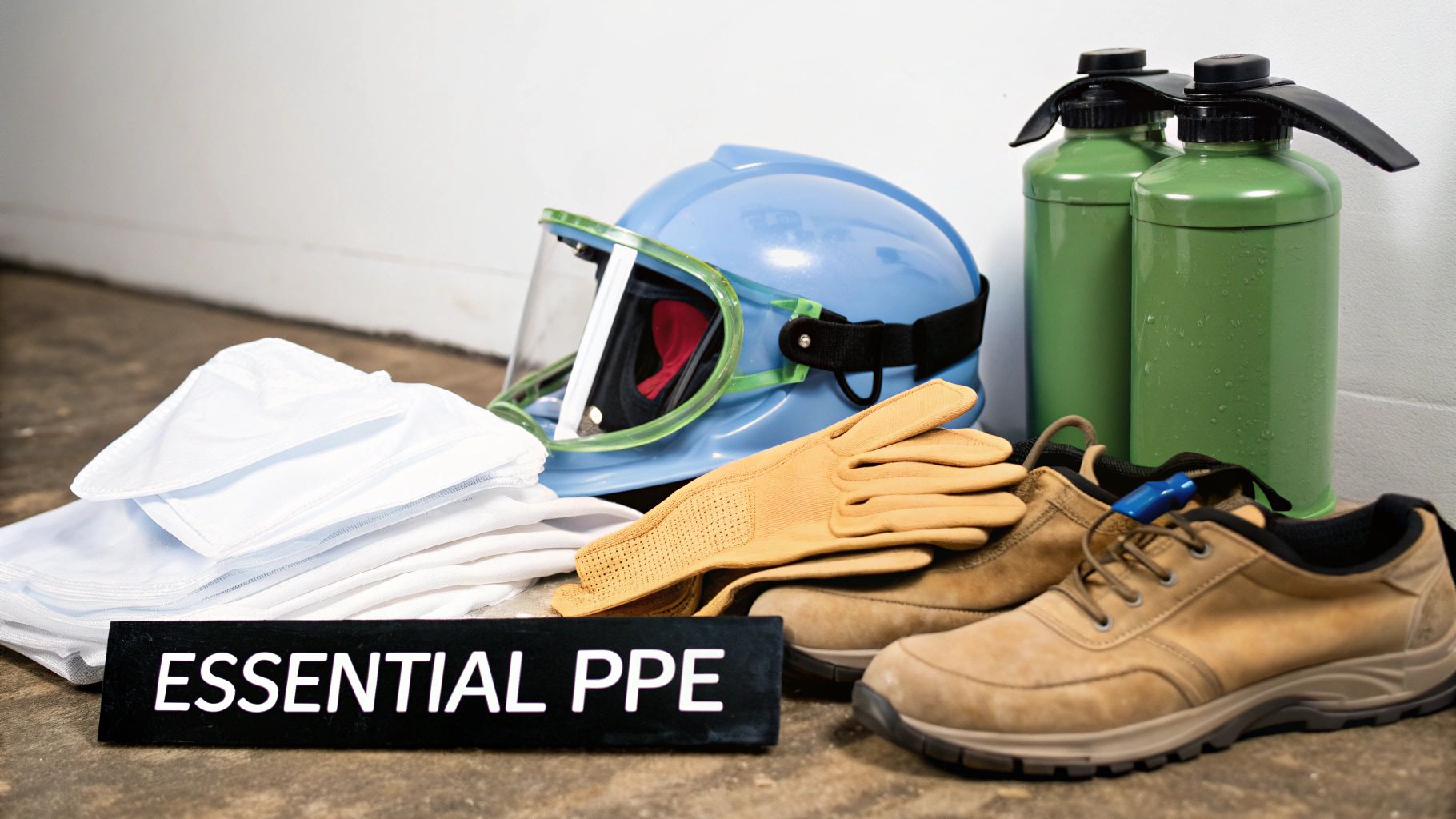
When you decide to "flüssiger stickstoff kaufen privat," you’re signing up for more than just the nitrogen itself. You're committing to an unflinching safety routine. This isn't just good advice; it's a necessity. Working with a substance that sits at a bone-chilling -196°C is serious business, and the right gear is your only line of defence. Trying to cut corners here is a direct path to severe injury.
The single most important piece of hardware in your entire setup is your storage container. Let me be blunt: get this wrong, and nothing else matters.
Let's clear something up right away: you absolutely cannot use a regular thermos, a picnic flask, or any other standard insulated bottle. It's a shockingly common question, and the answer is always a hard no. Those containers aren't built for the extreme cold or, more critically, the pressure build-up from the nitrogen as it naturally evaporates. A sealed, inadequate container is, for all intents and purposes, a potential bomb.
The only safe and correct tool for the job is a Dewar flask (or Dewar vessel). It's a specialised, non-pressurised, vacuum-insulated container designed specifically for cryogenic liquids.
A proper Dewar isn't just a fancy bottle. It's an engineered safety device with a few key features:
For private use, you'll generally be looking at Dewars in the 5 to 25 litre range. A 5-litre flask is handy for quick, small-scale jobs, but be aware its holding time is shorter. A larger 25-litre Dewar can keep nitrogen for several weeks, making it far more practical for ongoing projects.
Buying a new Dewar is the foolproof option. It comes with a manufacturer's warranty and you know its performance is guaranteed. Of course, that comes with a higher upfront cost. Second-hand Dewars can be a great way to save money, but you must inspect them with a critical eye.
If you're looking at a used Dewar, here's what to check:
Remember, a compromised Dewar isn't just inefficient; it's a hazard. A failed vacuum means the outer wall can get dangerously cold, and the boil-off rate will skyrocket, increasing the asphyxiation risk in enclosed spaces.
Once you've sorted out your Dewar, it's time to gear up. Your personal safety hinges on wearing the right PPE every single time you handle liquid nitrogen. This isn't about being overcautious; it's about respecting the very real dangers of instant frostbite and oxygen displacement. The industrial use of nitrogen in Germany soared to over 78,000 metric tons in 2023, largely for food processing where safety is non-negotiable. It's a clear signal that professional-grade safety protocols are the standard, even at home.
Your essential PPE kit needs to have the following items. You can often find complete kits and individual pieces from specialised suppliers. For a solid starting point, take a look at this collection of personal safety equipment from Cryonos.
Having the right equipment is step one. Making it a habit to use it correctly, every single time, is what will keep you safe.
Getting your hands on liquid nitrogen is one thing, but getting it home safely and storing it correctly is a whole different ball game. This is where your personal responsibility really kicks in. Mishandling your Dewar during the drive home or picking the wrong storage spot can lead to some genuinely dangerous situations. The journey requires a bit of planning, and where you decide to keep it needs to be chosen with the unique properties of liquid nitrogen front of mind.
Think of transporting a Dewar, even a small one, as having a very clumsy, top-heavy passenger who can't brace for turns. Your number one job is to make sure that container always stays upright and is securely fastened. A sudden stop or a sharp corner could easily tip it over. That could not only damage the flask but also cause a rapid, hazardous release of nitrogen gas.
Ideally, you'd transport a Dewar in the open bed of a pickup truck, strapped securely against the cabin wall. Why? It's all about maximum ventilation, which is the single most important safety factor when moving liquid nitrogen. If a truck isn't an option, you can use a car, but you absolutely have to take extra precautions.
Place the Dewar in the boot or on the rear passenger floor, wedging it in place with old blankets or using seatbelts to hold it firm so it can't slide or tip. Then, and this is crucial, you must have all the car's windows open for the entire journey. This constant airflow is your safeguard against the invisible threat of nitrogen gas building up inside the car.
Never, ever transport a Dewar flask in a sealed passenger cabin or boot. Liquid nitrogen is always evaporating—a process called 'boil-off'—and turning into a massive volume of gas. Even a tiny leak in a sealed car can displace oxygen to dangerously low levels in minutes. It's a life-threatening asphyxiation risk that gives you no warning—no smell, no colour, nothing.
Once you’re home, the same two principles apply: ventilation and stability. Choosing the right spot to store your Dewar isn't about what's convenient; it's about systematically eliminating the biggest risks of keeping cryogenic liquids at home.
Let's start with where not to store it: the basement. A cellar or any poorly ventilated indoor room is the single worst place you could choose. Nitrogen gas is slightly heavier than air and freezing cold, so it will sink and pool at the lowest point, pushing the breathable oxygen out from the ground up. An unventilated basement can quickly become an oxygen-deficient death trap.
A well-ventilated location is simply non-negotiable.
The whole point is to give that constant, slow boil-off of nitrogen gas a clear path to dissipate harmlessly into the atmosphere. This continuous venting is a normal part of how a Dewar works, but it highlights just how important your choice of storage space is. With nitrogen use growing in industrial settings, like in Germany’s liquid nitrogen purge systems market—projected to grow at a CAGR of 6.3% through 2035—we're seeing more innovation in safe handling. You can learn more about these advanced industrial nitrogen systems and their market growth. For home users like us, adopting that same professional-level focus on ventilation is key.
Finally, consider the physical spot. Place the Dewar on a flat, stable surface where it won’t get knocked over by people, pets, or a car. Keep it well away from any flammable materials and heat sources, which will only make it evaporate faster. If you treat transport and storage with the seriousness they deserve, you’ll ensure your experience with liquid nitrogen is both safe and successful.
You’ve got your Dewar flask filled and your safety gear on — this is where the real work begins. Whether you're flash-freezing ingredients for a wild culinary experiment or creating ethereal fog for a photoshoot, this is the moment where theory becomes practice. The key to doing it safely and successfully comes down to one thing: a healthy respect for the substance you're handling, channelled into deliberate, careful movements.
Pouring liquid nitrogen is less about speed and more about finesse. When you're transferring it from your Dewar into a smaller, secondary container (which also needs to be cryo-safe, like a stainless-steel bowl), the trick is to pour slowly and gently. Tilt the flask and let the liquid run down the inner side of the receiving vessel. This simple technique is the best way to minimise the violent boiling and splashing that happens when something that cold hits a room-temperature surface. Trying to rush it is a guaranteed way to get a dangerous splashback.
You’ve probably seen it happen with water on a hot skillet. If you spill a tiny bit of liquid nitrogen, you'll see small droplets skitter and dance across the floor, seemingly floating for a few seconds before disappearing. This is the Leidenfrost effect. A small pocket of insulating nitrogen gas instantly forms around the droplet, making it hover just above the surface.
While it’s a neat phenomenon to watch, it can give you a false sense of security. A single, tiny droplet might evaporate harmlessly, but a larger spill is a completely different story. A significant puddle of liquid nitrogen will easily overwhelm the Leidenfrost effect, leading to instant and severe contact with whatever it touches — including your skin. This is exactly why a proper pouring technique and your full set of PPE are non-negotiable.
This graphic lays out the simple, but critical, steps for safely moving your Dewar from your vehicle to its storage spot, long before you even think about pouring anything.
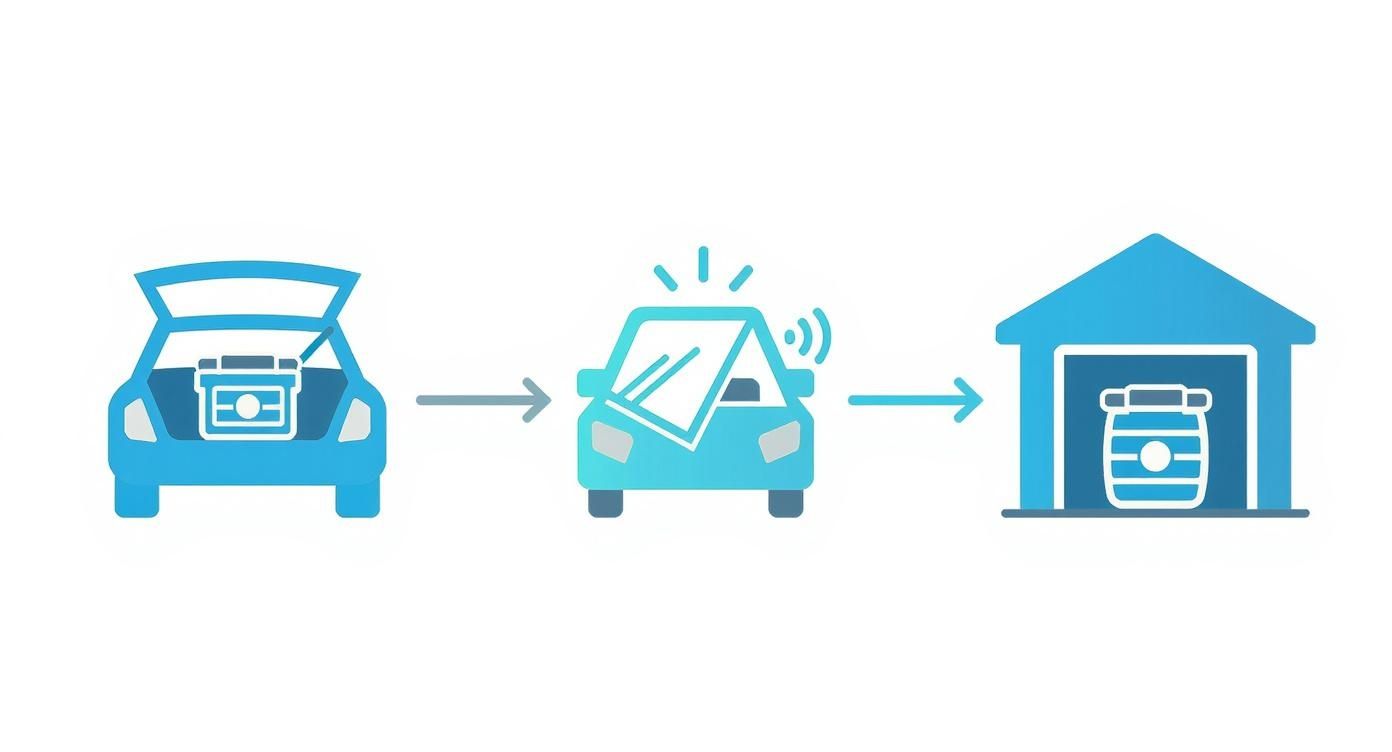
From securing the container in your car to placing it in a well-ventilated space at home, every step is part of a continuous safety process. It's not a one-off checklist.
Beyond the obvious and immediate danger of cold burns, there's a silent, invisible risk that is far more deadly: asphyxiation. Liquid nitrogen isn't toxic, but it can kill you simply by displacing the oxygen you need to breathe. The expansion ratio from liquid to gas is massive — just one litre of liquid nitrogen will expand to fill nearly 700 litres of space with nitrogen gas.
Think about working in a small utility room or a closed garage. An accidental spill of just a couple of litres would release almost 1,400 litres of nitrogen gas into the air. In a confined space, that can drop the oxygen level from a healthy 21% to below 15% in moments, leading to dizziness, confusion, and unconsciousness. Since nitrogen gas is both colourless and odourless, you get no warning signs. This is why proper ventilation isn't just a suggestion; it's the most important rule.
When you decide to buy liquid nitrogen privately, you’re taking on the responsibility of managing both the risks you can see and the ones you can't. A splash burn is immediate and obvious. An oxygen-deficient room is a silent trap that can be far more lethal. Always, always ensure a constant flow of fresh air.
To make it as clear as possible, here's a practical set of guidelines. Think of these as the ground rules. Committing them to memory will help you build the safe habits you need for any project involving liquid nitrogen. For a deeper dive into its properties, you can also read our article on just how cold liquid nitrogen is.
DO These Things Every Time:
NEVER Do These Things:
Even with all the steps laid out, a few practical questions almost always come up when you're getting serious about buying liquid nitrogen privately (flüssiger Stickstoff kaufen privat). Let's tackle some of the most common queries we hear. Getting these details sorted will help you move forward with total confidence.
This is usually the first thing people ask, and the answer really has two parts. First, there's the liquid nitrogen itself. For smaller, non-commercial amounts, you can expect to pay somewhere between €5 to €15 per litre. The final price tag swings a bit based on who your supplier is, where you're located, and the quantity you're buying.
The second, and often bigger, cost is the container. A brand-new Dewar flask is a serious bit of kit and can set you back several hundred euros. Because of this, you should always ask a potential supplier if they offer Dewar rentals. For a one-off project or a short-term experiment, renting is a much smarter, more budget-friendly way to go.
This all comes down to the quality and size of your Dewar flask. A small, portable 5-litre Dewar might only hold its contents for a few days, maybe a week at most. That's because the natural evaporation, what we call "boil-off," happens much faster in smaller containers where there's a higher surface-area-to-volume ratio.
On the other hand, a larger 25-litre Dewar that's in good shape can keep your liquid nitrogen for several weeks, sometimes even a bit longer.
A quick heads-up: The "static holding time" listed by the manufacturer is a best-case, lab-conditions number. Every single time you pop the lid, pour some out, or even just move the flask around, you're introducing heat and causing agitation. This speeds up evaporation, so always plan for a shorter real-world duration.
First thing's first: treating a cryogenic burn is completely different from a heat burn. Your immediate instinct should be to get away from the source and into a warm place.
Follow these critical first-aid steps:
If any liquid nitrogen gets in your eyes, flush them with clean water for at least 15 minutes and get to an emergency room right away. No exceptions.
While it’s technically possible with some incredibly specialised gear like a cryocooler, the short answer is no. For any private individual, it is absolutely not a practical, safe, or remotely cost-effective option.
The equipment needed is astronomically expensive, pulls a staggering amount of electricity, and is downright dangerous if you're not a trained professional. The whole process of liquefying nitrogen from the air is complex and super inefficient on a small scale. For any conceivable private or hobby project, buying from a professional gas supplier is the only sensible and safe route.
For all your cryogenic needs, from state-of-the-art Dewar flasks to essential personal safety equipment, Cryonos GmbH is your trusted partner. We provide medically licensed, high-quality solutions with an unmatched five-year warranty. Explore our full range of products and find the perfect equipment for your project at https://www.cryonos.shop.

