No Products in the Cart




At standard atmospheric pressure, liquid nitrogen sits at an incredibly frigid boiling point of -196°C (-320°F or 77 Kelvin). It’s hard to wrap your head around just how cold that is, but to put it in perspective, it's more than double the coldest temperature ever naturally recorded on Earth.
When people ask, "wie kalt ist flüssiger stickstoff" (how cold is liquid nitrogen), they’re tapping into a substance that operates at the very edge of everyday human experience. This extreme cold isn't just a random number; it's the precise physical point where nitrogen—the most common gas in our atmosphere—condenses into a liquid.
This constant, predictable temperature of -196°C provides a reliable and precise baseline that's absolutely critical for countless scientific and industrial processes.
Its stable boiling point is so dependable, for instance, that it's used to calibrate highly sensitive equipment in the pharmaceutical industry, guaranteeing accuracy in both research and manufacturing. This reliability makes liquid nitrogen one of the most essential and widely used cryogenic fluids today. You can learn more about its role in pharmaceutical applications on kayeinstruments.com.
To truly grasp the intensity of liquid nitrogen's cold, it helps to see how its boiling point looks across the different temperature scales. Each one provides a unique scientific lens on what "-196°C" really signifies.
| Scale | Temperature |
|---|---|
| Celsius (°C) | -196°C |
| Fahrenheit (°F) | -320°F |
| Kelvin (K) | 77 K |
This comparison quickly shows why scientists often prefer the Kelvin scale. It starts at absolute zero (0 K), the theoretical point where all atomic motion stops. At 77 K, liquid nitrogen is just a stone's throw away from this ultimate limit of cold.
Liquid nitrogen's incredible cold isn't some kind of scientific magic; it's all down to basic physics. The story starts with the air we breathe every day, which is made up of roughly 78% nitrogen. In its normal gaseous state, nitrogen molecules zip around freely and are full of energy. To get this common gas to turn into a liquid, you have to pull a massive amount of that energy out.
The process used to achieve this is called cryogenic distillation. Air is first compressed, which makes it hot, and then rapidly cooled down. This cycle of squeezing and chilling is repeated until the air itself liquefies. From that point, the different gases can be separated based on their unique boiling points. Think of it like turning steam back into water, but in reverse and on a scale that is profoundly colder. The entire field dedicated to these ultra-low temperatures is fascinating; you can get a great introduction by reading our guide on what is cryogenics.
To really wrap your head around just how cold we're talking, this graphic shows liquid nitrogen's boiling point across the three main temperature scales.
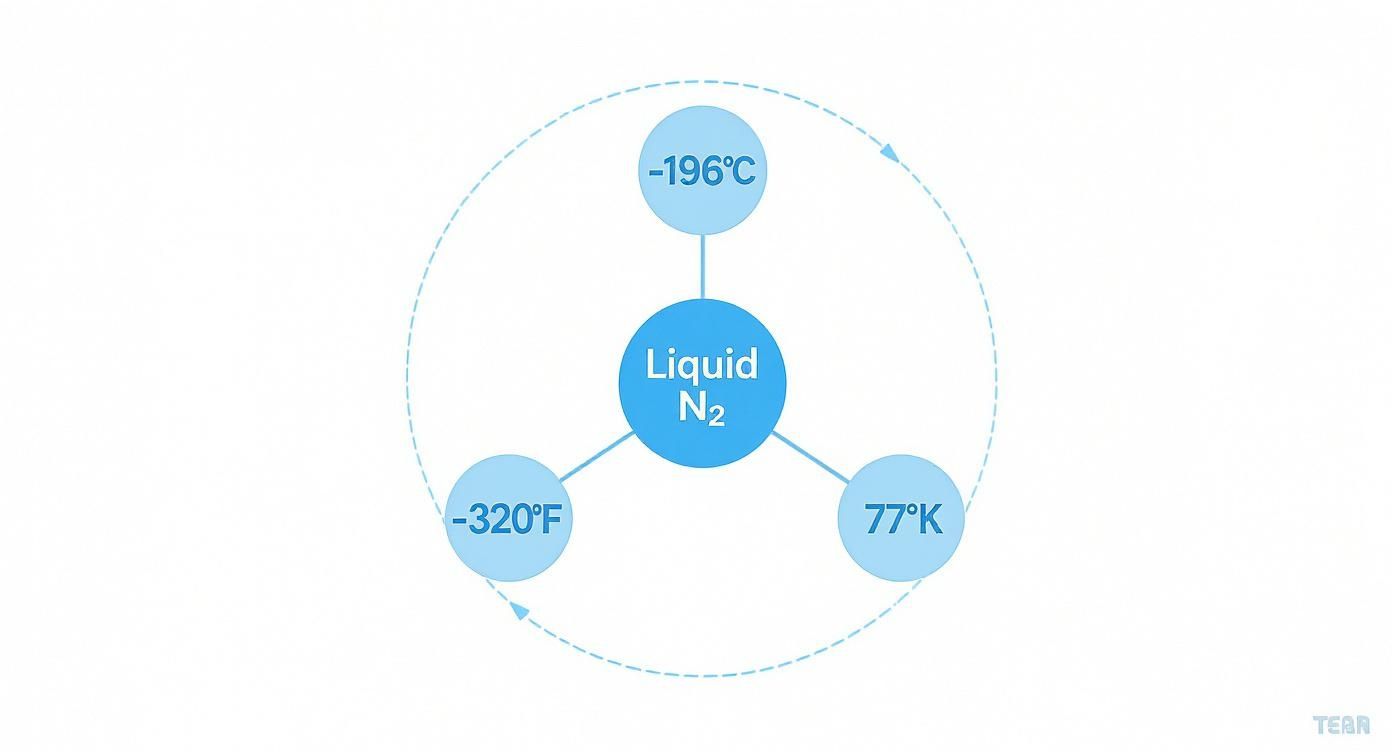
As you can see, whether you measure it as -196°C, -320°F, or 77 K, it's a temperature far beyond anything we experience in daily life.
One of the most mesmerising things you'll see with liquid nitrogen is the Leidenfrost effect. It’s the reason why a droplet can seem to dance and skitter across a much warmer surface instead of instantly freezing it solid.
When liquid nitrogen hits a surface that is significantly hotter than its boiling point—like your kitchen floor—the bottom layer instantly flashes into vapour. This creates a tiny, insulating cushion of nitrogen gas that the rest of the liquid droplet actually floats on, which dramatically slows down any further heat transfer.
Key Takeaway: The Leidenfrost effect creates a temporary protective barrier. This vapour layer is what prevents a brief, accidental splash from causing an immediate cryogenic burn, although any prolonged contact is still extremely dangerous.
This principle is absolutely critical for understanding how cryogenic fluids interact with their environment, showing the complex physics at play in something as simple as a spill.
The extreme cold of liquid nitrogen, clocking in at a steady -196°C, is much more than just a wild number. This cryogenic temperature is a powerful tool that has become indispensable across a massive range of industries, turning abstract physics into real-world innovations we see every day. From the doctor's surgery to the factory floor, its applications are as diverse as they are critical.
One of the most familiar roles for liquid nitrogen is in dermatology. Doctors use its intense cold to perform cryotherapy, a procedure that precisely freezes and destroys unwanted skin tissue. It’s a highly effective way to remove warts, skin tags, and even some precancerous lesions with minimal scarring.
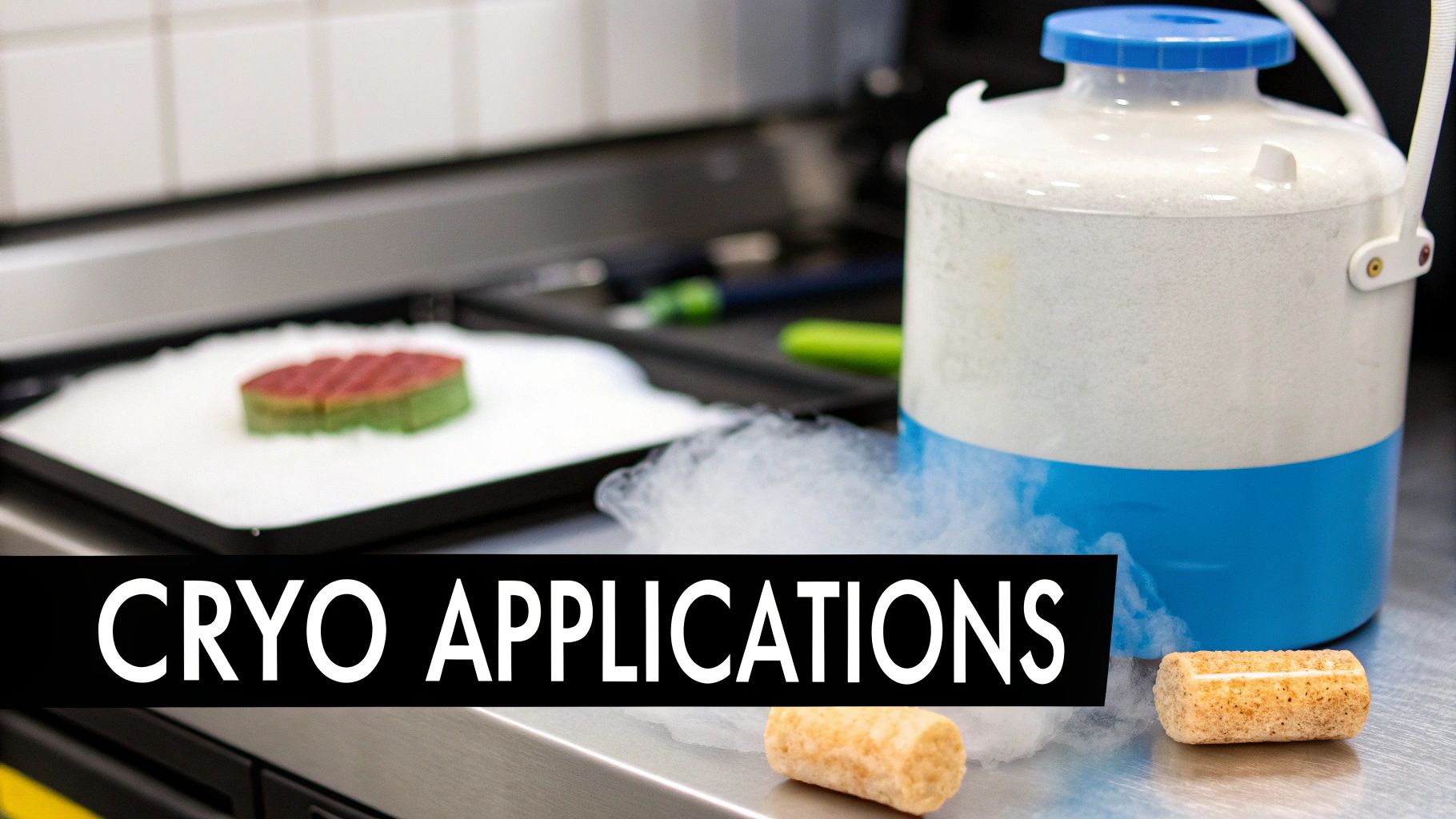
Beyond the clinic, liquid nitrogen’s reach extends deep into science and industry. Its incredible ability to achieve rapid freezing is absolutely crucial for preserving biological materials.
Cryopreservation: In labs and biobanks, it stands guard over vital samples like cells, tissues, and blood. The process essentially presses pause on all biological activity, allowing for the long-term storage needed for medical research, fertility treatments, and developing new therapies.
Food Industry: The food world relies on it for flash-freezing. By freezing things like berries and gourmet ice cream almost instantly, it stops large, destructive ice crystals from forming. This keeps the product's original texture and flavour intact in a way conventional freezing just can't match.
Manufacturing: In heavy industry, it’s used for something called shrink-fitting. A metal part, like a bearing, is dunked in liquid nitrogen, causing it to contract just enough to be slipped into another component. As it warms back up, it expands to create an incredibly tight, secure fit—no welding required.
It also plays a vital role as a coolant in cutting-edge science, where it chills sensitive electronics and high-temperature superconductors, pushing the boundaries of what's technologically possible.
A Key Industrial Player: The sheer versatility of liquid nitrogen makes it a cornerstone of modern industry. You can see its importance in market trends, where it’s a dominant force in any sector that needs reliable, powerful cooling solutions.
The German market is a perfect example, where the chemicals and pharmaceuticals sector has long been the biggest user. Its function as a refrigerant also made it the second-largest functional market in the country, proving just how widely it's used across multiple high-value industries. You can find more insights on the German liquid nitrogen market on marketsandmarkets.com. These applications show how understanding the answer to "wie kalt ist flüssiger stickstoff" (how cold is liquid nitrogen) unlocks a world of practical uses.
Working with a substance as intensely cold as liquid nitrogen demands absolute respect and a strict set of safety measures. At -196°C, even the briefest accidental splash can cause severe cryogenic burns, which are functionally the same as heat burns and can destroy skin tissue in an instant. Understanding these risks isn’t just important; it’s the first step to handling it safely.
The extreme cold isn't the only danger, though. As liquid nitrogen warms up, it rapidly expands into a massive volume of nitrogen gas—a single litre of liquid becomes nearly 700 litres of gas. This invisible, odourless gas can quickly displace oxygen in the air, creating a serious asphyxiation risk, particularly in rooms without good ventilation.
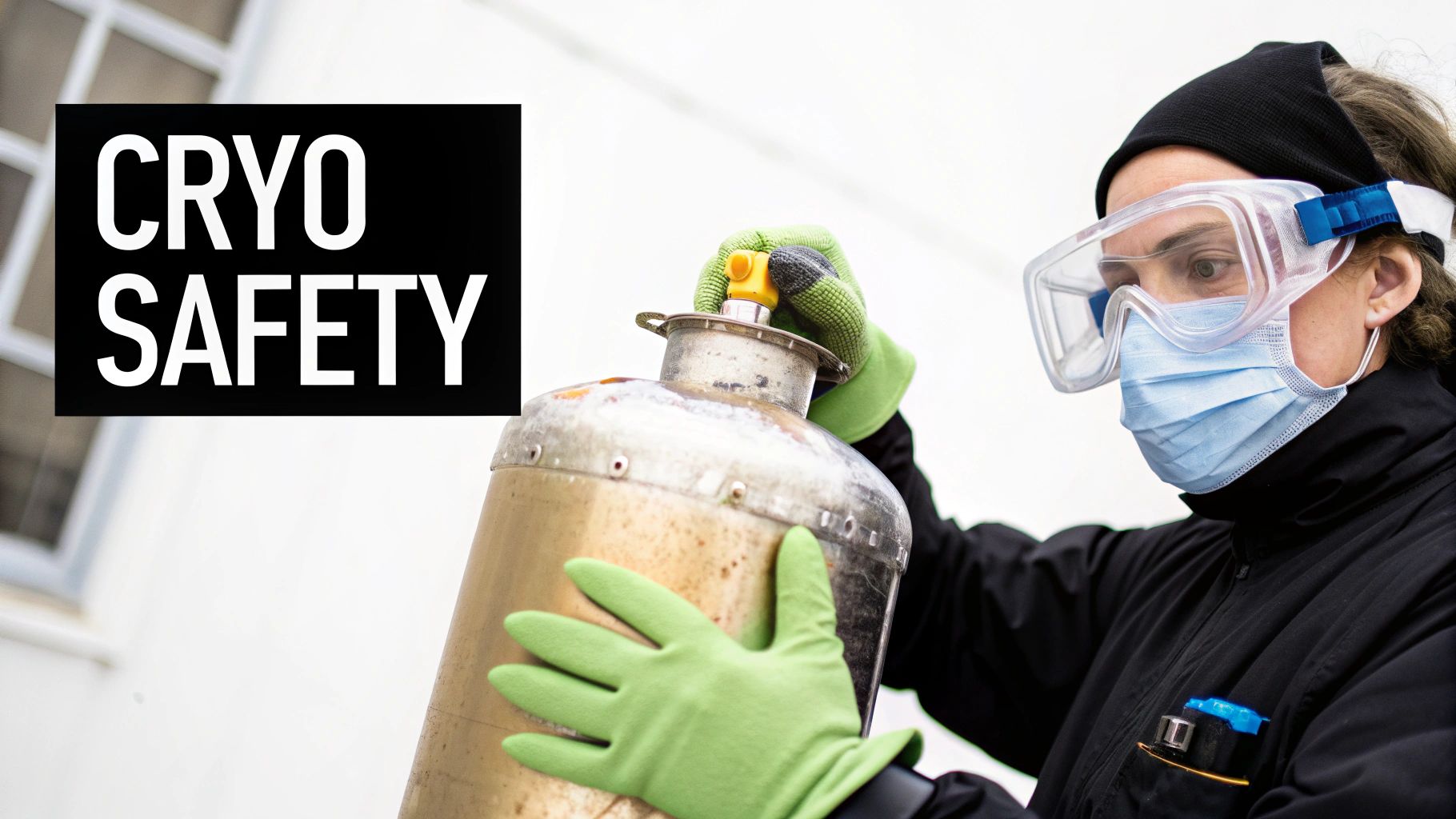
To manage these dangers, following established safety protocols is completely non-negotiable. Anyone working with liquid nitrogen must wear the correct Personal Protective Equipment (PPE) every single time. This gear is the primary barrier between you and a potentially serious injury.
Your essential PPE checklist should always include:
Beyond what you wear, the environment you work in is just as critical. Proper ventilation is paramount to stop nitrogen gas from building up. Because it has no colour or smell, it can displace the oxygen in a room and lead to suffocation without any warning.
Crucial Rule: Never, ever store or transport liquid nitrogen in a completely sealed container. The incredible pressure from the expanding gas will cause even the sturdiest container to rupture violently, creating a dangerous explosion. You must always use purpose-built, vented containers like Dewar flasks.
For a deeper dive into best practices, our guide outlines the 7 important rules for safe work with cryogenic liquids. It offers the detailed information you need to ensure a secure working environment. Following these guidelines is fundamental for preventing accidents.
How on earth do you safely move a substance that's constantly boiling away at -196°C? It's a serious logistical challenge. You can't just seal it in a regular bottle and hope for the best; transporting liquid nitrogen relies on some clever, purpose-built engineering to manage its extreme cold and the constant pressure from evaporation.
The absolute cornerstone of cryogenic storage and transport is a piece of kit called a Dewar flask. It might look like a heavy-duty thermos from the outside, but it's far more sophisticated. A Dewar is essentially a container within a container, with a near-perfect vacuum between the two walls. This design is incredibly effective at minimising heat transfer from the outside world.
Just as important is the specially designed lid. It's not airtight. This is crucial because it allows the small amount of nitrogen gas that naturally evaporates—the "boil-off"—to escape safely. Without this vent, the pressure would build up to dangerous, potentially explosive levels.
When you scale up to industrial quantities, the basic principles don't change, but the equipment certainly does. Massive, heavily insulated tanker trucks, which are really just gigantic Dewars on wheels, are used to transport huge volumes of liquid nitrogen across the country.
This entire process is a critical link in what's known as the "cold chain."
The cold chain is an unbroken, temperature-controlled supply line. It’s absolutely essential for preserving valuable and sensitive materials, especially in medicine and biotechnology where maintaining these ultra-low temperatures safeguards everything from cells and tissues to vital vaccines during transit.
This need for precise, reliable logistics is being driven by a growing global demand. The coolant market segment, for example, took a dominant 62% revenue share back in 2022, fuelled by its widespread use in everything from electronics manufacturing to food processing. As advanced pharmaceutical applications expand, the need for rock-solid transport solutions only becomes more critical. You can explore more detailed insights on the liquid nitrogen market on mordorintelligence.com.
Making sure this entire operation is safe and compliant is non-negotiable. There are strict rules governing these activities, and you can learn more about the specific regulations for transporting gas cylinders to get a better sense of the standards we all have to meet.
Working with a substance as powerful as liquid nitrogen always brings up good questions. Let's tackle some of the most common ones to give you a clearer picture of what to expect and how to stay safe.
This is easily the most asked question, and the answer is a bit surprising. For a fleeting moment—less than a second—you might get away with it. This is thanks to something called the Leidenfrost effect. The intense cold instantly vaporises a layer of nitrogen gas, creating a tiny, temporary cushion between the liquid and your skin.
But don't test this theory. That protective barrier vanishes in a heartbeat. Any contact longer than that split second will cause a severe cryogenic burn, which is every bit as damaging as a heat burn and will destroy skin tissue. Always, always wear proper cryogenic gloves and never handle liquid nitrogen with bare hands.
Absolutely not. This is a critical safety rule with no exceptions. You must never store liquid nitrogen in a standard thermos, sealed bottle, or any other airtight container. As liquid nitrogen warms up, it expands dramatically, turning back into a gas with enormous force. To put it in perspective, one litre of liquid becomes almost 700 litres of gas.
In a sealed container, this rapid expansion creates immense pressure that can lead to a violent and dangerous explosion. Liquid nitrogen must only be stored in specialised, vented containers called Dewar flasks, which are specifically designed to safely release this building pressure.
While it is incredibly cold, liquid nitrogen doesn't hold the title for the coldest substance. That honour goes to liquid helium. Liquid helium is significantly colder, boiling at around -269°C (-452°F), which is just a few degrees shy of absolute zero (0 K or -273.15°C).
Even so, liquid nitrogen is far more common, accessible, and affordable. Its perfect balance of extreme cold and practicality makes it the go-to cryogenic fluid for a massive range of scientific and industrial cooling jobs worldwide.
For all your cryogenic needs, from safe transport vessels to advanced storage solutions, Cryonos GmbH provides state-of-the-art equipment designed for reliability and safety. Explore our complete range of products.

