No Products in the Cart




At first glance, an ISO tank container might look like just another big metal box, but it's a highly specialised piece of engineering. At its heart, it’s a vessel designed to safely and efficiently move bulk liquids, powders, and gases all over the world. These tanks are the real backbone of the global bulk liquid supply chain, offering a rugged, reusable, and remarkably flexible solution for transport by ship, rail, or lorry.
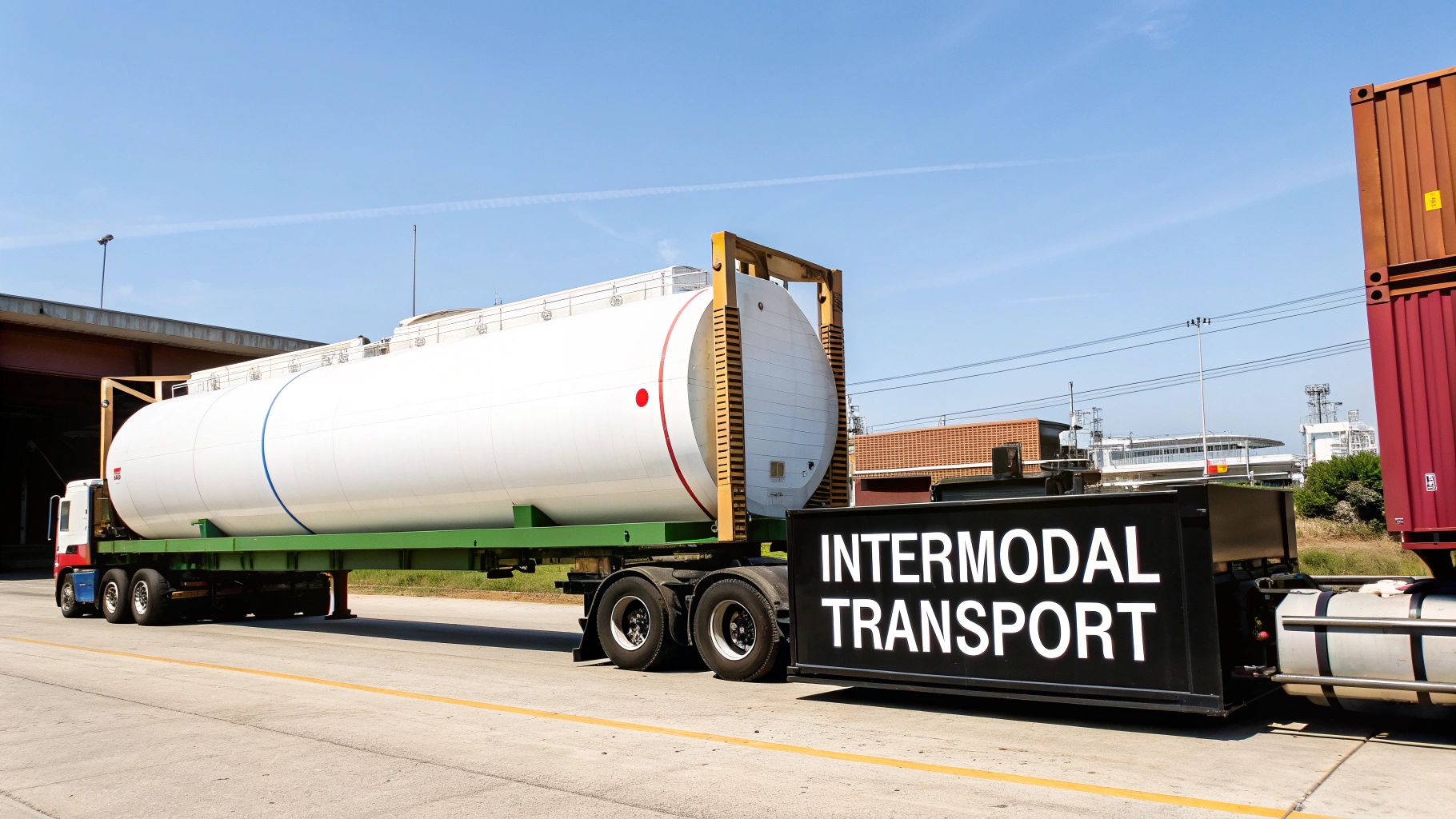
It's best to think of an ISO tank container not just as a tank, but as a complete high-performance system. The core is the inner vessel, or shell, which is usually built from tough stainless steel to prevent corrosion and keep the product pure. This cylindrical tank is then nestled inside a protective outer frame, constructed to the exact dimensions laid out by the International Organisation for Standardisation (ISO).
This standardised frame is the secret to its incredible versatility. It means the tank can be handled, stacked, and moved using the very same equipment as regular dry cargo containers. This creates a seamless intermodal transport chain. A single tank can travel from a cargo ship to a freight train and finally onto a lorry for its last-mile delivery, all without ever having to transfer its precious contents.
The design is brilliant in its simplicity and incredibly effective. The frame takes on all the stress of transport and shields the inner vessel from bumps and impacts, while the tank itself is solely focused on containing the cargo securely. This two-part structure brings some major benefits to the table.
Here's a quick look at the key advantages of this design.
| Feature | Description |
|---|---|
| Structural Integrity | The frame provides the muscle needed for stacking and lifting, protecting the more delicate pressure vessel housed inside. |
| Safety and Containment | This design dramatically cuts down the risk of leaks or spills, which is absolutely vital when moving hazardous or sensitive materials. |
| Efficiency | Skipping the need to pump liquids between containers at each transfer point saves a huge amount of time, labour, and prevents contamination. |
| Reduced Waste | A single ISO tank can replace dozens or even hundreds of smaller drums, significantly reducing packaging and handling waste. |
Ultimately, the synergy between the protective frame and the secure inner vessel is what makes these containers so reliable and efficient for global logistics. You can dive deeper into the design of specialised vessels and their importance in our guide on what you should know about cryogenic vessels.
An ISO tank container is the ultimate workhorse for bulk liquid logistics. A single 25,000-litre tank can take the place of over 100 traditional drums, drastically cutting packaging waste, handling effort, and the risk of spills.
The impact of this technology is massive, especially for industries with complex supply chains. Germany's powerful chemical sector, for example, depends heavily on ISO tank containers. With annual revenues around EUR 200 billion and facing significant logistics costs, the efficiency these containers bring is absolutely essential. This reliance proves they aren't just containers; they are critical pieces of infrastructure that keep global trade moving.
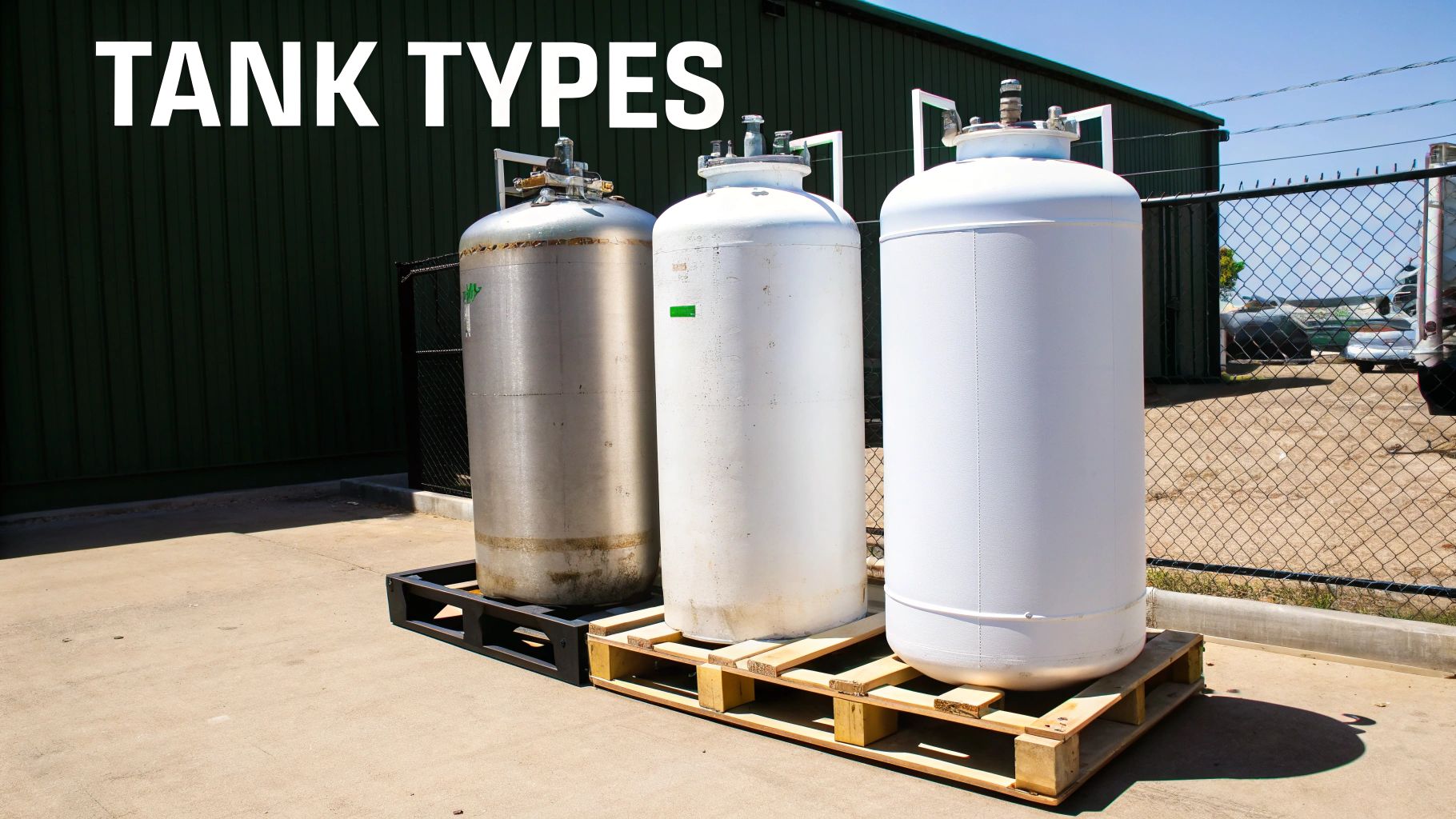
Choosing the right ISO tank container isn't a one-size-fits-all decision. To get the correct one for your cargo, you first need to understand the fundamental differences between the available types. Think of it this way: you wouldn't use a standard flask to keep coffee hot for hours, and you definitely wouldn't use a standard tank for super-cooled liquid nitrogen.
The various designs are engineered to safely handle specific products, pressures, and temperatures. Matching the tank to the cargo is the most critical step for a successful and compliant transport operation. Let's break down the types based on the key factors that really matter in the real world.
The first and most important distinction comes down to temperature. While most liquids travel at ambient, or surrounding, temperatures, some need extreme cold to stay in a liquid state. This creates a clear divide between standard tanks and highly specialised cryogenic tanks.
A T75 cryogenic tank is essential for moving liquefied industrial gases like liquid nitrogen (LIN), liquid oxygen (LOX), and liquefied natural gas (LNG). Its advanced insulation is the only way to keep these products in their liquid state throughout a long journey.
This specialised corner of the ISO tank containers market demands serious technical expertise and infrastructure. For instance, Germany's leadership in European logistics really shines in the cryogenic sector, where it operates the largest T75 tank container fleet on the continent. The nation's advanced capabilities mean it manages more than one-third of Europe's entire T75 fleet. You can discover more insights about the European cryogenic tank market.
After temperature, the material used to build the tank's inner vessel is the next crucial piece of the puzzle. The choice of material directly impacts what you can safely carry, preventing nasty chemical reactions, corrosion, or contamination.
Stainless Steel is the most common material you'll find, thanks to its excellent chemical resistance and durability. It’s the go-to choice for a huge array of chemicals, pharmaceuticals, and food products because it doesn't react with the cargo and is easy to clean to incredibly high standards.
Carbon Steel, on the other hand, is a more budget-friendly option used for specific products that aren't corrosive. While not as versatile as stainless steel, it’s perfectly fine for certain oils and non-aggressive substances where high chemical resistance isn't the top priority.
Finally, ISO tanks are also sorted by their capacity and ability to handle pressure. Capacity typically ranges from 14,000 to 26,000 litres, allowing shippers to pick a size that maximises the payload for their specific product density and route.
Pressure ratings are just as important, especially for hazardous goods or products that can build up vapour pressure. A tank designed for non-pressurised apple juice will be built very differently from one made to contain a pressurised chemical. These ratings ensure the tank can safely handle the internal forces of its contents under all sorts of transport conditions, preventing any risk of rupture or leaks. Getting these classifications right is fundamental to safe and efficient logistics.
When you're dealing with bulk liquid logistics, safety and compliance aren't just buzzwords—they're the foundation of the entire operation. For ISO tank containers, there's a complex web of standards ensuring that every trip, whether by ship, lorry, or train, is handled with the utmost care.
Think of these regulations less as bureaucratic red tape and more as a universal language. This language guarantees that equipment is compatible worldwide, while protecting people, the cargo itself, and the environment. Getting a handle on these codes is non-negotiable for anyone in the supply chain. It means you can verify compliance, sidestep expensive delays, and maintain the integrity of your operations.
So, what does the "ISO" in ISO tank container actually stand for? It refers to the International Organisation for Standardisation. This certification is the bedrock of the whole intermodal system.
It guarantees that every tank's frame has standardised dimensions and fittings. This is what allows them to be seamlessly handled by cranes, ships, trains, and lorries, no matter where you are in the world. This universal design is what makes the global logistics network for bulk liquids even possible. Without it, moving cargo between different modes of transport would be a chaotic, inefficient mess.
Beyond the basic frame standards, there are specific rulebooks for transporting goods, especially those classified as hazardous. Each mode of transport has its own set of regulations you need to follow.
Following these regulations isn't optional. Failing to comply can result in hefty penalties, rejected shipments, and most importantly, serious safety risks. Proper documentation, correct labelling, and certified equipment are absolute musts.
Understanding these different codes is crucial. Germany's market for ISO tank containers, for example, is a highly sophisticated ecosystem shaped by tight regulatory oversight. Strong environmental laws have created a market that is far more developed than many of its European neighbours.
Of course, compliance goes beyond just the container—it also covers the cargo inside. The same safety principles apply to smaller containers, which you can read about in our guide on the regulations for transporting gas cylinders. Mastering this regulatory landscape is the key to running a smooth, safe, and efficient operation.
Beyond the technical drawings and regulations, the real story of an ISO tank container is where it ends up and what it does. These aren't just passive steel boxes; they are active, indispensable tools that make modern supply chains tick across some of the most demanding industries out there.
From safeguarding life-saving biological materials to delivering the gases that fuel our factories, their real-world applications show just how versatile they are. Let's look at how different sectors put them to work, solving unique and often complex logistical puzzles every single day.
For any biobank, cell therapy lab, or research facility, the cold chain isn't just a priority—it's everything. The future of priceless biological samples, whether stem cells or tissues, hangs on maintaining ultra-low cryogenic temperatures without fail. This is precisely where the T75 ISO tank container proves its worth.
Think about the challenge: you need to move thousands of individual biological samples from a research hub to a long-term storage biobank across the country. Packaging each one is not just impractical but dangerously risky. The real solution is to ensure the destination's storage freezers have a constant, reliable supply of liquid nitrogen (-196°C).
A single T75 ISO tank can bring over 20,000 litres of liquid nitrogen straight to the facility's doorstep. This kind of bulk delivery guarantees a continuous, uninterrupted supply, protecting materials that could one day lead to a medical breakthrough.
The T75's "thermos flask" design, built around vacuum insulation, is engineered for this exact purpose. It keeps boil-off to an absolute minimum, making sure the maximum volume of liquid nitrogen actually arrives. For the scientific and medical communities that rely on these cryogenics, ISO tank containers are the safest, most efficient way to get the job done.
Industrial gas suppliers are another major user, moving huge volumes of liquefied gases that are the lifeblood of countless other sectors. Gases like oxygen, argon, and carbon dioxide are fundamental to manufacturing, food processing, and, most critically, healthcare.
Take a large hospital, for example. It has a non-negotiable need for a constant flow of medical-grade oxygen. Managing hundreds of small, high-pressure cylinders is a logistical nightmare. Instead, a hospital can maintain a large bulk storage tank on-site, which is easily refilled directly from an ISO tank arriving on a lorry. It's safer, far more efficient, and can scale with the hospital's needs.
Here are a few key industrial uses:
Because ISO tanks are intermodal, suppliers can build a flexible and incredibly robust supply chain. A tank might be filled at a production plant, travel hundreds of miles by rail, and then be transferred to a lorry for the final deliveries to several industrial or medical sites. This seamless journey ensures essential gases are always exactly where they need to be.
When it comes to food and drink, it's all about purity and hygiene. Moving liquids like fruit juices, spirits, vegetable oils, or even drinking water requires a container that isn't just clean but is guaranteed to prevent any hint of contamination.
This is a perfect job for food-grade ISO tank containers, which are typically made from high-quality stainless steel. They are designed to be cleaned to the most stringent standards. As sealed units, they shield their contents from anything external during transit. A tank dedicated solely to one product, like whisky or orange juice, ensures that the flavour, aroma, and quality arrive completely untainted. At scale, it's a level of reliability that drums or other containers just can't touch, making ISO tanks a quiet cornerstone of the global food supply chain.
Choosing the right ISO tank is easily one of the most important decisions you'll make in your entire logistics chain. Get it wrong, and you could be looking at anything from product contamination and cargo loss to hefty regulatory fines or, even worse, a serious safety incident. To sidestep these headaches, you need a clear, systematic way to approach the selection process.
This isn't about just finding a container that can hold your product. It’s about ensuring every last detail—from the tank's internal lining to the valve fittings—is perfectly matched to your specific cargo and its journey from start to finish. A methodical approach is your best bet for safety, efficiency, and total peace of mind.
This chart gives you a quick visual on how different industries typically match up with specific ISO tank applications.
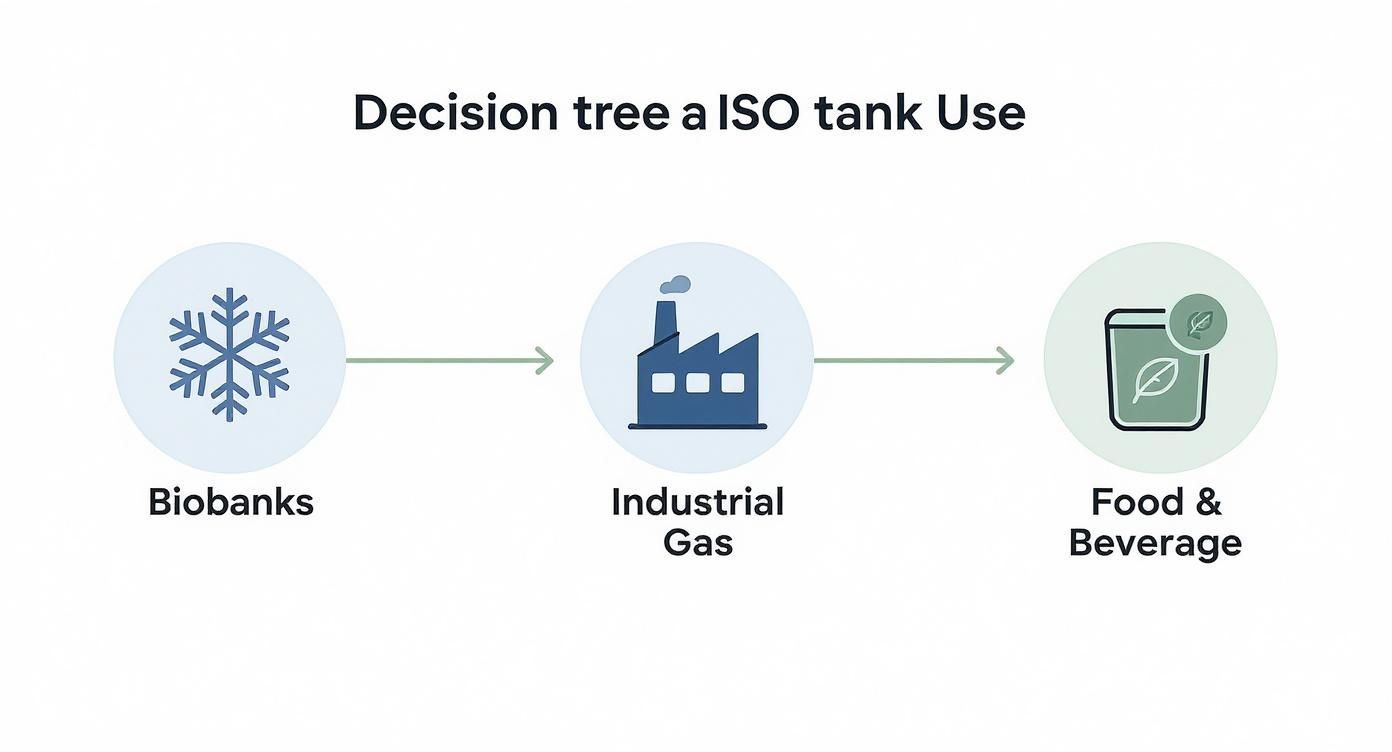
As you can see, the nature of what you're transporting is the number one factor driving your choice. Temperature-sensitive biologicals, high-pressure industrial gases, and purity-critical food products each demand a different solution.
The first question you have to ask is simple: is this tank safe for my product? The material of the tank's inner shell absolutely cannot react with what you're putting inside it. For most chemicals and food-grade products, 316 stainless steel is the gold standard because of its fantastic corrosion resistance.
But if you’re dealing with something highly corrosive, like certain strong acids, you might need a tank with a specialised lining or one built from a more exotic alloy. Always, always check the material safety data sheet (MSDS) to confirm compatibility. Skipping this step could lead to a chemical reaction that ruins both the tank and your valuable product.
Next up, think about temperature. Does your cargo need to stay warm, be kept cool, or just sit at a stable ambient temperature during its trip?
Getting the temperature control wrong can make unloading a nightmare—or even spoil the entire shipment. It’s a step you can't afford to overlook.
A tank is no good if you can't hook it up to your equipment. Before you sign on the dotted line, you must double-check that the tank's fittings are a perfect match for your site's loading and unloading infrastructure.
Make sure you verify the type, size, and location of every valve and connection. That includes the top-loading manlid, the bottom discharge valve, and the airline connection. A mismatch can bring your operations to a grinding halt and force you to buy expensive, last-minute adaptors.
Finally, never take the paperwork for granted. Every single ISO tank container is required to have a valid CSC (Convention for Safe Containers) plate—think of it as the tank’s passport for international travel. On top of that, you need to see proof of its recent inspections.
Tanks have to pass a pressure and thickness test every five years and a leakproofness test every 2.5 years. You should also ask for the cleaning history to guarantee that no residue from a previous cargo could cross-contaminate your product. For anything food-grade, pharmaceutical, or high-purity, this is absolutely non-negotiable. A clean, well-documented history is the best guarantee you have of a safe, reliable container.

Operating an ISO tank container isn’t just about moving cargo from A to B; it’s about managing risk with absolute precision. Safe handling and rigorous inspections are the twin pillars holding up the entire operation. They protect your people, the environment, and the valuable product inside. Without them, even the most advanced tank can become a serious liability.
Sticking to best practises is non-negotiable. This isn’t just about ticking boxes—it’s about building a robust safety culture. That means having a systematic approach for everything, from the quick visual checks before a trip to the mandated, in-depth structural tests. Every single step is designed to catch a potential problem before it has a chance to escalate.
Before any ISO tank container starts its journey, a thorough pre-trip inspection is a must. Think of it like a pilot's walk-around check before take-off. It’s a simple but vital step to confirm the container is fit for travel and ready to do its job safely.
This hands-on check should cover several key areas to make sure the tank is secure and all its equipment is functioning correctly.
The moments of loading and unloading are when the risk of an incident is at its highest. This is when people are interacting directly with the tank and its contents, so following strict safety protocols is essential to prevent accidents.
Proper personal protective equipment (PPE) is your first line of defence. This means, at a minimum, safety glasses, gloves, and steel-toed boots. Depending on the cargo, you might need additional gear like respirators or chemical suits. Grounding the tank is another crucial step, especially with flammable liquids, as it safely gets rid of any static electricity that could cause a spark.
For anyone working with cryogenic liquids, specific training is absolutely essential. You can explore our guide on the 7 important rules for safe work with cryogenic liquids to get a better handle on the unique risks involved.
A critical safety procedure is to always ground the ISO tank container before initiating any product transfer. This simple connection prevents the build-up of static electricity, a common ignition source for flammable vapours, and is a mandatory step in nearly all hazardous liquid handling operations.
To guarantee long-term safety and structural integrity, ISO tank containers are subject to a strict schedule of mandatory inspections. These tests go far beyond a simple visual check and are legally required to keep the tank in service.
These mandatory inspections are what certify that a tank remains safe for transporting bulk liquids, including hazardous materials, across global supply chains.
Even after getting to grips with the basics, you'll likely have a few specific questions when it comes to using ISO tank containers in your own operations. Let's tackle some of the most common queries to help you make smarter decisions for your supply chain.
An ISO tank is a remarkably durable piece of equipment. If you look after it with diligent maintenance, consistent inspections, and timely repairs, a standard stainless steel ISO tank can easily serve you for 20 to 30 years. Some last even longer.
Of course, its longevity really hinges on a few key factors. The type of cargo it carries is a big one—corrosive materials will naturally shorten its lifespan. Sticking to the mandatory 2.5-year and 5-year testing schedules is also non-negotiable for ensuring its structural integrity holds up over the long haul.
Absolutely. This is one of the biggest perks of using an ISO tank container. While they're built for intermodal transport, they double as excellent temporary or even medium-term static storage units once they reach their destination.
This flexibility means you don't have to bother transferring the product into a separate storage vessel.
This dual-use capability is a game-changer. It saves valuable time, cuts down on handling costs, and dramatically minimises the risk of spills or product contamination that can happen during transfer operations. Many businesses use them as buffer storage right at their production sites.
Cleaning an ISO tank is a highly specialised and critical job, all geared towards preventing cross-contamination between different cargoes. This isn't something you do yourself; it's always handled at certified, professional cleaning stations. The exact method depends entirely on what was in the tank before and what's going in next.
The process generally looks something like this:
When you're talking about food-grade products or high-purity chemicals, these cleaning protocols are incredibly strict to guarantee absolute product purity before the next load goes in.
Compared to other options like drums or flexitanks, ISO tank containers are widely seen as a much greener choice for moving bulk liquids. Their reusability is the main reason why; a single tank can stay in service for decades, which slashes the amount of packaging waste.
Think about it: one 25,000-litre ISO tank can replace more than 100 individual drums. That's a huge amount of manufacturing and disposal waste just wiped out. Plus, their robust, sealed design is far superior at preventing spills and leaks, protecting the environment during transit. The efficiency of intermodal transport also helps to lower the overall carbon footprint of the supply chain.
For state-of-the-art cryogenic solutions designed for secure storage and transport, trust the experts at Cryonos GmbH. We provide reliable, compliant equipment backed by decades of experience. Visit us at https://www.cryonos.shop to find the perfect solution for your needs.

