No Products in the Cart




Think of an ISO tank container as the unsung hero of global logistics. It's essentially a high-tech "thermos" built for the rough and tumble world of shipping, a standardised tank nestled securely inside a universal frame. This design allows it to move seamlessly between ships, trains, and lorries, carrying everything from everyday food products to highly specialised cryogenic gases.
Imagine the logistical nightmare of shipping 25,000 litres of a sensitive chemical across the globe in hundreds of separate drums. It would be a slow, risky, and incredibly clunky process. Every time the cargo moved from a ship to a train, it would need to be unloaded and reloaded, massively increasing the risk of spills, contamination, and costly delays.
This is exactly the problem ISO tank containers were designed to solve.
At its heart, an ISO tank is a robust cylindrical vessel, usually crafted from high-grade stainless steel and wrapped in insulation. This tank is then mounted inside a familiar rectangular steel frame—the same size and shape as a standard 20-foot shipping container. This simple but ingenious design is what makes it "intermodal." It can be lifted, stacked, and locked into place using the exact same equipment as any other shipping container on the planet.
This universal fit is the game-changer. It means the product inside never has to be transferred from one container to another during its journey. That single advantage is what drives the massive gains in efficiency and safety that industries rely on. For a broader look at how gas is moved safely, it's worth understanding the different types of portable natural gas tanks and the principles behind them.
To help you quickly grasp the core features of these workhorses, here’s a simple breakdown:
| Feature | Description | Benefit for Your Operations |
|---|---|---|
| Intermodal Frame | A standardised 20-foot frame allows the tank to be handled by any standard container equipment worldwide. | Massively simplifies logistics. No special equipment needed for transfer between ship, rail, or road. |
| Stainless Steel Vessel | The inner tank is built from high-grade, corrosion-resistant stainless steel. | Ensures product purity and integrity. Prevents contamination and is easy to clean between loads. |
| Insulation & Outer Shell | Layers of insulation and a protective outer layer surround the inner vessel. | Maintains a stable internal temperature, which is crucial for sensitive chemicals and cryogenic liquids. |
| Valves & Fittings | Top and bottom valves allow for safe, controlled loading and unloading of the contents. | Provides a secure, sealed system that minimises the risk of leaks and exposure during handling. |
This combination of features makes ISO tank containers an incredibly reliable and efficient solution for bulk liquid and gas transport.
The impact of ISO tanks goes far beyond just being convenient. Their design is the foundation for a logistics system that is fundamentally safer, more cost-effective, and better for the environment. For any organisation that moves bulk liquids or gases—from industrial chemical suppliers to cutting-edge biobanks—the benefits are impossible to ignore.
Here’s what really makes a difference:
In the end, this standardised approach injects much-needed reliability and predictability into even the most complex supply chains. It’s no wonder ISO tanks have become an indispensable part of modern global commerce.
While all ISO tanks share that standardised frame, what’s inside can be dramatically different. Think of it like this: a sports car and a heavy-duty lorry both have four wheels and an engine, but they’re engineered for wildly different jobs. In the same way, ISO tanks are purpose-built for their cargo, with each type having its own unique design.
Not all liquids or gases behave the same. Some are corrosive, some need to be kept under immense pressure, and others must remain colder than an Antarctic winter. To handle this diversity, the industry uses a classification system with different "T-codes" (like T11, T50, and T75) that tell you the tank's specific capabilities.
Getting these distinctions right is absolutely critical for safety, efficiency, and product integrity. Choosing the wrong type isn't just inefficient—it can be incredibly dangerous.
The T11 ISO tank is the one you'll see most often in general logistics. It's the versatile, reliable choice for a huge range of non-hazardous and hazardous liquid chemicals. If ISO tanks were vehicles, the T11 would be the dependable utility van of the fleet, handling a wide array of tasks without a fuss.
These tanks are the go-to for products like:
Their construction is robust yet straightforward, designed for safe containment and, importantly, easy cleaning between different loads. This versatility is what makes them the backbone of bulk liquid transport all over the world.
When you need to move liquefied petroleum gas (LPG) or ammonia, a T11 just won’t cut it. These substances only stay liquid when they're stored under serious pressure. This is where the T50 ISO tank comes in, a specialised high-pressure vessel built for the job.
A T50 tank is engineered to withstand internal pressures many times greater than the atmosphere outside. This incredibly robust construction is non-negotiable for safely transporting industrial gases that would otherwise vaporise instantly.
Imagine trying to contain the force of a deeply submerged submarine—the T50 is built with a similar principle of immense structural strength. A manufacturing facility that needs a steady supply of butane or propane depends entirely on the certified pressure-handling capabilities of a T50 tank to get its materials safely.
The infographic below shows the core benefits that all ISO tank types deliver, from these general-purpose models to the most specialised units.
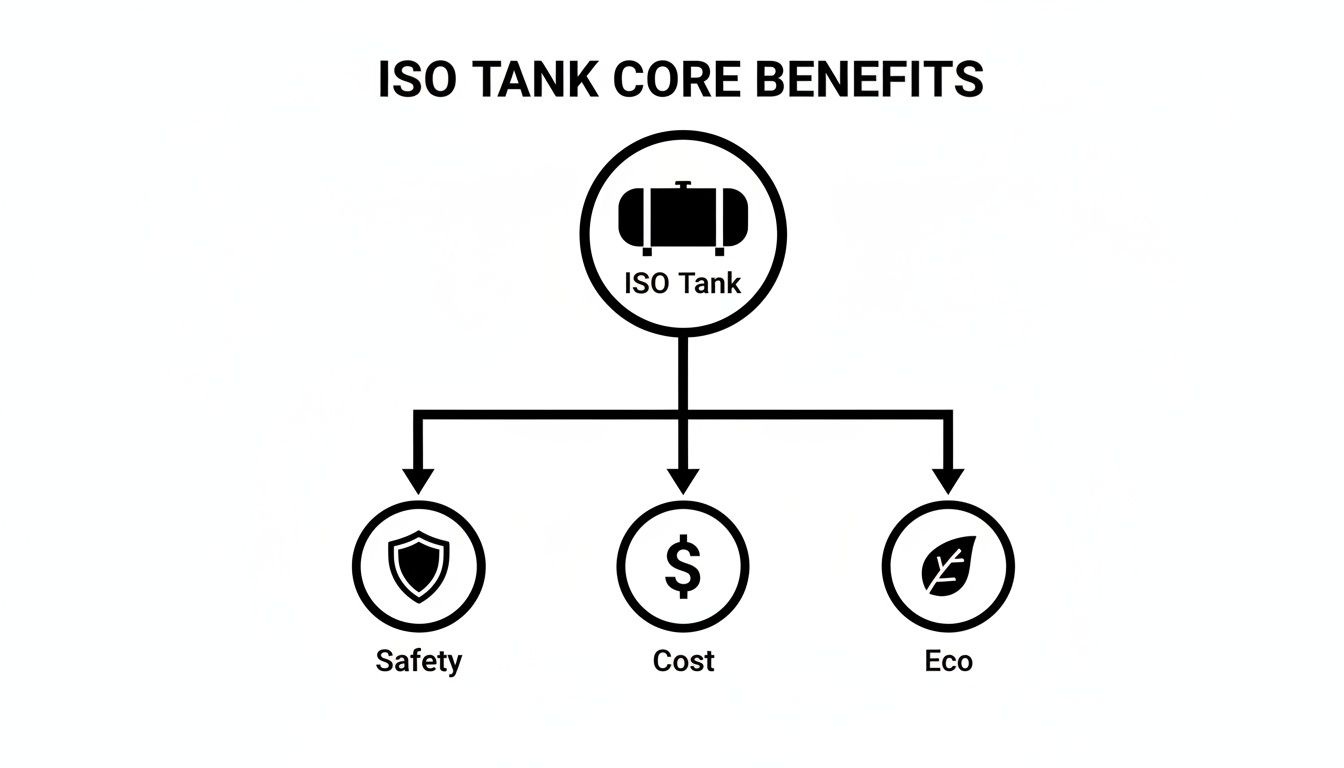
This really highlights how safety, cost-efficiency, and environmental thinking form the foundation of why standardised ISO tanks are so widely used.
For the world of cryogenics, where temperatures plummet to unimaginable lows, you need another level of engineering entirely. The T75 ISO tank is the master of extreme cold, designed specifically to transport cryogenic liquids like Liquid Nitrogen (LN2), Liquid Oxygen (LOX), and Liquefied Natural Gas (LNG).
These substances are kept at temperatures as low as -196°C (-320°F). At such extremes, normal materials would become brittle and fail. Even more critical, any heat seeping in from the outside world would cause the liquid to boil off and escape, leading to product loss and a major safety hazard.
To stop this from happening, the T75 uses a brilliant "tank-within-a-tank" design:
This advanced construction is precisely why a biobank or a cell therapy laboratory absolutely depends on T75 tanks. They need a constant, reliable supply of LN2 to preserve priceless biological samples. The superior insulation of a T75 minimises "boil-off," ensuring the liquid nitrogen arrives with maximum volume and the samples stay safely frozen. It’s the ultimate high-tech thermos, built for some of the most sensitive and valuable cargo on the planet.
When you're moving sensitive or hazardous materials in an ISO tank, compliance isn't just about ticking boxes. It’s the absolute bedrock of safety and operational integrity. These regulations are a universal language, making sure a tank loaded in one country meets the exact same tough standards as one thousands of miles away.
For any lab, biobank, or industrial company handling valuable cargo, getting to grips with these frameworks is non-negotiable. They’re your guarantee that the container has been built, tested, and maintained to handle the immense pressures of transport. Ultimately, they protect your cargo, your team, and everyone else involved in the journey.
These rules aren't just arbitrary red tape; they're the product of decades of real-world experience, all designed to prevent disaster and ensure product purity.
Getting a tank from A to B often involves road, rail, and sea, and each mode of transport has its own specific rulebook. While they all share the same core safety principles, they have unique requirements tailored to the risks of each environment. Think of them as specialised chapters in the same global safety manual.
The three main regulations you'll come across are:
Adherence to these standards is non-negotiable. At Cryonos, all our transport solutions—especially for medical-grade products—are fully ADR-licensed. This gives our clients guaranteed compliance and total peace of mind for their logistics.
The table below breaks down these key regulatory frameworks, showing who's in charge and what each one focuses on.
| Regulation | Governing Body | Primary Transport Mode | Key Focus Area |
|---|---|---|---|
| ADR | United Nations Economic Commission for Europe (UNECE) | Road | Vehicle placarding, driver training, tank construction for lorries. |
| RID | Intergovernmental Organisation for International Carriage by Rail (OTIF) | Rail | Wagon compatibility, marshalling rules, rail-specific structural integrity. |
| IMDG Code | International Maritime Organization (IMO) | Sea | Stowage and segregation, vessel stability, marine pollutant rules. |
As you can see, while the goal is the same—safe transport—the specifics are tailored to the environment, creating a comprehensive safety net across the entire logistics chain.
The reliance on these frameworks is only growing. Western Europe's tank container market is projected to expand at a 9.89% CAGR through 2033, making strict compliance more critical than ever. German operators are a huge part of this, managing thousands of tanks that support Europe’s chemical and industrial sectors. For a deeper dive, you can explore the 2025 Global Fleet Report.
A certificate isn’t a lifetime pass; it’s an ongoing commitment to safety. To keep their licenses, all ISO tanks must go through a rigorous schedule of periodic inspections and re-certifications. This process ensures the tank's structural integrity hasn't been compromised by wear and tear.
These inspections are typically required every 2.5 to 5 years and include several vital checks:
This recurring validation is what makes the entire system so trustworthy. It confirms that a ten-year-old tank is just as safe as one fresh from the factory. These principles of secure handling and certified equipment are universal, which is why we’ve also put together a guide on the safe transport of gas cylinders.
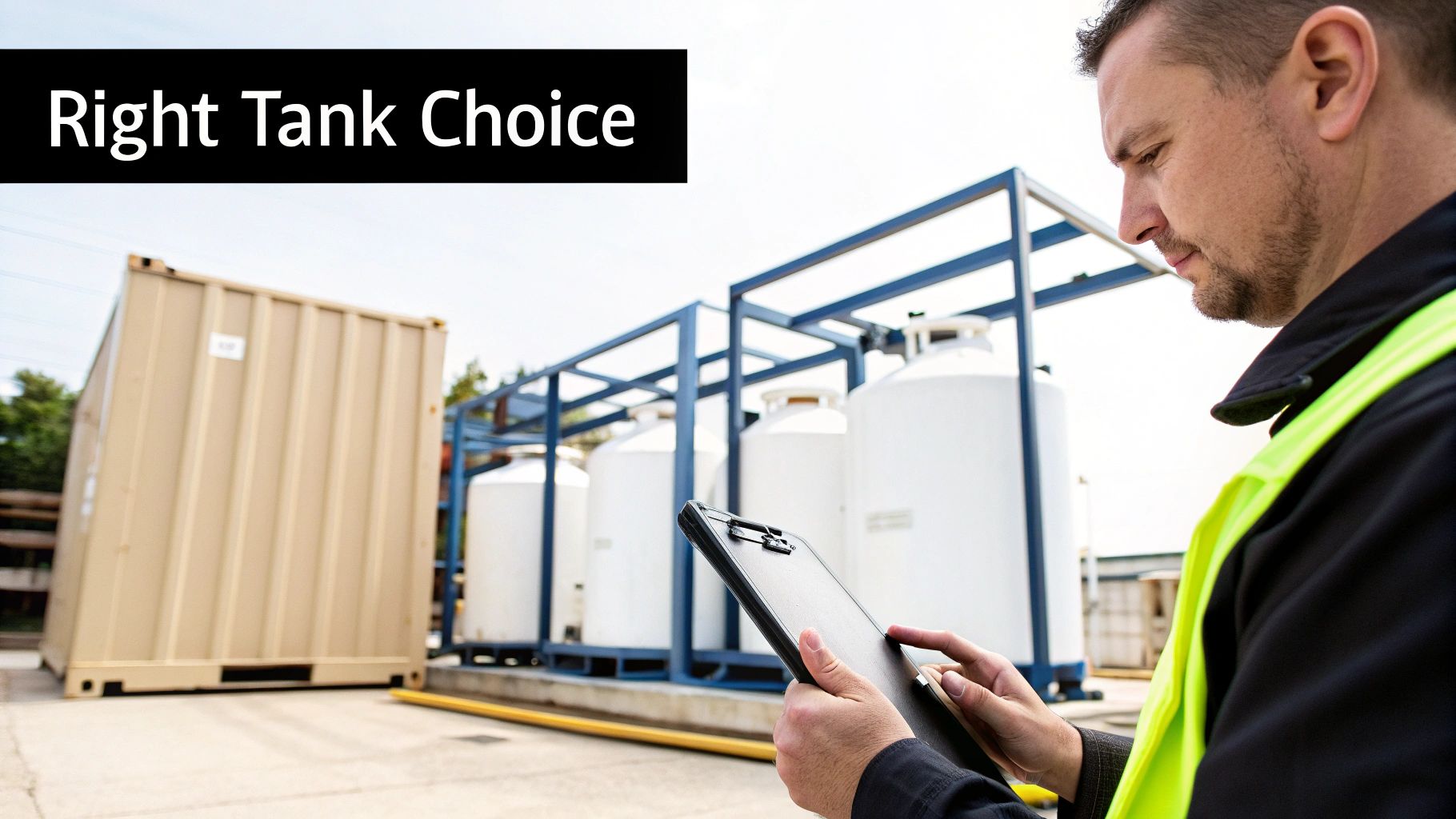
Choosing the right ISO tank container is about much more than just matching it to your cargo. It's a strategic decision that has a direct impact on safety, operational efficiency, and your bottom line. Get it wrong, and you could be looking at product loss, compliance headaches, or even a catastrophic failure.
To make a smart choice, you need to dig deeper than the basics. It’s about looking at the specific demands of your operation—everything from the chemical makeup of your product to the conditions it will face on its journey. A methodical approach is the only way to guarantee you end up with a container that performs exactly as you need it to.
First things first: you absolutely have to understand the product you're shipping. Its physical and chemical properties are what dictate the fundamental design requirements of the ISO tanks containers you’ll need.
Start by asking these essential questions:
Answering these questions gives you a solid starting point and immediately helps narrow down the field of suitable tank types for your job.
Selecting the correct tank is a critical control point in logistics. For instance, a biobank requiring a steady supply of Liquid Nitrogen (LN2) must prioritise a T75 tank with superior vacuum insulation to minimise boil-off and protect priceless biological samples.
This kind of scenario-based thinking is key to aligning your equipment with your operational needs.
Once you’ve figured out the right type of tank, the next puzzle piece is size and how it slots into your wider supply chain. Standard ISO tanks containers usually hold between 14,000 to 26,000 litres, but simply picking the biggest one isn't always the smartest move.
Think about your operational flow. Are you delivering smaller batches to several different locations, or is one large shipment the most cost-effective route? Don't forget the "80% fill rule"—a crucial safety measure that leaves ullage (empty space) for thermal expansion, which naturally affects your usable volume.
You also need to consider the infrastructure at both ends of the journey. Make sure the sites can handle the weight and dimensions of the tank you choose and have the right fittings for safe loading and unloading.
The material of the tank's inner shell has to be completely compatible with your product. A mismatch here can lead to corrosion, which not only compromises the tank's structural integrity but also contaminates your cargo.
Always double-check material compatibility using a chemical resistance chart or by speaking with an expert. This simple step can prevent incredibly costly damage and ensures your product stays pure from start to finish. It’s a small check that can save you from a world of financial and reputational pain.
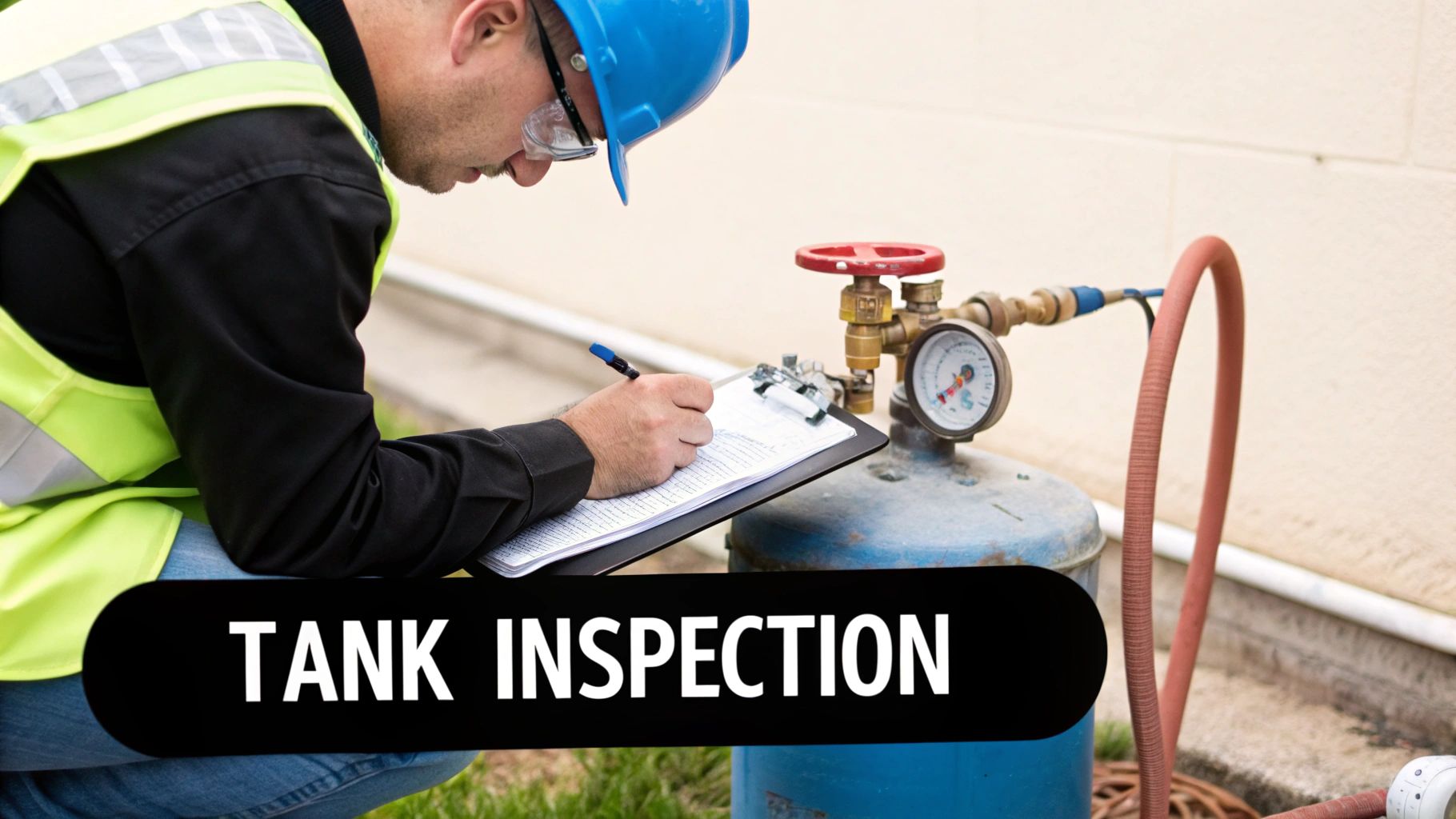
Think of an ISO tank container as a significant long-term asset. But like any high-value equipment, its real worth and operational lifespan are only unlocked through diligent care. A solid maintenance and inspection strategy isn't just about ticking compliance boxes—it’s about protecting your investment, ensuring safety, and guaranteeing product purity with every single shipment. Skimp on this, and you're looking at costly downtime, regulatory fines, and potentially compromised cargo.
Good maintenance doesn’t just happen during scheduled periodic checks. It's a continuous process that keeps the tank ready for its next journey at a moment's notice. This means getting into the habit of routine pre-trip inspections. Simple but consistent checks of valves, gauges, and safety relief devices can catch small issues before they snowball into serious problems.
A systematic approach is always the best way to maintain the integrity of your ISO tanks. Having a straightforward yet thorough checklist ensures no critical component ever gets overlooked.
Your daily or pre-trip checks should always include:
This proactive stance is absolutely essential for operators across Europe. In 2023, there were over 210,000 ISO tanks in use, with a huge number in Germany alone, supporting more than 320,000 intermodal trips. The entire fleet's safe and efficient operation hinges on these strict inspection protocols.
For industries like pharmaceuticals, biotech, and food and beverage, preventing cross-contamination is non-negotiable. Proper cleaning is a cornerstone of ISO tank maintenance, protecting the purity of high-value, sensitive products.
After each load, the tank must be thoroughly cleaned according to industry-specific standards. This often involves multi-stage washing with approved cleaning agents, high-pressure rinsing, and complete drying to eliminate any residue.
When it comes to cryogenic tanks used in biobanking or cell therapy, making sure the vessel is completely free from moisture or contaminants is paramount. This preserves the integrity of both the cryogenic liquid and the priceless biological samples it protects. You can learn more about our own commitment to operational excellence by exploring our detailed cryogenic safety guidelines.
Ultimately, a well-maintained ISO tank is a reliable one. By embedding these best practices into your daily operations, you don't just meet regulatory requirements—you extend the working life of your equipment. This reinforces the long-term value of your assets and ensures they perform safely and efficiently for decades.
As we've walked through the world of ISO tank containers in this guide, from their basic design to choosing the right one for your job, a few core ideas keep popping up. We've seen the power of standardisation, the critical role of specialised design, and the absolute, non-negotiable need for rigorous compliance. These aren't just buzzwords; they're the pillars of a secure, efficient, and reliable supply chain for the most sensitive materials.
Getting these elements right is what separates a merely functional logistics setup from a truly exceptional one. It’s about much more than just getting a product from point A to point B. It’s about making sure every single litre of cryogenic liquid or every biological sample arrives with its integrity perfectly intact, supported by a system that puts safety and predictability first, every step of the way. This is how a simple delivery becomes a guarantee of quality.
At Cryonos, we don't just sell tanks. We deliver complete, turn-key solutions built on these very principles. We know that biobanks, labs, and industrial gas suppliers need more than just a piece of equipment—they need a partner who can manage the intricate details of cryogenic transport. Our medical-licensed quality and ADR-compliant systems are designed to fit seamlessly into your operations, giving you the peace of mind that comes only from guaranteed compliance and top-tier performance.
Take the German chemical industry, for example. It heavily relies on clever ISO tank solutions to wrangle massive logistics costs and stay competitive. Customised tanks with advanced tracking are already cutting down on road mileage and boosting payload capacity, proving just how valuable specialised equipment can be. You can learn more about the evolving ISO tank container market and its impact on European logistics. This is the level of excellence we bring to the cryogenic sector.
Our job doesn't end when the equipment is delivered. We offer solid services like worldwide shipping and expert technical support to make sure your work continues without a hitch. The long maintenance intervals and five-year warranties on our products speak to our confidence in their durability and reliability.
We believe true partnership is about end-to-end support. From navigating customs to providing on-site maintenance, our team is built to be an extension of yours. That way, you can stay focused on your core mission.
Your challenges are unique, so your logistics solution should be too. If you're dealing with the complexities of cryogenic storage and transport, our experienced technicians are here to help. See how our dedicated transport solutions can protect your most critical assets. Get in touch today, and let's talk about building a secure, compliant, and efficient logistics framework that’s made just for you.
When you start looking into ISO tank containers, a few practical questions almost always pop up. Let's tackle some of the most common ones to give you a clearer picture of their value, flexibility, and how they fit into modern logistics.
An ISO tank isn't a disposable item; it's engineered for the long haul. Thanks to its tough stainless steel core and a protective outer frame, a well-cared-for tank is a genuine long-term asset.
With the right maintenance schedule and by following the mandatory periodic checks, an ISO tank container can easily last 20 to 30 years, and sometimes even longer. This incredible durability makes it a far more sustainable and budget-friendly choice compared to single-use options like drums or flexibags, which just add to the waste pile after one trip.
While their main job is moving cargo between trucks, trains, and ships, ISO tanks are robust and sealed, making them perfectly suitable for temporary or intermediate storage. Think of them as a handy buffer in your supply chain, holding product safely until you're ready for the next step in production or distribution.
But for dedicated, long-term storage, especially for sensitive cryogenic products, they might not be the best tool for the job. Specialised stationary vessels are usually the way to go here. Those units are built specifically to minimise product loss from evaporation over long periods—a crucial detail when you're dealing with substances like Liquid Nitrogen (LN2), where every litre is valuable.
The capacity of an ISO tank is measured in litres, with standard sizes typically falling between 21,000 to 26,000 litres. This gives you a massive volume for bulk liquids and gases. A single tank can do the work of dozens of smaller containers, which really simplifies handling and cuts down on costs.
When you're planning a shipment, though, there's one golden rule you can't forget: the '80% fill rule'.
The '80% fill rule' is a critical safety measure that requires leaving at least 20% of the tank's volume empty. This space, called ullage, is vital for accommodating the natural thermal expansion of liquids during travel, which prevents a dangerous build-up of pressure.
So, a 25,000-litre tank really has a safe fill capacity of around 20,000 litres. Factoring this into your logistics is an absolute must for a safe and compliant journey.
At Cryonos GmbH, we don't just supply state-of-the-art cryogenic equipment; we provide the expertise to help you master these critical operational details. Explore our complete range of secure and compliant solutions for your laboratory, biobank, or industrial needs.

