No Products in the Cart




You're standing at a familiar bench problem. A solution needs heating, but it also has to stay uniform from top to bottom. If someone heats it without mixing, temperature gradients form. If someone stirs it by hand, the result depends on technique, timing, and patience. In a regulated laboratory, that's not a small inconvenience. It's a repeatability problem.
That's why magnetic hotplate stirrers have become such a standard part of modern lab work. They combine controlled heating with hands-free mixing in one compact device, which sounds simple until you consider what that means for sample preparation, media dissolution, buffer making, and routine analytical work. For a new lab manager, they often look straightforward on the surface, but the value lies in the details: how stable the temperature is, how reliably the stir bar stays coupled, and how closely real solution conditions match the setpoint on the display.
A magnetic hotplate stirrer solves a practical lab problem that used to require too many compromises. You need heat. You need motion. You need both at the same time, without introducing contamination from a manual stirring rod or uneven heating from an improvised setup.
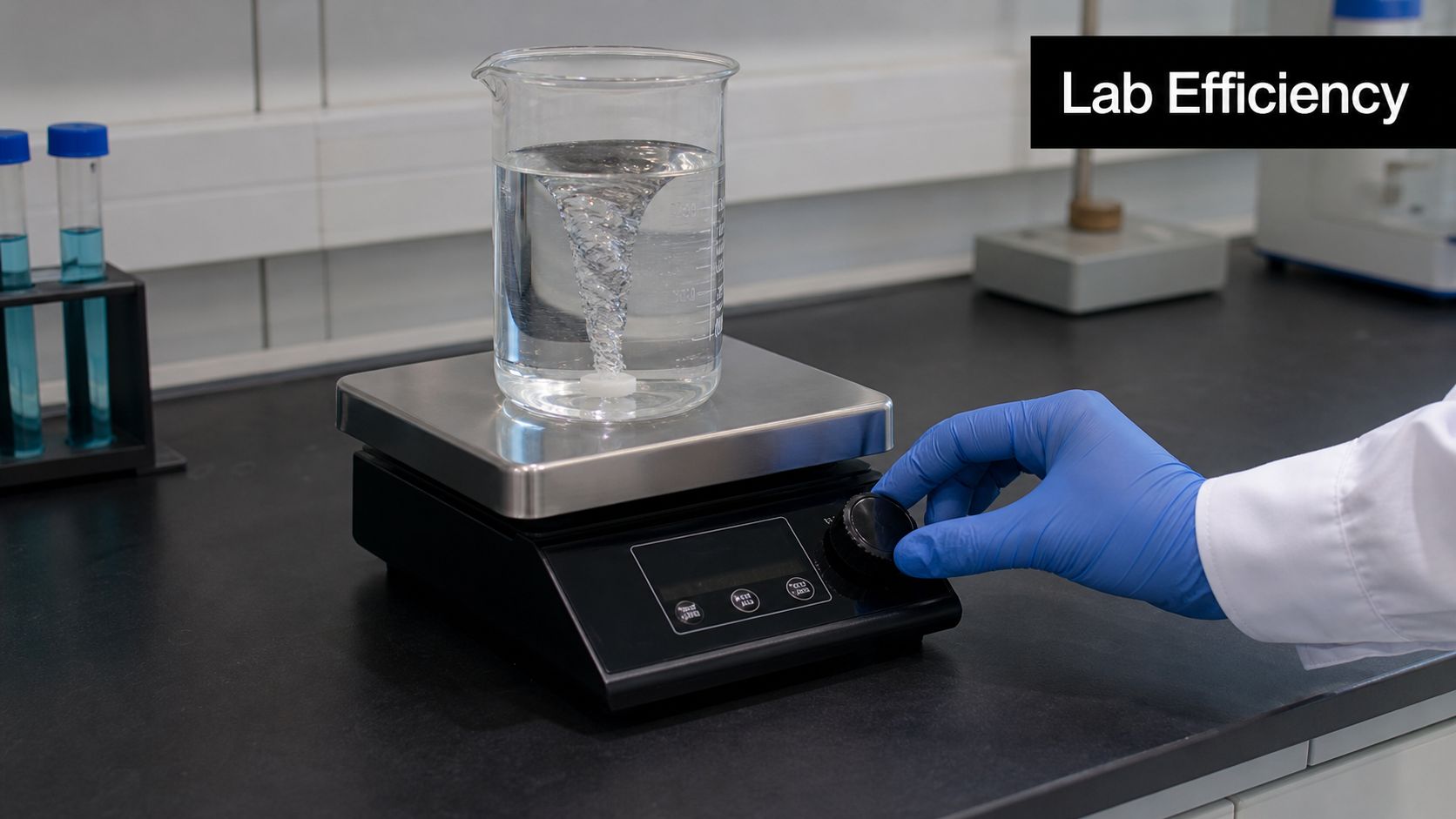
In daily laboratory use, that combination matters more than many buyers first realise. A buffer has to dissolve fully. A reagent blend has to remain homogeneous while warming. A sensitive preparation step has to be performed the same way by different operators on different days. The instrument turns those tasks into a controlled process rather than a manual skill test.
The reason these devices became so common is not just convenience. It's control.
Instead of one person heating and another person watching for hotspots or settling solids, the unit continuously stirs while the plate supplies heat. That reduces manual intervention and helps standardise preparation steps. In practical terms, this is why magnetic hotplate stirrers appear so often in chemical, pharmaceutical, academic, hospital, and industrial labs.
Practical rule: If a liquid must be both warmed and kept uniform, a combined hotplate stirrer is usually safer and more repeatable than separate manual steps.
A good operator quickly notices another benefit. Bench space stays organised. One device replaces a more awkward arrangement of separate tools, and fewer hands-on steps usually means fewer chances for spills, splashes, or inconsistent timing.
For a lab manager, this instrument isn't just another bench accessory. It affects training, reproducibility, and workflow consistency.
When teams choose the wrong model, they tend to see the same issues: weak stirring at higher viscosity, overshoot during heating, unstable low-speed control, or a display temperature that doesn't reflect what's happening in the vessel. Those problems don't always show up in a brochure, but they show up quickly in daily use.
That gap between specification and performance is where most buying mistakes happen.
At first glance, magnetic hotplate stirrers can seem almost invisible in how they operate. You place a beaker on top, drop in a stir bar, set speed and temperature, and the liquid starts moving while the vessel warms. The mechanism is simple once you break it into two separate systems.
A useful way to think about the stirring side is this: one magnet spins below a surface, and another magnet above that surface follows it. The plate sits between them, but the magnetic field still couples the motion.
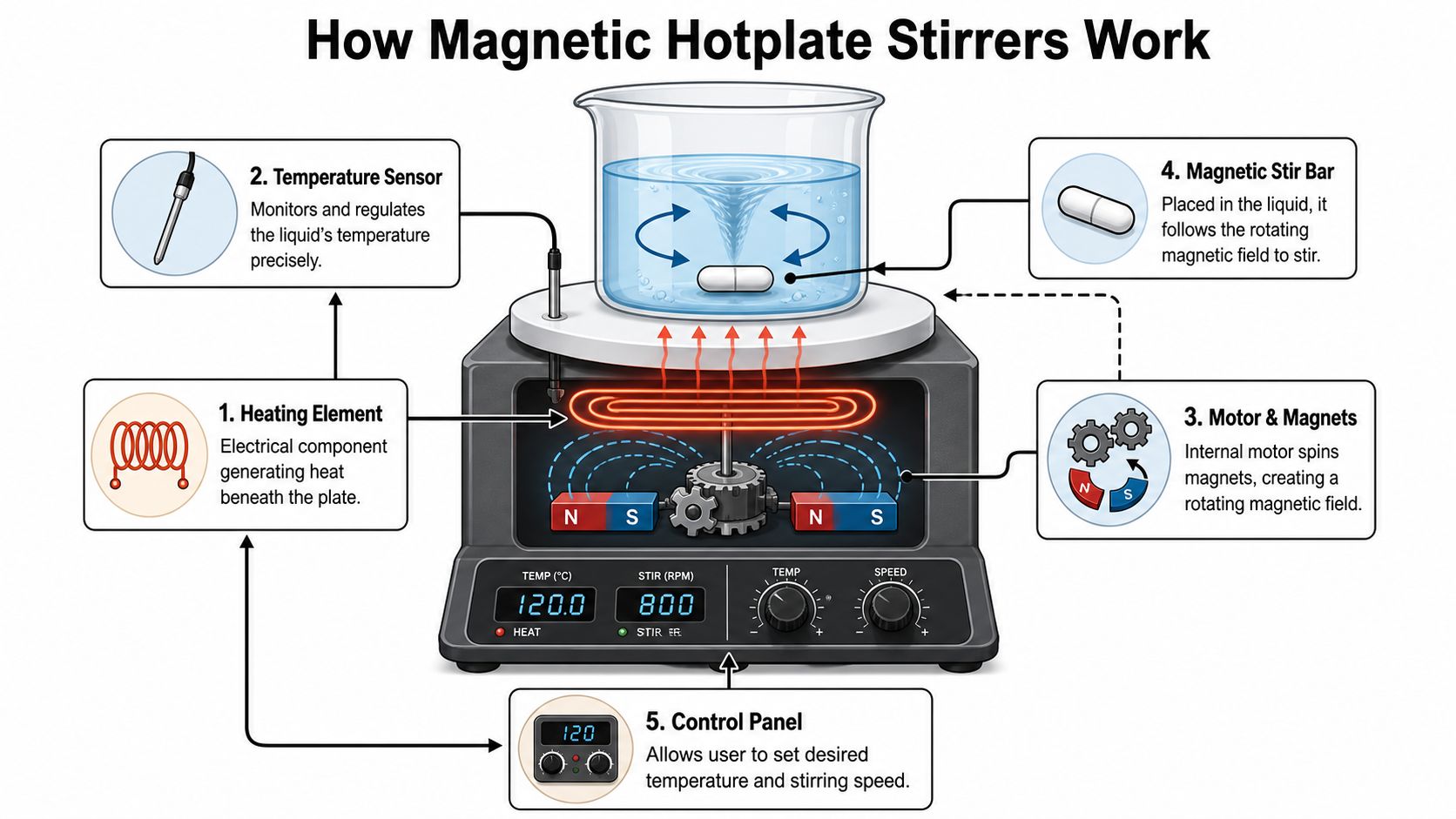
Inside the unit, a motor rotates a magnetic assembly. Inside the vessel, a small magnetic stir bar responds to that rotating field and spins with it. As the bar turns, it pulls the surrounding liquid into motion and creates mixing.
That stir bar has a long history. According to Labnet International's note on the history of the magnetic stirrer, Richard Stringham patented the first magnetic stirrer in 1917, and the stir bar was nicknamed a “Flea” because it jumped and spun in the flask. The basic principle remains the same today, even though modern instruments offer better control, safer housings, and more refined electronics.
Readers often get confused about one point here. The stir bar is not powered directly. There is no wire, battery, or motor inside the vessel. The motion comes entirely from magnetic coupling through the plate.
The heating function is separate from the stirring function, even though the user experiences them as one process. A heating element beneath the plate converts electrical energy into heat. That heat moves into the plate surface, then into the vessel, and finally into the liquid.
This sequence explains why the displayed plate temperature and the actual liquid temperature aren't always identical. Heat has to travel through material interfaces, vessel walls, and the liquid itself. If mixing is poor, one region of the solution may warm faster than another.
A short visual demonstration helps make that relationship easier to grasp.
The benefit emerges when stirring and heating happen simultaneously. Stirring improves heat distribution through the liquid, and heating changes viscosity and dissolution behaviour, which in turn affects how the liquid stirs.
Here's where users often run into trouble:
Stable stirring is not just about making a visible vortex. It's about keeping the entire solution as close as possible to one consistent thermal and compositional state.
Once you understand that, the machine stops looking like a black box. It becomes a controllable combination of motor, magnetic field, heating element, sensor, and operator settings.
A new lab manager often starts with the datasheet and assumes the biggest numbers point to the best instrument. Then the unit arrives, the method is transferred, and a simple task like warming a buffered solution takes longer than expected or settles at the wrong actual liquid temperature. That gap between brochure values and bench behaviour is where specification reading becomes a practical skill.
Commercial magnetic hotplate stirrers are commonly sold with broad heating ranges, moderate to high stirring speeds, and small-to-medium volume capacities, as shown in Ted Pella's hotplate and stirrer product information. Those values help you sort products into classes. They do not tell you, by themselves, whether a unit will hold a narrow working temperature in your vessel, with your fill volume, under your room conditions.
The maximum plate temperature is easy to advertise. The more useful question is narrower. How accurately can the instrument bring a real sample to the temperature your SOP requires, and how steadily can it keep it there?
For regulated laboratories, that distinction matters every day. A plate may be able to reach very high surface temperatures, yet still show a meaningful difference between the setpoint, the plate surface, and the liquid inside the vessel. If your workflow involves media, buffers, reagents, or other temperature-sensitive preparations, repeatability at ordinary working temperatures usually matters more than extreme top-end heat.
Controller design plays a large role here. A PID controller works like a driver making small steering corrections instead of jerking the wheel. It continually adjusts power to reduce overshoot and drift. That usually gives tighter control than simple on-off heating, especially during long runs or when the thermal load changes.
External temperature sensing can matter even more than the controller label. If your process depends on the actual liquid temperature rather than the plate surface temperature, a probe-based setup may be closer to what you need. In some workflows, a laboratory water bath for gentle temperature control is chosen for the same reason. It often gives more direct control over the sample environment than dry plate heating.
RPM is often misunderstood because it looks precise. In practice, it is only one part of mixing performance.
A stirrer rated for high speed may still struggle with viscous liquids, tall vessels, off-centre loading, or a poorly matched stir bar. Another unit with a lower headline RPM may produce more stable mixing because the magnetic coupling stays engaged under load. For daily lab work, stable low and mid-range control is often more useful than an impressive maximum number.
A simple way to read this spec is to treat RPM like a car's speedometer. It tells you how fast the wheels can turn, not how well the car climbs a hill with passengers inside. In the same way, stirring performance depends on liquid resistance, vessel geometry, fill volume, and stir bar selection, not just the number printed on the sheet.
Capacity ratings are best read as upper limits. They are not a promise of ideal performance at that volume.
If a unit is rated to handle a given load, expect mixing and heating to be easier and more predictable below that limit. Near maximum capacity, small differences in vessel diameter, liquid viscosity, ambient heat loss, or bar alignment can have a visible effect. In a regulated setting, that means two operators can follow the same written method and still get slightly different thermal behaviour if the system is working close to its limit.
That is why experienced buyers leave headroom.
The top plate affects chemical compatibility, heat transfer behaviour, cleaning, and long-term wear. Ceramic and aluminium are the most common choices, but the better option depends on the type of work your lab does.
| Feature | Ceramic Top | Aluminium Top |
|---|---|---|
| Chemical resistance | Typically preferred when resistance to corrosive exposure is important | Usually less resistant than ceramic in harsh chemical contact |
| High-temperature suitability | Often chosen for higher-temperature and chemically demanding work | Commonly selected where fast heat transfer is valued |
| Heat transfer character | Good surface durability, but heating behaviour depends on model design | Often associated with quicker, more even heat spread across the plate |
| Surface strength | Resistant to many chemical exposures when handled correctly | Mechanically strong, but surface condition still matters for performance |
| Typical buying priority | Chemical resistance and high-temperature tolerance | Heating uniformity and responsive heat transfer |
Ceramic tops are often chosen where chemical exposure is a bigger concern. Aluminium tops are often chosen where faster heat response and more even plate spread are priorities. Neither material is automatically better. The right choice depends on what the plate sees in normal use, how often it is cleaned, and how tightly your process depends on heat-up behaviour.
One of the most important performance questions rarely appears as a single headline spec. It is the difference between the displayed temperature and the temperature the sample experiences.
That difference can be small in one setup and significant in another. Vessel wall thickness, vessel material, liquid volume, sensor position, mixing quality, and heat loss to the room all affect it. This is one reason two hotplate stirrers with similar datasheet values can behave very differently in the same laboratory.
For Cryonos GmbH, this is the point where selection becomes less about catalog comparison and more about process fit. If your lab works under GMP, GLP, ISO, or internal validation rules, temperature control should be judged by real sample conditions, not only by the plate specification. A good buying decision comes from asking a practical question early: what temperature does the liquid need to reach, how close must it stay to that target, and how will we verify that during routine use?
In regulated environments, magnetic hotplate stirrers are rarely used for dramatic chemistry. More often, they handle the quiet, routine steps that determine whether later analytical or biological work is trustworthy. When a solution is prepared badly at the start, every downstream step carries that error forward.
A biobank technician may need to prepare buffers, warm aqueous solutions, or resuspend material without introducing strong shear or contamination risks. In that setting, a magnetic hotplate stirrer offers controlled mixing with limited hands-on contact.
Hospitals and fertility clinics face similar needs during routine preparation tasks. The priority is not theatrical speed. It's consistency between operators, shifts, and batches. That's also why some labs compare these units with alternatives such as a laboratory water bath for gentle temperature control when direct plate heating may not suit the sample.
Cell therapy workflows often involve dissolving powders, preparing supplements, or combining media components that need uniform mixing while warming. If heat distribution is uneven, dissolution slows down. If the temperature rises too aggressively, heat-sensitive components may be exposed to conditions the operator didn't intend.
That makes controllable mixing valuable even when the target temperature is modest. The device doesn't replace good process design, but it gives staff a repeatable base condition.
In sensitive prep work, the difference between “heated” and “heated evenly” can decide whether a process behaves the same way tomorrow.
In pharmaceutical quality control labs, solution preparation often feeds directly into analytical methods. If powders don't dissolve completely, or if the sample isn't homogeneous when aliquots are taken, the analytical result may reflect sample handling rather than product quality.
For that reason, hotplate stirrers are commonly used during sample dissolution, reagent preparation, and pre-analysis mixing steps. The value is procedural discipline. The instrument keeps the sample moving while the operator performs other parts of the workflow.
Some laboratories need parallel processing rather than one-vessel-at-a-time preparation. For those settings, multi-position magnetic hotplate stirrers can scale throughput. One documented configuration supports six vessels up to 1 L each, with a stirring range of 150 to 1600 rpm and 300 W heating power according to SISCO's six-position magnetic stirrer product page.
That kind of setup is useful for parallel sample preparation, method comparison, or batch-style routine work. The main operational lesson is simple: throughput increases, but thermal demand also increases, so users need to watch how evenly heat is shared across the workload.
At 8:30 a.m., one analyst is dissolving a buffer, another is warming a viscous standard, and a third needs a repeatable prep step for a regulated method. All three jobs may fit on the same type of instrument. They do not place the same demands on it.
That is why hotplate stirrer selection should start with workflow, not with the highest temperature or the longest feature list. In real laboratories, the gap between a datasheet setting and the temperature inside the liquid is often where problems begin. A unit can reach the stated plate temperature and still heat the sample too slowly, too unevenly, or with more overshoot than the method can tolerate.
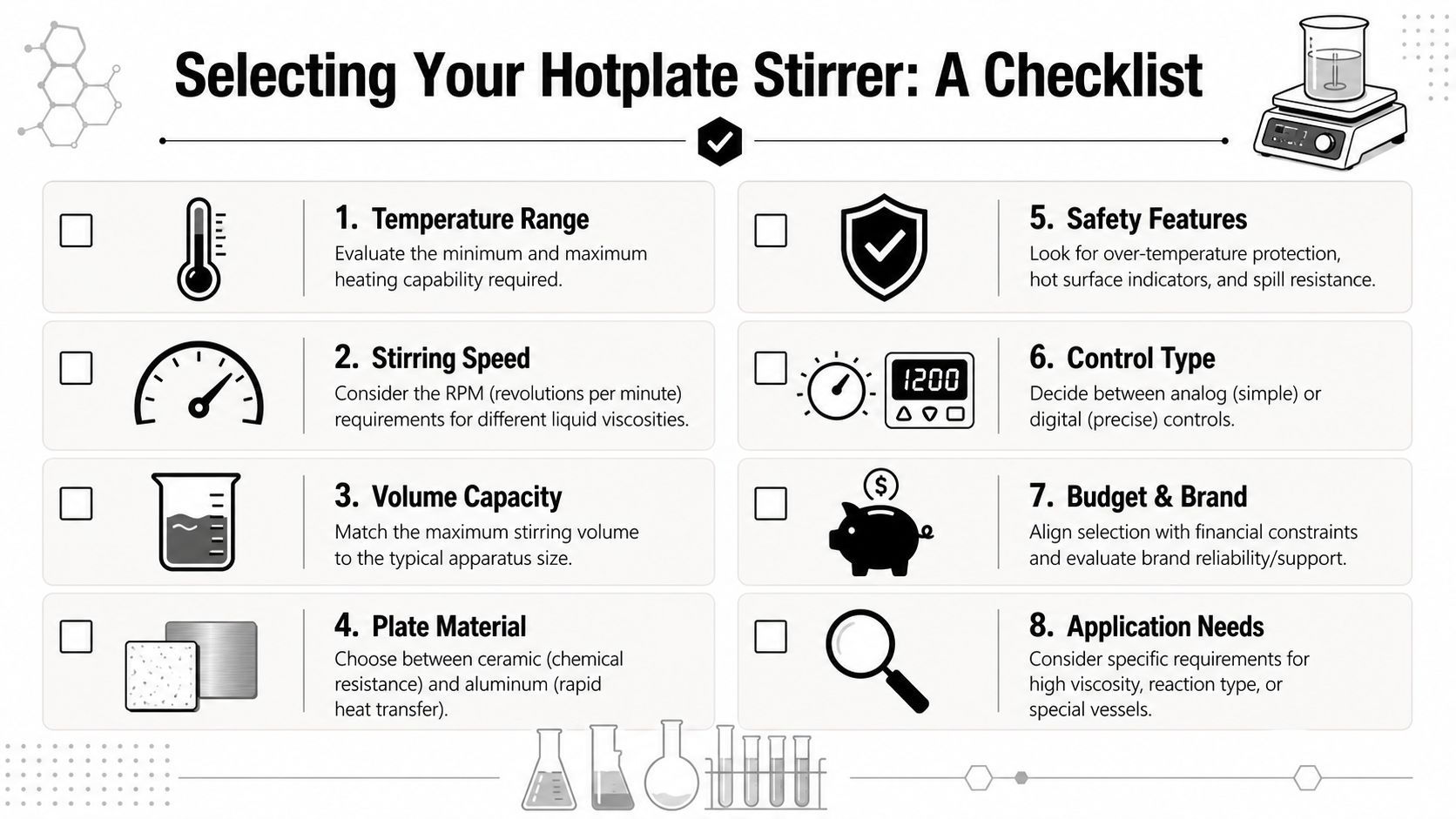
For a new lab manager, the easiest mistake is buying for nominal capacity. The better approach is to buy for the hardest routine task the instrument must handle predictably, day after day. Cryonos GmbH recommends treating the hotplate stirrer as part heater, part mixer, and part process-control device. If one of those three roles is mismatched to the application, the whole setup becomes less reliable.
The vessel and the liquid behave like a heat-transfer system together. A thin aqueous solution in a flat-bottom beaker responds very differently from a viscous formulation in a tall glass vessel. The hotplate only heats the vessel surface. From there, heat still has to move through the liquid, and stirring has to distribute it.
Ask these questions first:
This is the practical reason many labs see a difference between the setpoint on the screen and the temperature measured in the sample. The instrument is controlling the plate. Your method depends on the liquid.
A precise display is useful, but the display alone does not tell you how the unit behaves after you place a real vessel on it. In regulated environments, that distinction matters. Repeatability depends on how well the hotplate stirrer responds to changing thermal load, room conditions, fill volume, and viscosity.
A good selection question is simple: how stable is the unit once the sample is heating and mixing?
For more demanding methods, prioritize:
A hotplate stirrer works like a stovetop with a built-in mixer, but laboratory work is less forgiving than cooking. A few degrees of overshoot may be harmless in general prep. In sample preparation for validated methods, the same drift can change dissolution rate, viscosity, or reaction timing.
If your process needs mixing without direct heating, a dedicated laboratory orbital shaker may fit that task better. It serves a different motion pattern and should be chosen for different workflows.
Shared labs often struggle less with raw instrument power than with setup inconsistency. One operator centers the vessel well and chooses the right stir bar. Another uses the same unit with a different beaker, different fill level, and a bar that decouples halfway through the run. The result is not a faulty instrument. It is a poor match between equipment, procedure, and user environment.
That is why buying standardization has value. Similar controls across benches reduce training time and lower the chance of setup variation between operators.
Selection should include what happens after installation. Service access, replacement parts, and calibration options affect whether the unit stays useful over years of routine work.
Review these points before purchase:
The best hotplate stirrer is usually the one that behaves predictably with your actual vessels, liquids, and operators. In regulated labs, that predictability matters more than headline specifications.
A hotplate stirrer often fails a process long before it fails electrically. The usual problem is drift between what the unit should do, what the display suggests, and what the liquid in the vessel experiences. In a regulated lab, that gap matters. A plate can look clean, power on normally, and still give unreliable heating because residue, sensor offset, or poor setup has changed how heat reaches the sample.
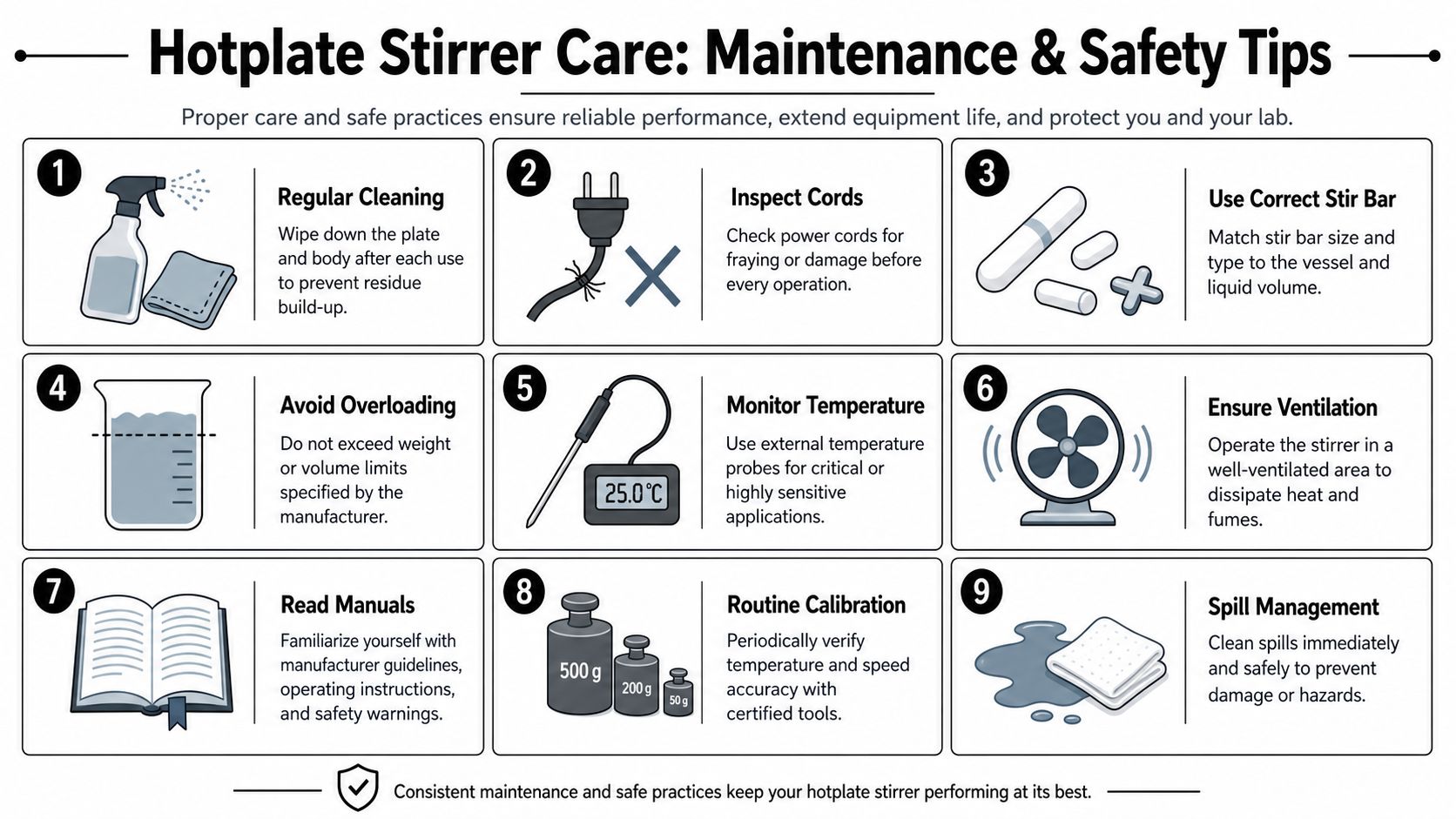
Good maintenance is really heat-transfer control plus basic electrical safety. If either part is neglected, the instrument becomes harder to trust.
Treat the plate surface like a contact area, not just a housing cover. Any baked-on residue acts like an unwanted barrier between the heater and the vessel base, much like scale on a heat exchanger. Even a small patch can change how evenly heat moves into the liquid.
A practical routine looks like this:
These checks are simple, but they prevent two common lab problems. Poor stirring reduces temperature uniformity in the liquid, and a dirty or damaged top plate reduces consistency from run to run.
Built-in protections help, but they do not verify that your sample is at the intended temperature. That is the practical gap many new lab managers discover after installation. The instrument may control the plate well while the solution still runs hotter, cooler, or less evenly than the process allows.
For routine work, the built-in control system may be adequate. For release testing, validated preparation steps, or temperature-sensitive chemistry, confirm the liquid temperature with an external probe or separate reference check. This is especially important after servicing, relocation, heavy spill events, or any change in vessel type.
Use direct precautions:
Labs that maintain other thermal equipment usually apply the same discipline across the bench and the room. The same logic used for laboratory water cooling systems and temperature control infrastructure applies here. Stable results depend on the whole thermal path, not just the number on the display.
A hotplate stirrer in a critical process should be treated as a controlled heat source that also mixes, not as a simple warming device.
In GxP and ISO environments, maintenance records show whether the unit remained suitable for use between purchase and audit. That is the point of the paperwork. It creates traceability when someone asks a basic but important question: why should this temperature reading be trusted on this day, for this batch, with this method?
Record cleaning, inspection, temperature verification or calibration activity, repairs, and any event that could affect performance. If one unit is reserved for critical preparation steps, identify it clearly in the SOP and define what checks are required before release-related work.
A short, repeatable log is usually better than an elaborate form that staff stop using. The goal is consistent evidence, not paperwork for its own sake.
Most day-to-day problems follow a small number of patterns. A quick, orderly check often solves them without service intervention.
Likely causes include excessive speed, poor vessel centring, the wrong stir bar, or a liquid that's more difficult to mix than expected.
Try these steps in order:
This often comes from the vessel rather than the heater itself. Poor thermal contact, residue on the plate, or insufficient mixing can all make heating appear weak.
Work through the basics:
If speed fluctuates, start by checking for spills, sticky controls, or unstable placement on the bench. If the instrument doesn't power on, inspect the power connection and remove the unit from use if any electrical damage is visible.
If the simplest checks don't resolve the issue, document the fault and hand it over for qualified service rather than improvising a repair.
If your lab is reviewing heating and mixing equipment alongside cryogenic storage, transport, and sample-handling infrastructure, Cryonos GmbH can help you source reliable laboratory solutions with practical technical support. Their team works with biobanks, hospitals, research institutes, and cell therapy environments that need dependable equipment, strong service continuity, and compliance-focused guidance.

