No Products in the Cart




Your cultures are growing, but your workflow probably isn't. A few flasks on a bench shaker and a separate incubator can carry a project for a while. Then one day the work changes. More samples. More repeat runs. More pressure to keep conditions consistent across people, shifts, and rooms.
That's usually when a lab manager starts looking for a shaker for incubator use and realises the choice isn't as simple as “buy the one with the right rpm”. The hard part isn't only shaking speed. It's long-term compatibility, environmental control, cleaning burden, service access, and whether the setup will still make sense when your throughput doubles.
In Germany and across European research hubs, this category matters because it sits inside a broader laboratory-instrument market valued at USD 0.31 billion in 2025 and projected to reach USD 0.46 billion by 2034 at a 4.31% CAGR, according to Custom Market Insights' incubator shaker market overview. That scale reflects how central controlled incubation and agitation have become in life-science work, especially in dense research environments such as biopharma labs, hospitals, and academic institutes.
The first sign you've outgrown an improvised setup isn't always a breakdown. More often, it's inconsistency. One batch grows well, the next one lags. One technician fills flasks a little differently. Another uses a slightly different shelf position. Someone opens the incubator door more often than they should because samples are spread across too many devices.
A proper incubator shaker solves a very specific lab problem. It keeps temperature-controlled incubation and continuous agitation in one controlled system so your cultures aren't relying on workarounds.
Early-stage setups often depend on habits that don't scale well:
For suspension cultures, microbial growth, and process development work, controlled movement isn't a luxury. It's part of the biology. If the culture needs motion for gas exchange or to stay evenly suspended, the device choice affects the result directly.
Practical rule: If your team has started building unwritten rules around one awkward piece of equipment, you've probably reached the point where dedicated equipment will save time and reduce avoidable variation.
German labs, especially those linked to biotechnology, hospitals, biobanks, and pharmaceutical development, operate in environments where reproducibility matters as much as capacity. An incubator shaker sits right in that overlap. It isn't just a convenience tool. It's standard equipment in workflows that need stable culture conditions and controlled agitation.
That's why buyers who focus only on purchase price often regret it later. The key question isn't “Can this unit shake?” It's “Can this unit support our biology, our cleaning routine, our validation needs, and our expected throughput without becoming a constant workaround?”
An incubator shaker combines two jobs in one machine. It holds samples at a controlled temperature, and in some models a controlled atmospheric environment, while also moving them in a defined shaking pattern. The simplest way to think about it is this: it's a climate-controlled mixing platform for living samples.
That dual function matters because many cultures don't grow well in a static vessel. Cells and microorganisms may need motion to improve mixing, support gas exchange, and reduce settling.
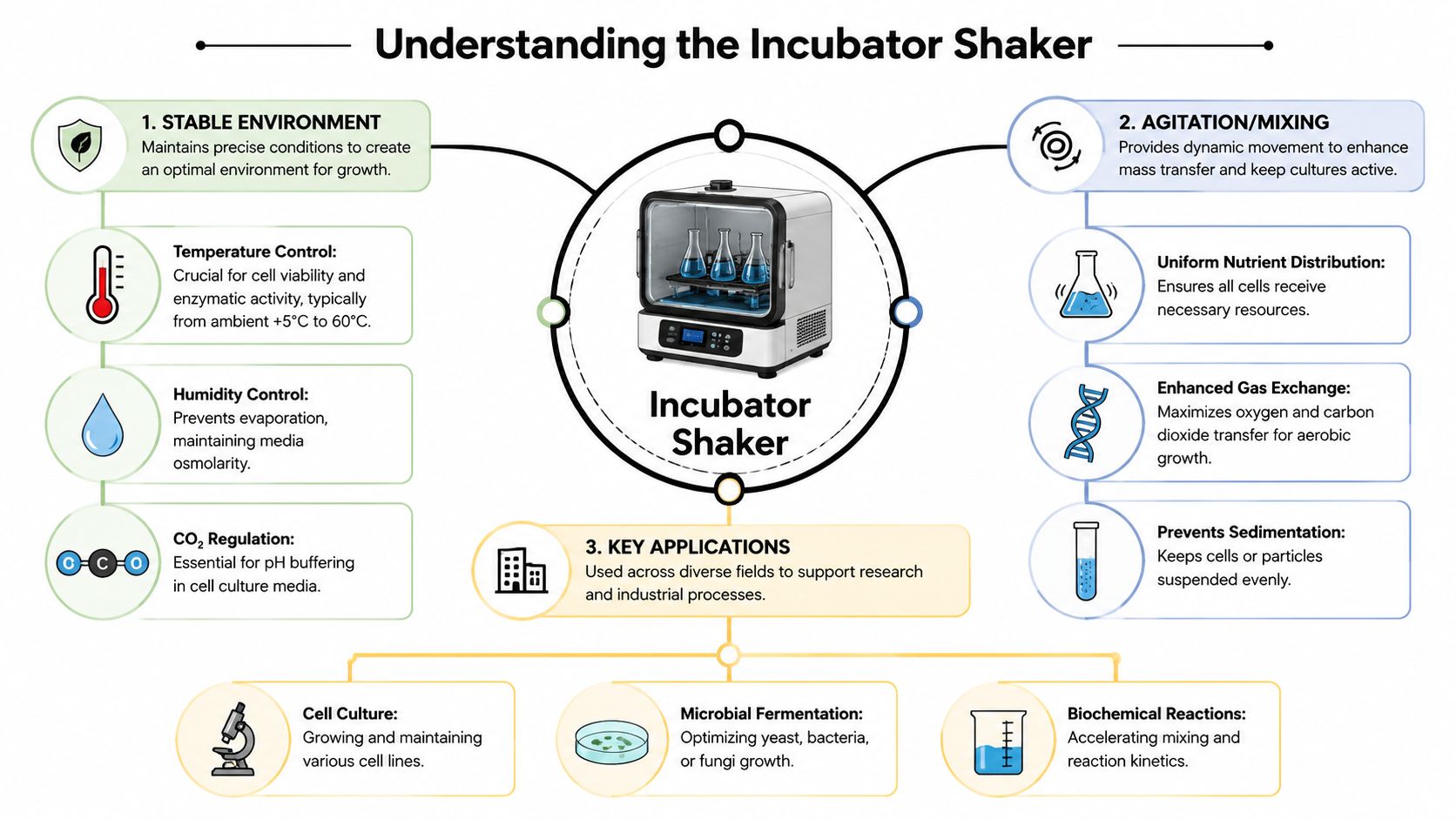
A standard incubator creates a stable environment. A standard shaker creates motion. An incubator shaker does both at once, which is why it's common in microbiology, protein expression work, and suspension culture workflows.
Here's what each side contributes:
For many buyers, the confusion starts with the word “incubator”. They assume every model automatically handles CO2 and high humidity. That isn't true. Some units are temperature-controlled shakers only. Others are built for cell culture conditions that include CO2 and humidity management. You have to match the chamber environment to the biology.
The shaking action affects more than whether liquid looks mixed. In practice, motion changes oxygen transfer, evaporation behaviour, and how evenly cells or microbes experience their medium.
One lab-grade model lists a temperature range from ambient plus 5°C to 60°C, while another table-top unit reaches 70°C and 400 rpm with a 450 × 450 mm shaking plate, as shown in Stericox's incubator shaker specifications. Those figures are useful because they show the general operating envelope many buyers will encounter.
What often gets missed is that the highest speed on the spec sheet isn't automatically the best setting. Flask shape, fill volume, closure type, and splash risk can limit what's usable in daily work.
A shaker that can run faster than your vessels can safely tolerate isn't giving you more process freedom. It may just be giving you a larger number on a brochure.
Incubator shakers tend to appear where cultures must stay active during incubation:
The key point is simple. If your sample needs stable heat and controlled motion at the same time, a proper incubator shaker is usually the right class of equipment.
The first buying mistake many people make is comparing models before they've decided on the motion type. That's backwards. Start with the movement profile, because the way a platform moves changes how your culture behaves.
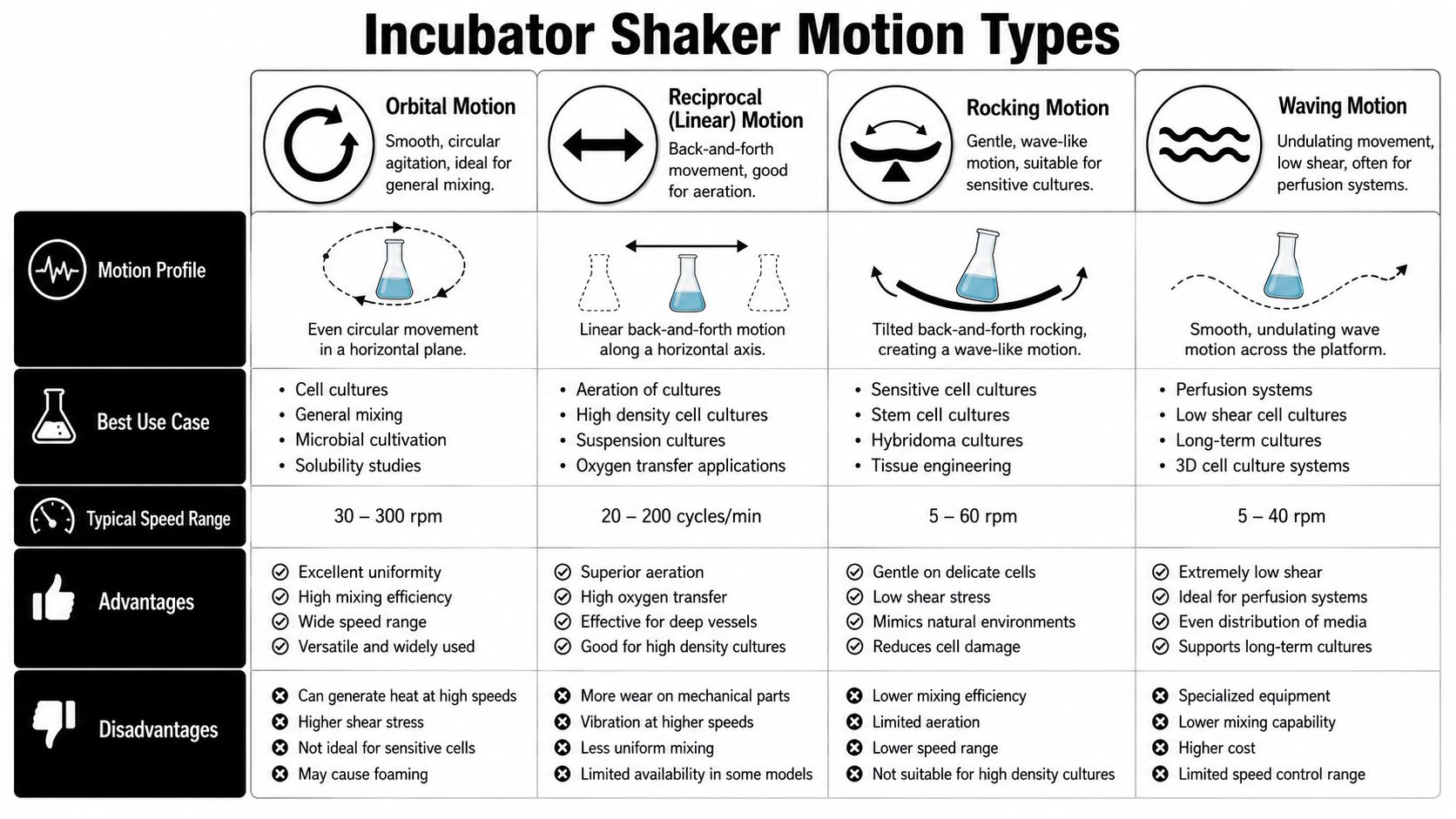
This is the motion most labs mean when they talk about an incubator shaker. The platform moves in a circular path, which creates smooth, repeatable mixing and is widely used for flask culture.
Orbital motion usually suits:
If your team is still getting familiar with shaker selection, a good primer on orbital shaker laboratory basics can help frame the differences between orbital units and other shaker formats.
Reciprocal shakers move back and forth in a straight line. That creates a more directional sloshing effect than orbital movement. Some labs prefer it for extraction, washing, or applications where the sample benefits from stronger directional agitation.
The trade-off is that reciprocal motion can be less universally useful for standard flask culture. It can work well, but it tends to be chosen for more specific process needs rather than as a default all-rounder.
Rocking platforms tilt gently from side to side. This creates a wave-like movement rather than a circular one. It's often chosen when the sample is more sensitive or when the goal is gentle mixing rather than vigorous aeration.
This type can make sense for:
Waving motion is common in specialised disposable-bag or perfusion-style setups rather than in the classic flask-based incubator shaker format. It produces an undulating liquid wave and can support low-shear processing.
Most first-time buyers won't choose this unless their process already points toward bag-based culture systems or a specialised bioprocess platform.
| Motion type | What it feels like in use | Best fit |
|---|---|---|
| Orbital | Smooth circular mixing | General culture, flasks, routine biotech work |
| Reciprocal | Back-and-forth agitation | Extraction, washing, directional mixing |
| Rocking | Gentle wave motion | Sensitive samples, lower-shear handling |
| Waving | Undulating fluid movement | Specialised bag or perfusion workflows |
If you're buying for a mixed-use lab and don't have a specialised process constraint, orbital motion is usually the most practical starting point.
The point isn't that one motion is universally superior. It's that a mismatch here can't be fixed later by buying a nicer control panel or a larger platform.
Once you've chosen the motion type, the spec sheet becomes useful. At this point, you stop shopping by category and start judging whether a specific unit can support your actual vessels, your room layout, and your cleaning routine.
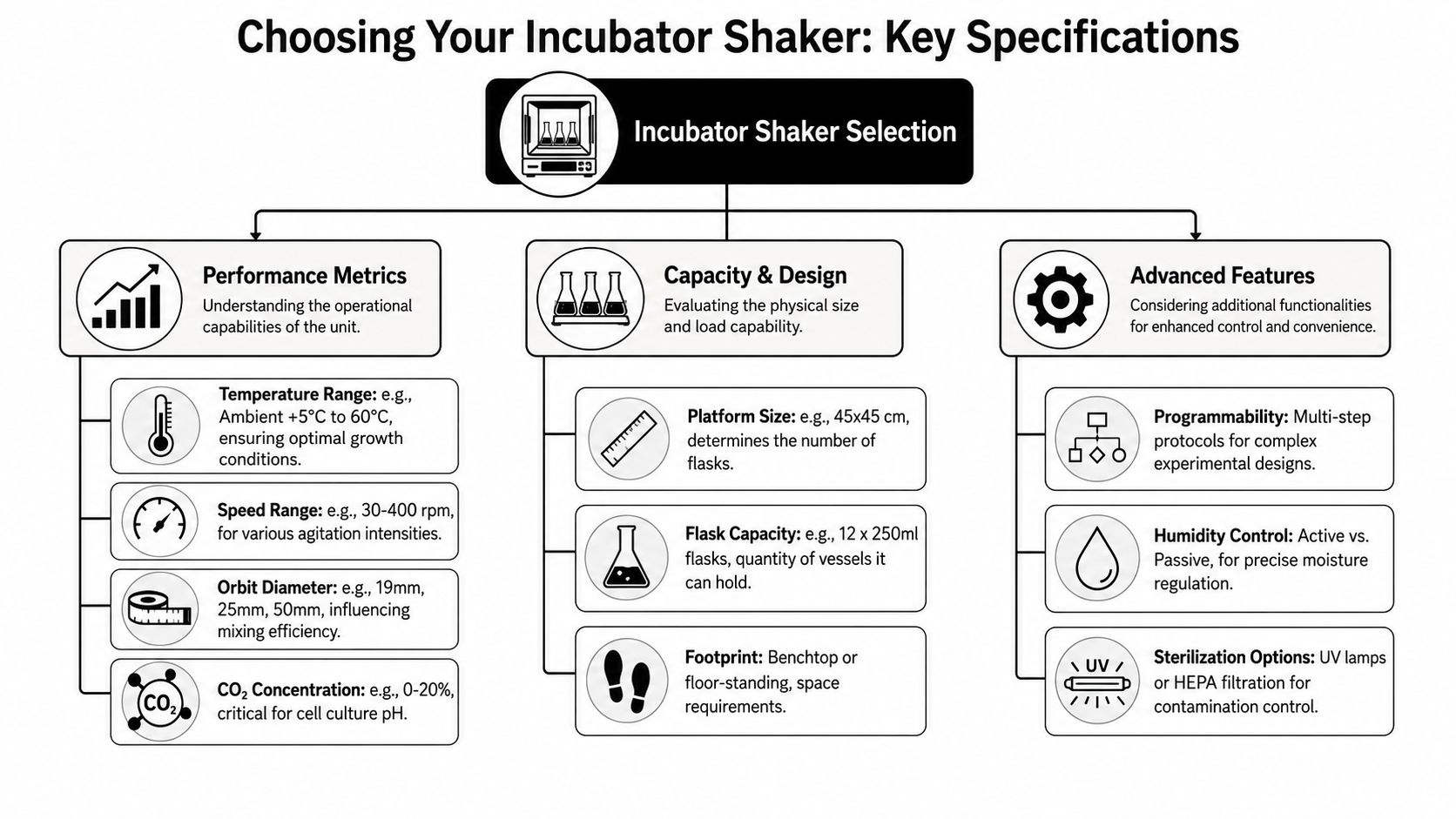
Most buyers look first at temperature range and rpm. That's sensible, but incomplete.
A useful way to read these figures is to ask what they mean in operation:
A common trap is buying the machine with the widest published range instead of the one with the most suitable working range for your routine runs.
A shaker can be technically impressive and still be the wrong buy if it monopolises valuable bench or floor space. This is why stackability matters more than many first-time buyers expect.
A modern platform specification sheet states that up to three units can be stacked, regardless of whether the configuration is CO2 or orbital, according to the Intelli-Stack specification sheet. For labs with limited floor space, that can increase throughput without expanding the footprint in the same proportion.
But stackable doesn't automatically mean convenient. Before choosing a stackable unit, ask:
Materials and chamber design affect daily work more than the glossy brochure suggests.
Look closely at:
Use the spec sheet as a conversation starter, not as the final answer. Ask for plain-language clarification on these points:
A good purchase decision usually comes from understanding the machine in use, not just admiring the list of features.
This is the decision most labs struggle with. You may already own a working incubator, so putting a separate shaker inside it looks efficient. Sometimes it is. Sometimes it becomes the source of repeat failures, awkward maintenance, and impossible validation questions.
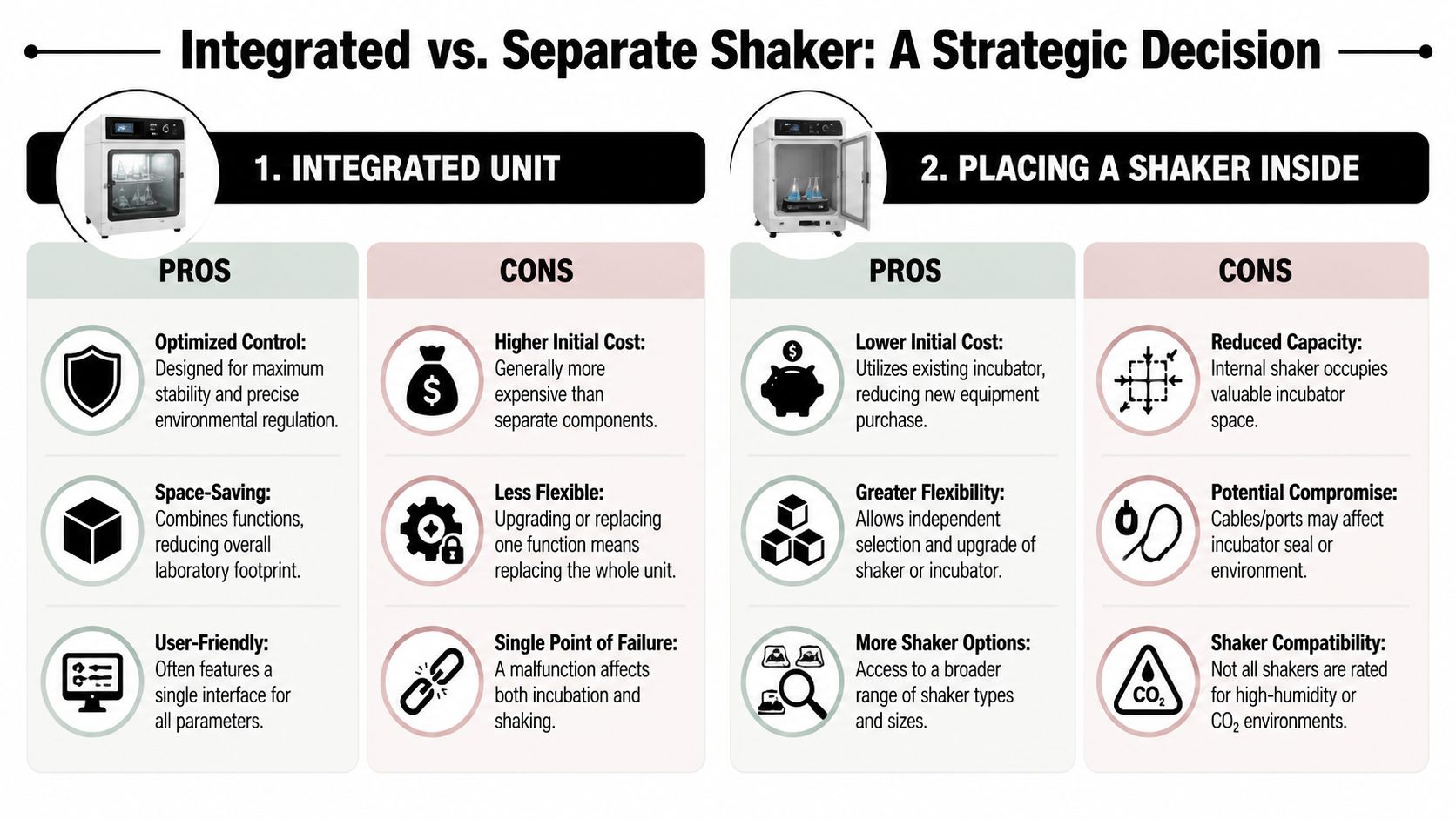
An integrated incubator shaker is purpose-built. The drive system, chamber airflow, access geometry, and environmental controls are designed to operate together.
That usually makes an integrated unit the cleaner choice when you need:
If your team is also comparing broader incubator options, this overview of an incubator for laboratory use is a useful reference point for understanding what the chamber itself must support.
A short video can help visualise the strategic difference before you compare individual models.
A separate shaker inside an existing incubator can be reasonable if the environment is basic, the application is not highly demanding, and the chosen shaker is compatible with that use condition.
Existing guidance notes that a non-incubated orbital shaker can be used in a regular incubator if conditions stay within about 4–40°C, but that using one in a humid CO2 incubator is problematic because the electronics and mechanics aren't designed for continuous warm, humid, and corrosive conditions. That raises the risk of failure and contamination, as explained in Lab Supply Network's guidance on using an orbital shaker inside an incubator.
That single point should stop many rushed purchases. “Fits inside” is not the same as “built for the environment”.
Warm air alone is one thing. Warm air plus humidity and CO2 is a very different service condition for motors, electronics, seals, and metal components.
The retrofit route often looks cheaper at the start because you're reusing an incubator you already own. The trouble starts later.
Common hidden issues include:
Choose an integrated unit when your process depends on controlled incubation and agitation as a core, routine, validated operation.
Choose a separate shaker inside an incubator only when the environment is appropriate, the compatibility is clear, and the trade-offs are acceptable to the users who'll live with that setup every day.
A reliable shaker for incubator use can still perform badly if it's installed carelessly. Most long-term problems don't begin as dramatic failures. They begin as small mechanical compromises. A shelf that flexes slightly. A unit that isn't level. A platform loaded unevenly because that was the quickest way to fit all the flasks.
Mechanical fit is one of the most overlooked failure points in shaker setups. Vendor guidance recommends checking incubator shelf deflection with a precision level, because bowing or tilt under operational load can affect both shaker performance and incubator integrity, as noted in Eppendorf's incubator-shaker guide.
That advice matters because a shelf can appear acceptable when static and still shift under real operating conditions.
Before first use, confirm:
Even a sturdy shaker can become noisy, unstable, or uneven if it's loaded carelessly. Train staff to think in terms of balanced distribution, not just maximum count.
Good practice includes:
The machine doesn't care how full your schedule is. If the load is uneven, the bearings and drive system will pay for it.
Routine maintenance should be boring. If it isn't, the setup is already drifting into trouble.
Build a schedule around:
For labs handling sensitive biological materials, maintenance planning should also include decontamination practicality. A machine that is difficult to clean thoroughly becomes difficult to trust.
By the time you're collecting quotes, the best choice is usually obvious if you ask the right questions in the right order. Not “Which unit has the most features?” Ask “Which unit fits our biology, our room, and our maintenance reality?”
Use this as your final filter:
Ask the technicians who will load it every day what they hate about the current setup. Their answers are often more valuable than the marketing sheet.
A lab that also works across sample storage and transport may already know Cryonos GmbH through its cryogenic equipment portfolio for biological materials, but that doesn't replace the need to judge an incubator shaker on application fit, chamber compatibility, and maintainability inside your own workflow.
For buyers comparing small benchtop mixers alongside larger shaking systems, this guide to the Vortex-Genie 2 can also help clarify where a vortex mixer fits and where it definitely doesn't.
A good purchase feels slightly conservative in the best sense. It supports the work you're doing now, leaves room for the work you'll do next, and doesn't force your staff to invent new rules just to keep it running.
If your lab is planning equipment for biological sample workflows beyond incubation, Cryonos GmbH supplies cryogenic storage, transport, and handling systems used by biobanks, cell therapy laboratories, hospitals, and research facilities. Their portfolio is relevant when incubated culture workflows connect directly to controlled cold-chain storage or sample movement requirements.

