No Products in the Cart




Figuring out "wie viele gasflaschen darf man transportieren" (how many gas cylinders can one transport) isn't a simple numbers game. The real answer depends entirely on why you're moving them. Are they for a weekend barbecue, or are they for your business? For personal trips, the rules are all about common-sense safety, not strict quantities. But for commercial use, everything changes, and you'll need to get familiar with the ADR "1000-point rule".
When you're transporting gas cylinders in Germany, the very first thing to sort out is whether you're doing it as a private individual or for commercial reasons. This single distinction is the foundation for everything that follows, essentially giving you two completely different roadmaps to follow.
The regulations here are no joke. In Germany, this is all covered by the Gefahrgutverordnung Straße, Eisenbahn und Binnenschifffahrt (GGVSEB). This is Germany's way of implementing the wider European rules, known as the ADR (Agreement concerning the International Carriage of Dangerous Goods by Road).
Luckily for private individuals, this framework offers big exemptions. This means there's no hard legal limit on the number of cylinders you can carry, as long as you nail the basic safety steps. Official sources always stress the importance of securing your load properly, and you can learn more about the GGVSEB regulations to see what they mean for you.
For anyone moving cylinders for work, however, the landscape shifts dramatically. The ADR introduces a points-based system that strictly dictates how much you can carry before you're hit with a whole raft of legal requirements.
To make these two paths clearer, let's look at the main differences side-by-side. This overview should help you see why knowing your purpose is the crucial first step.
The table below really breaks down how different the mindset needs to be for each scenario.
| Regulation Aspect | Private Transport (e.g., Car) | Commercial Transport (e.g., Van/Lorry) |
|---|---|---|
| Primary Limit | No specific quantity limit; focus is on safety | The "1000-point rule" based on gas type and weight |
| Main Concern | Proper securing, ventilation, and upright position | Calculation of ADR points, documentation, vehicle placarding |
| Documentation | Generally not required | Transport documents (Beförderungspapier) often mandatory |
| Driver Training | None required | ADR training certificate may be needed if limits are exceeded |
As you can see, a private individual's main job is practical, hands-on safety. In contrast, a commercial operator has to navigate a much more complex world of calculations, paperwork, and official rules. Getting this distinction right is key to transporting gas cylinders both safely and legally.
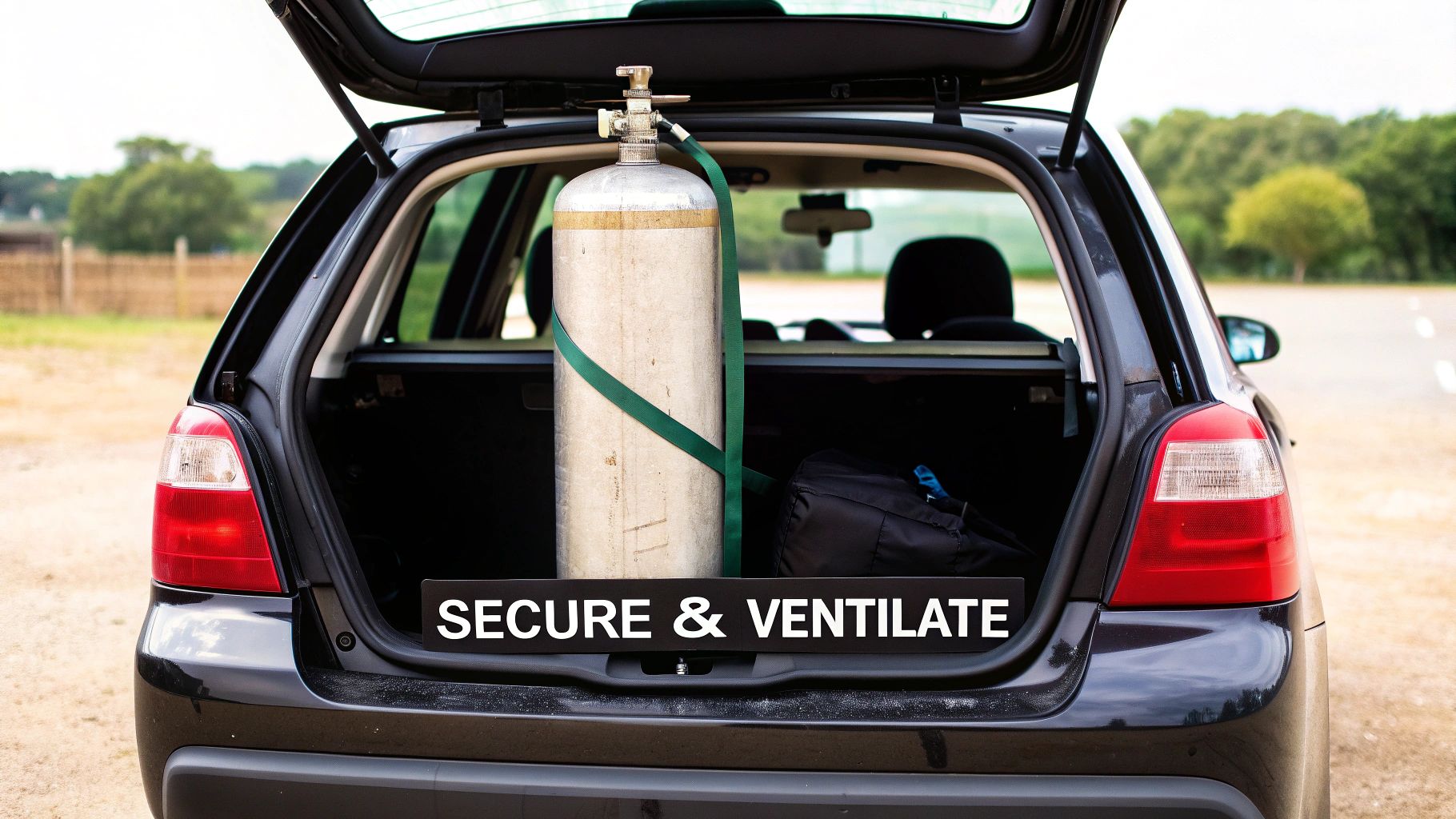
When you're just picking up a fresh propane cylinder for the weekend barbecue or grabbing a small tank for a camping trip, the rules become much more practical. The question "wie viele gasflaschen darf man transportieren" (how many gas bottles can you transport) shifts from a complex legal calculation to a matter of fundamental safety.
For private transport, the law doesn't actually give you a hard number. Instead, it’s all about how you handle the cylinders you’re carrying.
Think of it this way: one cylinder rolling around loose in your boot is infinitely more dangerous than three that are properly locked down. For personal use, the number one priority is stopping any movement that could damage the valve and trigger a leak. Your main responsibility is simply making sure every cylinder is transported correctly. The real risk isn't about having too many, but about not securing the ones you have.
Before you even turn the key in the ignition, run through these essential safety checks. They're simple, effective, and absolutely critical for preventing accidents with any gas cylinder, no matter how many you're carrying. Getting these right is the key to a safe and legal trip.
Understanding the real-world dangers makes it clear why the rules are focused on securing the load. When you look at the statistics, the greatest danger in private gas transport isn't about breaking some imaginary quantity limit; it's the simple failure to tie things down properly. This is the single most important point safety authorities stress over and over.
In Germany, transport safety data reveals that over 90% of violations involving gas cylinders are due to improper securing, not excessive quantities. These incidents dramatically elevate the risk of leaks or explosions, especially with flammable gases.
This really hammers home the point: securing even a single cylinder correctly is the most important thing you can do.
While commercial operations deal with complex rules and require specialised gear, like equipment for the safe transport of nitrogen, it’s all built around the same core principles of stability and safety. When you’re heading home with a cylinder, your focus should be squarely on preventing movement and ensuring good ventilation.
The moment you transport gas cylinders for work—whether you're a welder heading to a job site, a roofer with propane tanks, or a technician with calibration gases—the rules change. You've officially entered the world of commercial transport, which is governed by a formal framework called the ADR (Agreement concerning the International Carriage of Dangerous Goods by Road).
This might sound a bit intense, but it's all about managing the higher risks that come with professional activities. The good news is, there's a practical exemption built right in for tradespeople and professionals like you: the 1000-Punkte-Regel, or the 1000-point rule.
Think of it as having a 1000-point "risk budget" for your vehicle. As long as your total load stays under this threshold, you can operate under a much simpler set of rules. You get to skip the full ADR driver certification, specialised vehicle equipment, and those bright orange warning placards. It’s a smart system that lets you get the job done without the heavy burden of regulations designed for massive tankers and haulage trucks. The key is knowing how to count your points.
At its heart, the system recognises that not all gases carry the same level of risk. The ADR sorts dangerous goods into different transport categories based on how hazardous they are. A highly flammable gas like propane, for example, is in a more restrictive category than an inert gas like nitrogen.
Each category is assigned a multiplier, which tells you how many points to count for each kilogram or litre you're carrying.
To figure out your total, you just multiply the amount of each gas you're carrying (in kg or litres) by its category multiplier. If you have different types of gases, you add up the points for each to get a grand total.
The goal is simple: Keep your total points under 1000. If you go over, you lose the exemption. That means you're in full ADR territory, which is a whole different ball game requiring certified equipment, driver training, and more.
Let's make this real. Say you're a roofer and need to transport two 11 kg propane cylinders for your torching equipment. Propane is a flammable gas, so it falls into Transport Category 2, which has that multiplier of 3.
Here’s the simple maths:
2 cylinders × 11 kg per cylinder × 3 points/kg = 66 points
At just 66 points, you are comfortably below the 1000-point limit. You can legally transport these cylinders without needing an ADR-certified vehicle or special driver training, as long as you follow the other essential safety precautions like securing the load properly.
Getting these calculations right is crucial for staying compliant. If you want to dive deeper into the specifics, our comprehensive guide on the regulations for transporting gas cylinders breaks everything down even further. Knowing the rules is the best way to make sure every trip is safe and legal.
Knowing the 1000-point rule in theory is one thing, but making it work on the job is what really matters. Let's move away from the abstract regulations and look at real-world situations tradespeople face every single day. This is where a bit of quick maths becomes your best tool for staying on the right side of the law.
The system is actually quite straightforward at its core. You just multiply the net weight of your gas (in kilograms) by a specific multiplier assigned to its transport category. As long as the grand total stays under 1000 points, you’re covered by the ADR exemption. That means no need for full ADR driver training or those bright orange warning placards on your vehicle.
This simple flowchart walks you through the decision-making process for tallying up your ADR points.
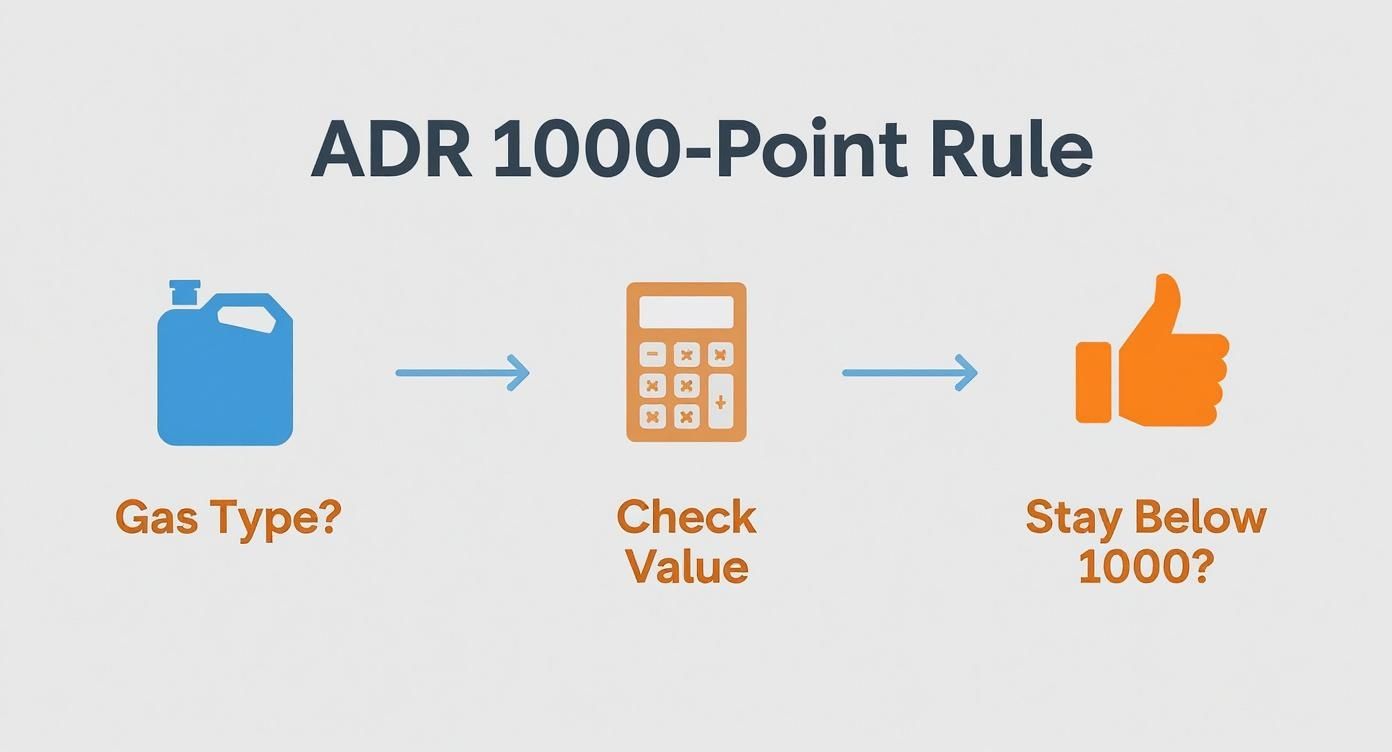
As you can see, it’s a logical sequence: identify the gas you're carrying, find its points value, and do the simple calculation to make sure your total load is below the 1000-point threshold.
Let's run the numbers for a couple of common scenarios to see how this plays out in practice. These examples show just how quickly different gases can add up, which is why getting the calculation right is so crucial.
Example 1: A Roofer's Propane Load
A roofer needs to transport four standard 11 kg propane cylinders for a torch-on felt job. Propane is a flammable gas, placing it in Transport Category 2.
Example 2: A Welder's Mixed Gas Load
A mobile welder is heading to a site with a mixed load for repairs: two 20-litre (around 20 kg) cylinders of Oxygen and one 10-litre (around 10 kg) cylinder of Acetylene.
The key here is to calculate the points for each type of gas separately and then add them together.
Even with two different categories of gas on board, the total of 70 points is very low. This transport is fully compliant under the small load exemption.
To make things easier when you're calculating your own load, here’s a quick-reference table. It covers the most common gases you're likely to use and shows their multipliers, helping you quickly figure out how many gas cylinders you can legally transport.
| Gas Type | Transport Category | Multiplier (Points per kg/litre) | Max Quantity under 1000-Point Rule |
|---|---|---|---|
| Propane / Butane | 2 | 3 | 333 kg |
| Acetylene | 2 | 3 | 333 kg |
| Oxygen | 3 | 1 | 1000 kg |
| Nitrogen / Argon | 3 | 1 | 1000 kg |
| Carbon Dioxide (CO2) | 3 | 1 | 1000 kg |
This table simplifies the process, but remember that the ultimate responsibility for compliance rests with you.
A crucial takeaway: these exemptions are not a free pass on safety. Your load must always be properly secured, cylinders kept upright, and your vehicle must have adequate ventilation. The moment you cross that 1000-point threshold, your legal obligations change completely.
Whether you’re a homeowner grabbing a single cylinder for the weekend barbecue or a seasoned contractor with a van full of them, the core rules of safe transport don't change. It’s one thing to know the official limits on wie viele gasflaschen darf man transportieren, but mastering the practical 'how-to' of securing your load is what truly prevents accidents. Getting this part right is absolutely non-negotiable.
Picture an unsecured gas cylinder in the back of your car. It’s essentially a heavy, unpredictable missile. One sudden brake or a sharp turn, and it can tip over, slide, or roll with surprising force. This isn't just about a loud noise; that movement could easily damage the valve, leading to a serious, uncontrolled gas leak. The entire goal is to make sure that simply can't happen.
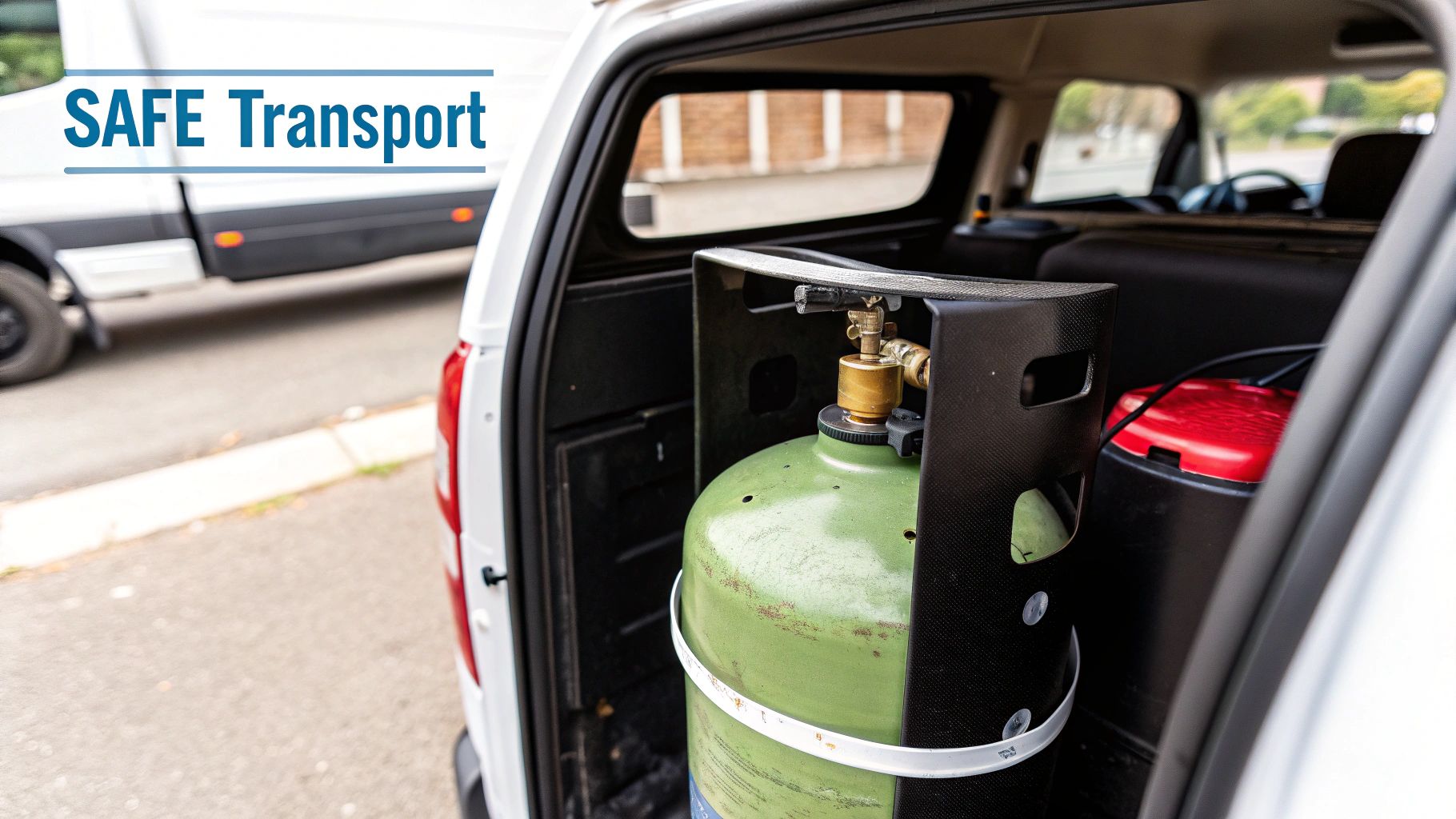
To stop a cylinder from moving an inch, you need the right gear and the right technique. Just wedging it between a couple of toolboxes won't cut it. It needs to be actively held in place for the whole journey.
Here are the most reliable ways to do it:
One of the most easily forgotten risks is the build-up of gas inside an enclosed space, like your car boot or the back of a van. Most common fuel gases, such as propane, are heavier than air. What this means is that if a small, slow leak develops, the gas won't just float away; it will sink and pool at the lowest point.
This creates an extremely dangerous situation. A tiny spark—from static electricity, your car's wiring, or anything else—could be enough to ignite that pocket of gas, causing a fire or even an explosion. This is exactly why good ventilation isn't just a suggestion; it's a critical safety rule. Always crack a window or make sure your transport area has a constant flow of fresh air.
The core principle of safe gas transport is prevention. Every step, from securing the cylinder to ensuring ventilation, is about proactively managing risk before it has a chance to escalate.
Before you even turn the key, get into the habit of running through these last few essential checks. Think of them as your first and best line of defence against any potential problems. These simple habits are the foundation of all transport regulations. For a more detailed dive into safety protocols, Cryonos offers a wealth of information on their safety resources page.
To get a real grip on today's gas transport regulations, it helps to look back at how we got here. The rules answering "wie viele gasflaschen darf man transportieren" weren't just invented out of thin air; they’re the product of decades of experience and, unfortunately, some hard lessons learned from past accidents.
For a long time, gas transport laws in Germany were a confusing jumble of local and regional rules. But as freight traffic exploded after the 1980s, it became painfully obvious that this patchwork system wasn't just inefficient—it was dangerous. The call for a unified, safer standard grew too loud to ignore.
This push for consistency led to a major shift. By 2001, Germany had fully adopted the European ADR standards into its national law, finally creating a single, clear set of rules for everyone. If you're curious, you can explore the history of these regulatory changes to see the full picture. This move established clear mandates for everything, from how many cylinders you can carry to the packaging and driver training required.
These regulations are not just bureaucratic red tape. They are life-saving measures built on decades of real-world data, designed to protect transporters, first responders, and the public from the inherent risks of moving dangerous goods.
At the end of the day, every single rule—whether it’s about strapping a cylinder down securely or calculating ADR points—exists for one simple reason: to prevent things from going wrong and keep everyone safe.
Even when you think you’ve got a handle on the rules, tricky questions always seem to pop up right when you’re loading a gas cylinder. Let’s clear up some of the most common ones so you can stay safe and compliant.
No, you absolutely should not transport a gas cylinder lying down. All safety regulations are crystal clear on this: they must be kept upright and securely fastened.
Here’s why it’s so critical: when a cylinder is on its side, the pressure relief valve can end up covered by liquid gas instead of vapour. If that valve needs to activate, it won't just vent a bit of gas—it could blast out a dangerous jet of liquid fuel. That creates an immediate and severe fire hazard you don't want anywhere near your vehicle.
For small quantities meant for personal use, like grabbing a single cylinder for your barbecue, you don’t need to worry about any special transport documents (Beförderungspapier). Your only job is to focus on the practical safety steps—upright, secured, ventilated.
However, the moment it's for commercial purposes, the game changes. Even if you're staying under the 1000-point rule, you'll almost always need a transport document that clearly details the type and amount of gas you're carrying.
The penalties in Germany can be surprisingly steep. A simple mistake, like failing to properly secure a single cylinder, could easily land you a fine of several hundred euros.
For commercial operators, the stakes are much higher. Getting caught over the 1000-point limit without full ADR compliance can lead to massive fines, your vehicle being seized, and serious personal liability if an accident happens.
It's crucial to remember that "I didn't know" is never a valid defence. The authorities take the transport of dangerous goods very seriously because the potential for public harm is so high.
Yes, you can often transport different gases in the same vehicle, but you have to do the maths carefully. If you're carrying a mixed load under the 1000-point rule, you must calculate the points for every single gas and add them all together to make sure the total stays below that magic 1000-point threshold.
While common combinations are usually fine, some gases are strictly forbidden from being loaded together because of the risk of dangerous chemical reactions. Always double-check the co-loading regulations for the specific gases you're transporting.
At Cryonos GmbH, we specialise in providing ADR-compliant solutions for the safe transport and handling of industrial gases and sensitive biological samples. Explore our state-of-the-art cryogenic equipment and ensure your operations meet the highest safety standards at https://www.cryonos.shop.

