
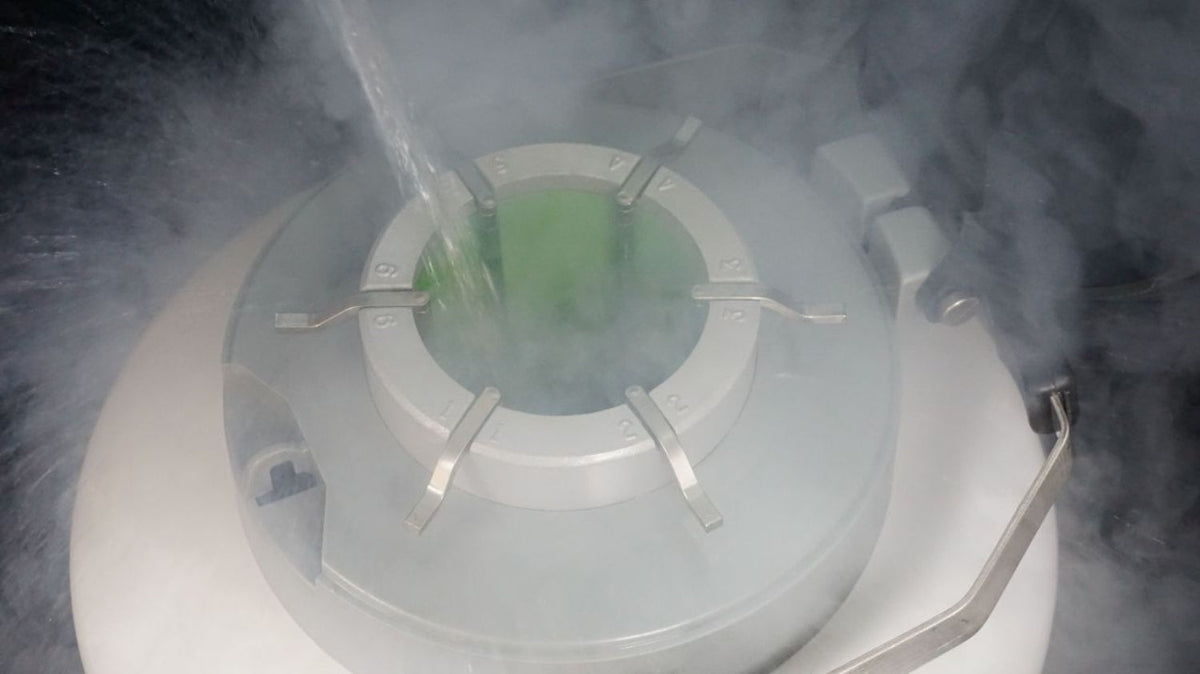

Cryogenics is a highly specialized subfield of thermodynamics and process engineering, dealing with the production, handling, and utilization of extremely low temperatures. In cryogenics, temperatures below −150 °C are generally considered, a range in which the behavior of gases, materials, and even biological systems changes fundamentally.
While cold in everyday life is usually associated only with refrigeration or preservation, cryogenics opens an entirely different dimension: it enables the liquefaction of gases, nearly lossless energy transfer, ultra-precise manufacturing processes, and long-term preservation of biological materials.
Below, 10 fascinating facts about cryogenics are presented in detail.
1. Cryogenics begins where conventional cooling reaches its physical limits
The distinction between conventional refrigeration and cryogenics is not only technical but fundamentally physical. While traditional cooling systems reach temperatures of around −50 °C, or in special cases down to −80 °C, true cryogenics starts significantly lower – typically below −150 °C.
The reason lies in the dramatic reduction of thermal energy. Molecules move much more slowly at these temperatures, causing intermolecular forces to dominate. This leads to the liquefaction of gases and entirely different mechanical behavior of materials.
Typical physical effects in cryogenics include:
- Liquefaction of gases through extreme cooling
- Drastically reduced molecular motion
- Transition to new material properties (e.g., brittleness)
Technically, such temperatures are achieved only through complex processes, such as multistage cooling or specialized expansion techniques. These systems are far more sophisticated than conventional refrigeration and require precisely tuned components.
2. Invisible gases become visible and precisely controllable
A fascinating effect of cryogenics is that gases, which are invisible under normal conditions, become clearly visible and tangible in their liquid state. This makes them not only easier to observe but also far more controllable and measurable.
Common examples of liquefied gases in cryogenics include:
- Liquid oxygen → pale blue in color
- Liquid nitrogen → colorless and clear
- Liquid hydrogen → also colorless
- Liquid helium → colorless, extremely fluid
Helium is particularly interesting because:
- It has a boiling point of only −269 °C
- It exhibits extremely weak atomic interactions
- Below 2.17 K, it enters a superfluid state, flowing without friction
In this state, helium shows extraordinary properties, such as frictionless flow or “creeping” along container walls. These phenomena are not only scientifically fascinating but also relevant for advanced technologies.

3. Liquefaction of gases reduces volume by orders of magnitude
A central benefit of cryogenics lies in the extreme volume reduction of gases. In their gaseous state, molecules are far apart and move freely. Rapid cooling reduces this movement, causing molecules to pack tightly together – the gas becomes liquid.
The effect is enormous: one liter of liquid nitrogen corresponds to approximately 700 liters of gaseous nitrogen. Similar ratios apply to many other technical gases.
Typical volume ratios:
- Nitrogen: approx. 1 : 694
- Oxygen: approx. 1 : 860
- Hydrogen: approx. 1 : 848
This compression has immense economic advantages. Only through cryogenics is it possible to store and transport large volumes of gas efficiently, while also imposing new requirements for insulation and minimizing evaporation losses.
4. Materials change fundamentally at extremely low temperatures
Cryogenics has a significant impact on material behavior. As temperatures decrease, atomic mobility within the crystal lattice is reduced, directly affecting mechanical properties.
Many materials lose ductility and become brittle, meaning they no longer deform under stress but fracture suddenly. This effect is particularly pronounced in unalloyed steels.
Typical material changes include:
- Decreased ductility
- Transition to brittle fracture behavior
- Partial increase in strength
However, cryogenics does not affect materials only negatively. In certain cases, it can be used deliberately to improve properties.
In practice, cryogenics is applied for:
- Cryogenic deburring of plastic or metal parts
- Shrink-fitting of high-precision components
- Improving wear resistance of tools
It is thus clear that cryogenics is not merely a cooling method, but also an active tool in manufacturing technology.
5. Shock freezing alters the microstructure of food
Cryogenics plays a key role in modern food processing, particularly in shock freezing. Unlike conventional freezing, this process cools food extremely quickly.
The rate of cooling directly affects the microstructure. Slow freezing produces large ice crystals that damage cells, while cryogenic shock freezing forms very small crystals, preserving cell structures.
The result is significantly higher product quality:
- Texture and taste are maintained
- Nutrients are better preserved
- Water loss during thawing is minimized
Typical applications include high-quality products such as fish, berries, or meat, where maintaining quality is crucial. Cryogenics ensures not only longer shelf life but also consistently high product quality – a key advantage in competitive markets.

6. The Leidenfrost effect makes liquids appear to “float”
A particularly striking phenomenon in cryogenics is the Leidenfrost effect, which occurs when an extremely cold liquid contacts a much warmer surface. At that moment, the liquid vaporizes instantly at the contact point, forming a thin insulating gas layer that significantly reduces direct heat transfer.
This produces effects such as:
- Apparent levitation of liquid droplets
- Rapid, uncontrolled movements
- A “dancing” appearance on the surface
However, this gas layer is stable only briefly. In practice, it does not provide reliable protection, so handling cryogenic liquids always requires appropriate safety measures.
7. Superconductivity is impossible without cryogenics
Cryogenics underpins one of the most fascinating physical phenomena: superconductivity. In this state, electrical conductors exhibit zero resistance.
This effect occurs only at extremely low temperatures. It arises from the formation of so-called Cooper pairs – bound electron pairs that move through the crystal lattice without energy loss.
Additionally, superconducting materials completely expel magnetic fields from their interior, a phenomenon known as the Meissner effect.
Applications include:
- High-precision magnetic resonance imaging (MRI)
- Powerful particle accelerators
- Energy-efficient power transmission
Without cryogenics, none of these technologies would be feasible.
8. Cryogenics is key to the hydrogen economy
Cryogenics is increasingly important in the context of the energy transition. Hydrogen is a promising energy carrier but presents significant storage and transport challenges.
In its gaseous state, hydrogen has very low density. Only through liquefaction at approximately −253 °C does it become compact enough for efficient use.
Such extreme temperatures pose enormous technical challenges. Even minimal heat input leads to evaporation losses (“boil-off”). To minimize this, advanced tank systems with vacuum insulation and multilayer reflective systems are employed.
Cryogenics is thus a central enabler for the economical use of hydrogen.
9. Cryogenics can virtually halt biological processes
One of the most fascinating applications of cryogenics is cryopreservation. Biological materials are stored at extremely low temperatures, effectively bringing chemical and biochemical processes to a near-complete halt.
At temperatures around −196 °C, as achieved with liquid nitrogen, reactions slow so dramatically that cell aging essentially stops.
Special procedures are required to achieve this, including controlled cooling protocols and the use of cryoprotectants that prevent harmful ice crystal formation.
Applications include:
- Reproductive medicine
- Stem cell research
- Medical biobanks
Cryogenics enables long-term, safe preservation of sensitive biological systems.

10. Cryogenic containers are crucial for efficiency and safety
A critical component of any cryogenic application is storage. Cryogenic liquids can be used efficiently only if they are stored reliably and with minimal loss.
Modern cryogenic containers are highly engineered systems that simultaneously address multiple physical challenges. They minimize heat influx through a combination of vacuum insulation and reflective multilayer systems.
At the same time, they must ensure that pressure generated by evaporation is safely released via precisely calibrated valves and safety mechanisms.
Even small differences in quality can have significant consequences:
- Increased evaporation losses
- Higher operating costs
- Potential safety risks
Therefore, selecting high-quality components is essential for the economical and safe operation of cryogenic systems.
Conclusion: Cryogenics is a key technology of modern industry
Cryogenics combines fundamental physical principles with advanced engineering. It enables applications ranging from the food industry to energy technology and medical applications.
Key takeaways:
- Cryogenics fundamentally changes material properties
- It enables entirely new technological solutions
- It is indispensable for many future technologies
What sets this field apart is the combination of scientific complexity and practical relevance. Cryogenics transforms not only temperatures but also materials, processes, and entire industries.
Cryonos – Your Expert Partner for High-Quality Cryogenic Solutions.
Disclaimer
The information provided in this blog post is intended solely for general informational purposes. It does not constitute legal, medical, technical, or safety-related advice and cannot replace personalized professional consultation. Although we compile the content with the utmost care, we make no representations or warranties regarding the completeness, accuracy, or timeliness of the information provided. Use of the information is at your own risk. We expressly disclaim any liability for damages, whether direct or indirect, arising from the use of or reliance upon the information described in this blog. Please always adhere to applicable laws, regulations, standards, and safety guidelines. For specific questions or decisions, always consult qualified professionals.


