No Products in the Cart




A shipment arrives on Monday morning. The paperwork is complete, the labels are right, and the receiving team has no obvious reason to worry. Then the samples are checked, or the device is powered on, and something is off. A cryogenic vessel shows signs of temperature disturbance during transport. An electronic assembly that passed bench testing now behaves erratically after a route simulation. The failure didn't happen because the team ignored quality. It happened because real-world stress was never reproduced properly before release.
That's where the environmental test chamber becomes more than a box that gets hot or cold. In a serious lab or production setting, it's a controlled way to ask a hard question before the market, the clinic, or the transport lane asks it for you: what happens when this item faces the actual conditions it will meet outside the lab?
For biobanks, hospitals, fertility clinics, and cell therapy teams in the DE region, that question gets sharper when cryogenic transport is involved. A chamber may look precise on paper and still behave very differently once you load it with a real vessel, add transport-like stress, and expect defensible results.
A lot of failures are not design failures in the usual sense. They're environment failures. The product works in a calm room, under a technician's eye, with no moisture swings, no transport vibration, and no thermal shock. Then it leaves the lab and enters the world that actually matters.
That's why reliability testing sits inside quality assurance rather than outside it. A medical sample, a sensor, a battery module, or a packaged biologic doesn't get judged by how it performs in ideal conditions. It gets judged by how it performs after storage, transport, handling, and exposure to changing surroundings.
In plain terms, an environmental test chamber lets a team rehearse trouble before trouble becomes costly. You're not only checking whether something survives heat or cold. You're checking whether it remains safe, stable, usable, and compliant after controlled stress.
Typical failure modes include:
Practical rule: If a test doesn't reflect the conditions of shipping, handling, and loading, it may validate the chamber more than the product.
Environmental testing didn't start as a polished industrial discipline. According to a history of environmental test chambers published by Associated Environmental Systems, the first formal environmental test chamber was built in 1951 by Charles Conrad. The technology grew from a modified freezer into a standard reliability tool used before market release across sectors. That history matters in Germany and the wider DE region because chamber testing is tied closely to industrial quality systems, especially where documentation, durability, and compliance have to stand up to scrutiny.
In cryogenic workflows, the consequences aren't abstract. A missed temperature excursion can affect sample integrity. A poorly designed transport simulation can create false confidence. A chamber run that looks clean in the report may still miss what happens when a loaded vessel moves over a real road profile.
That's why teams treating chamber testing as a tick-box exercise usually learn the same lesson the expensive way. The chamber isn't there to decorate a specification file. It's there to protect the work inside it.
The simplest useful definition is this: an environmental test chamber is a weather machine for products and samples.
It creates a controlled environment so a lab can expose an item to planned conditions such as heat, cold, humidity, light, or motion-related stress and observe what happens. Instead of waiting months for field failures, engineers and scientists bring those conditions into the lab and repeat them on demand.
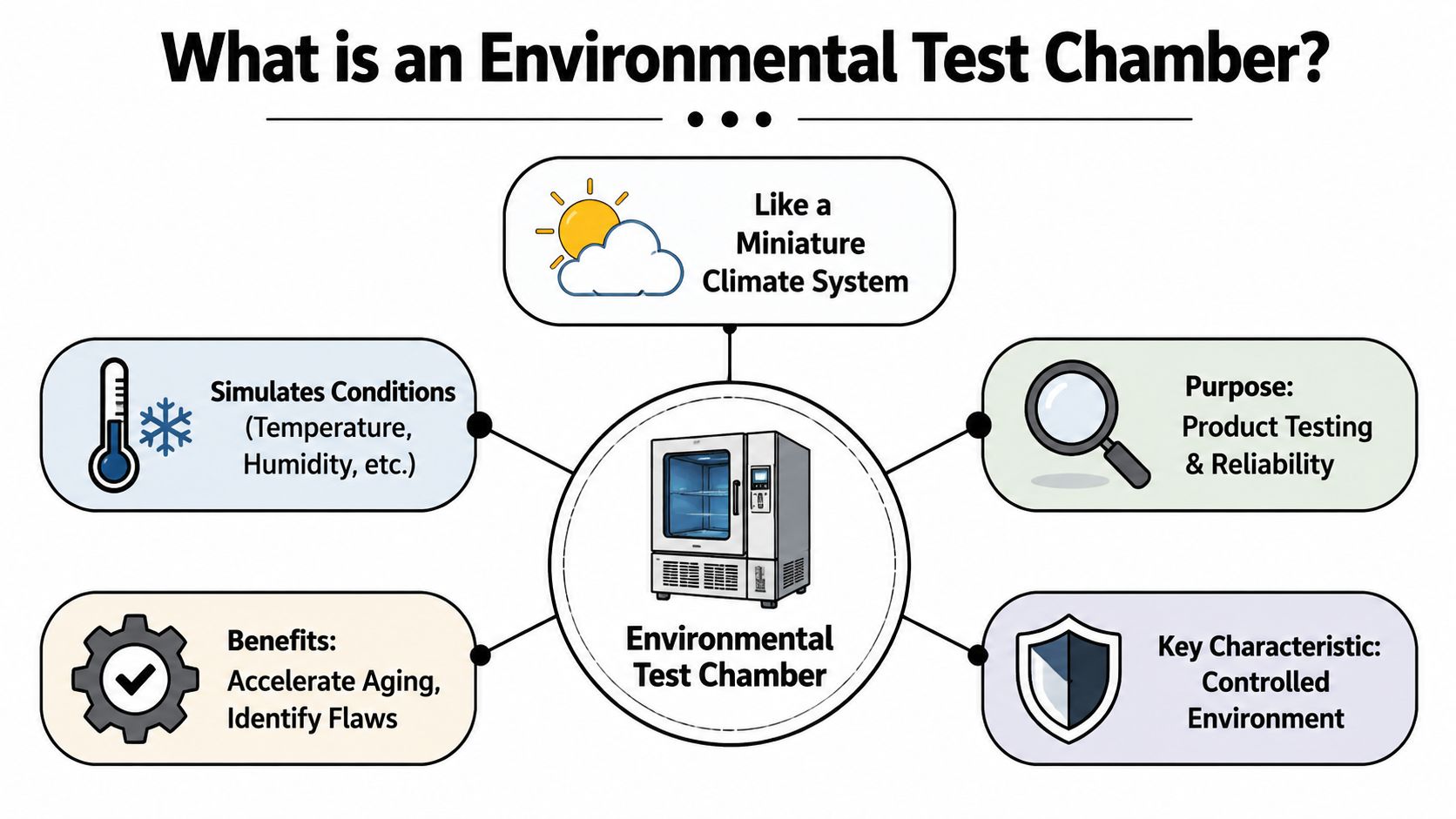
If you put a product outdoors, the weather decides the test. Temperature changes are uneven, humidity shifts unpredictably, and every day is slightly different. A chamber removes that randomness. It gives you a repeatable setting so you can compare runs, investigate failures, and document performance.
That controlled setting is what makes the results useful. You're not just stressing a specimen. You're creating conditions that can be repeated for another batch, another supplier lot, or an audit review.
Three common reasons teams use a chamber are:
This isn't a niche product category. The Grand View Research market report on environmental test chambers estimates the global market at USD 1,013.5 million in 2025 and projects USD 1,283.5 million by 2033. Those figures are global, but they matter in the DE region because the same user sectors named in that market context, including automotive, electronics, and pharmaceuticals, are central to German manufacturing and R&D.
A chamber's real job is simple to state but hard to do well. It must create a stable, known environment while the item inside changes, stores energy, releases moisture, blocks airflow, or adds thermal mass. That's why the best buyers don't ask only, “What setpoint can it reach?” They ask, “What will it do with my load inside?”
A chamber is only as trustworthy as the conditions it can maintain around the real specimen, not the empty space around it.
Not every environmental test chamber does the same job. Buyers often get confused because vendors use broad language, while the application needs are specific. The cleanest way to choose is to think in terms of the main stress you need to reproduce.
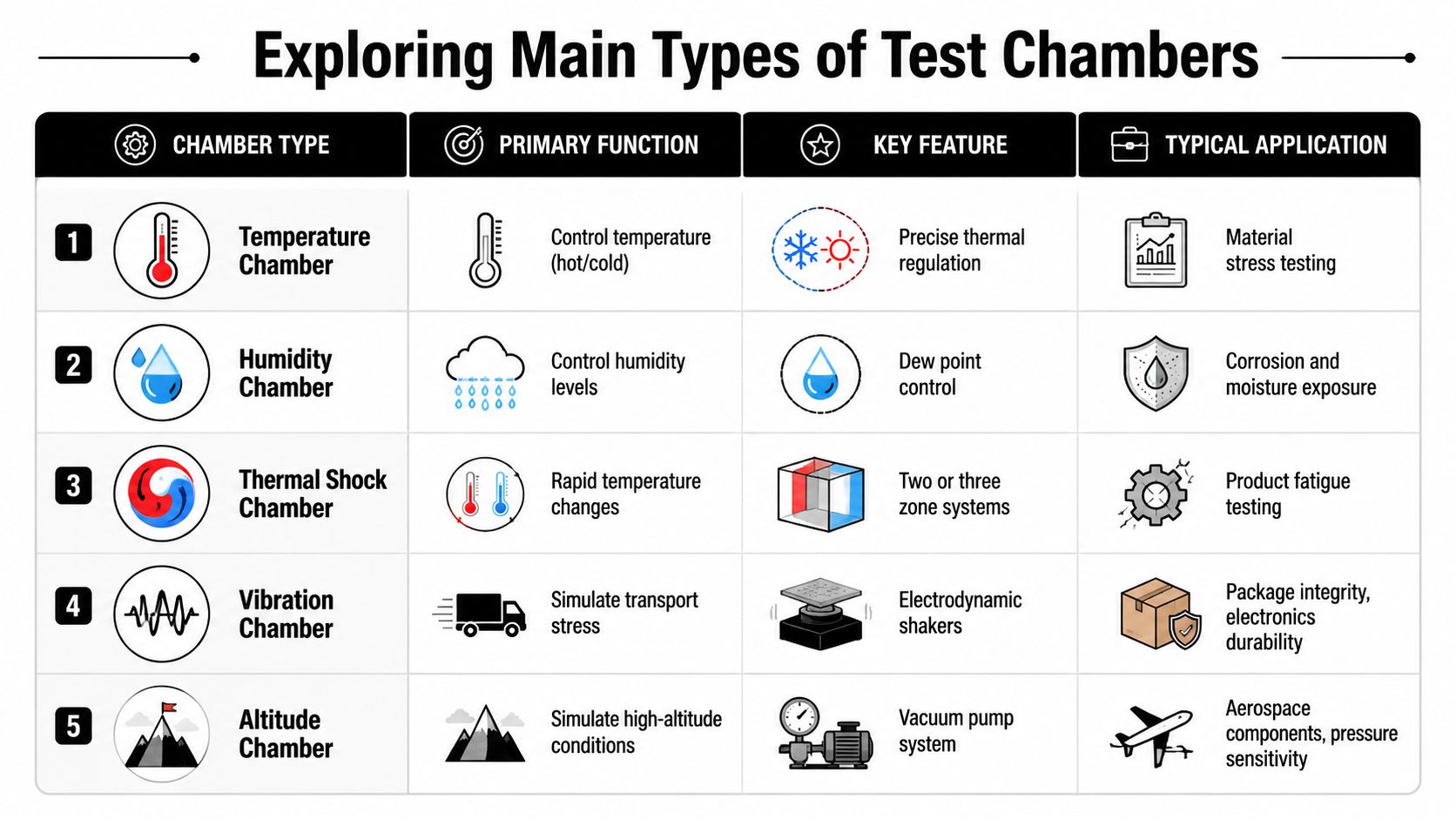
A temperature chamber handles heat and cold exposure. Labs use it when they need to know whether a material, assembly, or container still performs after a thermal hold or cycle. This is the familiar option for product conditioning, ageing studies, and low or high temperature stress.
A humidity chamber adds moisture control. That matters when water vapour changes the behaviour of packaging, coatings, electronics, labels, or stored materials. If condensation, corrosion, or moisture uptake can alter the result, humidity control stops being optional.
A thermal shock chamber is built for rapid transition between hot and cold zones. The point isn't only to reach two temperatures. The point is to force the specimen through abrupt change and reveal weaknesses in bonds, joints, seals, or interfaces.
A vibration-capable setup addresses transport conditions. For transport validation, static temperature control alone often isn't enough. A road journey adds motion, shifting airflow and changing how the load behaves inside its container.
A specialised category matters for low-temperature work: cryogenic-compatible chamber use. That doesn't always mean the chamber itself is a cryogenic storage device. It means the chamber and test design can handle cryogenic vessels, transport units, and the thermal behaviour that comes with them.
Here's a quick comparison:
| Chamber type | Best for | Common blind spot |
|---|---|---|
| Temperature chamber | Heat and cold exposure | Assuming setpoint equals specimen temperature |
| Humidity chamber | Moisture and condensation effects | Ignoring recovery after door opening or wet loads |
| Thermal shock chamber | Rapid hot-cold transitions | Overlooking internal specimen lag |
| Vibration-related setup | Transport simulation | Testing empty packaging instead of loaded systems |
| Cryogenic-relevant setup | Loaded vessel and transport scenarios | Trusting generic datasheet performance |
After a brief overview, this video gives a useful visual sense of how chamber systems are used in practice.
A few practical matches help:
The mistake I see most often is selecting by brochure category rather than test objective. If your real question is, “Will this loaded cryogenic vessel protect the sample during regulated road transport?” then a standard temperature chamber may only answer a smaller, easier question than the one you need answered.
Spec sheets can look precise while hiding the most important part of the decision. A chamber can list impressive numbers and still be a poor fit for your protocol. The trick is to translate each specification into a real-world question.
The stated range tells you the outer limits of what the chamber can produce. Some standard climatic chambers span -80°C to +300°C, as described in IQS Directory's overview of environmental test chamber types. That sounds broad, and it is, but range alone doesn't guarantee useful control at your working condition.
The more practical selection rule from the same source is to keep at least 10°C of temperature headroom above the target setpoint. If your profile requires -40°C, a -70°C chamber is recommended so the controller isn't working at its limit. In everyday terms, that's like driving a vehicle with reserve power instead of keeping the engine pinned the whole journey.
Uniformity tells you how evenly conditions are distributed inside the chamber. If the top shelf and bottom shelf experience different conditions, your results may reflect placement rather than product performance.
Ramp rate tells you how quickly the chamber changes temperature. That matters when your method depends on a realistic transition rather than a leisurely drift. A chamber that eventually reaches the target may still fail the protocol if the specimen lags too much under load.
Use these questions when reading a specification sheet:
Selection advice: Buy for the loaded process, not the empty cabinet.
Humidity specifications often look straightforward until you introduce real materials, absorbent packaging, or vessels with complex surfaces. Moisture doesn't spread through a loaded chamber as neatly as it does in a clean brochure diagram.
A useful way to think about the core metrics is this:
| Spec on paper | What it really asks in practice |
|---|---|
| Temperature range | Can the chamber reach the conditions you need? |
| Headroom | Can it control those conditions without strain? |
| Uniformity | Will all specimens see similar exposure? |
| Ramp rate | Can it change fast enough for the protocol? |
| Stability | Does it hold the condition without drift? |
| Humidity performance | Will moisture behave consistently around your actual load? |
When readers struggle with specs, it's usually because they assume the chamber controls the specimen directly. It doesn't. It controls the air and environment around the specimen. Your load shape, mass, packaging, and vessel design determine how much of that control reaches the item you care about.
This is the point where many otherwise careful teams get caught. They assume a standard environmental test chamber that looks accurate on paper will also behave accurately when loaded with a cryogenic transport vessel. In practice, that assumption can fail badly.
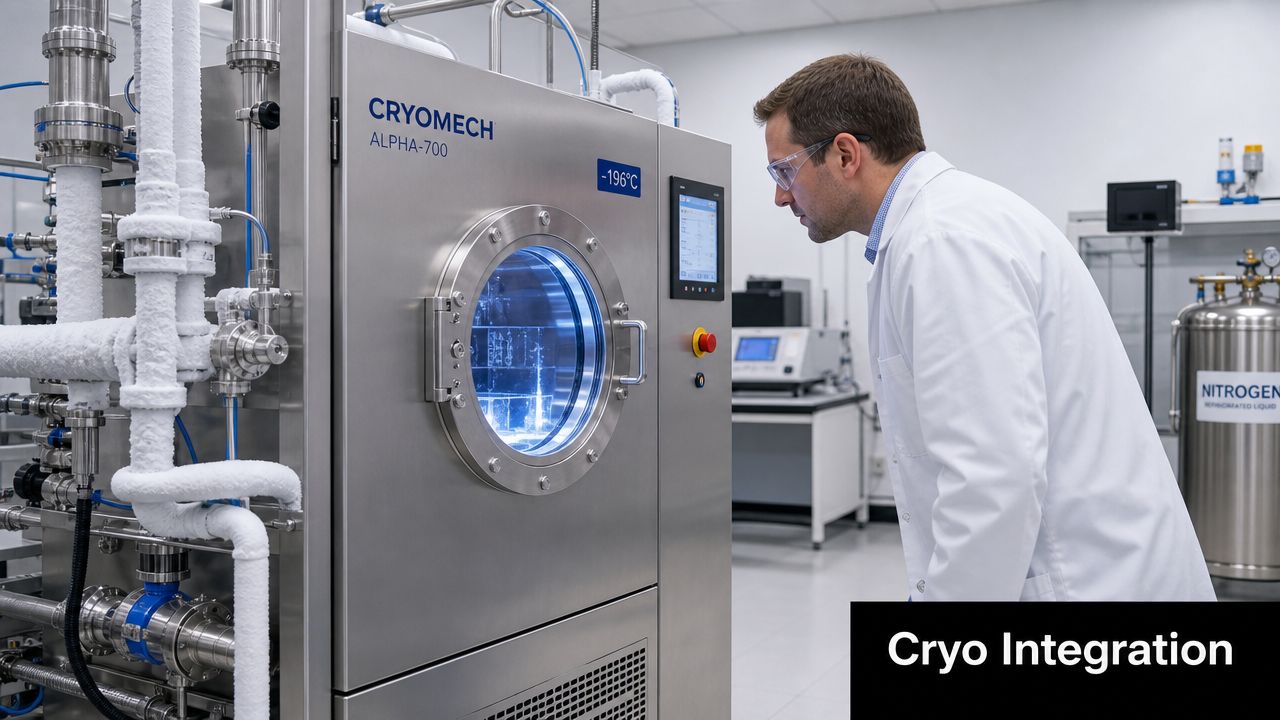
A generic chamber datasheet may claim ±0.5°C accuracy. But the cryogenic workflow doesn't involve an empty chamber and a neat metal coupon. It often involves loaded transport vessels, insulation layers, internal thermal mass, and handling conditions that disturb airflow and recovery.
That's why the most important performance question is not, “What does the empty chamber claim?” It's, “What happens when I place my real cryogenic system inside and simulate transport conditions realistically?”
According to the verified data provided for this topic, recent BAM-related cryogenic chamber context referenced through Instron's environmental chamber materials shows up to 40% deviation in uniformity when chambers are loaded with cryogenic transport vessels simulating road vibrations. For DE-region biobanks, that's not an academic issue. ADR-regulated road transport means the vessel and payload may be exposed to conditions that a static chamber test does not represent well.
Cryogenic transport vessels don't behave like simple samples. They create a local thermal system inside the chamber. Their geometry can redirect airflow. Their insulation can delay heat exchange. Their mass can slow down transitions. Add motion or vibration and the chamber environment may become less uniform than the published specification suggests.
That creates several risks:
A related operational issue appears when teams try to align chamber validation with medical-licensed cryogenic storage and transport practices. For labs comparing test simulation against storage reality, it helps to understand the design logic behind an ultralow temperature freezer, because freezer performance and chamber performance answer different questions even when both involve low temperatures.
If your test object is a cryogenic vessel, then the vessel is part of the thermal system. Treating it like a passive item is a validation mistake.
For critical sample pathways, I'd want evidence on four points before I accepted a chamber study as meaningful:
For cryogenic biological workflows, this gap between brochure performance and loaded behaviour is one of the most overlooked risks in chamber selection. The chamber may still be the right tool, but only if the validation method respects the physics of the vessel, the payload, and the transport route you're trying to simulate.
Procurement gets easier when you stop asking, “Which chamber is best?” and start asking, “Which chamber can defend my method?” The right purchase is the one that fits your specimens, your standards, your building, and your maintenance reality.
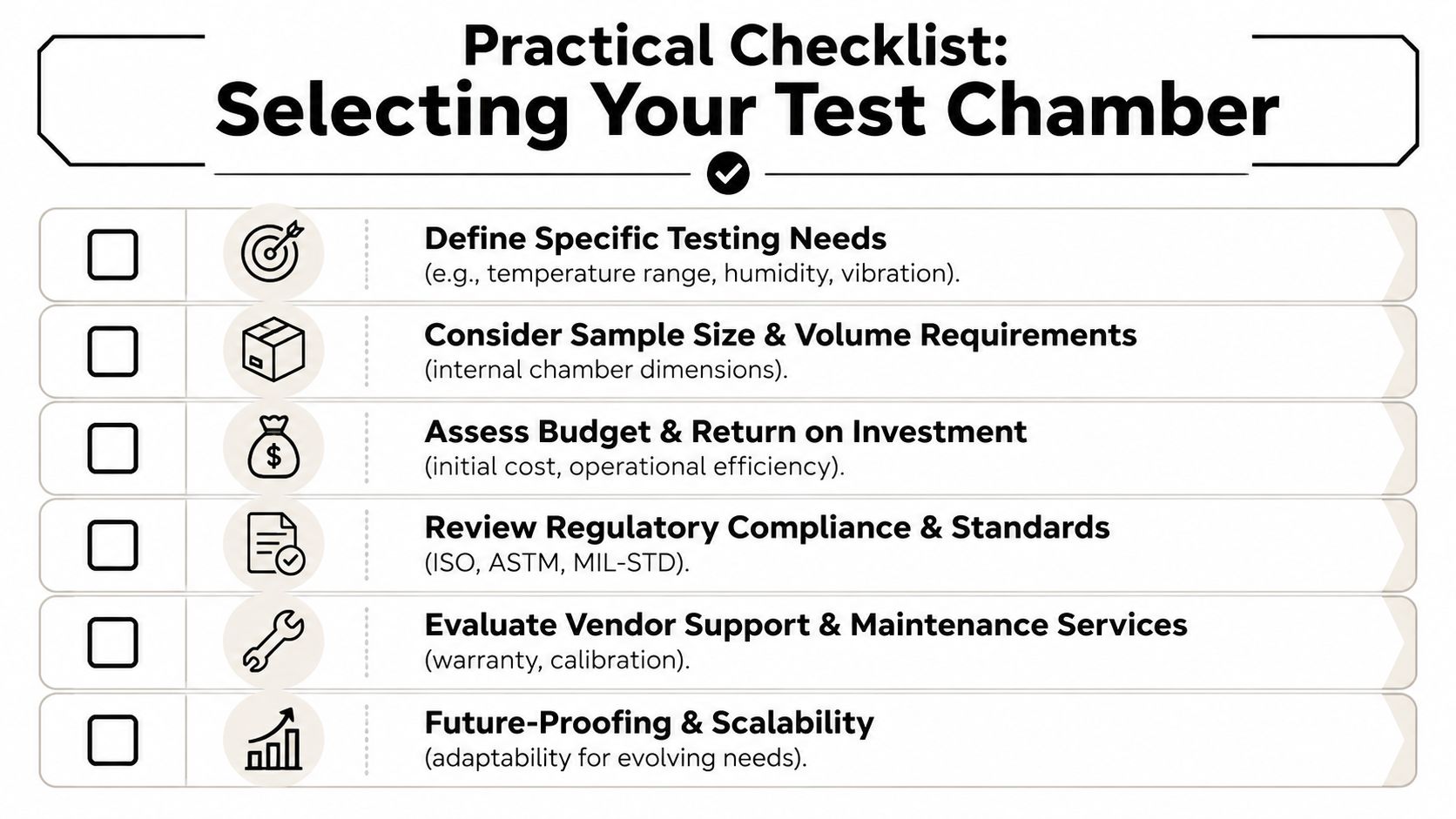
Start with the test itself. Write down the actual use case in one sentence. If that sentence mentions transport, cryogenic vessels, mixed payloads, shelf-life work, or qualification against a formal internal procedure, those details should shape the specification before any vendor discussion.
Then move through the shortlist below.
Use this decision frame with suppliers:
| Procurement topic | What to ask |
|---|---|
| Method fit | Has this chamber been matched to my actual protocol, not just my target temperature? |
| Instrumentation | Can I log the points that matter around the real load? |
| Serviceability | How quickly can calibration, repair, and spare support be arranged? |
| Documentation | Will qualification records and operating documents support audit review? |
| Upgrade path | Can the setup adapt if the workflow changes? |
The chamber is a long-life instrument, not a one-off purchase. So ask blunt questions about service and ownership.
A strong buyer also asks the vendor to discuss failure scenarios. If the supplier can only repeat catalogue points and can't talk sensibly about airflow, loading, and recovery under your actual application, keep looking.
An environmental test chamber doesn't stay trustworthy just because it was installed correctly. It stays trustworthy because the team treats it like a precision instrument. That means calibration, maintenance, alarm checks, and loading discipline are part of the operating method, not optional extras.
The easiest mistake to make is poor loading. To preserve airflow and reduce thermal gradients, chamber loading should leave 20 to 30% of the internal volume open, according to Isotech's technical overview of environmental test chambers. That matters for general reliability work, and it becomes even more important when a lab is trying to validate performance in line with European programmes that use standards such as IEC 60068.
Good long-term practice usually includes:
Maintenance protects more than the chamber. It protects the validity of every decision made from the chamber's data.
Neglect has a predictable cost. The chamber may still run, but the data becomes harder to trust. In regulated or medically sensitive work, that's the true failure. Not a broken compressor. A broken chain of evidence.
If your work involves cryogenic storage, transport, or handling of sensitive biological materials, Cryonos GmbH can help you evaluate the practical side of compliant low-temperature workflows, from vessel selection to transport-ready cryogenic systems and long-term support.

