No Products in the Cart




A common question we see is, "Can I buy liquid nitrogen from a pharmacy?" People often search online for flüssiger stickstoff kaufen apotheke, hoping for a simple local solution.
The short answer is a firm no. You cannot typically buy liquid nitrogen from your local German pharmacy (Apotheke). They are set up for dispensing regulated medicines, not for handling hazardous cryogenic gases that require specialised equipment and safety protocols.
It's an understandable assumption. Liquid nitrogen is used in medical settings, like for cryotherapy to remove warts, so it seems logical that a pharmacy might stock it. However, this idea overlooks the substance's unique classification and the strict safety measures needed for its storage and transport.
Pharmacies simply aren't equipped to manage the risks that come with a substance chilled to -196°C.
The regulatory landscape in Germany draws a very clear line between standard pharmaceuticals and specialised materials like liquid nitrogen. This separation is there for a few critical reasons:
Going to a professional supplier isn't just a suggestion—it's a requirement for safety, legal compliance, and getting a reliable product. A specialist provides a complete, regulated solution, ensuring you get not just the liquid nitrogen but also the certified equipment and expert support to handle it safely. This is vital for anyone needing a steady supply for professional work.
For individuals looking to purchase it, there are specific guidelines to follow. You can learn more by checking out our guide on buying liquid nitrogen for private use.
This flowchart breaks down the decision-making process, making it clear where to go.
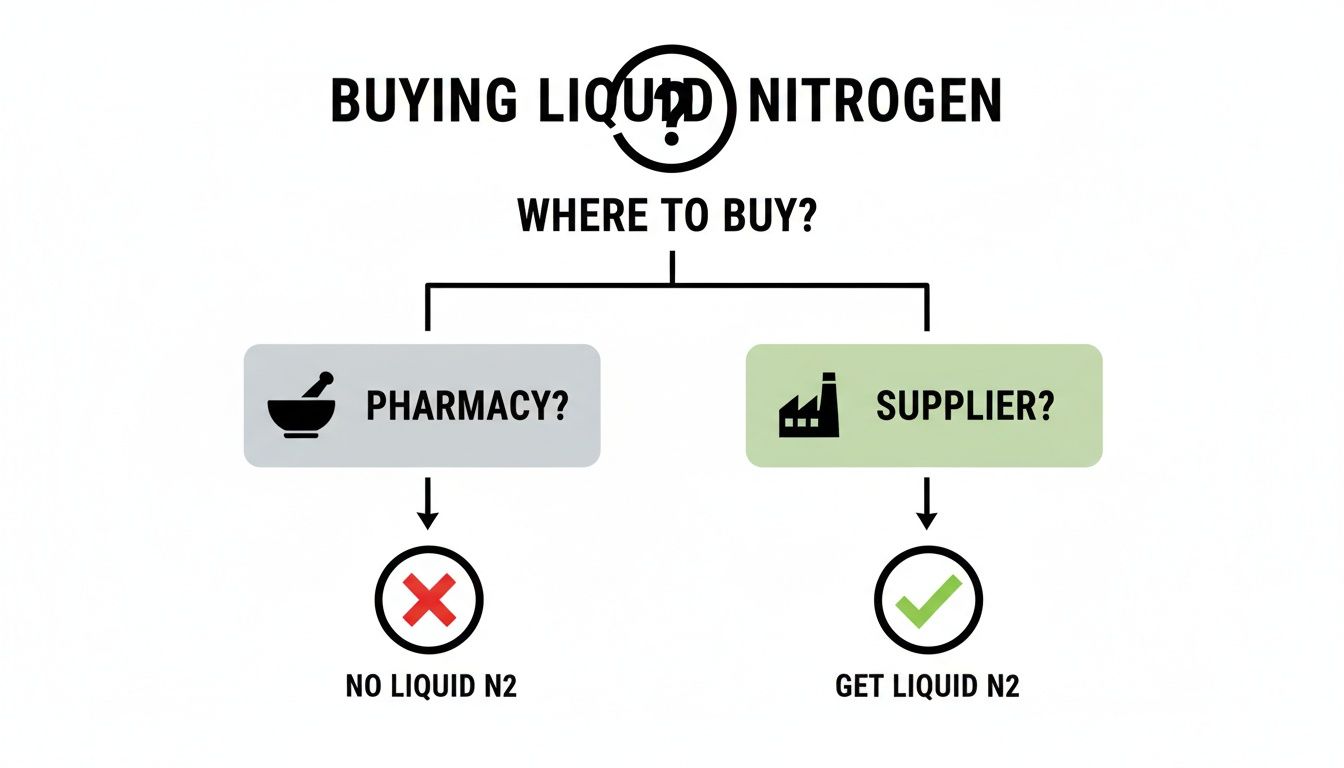
As the visual guide shows, certified suppliers are the only correct and safe path.
When deciding where to source liquid nitrogen, the choice is clear. Attempting to go through a pharmacy is not only a dead end but also ignores crucial safety and legal standards. Here’s a quick comparison to illustrate the difference.
| Attribute | Pharmacies ('Apotheke') | Specialised Suppliers (e.g., Cryonos) |
|---|---|---|
| Availability | Not available for sale. | Readily available in various quantities. |
| Safety Compliance | Not equipped or certified to handle cryogenic liquids. | Fully compliant with all safety and transport regulations (ADR). |
| Equipment | Do not stock or provide cryogenic vessels (dewars). | Offer certified, high-quality dewars and all necessary PPE. |
| Expertise | Staff are trained in pharmaceuticals, not cryogenics. | Staff are experts in cryogenic handling, safety, and applications. |
| Legal Status | Not legally permitted to distribute liquid nitrogen. | Legally certified and licensed to sell and transport. |
| Support | Cannot offer advice on handling or use. | Provide comprehensive support and guidance. |
The table highlights that for every critical aspect—from availability and safety to equipment and expertise—a specialised supplier is the only viable and responsible choice.
The demand for liquid nitrogen is growing, which makes a robust supply chain managed by experts more important than ever. In Germany, the liquid nitrogen market was valued at USD 280 million in 2024 and is expected to hit USD 450 million by 2032, driven by industries like healthcare and biotechnology.
This growth underscores the need for reliable suppliers like Cryonos GmbH, who provide complete solutions, including ADR-compliant transport vessels with excellent low evaporation rates. Key consumers like hospitals and fertility clinics, which use about 25% of Germany’s liquid nitrogen, rely on these scalable and dependable supply chains—something a local pharmacy could never provide.
The core issue isn't just getting your hands on liquid nitrogen; it's about doing so in a way that is safe, legal, and sustainable for whatever you need it for. Trying to source it from an unequipped outlet like a pharmacy is a practical impossibility under German law and introduces risks that are simply not worth taking.
This reality shapes the entire process. While you can find over-the-counter wart-freezing treatments in pharmacies, those products use different chemical compounds that don't reach the extreme temperatures of pure liquid nitrogen. The real cryotherapy performed by dermatologists uses medical-grade liquid nitrogen sourced from professional suppliers—never from a pharmacy shelf.
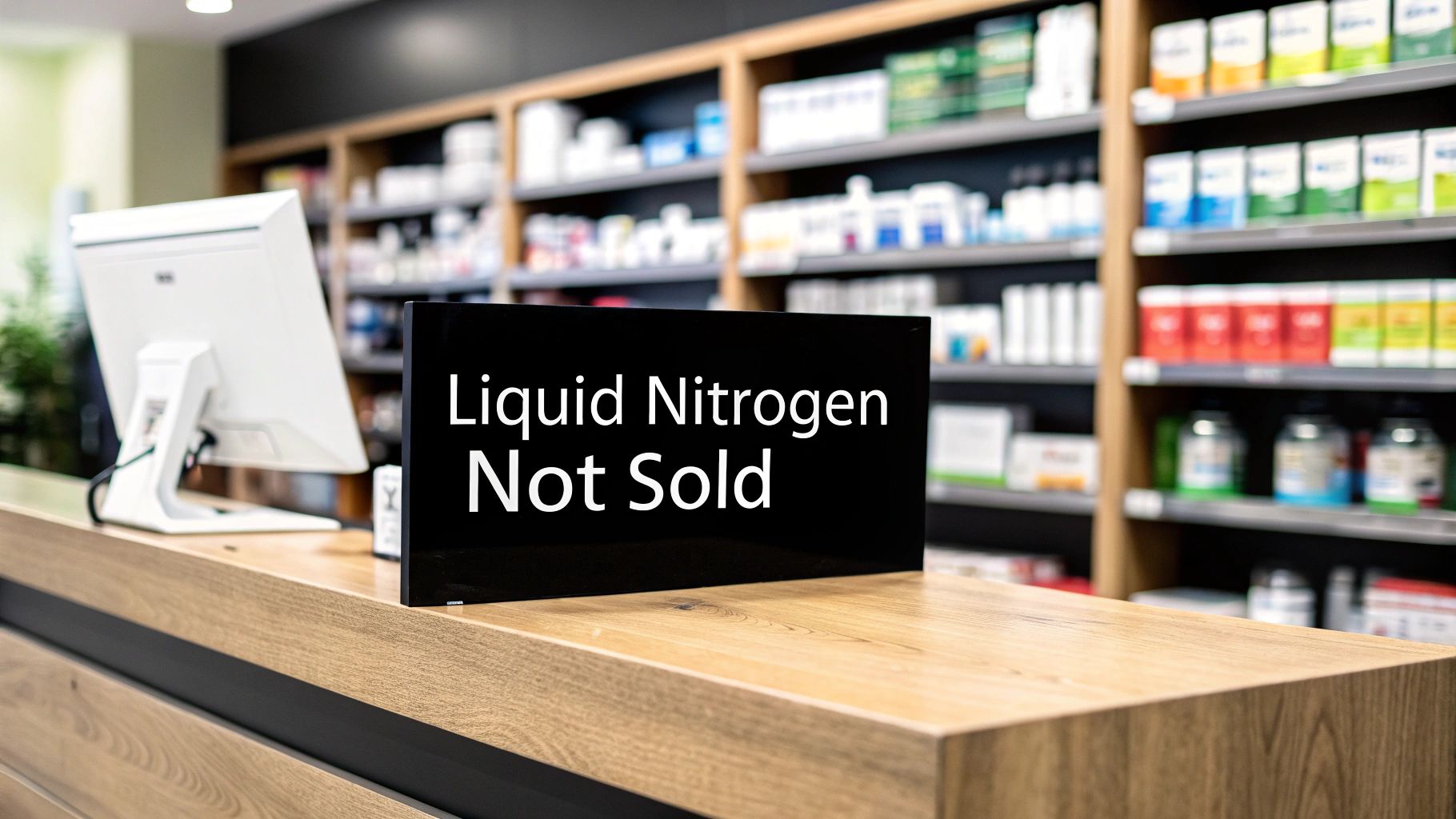
Alright, so we've established that a professional supplier is your only real, safe, and legal option—and that searching for flüssiger stickstoff kaufen apotheke is a guaranteed dead end. The next practical step is to drill down into what you actually require. Buying liquid nitrogen isn't like picking something off a shelf; it's a specific transaction tailored to your needs.
Your specific application is what drives everything: the volume, the delivery frequency, and the kind of storage you'll need. Getting this part wrong can lead to wasted money, operational headaches, or worse, serious safety risks. Before you can even think about an order, you need a crystal-clear picture of your consumption. Are you a busy biobank needing daily top-offs for cryopreservation freezers? Or do you just need an occasional supply for industrial cooling? The requirements for each are worlds apart.
First things first, you need to do a little self-assessment of your usage. The amount of liquid nitrogen you'll go through isn't just about what you're using it for. Environmental factors and how often you're using it play a huge part.
A major factor here is the boil-off rate—the natural evaporation of liquid nitrogen as it soaks up heat from the air around it. This rate is influenced by a few key things:
To get a solid estimate, track your consumption over a typical work cycle, whether that's a week or a month. This gives you a baseline to forecast your future needs and set up a delivery schedule that makes sense, preventing those nightmare scenarios where you run out unexpectedly and critical work grinds to a halt.
Once you've got a handle on your volume, the next move is picking the right storage container. This choice is just as vital as the nitrogen itself. The vessel you use directly impacts safety, efficiency, and how smoothly your work flows. Your main choices are between dewars and larger liquid cylinders.
A classic mistake we see is people choosing a vessel based only on its capacity, completely ignoring its intended purpose. For instance, trying to use a huge, bulky liquid cylinder for small, precise transfers in a cramped lab space is not only clumsy but also significantly increases the risk of spills.
The right vessel isn't just a container; it's a tool that should integrate seamlessly into your workflow. Matching the vessel to the task prevents the costly error of over-sizing or under-sizing your equipment, which can waste both product and time.
To help you make the right call, let's look at a couple of real-world scenarios:
Scenario 1: High-Precision Lab Work Imagine a university research lab doing delicate cryosurgery experiments. They need small, exact amounts of liquid nitrogen throughout the day. For them, a small-capacity dewar (say, 10-30 litres) is perfect. It's light, easy to handle for controlled pouring, and its smaller opening helps minimise boil-off during frequent use.
Scenario 2: Continuous Supply for a Fertility Clinic A fertility clinic's cryopreservation tanks need a constant, reliable supply to keep samples safely at -196°C. Here, a large, pressurised liquid cylinder (180+ litres) is the way to go. It can be hooked up directly to automated filling systems, guaranteeing an uninterrupted supply without the hassle of constant manual refilling and reducing the risk of temperature fluctuations.
The Cryonos AC LAC XL series, for example, offers a range of capacities designed specifically for these varied workflows. This ensures that whether your needs are large or small, you have a vessel that boosts both safety and efficiency. This kind of careful planning means you’re not just buying nitrogen; you’re investing in a complete, optimised solution.
Getting your hands on liquid nitrogen in Germany isn't like a typical purchase. It's a process governed by a clear legal framework designed to keep everyone safe and prevent misuse. Unlike standard lab supplies, you can't just pop it in a shopping cart and head to checkout.
Professional suppliers have a legal duty to verify who you are and what you're using it for. This means a bit of paperwork is just part of the deal.
This isn’t about making life difficult; it’s about accountability. Liquid nitrogen is a hazardous substance, and these rules ensure it only goes to legitimate businesses and institutions that know how to handle it properly. This is a major reason why the whole flüssiger stickstoff kaufen apotheke (buying liquid nitrogen at a pharmacy) idea is a non-starter. Pharmacies simply aren't equipped for this level of commercial vetting and safety compliance.
First things first: for any professional purchase in Germany, you need to be a registered business or institution. Suppliers must confirm they’re dealing with a legitimate commercial entity, not an individual trying to buy it for unverified reasons.
The check is usually pretty straightforward. You'll need to provide your business registration details, known as a Gewerbeanmeldung. For universities, research labs, or medical centres, official institutional documents work just as well. This step instantly sets up a professional, B2B relationship and is the absolute baseline before any order can move forward.
Once your business is verified, the next key document is the Verwendungszweckerklärung, which translates to a "declaration of intended use." It’s a formal statement you give the supplier explaining exactly how you plan to use the liquid nitrogen. This is a legally required document that's crucial for preventing hazardous materials from being diverted for illegal activities.
So, what goes into this declaration?
Don't see the Verwendungszweckerklärung as a bureaucratic hoop. Think of it as a formal safety agreement between you and your supplier. It legally documents your commitment to responsible use, protecting both of you and ensuring you're compliant with German chemical safety laws.
This declaration becomes a permanent part of the sale's official record. Professional suppliers like us at Cryonos take this very seriously—it's a cornerstone of our legal and safety protocols. It ensures every litre of liquid nitrogen we supply is accounted for and is being used for a legitimate, documented purpose.
Depending on your field, you might need to provide even more documentation. The rules can get tighter in highly regulated sectors. For instance, if you're in the pharmaceutical or medical device manufacturing game, you might need to show proof of GMP (Good Manufacturing Practice) certification.
Likewise, businesses in the food and beverage industry using liquid nitrogen for flash-freezing must meet specific food safety standards. Your supplier may ask for documents related to your HACCP (Hazard Analysis and Critical Control Points) plan to ensure their product is being used in a compliant process.
Having these industry-specific certificates ready will make the whole procurement process much smoother and shows you're committed to regulatory standards from the get-go.
Moving liquid nitrogen from A to B isn't like picking up other lab supplies. It's a serious business, governed by a strict set of rules that are absolutely non-negotiable. The whole process falls under the ADR – that's the European Agreement concerning the International Carriage of Dangerous Goods by Road. Getting this right is about more than just ticking boxes; it's about safety and staying on the right side of the law.
Trying to sidestep these regulations is a recipe for disaster. The consequences aren't just a slap on the wrist; we're talking about hefty fines and, worse, the risk of a catastrophic accident. This is precisely why the idea of getting flüssiger stickstoff from a local pharmacy just isn't feasible. They simply aren't equipped to be part of this highly regulated transport chain.
The ADR framework is designed to classify dangerous goods, and liquid nitrogen is firmly on that list. It’s identified as UN 1977, Class 2.2 – a non-flammable, non-toxic gas that poses a significant asphyxiation risk by displacing oxygen.
This classification sets off a chain reaction of mandatory safety requirements for anyone involved in its transport.
For a more detailed look into the rules for transporting pressurised gases, our guide is a great resource. You can find more on the safe transport of gas cylinders in our detailed article.
Perhaps the single most important piece of the puzzle is the container. You can't just pour liquid nitrogen into any old insulated flask and hit the road. To transport it legally and safely, you need a specialised, ADR-licensed vessel. These containers are specifically engineered and have been through rigorous testing to handle the extreme cold and the bumps and rattles of transport.
Your standard laboratory dewar is great for storage in your facility, but it almost certainly isn't certified for transport on public roads. An ADR-compliant vessel, like the ones you'll find in the Cryonos portfolio, is built differently:
There's no way around this: you must use a supplier that provides certified, ADR-licensed transport vessels. It's a cornerstone of a compliant supply chain and your best guarantee that the liquid nitrogen will get to you without a hitch. This is a level of professional assurance you'll never get when trying to figure out how to flüssiger stickstoff kaufen from unofficial sources.
So, what does all this mean for you when you place an order? Your role and responsibilities really depend on how you choose to receive your liquid nitrogen.
At the end of the day, mastering safe transport is about knowing the rules and choosing a partner who follows them to the letter. It ensures every step of the journey, from our facility to yours, is secure, properly documented, and completely compliant.
Once your liquid nitrogen is delivered and on-site, the responsibility for keeping everyone safe falls squarely on your team's shoulders. Working with a substance chilled to -196°C is no joke—it demands a systematic and unwavering commitment to safety. This isn't just about ticking boxes for compliance; it's about building a culture where every action is deliberate and every risk is managed.
A simple mistake, like grabbing a beaker without the right gloves or working in a stuffy room, can lead to serious trouble, fast. The goal is to make safety so ingrained in your day-to-day work that it becomes second nature. It all starts with the right gear and extends to how you handle, store, and prepare for any potential emergencies.
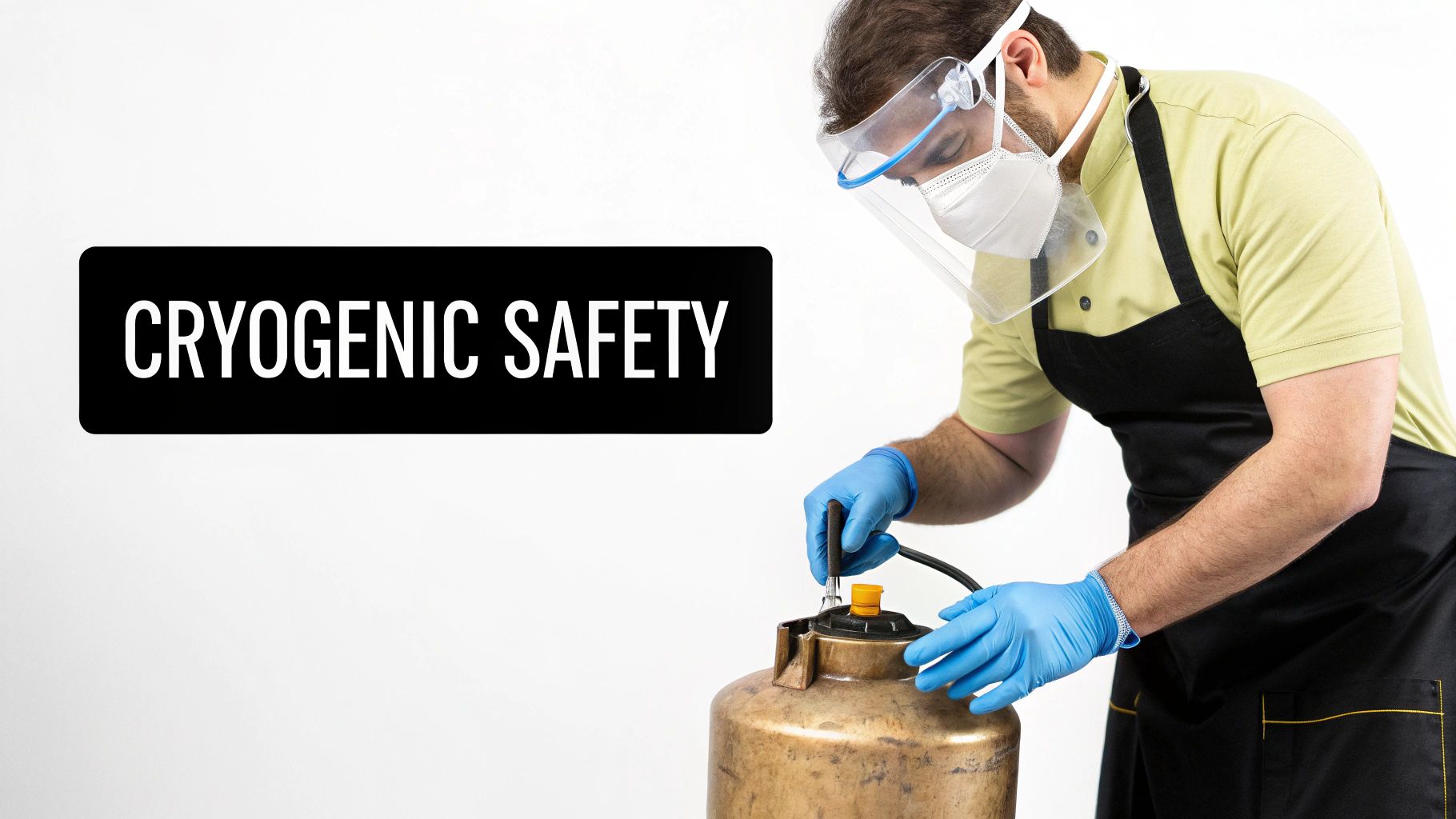
Personal Protective Equipment (PPE) is your absolute, non-negotiable first layer of protection against the intense cold of liquid nitrogen. Even a tiny splash can cause a severe cryogenic burn, which is just as damaging as a thermal burn from a flame. Getting your team kitted out with the right PPE is the most basic—and most critical—safety measure you can take.
Your essential PPE checklist must include:
And remember, standard rubber or latex gloves offer zero protection. In fact, they can make an injury much worse by trapping the intensely cold liquid right against your skin.
Beyond wearing the right gear, how your team works is what truly creates a safe environment. The way you transfer, store, and move around liquid nitrogen directly determines your level of risk. But the most significant hidden danger isn't the cold—it's the invisible gas it produces.
As liquid nitrogen warms up and evaporates, it expands to 700 times its liquid volume. This process rapidly displaces oxygen from the air, creating a serious risk of asphyxiation, especially in closed-off or poorly ventilated areas.
Good ventilation isn't just a suggestion; it's an absolute must. Always work in a well-ventilated space. If you're in a more confined area, an oxygen-level monitor is an essential piece of safety kit. Its alarm provides a critical warning if oxygen levels start dropping to a dangerous point.
To keep daily operations safe, you need to establish and enforce strict handling protocols.
Best Practices for Transfers:
Having an emergency response plan is just as important as your daily procedures. For a deeper dive, check out these 7 important rules for safe work with cryogenic liquids in our detailed guide. Your plan should clearly outline the steps for dealing with spills, accidental skin contact, and what to do if that oxygen alarm goes off. Every single person on your team needs to be trained on this plan and know exactly what their role is in an emergency.
Diving into the world of cryogenic gases can feel complex, and it’s natural to have questions, especially with safety and compliance on the line. Getting clear, practical answers is the only way to make the right call for your operations. We’ve pulled together some of the most common queries we get from professionals to give you direct, no-nonsense insights.
Think of this as a way to clarify your next steps, helping you move from uncertainty to confident action.
Choosing a supplier isn't just about finding the best price per litre. Far from it. The right partner provides a complete, integrated solution that puts safety, reliability, and genuine expertise first. You'll want to steer clear of suppliers who just drop off the gas and leave you to figure out the rest.
A truly top-tier supplier should bring more to the table:
A turn-key provider who manages everything—from the quality of the nitrogen itself to the certification of the equipment—is the gold standard. This holistic approach gives you a robust, dependable supply chain you don't have to worry about.
Delivery timelines really depend on your location, order volume, and the supplier's logistics network. For operations where a constant supply is mission-critical—think biobanks or fertility clinics—these details are everything.
Established suppliers usually have their delivery routes and schedules dialled in for prompt service. Some, like Cryonos, even offer instant worldwide shipping to ensure your team never faces costly downtime.
The smartest strategy? Set up a recurring delivery schedule. This proactive approach takes the stress out of last-minute orders and prevents any interruptions to your workflow. Always talk about delivery frequency and lead times upfront to find a rhythm that works for you.
Absolutely not. This is one area where there is zero room for compromise. Liquid nitrogen must only be stored and transported in purpose-built cryogenic vessels, known as dewars. Trying to use any other container, like a standard thermos or an insulated bottle, is incredibly dangerous.
Everyday containers simply aren't built to handle the extreme cold of -196°C. The thermal shock can cause them to shatter violently.
Beyond that, they lack the critical safety features of a professional dewar. Certified cryogenic vessels are engineered with:
Always insist on certified equipment, such as the AC LIN or AC LAC XL series vessels, which are rigorously tested to meet strict international safety standards. It’s a fundamental rule that protects your people and your facility.
Ready to secure a reliable, compliant, and safe liquid nitrogen supply for your professional needs? The team at Cryonos GmbH is here to provide a complete solution, from certified dewars to expert guidance. Explore our state-of-the-art cryogenic solutions at https://www.cryonos.shop.

