No Products in the Cart




You're standing in front of a cylinder rack. One bottle is acetylene, another argon, another carbon dioxide, and another oxygen. The labels are clear, but the decision often isn't. If you choose the wrong gas, the weld may look acceptable at first and still fail later through porosity, oxidation, poor penetration, or corrosion problems.
That's why gas welding gases shouldn't be treated as background consumables. Gas controls heat, chemistry, arc behaviour, and contamination risk. In a fabrication bay, that affects rework and throughput. In a laboratory, biobank, or medical setting, it can also affect the reliability of stainless assemblies, cryogenic lines, and sensitive equipment where cleanliness and corrosion resistance matter.
The first useful distinction is simple. Welding gases fall into two main families.
One family creates heat. These are the gases used in oxy-fuel processes, where a fuel gas burns with oxygen to produce a flame for welding, brazing, heating, or cutting.
The other family protects the weld. These are shielding gases used in arc welding processes such as MIG, MAG, and TIG. Their job isn't to burn. Their job is to keep the weld pool away from the surrounding air.
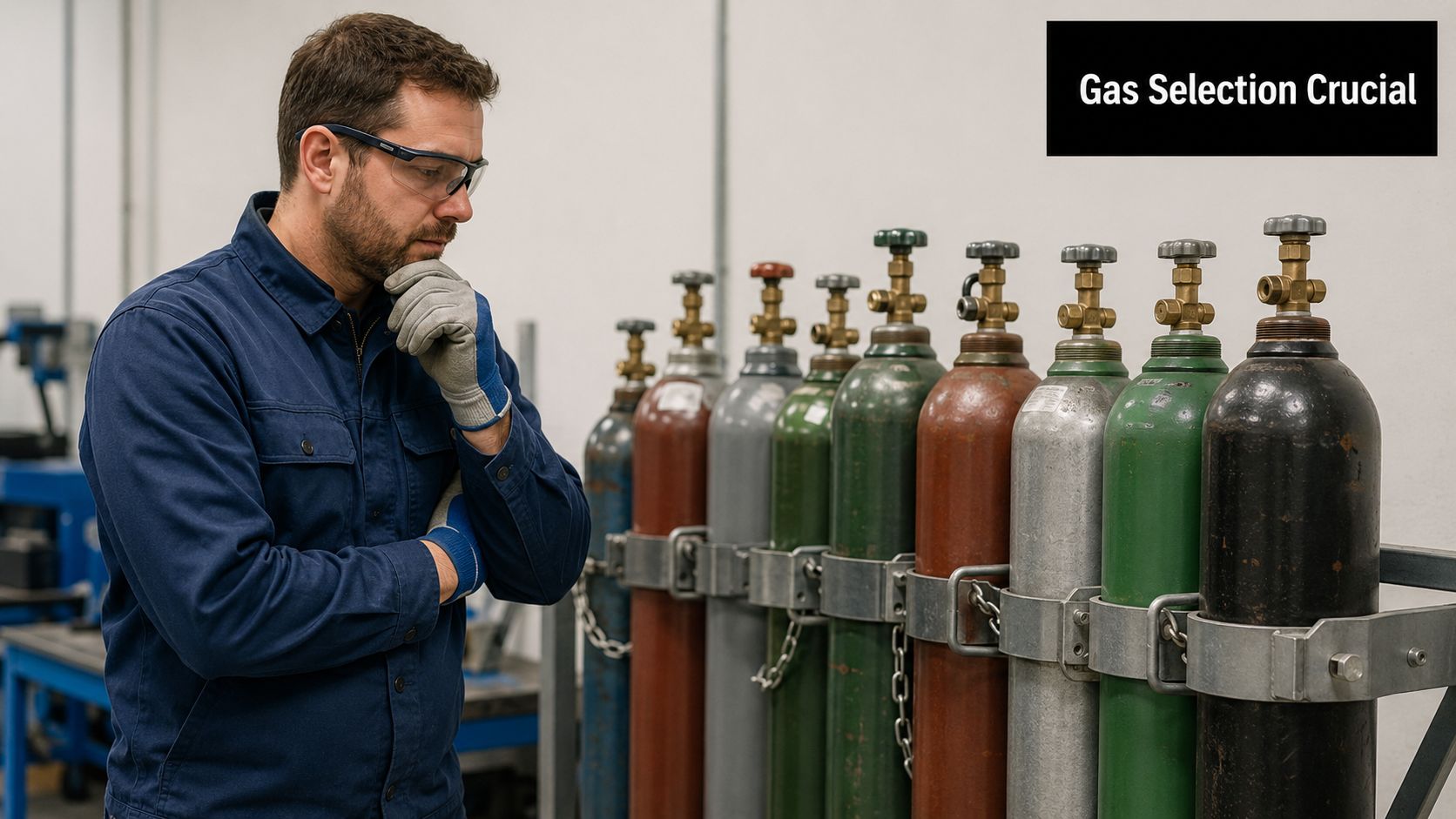
A common beginner mistake is to think all welding gases do roughly the same thing. They don't.
If you remember only one idea, remember this. Gas is part of the welding process itself, not an accessory attached to it.
Practical rule: If you change the gas, you've changed the process.
A workshop technician usually feels the effect through arc stability, cut quality, and clean-up time. A lab manager may see it in a different way. Root oxidation on stainless tubework, contamination risk, or inconsistent weld appearance on small precision joints can all trace back to gas quality, flow, or gas selection.
That's also why “best gas” is usually the wrong question. The better question is, best gas for which metal, which process, and which quality requirement?
Fuel gases are like different fuels for the same engine. Some burn fast and intensely. Some are steadier and better suited to heating than fusion welding. Some are chosen because they're practical in the field, not because they're perfect for every torch job.
Historically, acetylene became the enabling gas for modern oxy-fuel welding after its discovery in 1836, and practical welding and cutting applications followed in the late 19th and early 20th centuries, when oxy-acetylene welding became a cornerstone process for metalworking before electric arc methods dominated, as outlined in this history of welding and oxy-acetylene development.
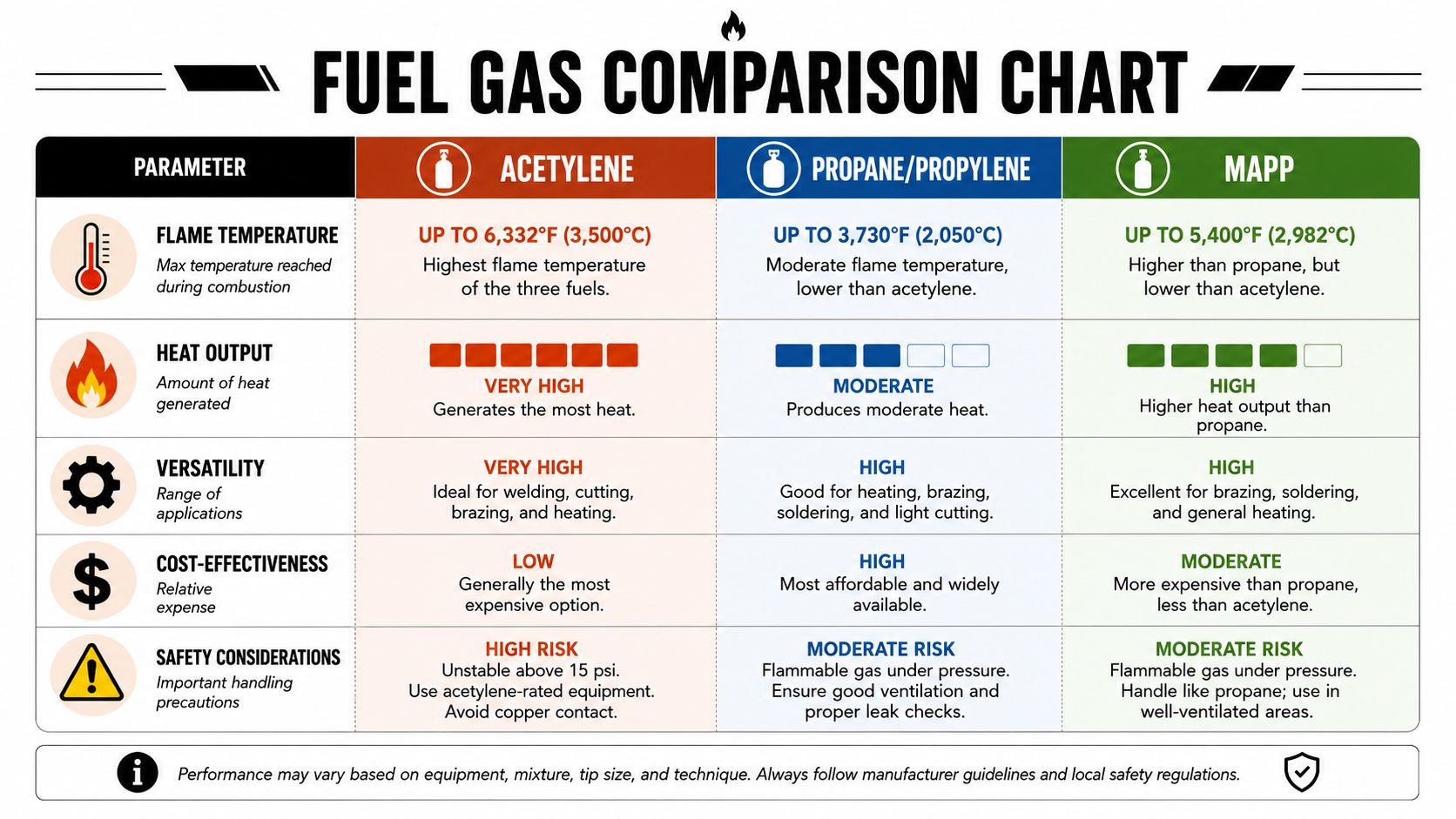
Acetylene is the classic oxy-fuel choice for a reason. It gives a very concentrated, energetic flame and works well when you need a flame that can both heat and fuse metal efficiently.
For many technicians, acetylene feels responsive. Small torch adjustments produce noticeable changes at the tip. That makes it useful for welding, brazing, repair work, and cutting.
Where it fits well
Trade-offs
If you work with oxy-acetylene regularly, this guide to acetylene oxygen welding basics is a useful process reference.
Propane and propylene are often discussed together because they fill similar roles in many shops. They're commonly chosen for heating, brazing, and cutting support tasks rather than classic fusion gas welding.
Think of them as broader, less concentrated heat sources. They can be very practical when you need sustained heating over an area instead of a sharply focused flame core.
Many users know MAPP by name because it became associated with portable heating and brazing applications. In practical terms, people often choose it when they want a fuel that feels more energetic than simple LPG options in handheld work.
Its appeal is convenience and versatility in maintenance work, small assemblies, and field use. But the exact suitability depends on the torch system and the task. It's not a universal substitute for acetylene.
Hydrogen is less common in general workshop conversation, but it has specialised uses where a very clean flame characteristic is useful. It isn't the default fuel gas for routine fabrication, and it demands a very careful approach to compatibility and safety.
In precision environments, the attraction is usually process-specific. People choose it because the application calls for it, not because it's broadly convenient.
When technicians compare fuel gases, they often focus on temperature alone. That's too narrow. A better comparison uses these criteria:
| Decision factor | What to ask |
|---|---|
| Heat character | Do you need concentrated heat for fusion, or broader heat for warming and brazing? |
| Process type | Are you welding, cutting, brazing, soldering, or simply heating? |
| Equipment match | Is the torch, tip, regulator, and hose setup approved for that gas? |
| Site safety | Does the work area support the storage and ventilation requirements of the gas? |
A gas can be perfectly good and still be the wrong choice for your torch, joint, or work environment.
If your job is traditional oxy-fuel welding, acetylene remains the reference point many operators understand best. If your job is mostly heating, brazing, or support work, propane or propylene may be more practical. If your work is specialised, portable, or equipment-limited, MAPP-type options may enter the conversation. If the application is highly specific, hydrogen may be justified.
The key isn't memorising a ranking. It's matching the flame behaviour to the metallurgical job.
Oxygen does one job in oxy-fuel work. It releases the energy in the fuel. Without it, the torch doesn't produce the flame characteristics needed for effective heating and cutting.
That doesn't mean oxygen is “better” when there's more of it. In welding, excess oxygen can push the chemistry in an unwanted direction. Controlled proportion is what matters.
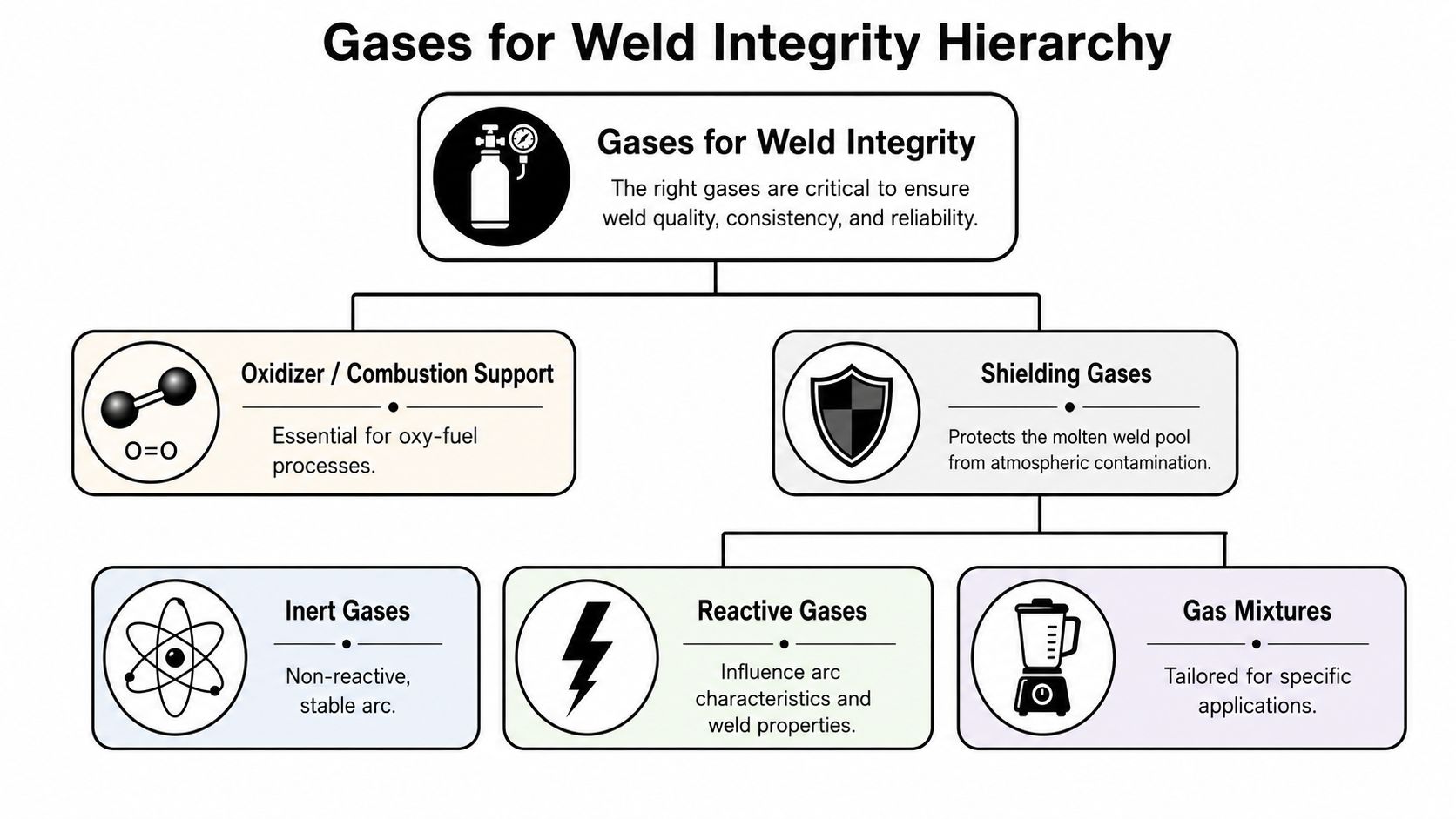
In an oxy-fuel torch, oxygen acts like the second half of the reaction. The fuel gas provides combustible material. Oxygen supports combustion strongly enough to produce a useful working flame.
That's why oxygen cleanliness and equipment compatibility matter. The gas is not there as a passive additive. It actively shapes flame intensity and cutting performance.
Shielding gases work differently. They don't create the heat source in TIG, MIG, or MAG. They create a local atmosphere around the arc and molten metal.
A useful analogy is a bubble over the weld pool. If that bubble stays intact, the hot metal is protected. If the bubble breaks, air gets in and weld quality suffers.
The reason is straightforward. According to the AWS shielding-gas standard background, the shielding atmosphere must exclude oxygen, nitrogen, and hydrogen to prevent porosity and other defects, and gas composition is chosen to tune heat input, penetration, and transfer mode for the workpiece, as described in this AWS shielding gas reference.
Some shielding gases are mainly passive protectors. Others do some protection and also change the behaviour of the arc.
For many users, the easiest summary is this: inert gases protect more passively, active gases influence more aggressively.
Argon and helium became central to high-quality gas-shielded welding in the 1940s with the development and patenting of TIG welding in 1941 by Russell Meredith. Historical accounts note that the process was first called Heliarc because helium was used as the shielding gas. A recent industry estimate also values the global welding gas market at $3.61 billion in 2024, with a projection to $6.08 billion by 2034 at 5.4% CAGR, which underlines that these gases remain industrially important rather than historical leftovers, according to this welding gas market and TIG history overview.
For a practical look at argon's role in shielding, Cryonos also has a German-language article on argon as a shielding gas.
If a weld pool is reactive and exposed, the atmosphere will affect it. Shielding gas exists to stop that from happening.
In general fabrication, poor shielding often shows up as visible defects or extra cleaning. In lab and biobank environments, the consequences can be more subtle. A discoloured root, a rough internal surface, or reduced corrosion performance on stainless components may not fail immediately, but they can still compromise a critical assembly later.
That's where gas quality stops being a cost line and becomes part of quality assurance.
A torch flame tells you what chemistry you're creating. Skilled operators don't just set pressures and start welding. They read the flame and adjust it until the torch suits the metal.
With oxy-acetylene work, people usually talk about neutral, carburising, and oxidising flames. Those terms sound abstract until you connect them to what happens in the weld pool.
A neutral flame is the everyday standard for many steel welding tasks. It doesn't push the weld pool strongly towards extra oxidation or excess carbon pickup.
In use, it tends to feel balanced. The flame is controlled, the puddle behaves predictably, and the operator can focus on travel speed and filler addition rather than fighting the chemistry.
A carburising flame is also called a reducing flame. It carries excess fuel character, which means it can influence the surface and chemistry differently from a neutral flame.
That can help in certain specialist applications, but it can also cause trouble if used casually. On the wrong job, it can leave deposits, disturb bead appearance, or change the metal surface in ways you didn't want.
An oxidising flame has more oxygen character than a neutral flame. On some materials and joining methods, that's useful. On steel fusion welding, it can be harmful if it drives the chemistry too far.
Operators often become confused. They assume “hotter” means “better”. It usually doesn't. The right flame is the one that gives the metal the chemistry it needs, not the one that looks the fiercest.
Use your senses, but don't rely on instinct alone.
The flame is a chemical tool. If the metal reacts badly, the torch setting is part of the cause.
That same principle applies in arc welding even though there's no visible flame cone. Gas selection still acts as contamination control, and standardised gas compositions are chosen because the atmosphere around the work must exclude harmful contaminants and shape penetration and transfer behaviour, as noted earlier.
Material matters more than people think. Many gas selection errors happen because someone learns one successful setup on mild steel and then tries to apply it to stainless or aluminium.
That usually ends badly.
For MIG/MAG welding mild steel in Germany, the most common shielding gas is 75% argon / 25% carbon dioxide (C-25). It's widely used because it offers a stable arc, relatively low spatter, and good puddle control, and short-circuit transfer is typically run at 25 to 35 cfh, which is about 12 to 17 L/min, according to Miller Electric's guidance on MIG shielding gas choice and flow range.
For many workshop jobs, that mix gives a practical balance. It doesn't try to maximise a single variable. It gives usable arc behaviour and manageable clean-up.
Stainless changes the question from “Will it weld?” to “Will it keep its corrosion performance?” That's where many beginner guides stop too soon.
For stainless, gas selection often becomes more process-specific. Shielding, backing, and root protection matter because the unseen side of the joint can determine long-term performance. In critical systems, preserving the metal's surface condition is often just as important as producing a neat bead.
Aluminium is unforgiving when shielding is poor. The metal reacts quickly, and operators usually notice that immediately through arc behaviour and weld appearance.
That's why aluminium work typically demands a cleaner, more stable shielding approach than casual fabrication on mild steel. If the setup is sloppy, the metal tells you straight away.
Cast iron jobs vary widely. Some are true welding repairs. Others are better handled by brazing or controlled heating methods. Gas choice here depends less on a universal rule and more on whether you want fusion, local heating, or a lower-temperature joining approach.
This is one area where process discipline matters more than habit. A torch that works beautifully on one repair can create cracking or hard zones on another.
| Metal | Oxy-Fuel Gas | Shielding Gas (MIG/TIG) |
|---|---|---|
| Mild steel | Acetylene is a common reference choice for oxy-fuel welding, heating, and cutting | For MIG/MAG mild steel, 75% argon / 25% CO2 is a common choice |
| Stainless steel | Often treated cautiously in oxy-fuel work because heat control and oxidation matter | Process-specific shielding and root protection are often required |
| Aluminium | Oxy-fuel is generally not the first-choice method for precision aluminium welding | Argon-based shielding is commonly used where clean arc control is needed |
| Cast iron | Often approached through heating or brazing-focused torch work depending on the repair | Shielding choice depends on the exact arc process and repair method |
Choose gas by answering three questions in order:
If you answer those accurately, the gas choice usually becomes much clearer.
Poor gas handling ruins more than welds. It creates avoidable risk for people, buildings, and equipment. In professional settings, gas safety isn't a side topic. It's part of competent operation.
The first discipline is simple. Know exactly what cylinder you're handling, keep it identified, and keep it secured.
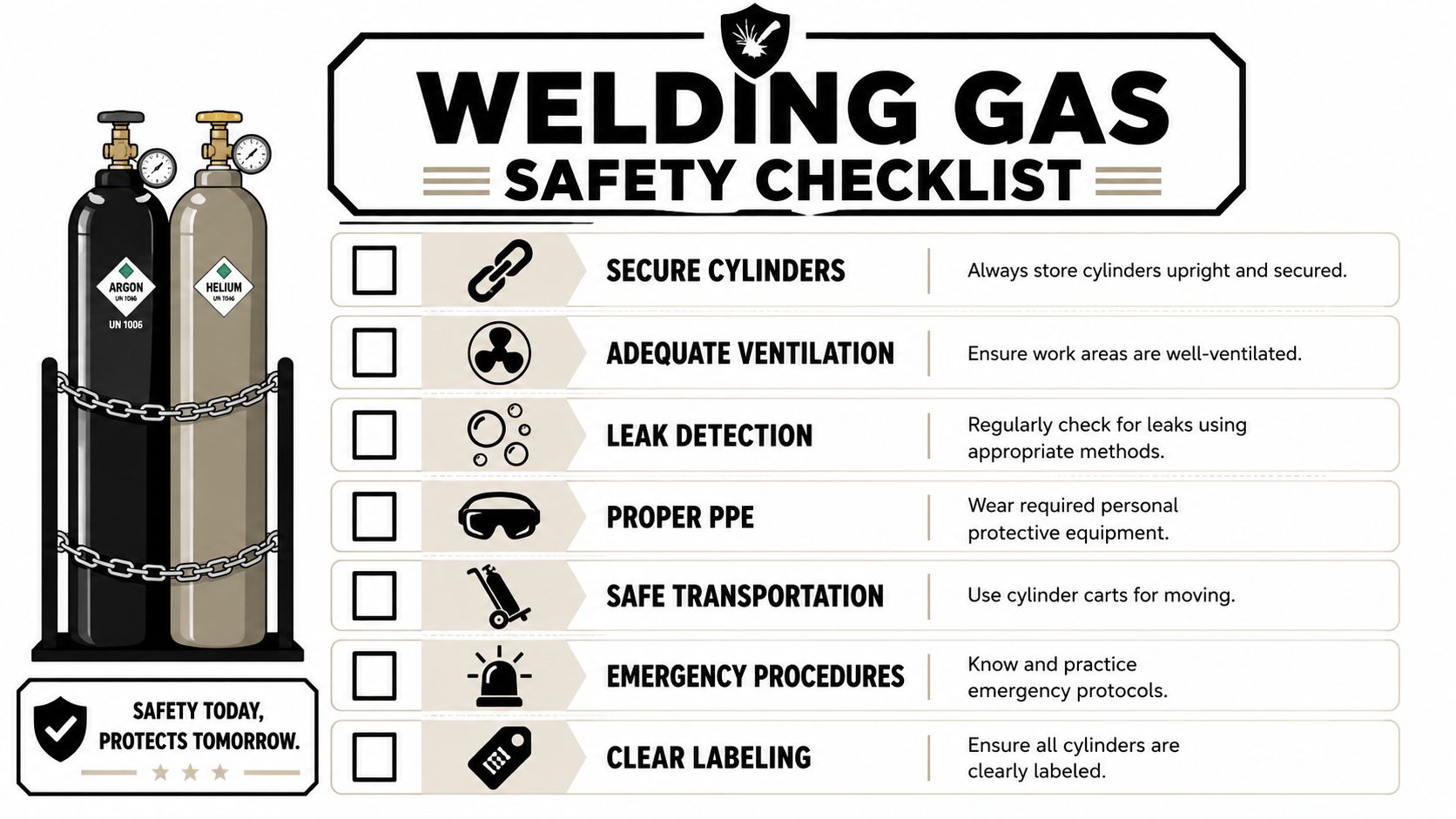
Some mistakes happen because people are rushed. Others happen because a cylinder looks harmless when it's standing in a corner. Both are dangerous habits.
For a broader operational overview, Cryonos provides a practical article on the storage of compressed gas cylinders.
Move cylinders with approved carts. Use regulators and fittings intended for the specific gas. Check hoses, valves, and connections before work starts, not after a problem appears.
Leak checking deserves special attention. People often focus on the dramatic hazards, such as fire. Quiet failures can be just as serious. Inert gases don't have to burn to harm someone in a poorly ventilated area.
This short video is a useful refresher on safe cylinder practice:
Many operators assume that if some shielding gas is good, more must be better. That isn't how shielding works. Research on shielding gas coverage shows that gas flow rate, nozzle stand-off, and torch angle affect quality systematically, and turbulent or misdirected flow can reduce shielding effectiveness and increase defects, as discussed in this study on shielding gas coverage and flow behaviour.
That matters for safety as well as quality. Excessive flow can waste gas, disturb shielding, and encourage bad habits where operators try to compensate for setup problems by turning up the regulator.
More flow doesn't guarantee more protection. Controlled flow is what protects the weld.
| Check | Why it matters |
|---|---|
| Cylinder secured | Prevents tipping and valve damage |
| Correct regulator fitted | Avoids incompatibility and leakage |
| Ventilation confirmed | Reduces accumulation risk |
| Labels verified | Prevents gas mix-ups |
| Flow set correctly | Supports shielding without turbulence |
If you manage a lab, workshop, or mixed-use facility, treat gas storage and use like any other controlled technical system. Written procedures, trained staff, and routine checks are not bureaucracy. They are part of doing the job properly.
Usually, no. A gas that works well for one metal or process may be a poor choice for another. Fuel gases and shielding gases do different jobs, and even within shielding gases, the right answer changes with metal, joint design, and quality target.
It can look economical at first because the gas itself may be a straightforward option for some MAG work. But gas choice shouldn't be judged by cylinder cost alone. Arc behaviour, spatter, cleaning time, and weld finish all affect the actual cost of the job.
Because shielding gas has to arrive at the weld in a stable way. If flow is excessive or poorly directed, the gas stream can become turbulent and pull in surrounding air instead of excluding it. When that happens, you can get the exact defects you were trying to prevent.
For many users in Germany, the common reference point is the argon and carbon dioxide blend covered earlier for mild steel MIG/MAG. It's popular because it balances arc stability and spatter control well. But “all-round” still depends on your machine, filler, joint type, and position.
Because stainless isn't only about joining the metal. It's also about preserving the surface and corrosion behaviour. If shielding or root protection is poor, the weld may still hold physically while losing corrosion performance where it matters most.
For demanding stainless applications, process-specific optimisation matters. Alleima notes that root protection can require gas purity of at least 99.995%, and that 20 ppm O2 is a practical upper limit at the root side for the best corrosion performance, as explained in this guide to shielding the weld and root protection purity.
Yes. In those settings, welded stainless parts, tubing, vessels, and support hardware may need a cleaner internal surface and more predictable corrosion behaviour than ordinary workshop fabrications. That doesn't always mean exotic gas choices. It does mean tighter control of purity, shielding, and procedure.
If your team handles industrial gases or cryogenic systems and needs practical support on storage, transport, and compliant equipment, Cryonos GmbH supplies cryogenic vessels, liquid cylinders, transport units, safety equipment, and related accessories for laboratories, biobanks, hospitals, and industrial users.

