No Products in the Cart




When you talk about industrial-scale refrigeration, one refrigerant stands out from the pack: ammonia. Known in the trade as R717, it’s a proven, highly efficient, and environmentally sound choice that has long been the backbone of heavy-duty cooling. Its biggest selling points? A zero Ozone Depletion Potential (ODP) and a zero Global Warming Potential (GWP), backed by thermodynamic performance that’s tough to beat.
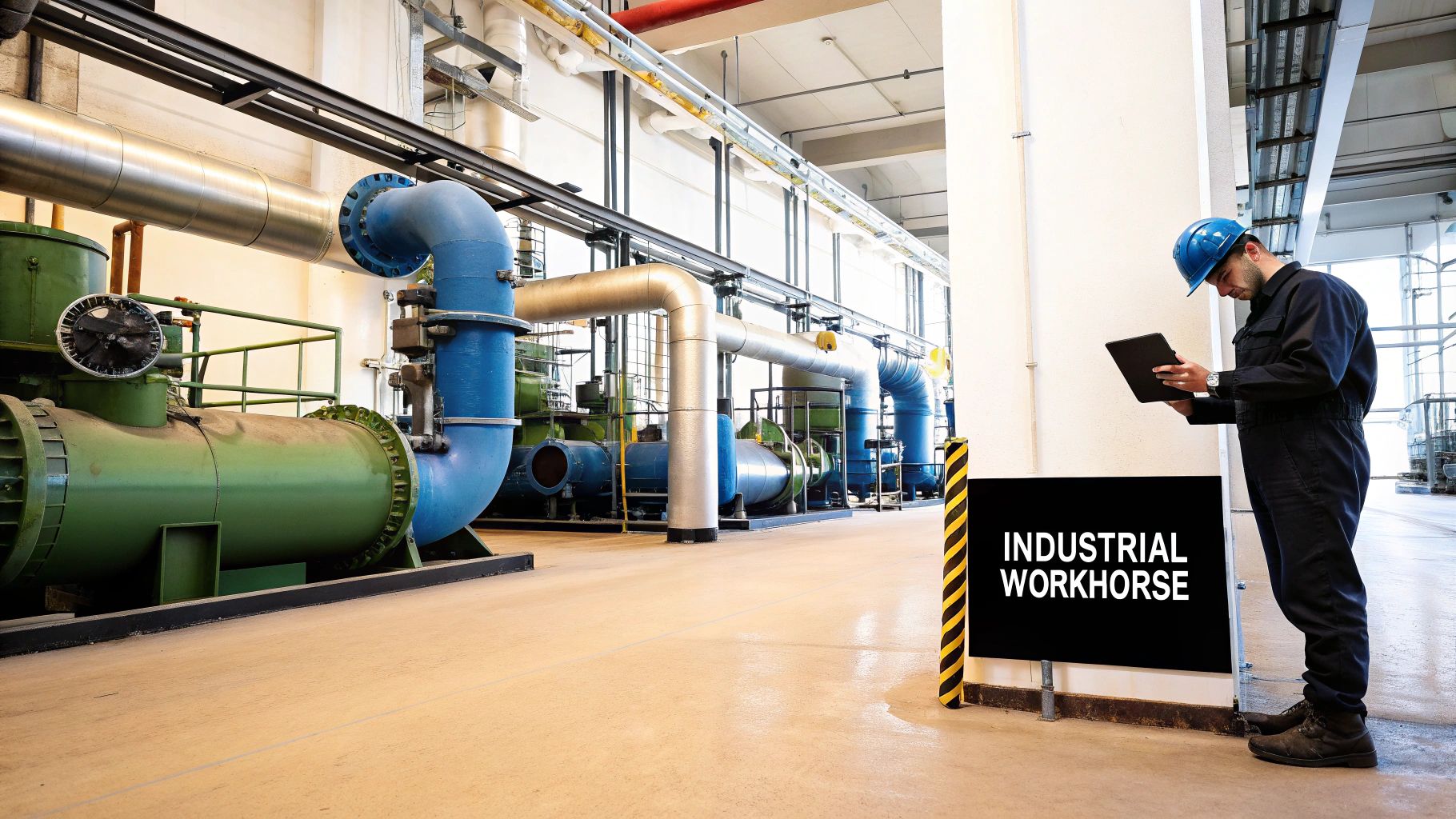
In the world of refrigerants, you have your sprinters and your marathon runners. Synthetic refrigerants like HFCs are the sprinters—quick and effective in the short term, but they rely on chemical engineering and are losing steam as environmental regulations tighten.
Ammonia, on the other hand, is the seasoned marathon runner. It's a natural substance with over a century of proven endurance, effortlessly handling massive cooling loads without breaking a sweat.
Ammonia's dominance in demanding industrial environments isn't by accident. It’s built on three core strengths that set it apart from synthetic alternatives, making it not just a smart choice for today, but a future-proof investment for any large-scale cooling operation.
This powerful combination makes ammonia the go-to refrigerant for large facilities where reliability and operational costs are paramount.
To put these numbers into context, here’s a quick look at how ammonia stacks up against other common refrigerants.
| Attribute | Ammonia (R717) | Common HFCs (e.g., R404A) | CO2 (R744) |
|---|---|---|---|
| GWP (Global Warming Potential) | 0 | 3,922 | 1 |
| ODP (Ozone Depletion Potential) | 0 | 0 | 0 |
| Energy Efficiency | Very High | Moderate | Good (in specific conditions) |
| Toxicity / Flammability | Toxic / Flammable | Low Toxicity / Non-flammable | Non-toxic / Non-flammable |
As you can see, when it comes to environmental credentials, ammonia is in a league of its own.
So, what do these technical specs mean on the ground?
For a plant manager at a food processing facility, ammonia’s high efficiency translates directly into lower electricity bills. It also means products can be frozen faster, locking in quality and improving throughput. For a biobank director, it guarantees the stable, uninterrupted cooling needed to protect irreplaceable biological samples.
Ammonia is more than just a chemical formula; it's a strategic asset. Its performance allows businesses to cut operational expenses, hit their sustainability targets, and insulate themselves from future regulatory uncertainty.
Ultimately, choosing ammonia is a decision for longevity and efficiency. It’s the reliable engine that powers the critical cold chain in industries from pharmaceuticals to food and beverage logistics, ensuring products are stored safely and affordably.
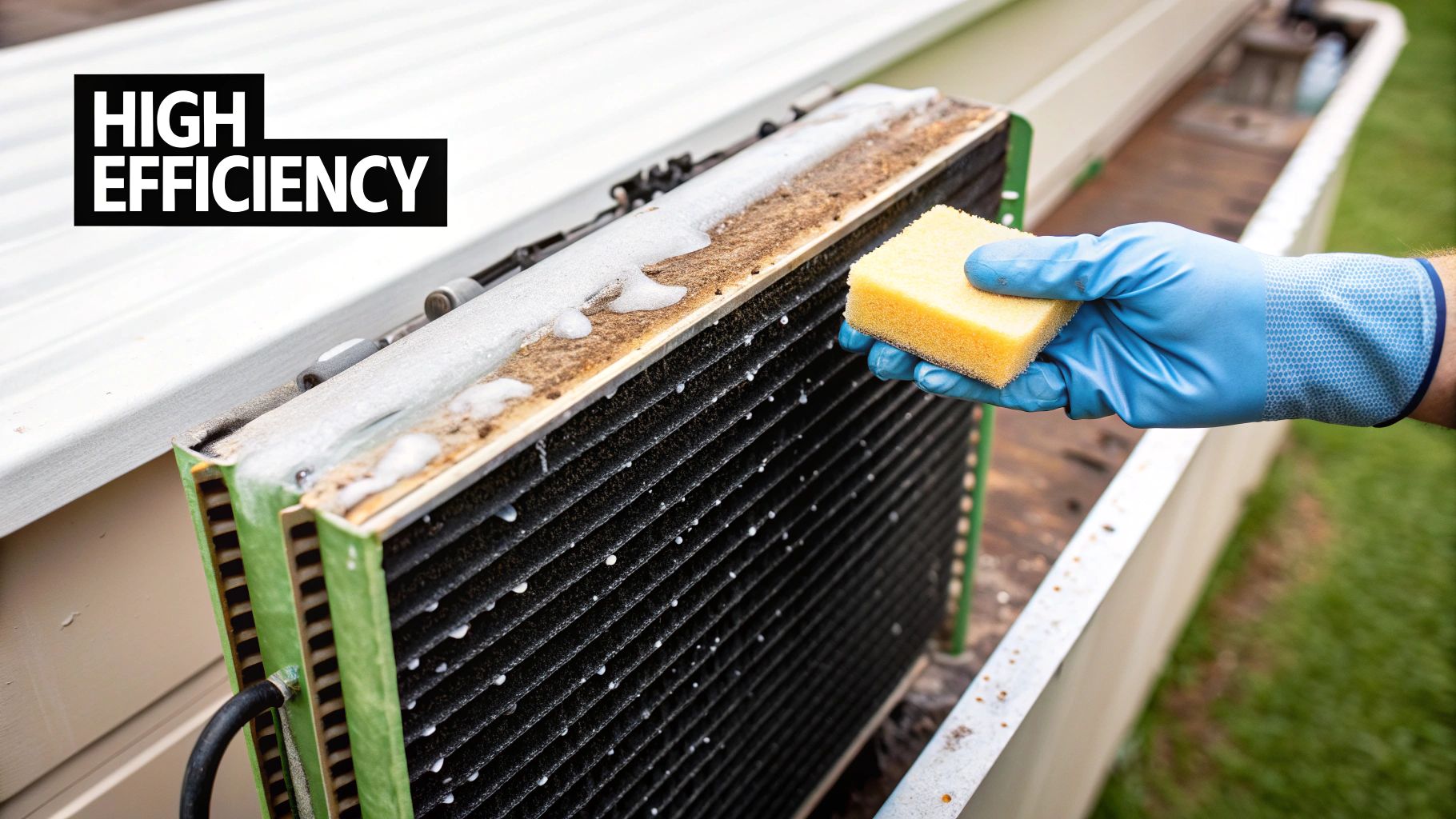 To get a real feel for why ammoniak als kältemittel has been the workhorse of heavy-duty applications for over a century, we need to look past its green credentials and get into its raw thermodynamic muscle. The secret weapon here is a property called the latent heat of vaporisation.
Think of it like this: you have two sponges to clean up a spill. One is a regular kitchen sponge, and the other is a high-tech, super-absorbent one. Both can do the job, but the super-absorbent sponge soaks up far more liquid before you need to wring it out.
In the world of refrigerants, ammonia is that super-absorbent sponge. Its high latent heat means it can absorb an enormous amount of heat energy from a room as it changes from a liquid to a gas. This allows it to cool a space much more effectively, kilogramme for kilogramme, than other refrigerants.
This incredible heat absorption isn't just a neat science fact; it's the engine driving real-world financial and operational gains. Because every cycle moves more heat, the entire refrigeration system can be designed to work smarter, not harder.
This efficiency brings some serious engineering advantages to the table:
For a massive industrial site like a food processing plant or a cold storage warehouse, those percentages add up quickly. Even a single-digit reduction in energy use can easily translate into tens of thousands of Euros saved every year on running costs alone. You can find out more about the different types of compressors used in these systems in our detailed guide.
Ammonia’s thermodynamic edge is a huge reason for its market growth, especially in efficiency-driven economies. Germany, for instance, holds a commanding 20.70% share of Europe's ammonia refrigerant market, a clear sign of the demand for high-performance cooling.
This dominance shows how well ammonia delivers on both performance and lower energy use. This is absolutely critical for specialised fields like biobanks and cell therapy labs, where perfectly stable, ultra-low temperatures are needed to protect irreplaceable biological samples.
This efficiency has a direct impact on a facility’s bottom line and its operational toughness.
A more efficient system is a more reliable system. Components that are not pushed to their limits experience less wear and tear, leading to longer service life, fewer breakdowns, and reduced maintenance expenses over the system's entire lifecycle.
This is exactly why facility managers and engineers who are focused on long-term Return on Investment (ROI) and sustainable operations keep coming back to ammoniak als kältemittel. It offers a clear path to lower operational costs and a much more robust, dependable cooling infrastructure. The initial investment pays for itself many times over through decades of unmatched performance and energy savings.
You can't talk about ammoniak als kältemittel without getting to the elephant in the room: safety. Let's be upfront—ammonia is classified as toxic and flammable (ASHRAE safety group B2L), and those properties demand respect. But the conversation has shifted dramatically from one of pure danger to one of sophisticated risk management.
For over a century, the industry has been honing the engineering and protocols to handle ammonia. What we have now is a highly controlled environment where risks aren't just minimised; they're actively managed with layers of modern tech and strict oversight. A well-designed ammonia system is a predictable, reliable asset, not a volatile hazard.
The fear surrounding ammonia often comes from not seeing the robust safety ecosystem built around it. Modern facilities don’t just cross their fingers and hope for the best. They engineer for the worst-case scenario, creating multiple, redundant safety nets that make a serious incident incredibly unlikely.
Today’s ammonia refrigeration systems are built according to stringent standards, most notably EN 378 here in Europe. This standard is the blueprint for safety, dictating everything from system design and material choice to installation and ongoing maintenance.
Instead of relying on a single safety feature, these systems use a multi-layered approach. Think of it like the safety features in your car—you have seatbelts, airbags, anti-lock brakes, and crumple zones all working together. An ammonia plant is no different, using integrated controls to prevent, detect, and contain any potential issues before they escalate.
These layers of protection are designed to work in concert, so if one fails, another is already in place to take over.
Three key engineering pillars form the foundation of a safe ammonia refrigeration plant, turning it from a potential risk into a highly controlled industrial tool.
Of course, all this engineering is backed by rigorous discipline. Facility personnel go through extensive training on standard operating procedures, emergency response, and using personal protective equipment (PPE). For more on handling industrial gases, our guide on the safe transport of gas cylinders provides some valuable insights.
The modern approach to ammonia safety isn't about eliminating risk—it's about controlling it with precision engineering. The focus is on proactive prevention and immediate, automated containment, which has given ammonia an excellent long-term safety record in industrial settings.
By reframing the conversation from one of fear to one of confidence, it's clear the risks tied to ammonia are well understood and highly manageable. With proper system design, professional installation, and a disciplined maintenance schedule, choosing ammoniak als kältemittel is a safe, reliable, and intelligent decision for any large-scale cooling application.
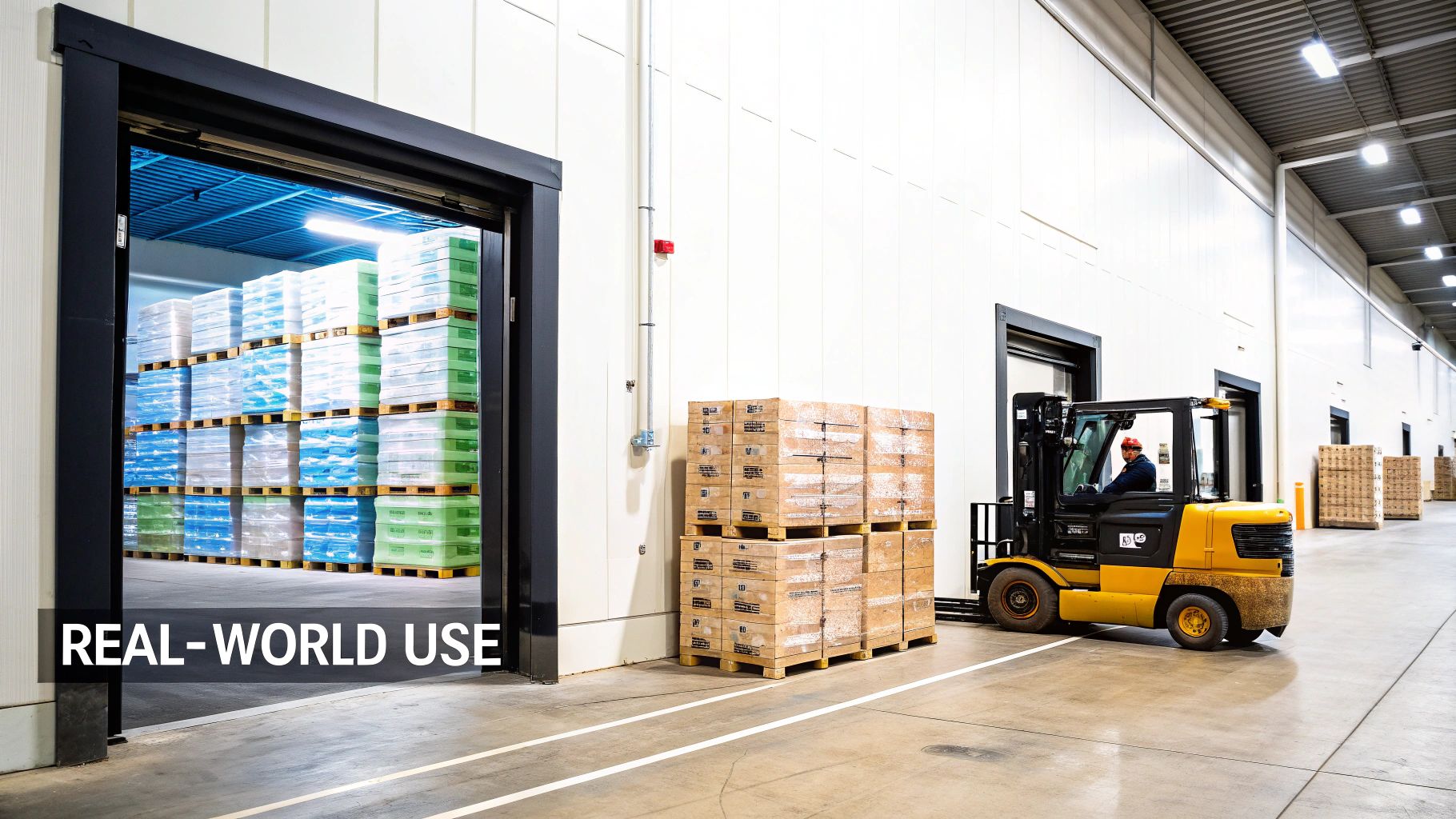
So, where does all this talk of thermodynamics and safety engineering actually meet the real world? This is where ammoniak als kältemittel really shows what it’s made of. You’ll find it hard at work in large-scale applications where high-capacity, unwavering cooling isn't just a nice-to-have, but an absolute operational necessity.
These are the kinds of places where even a tiny temperature fluctuation could mean catastrophic product loss or years of compromised research. Ammonia refrigeration systems are the invisible engines humming away in the background, from sprawling food processing plants to cutting-edge pharmaceutical labs, ensuring everything runs smoothly.
Nowhere is ammonia’s job more vital than in the food and beverage industry. Think about the journey your frozen peas take from a field to the supermarket freezer aisle. To lock in all that freshness and nutrition, they need to be flash-frozen—a process that yanks heat out incredibly quickly. Ammonia systems are masters at this, delivering the raw cooling power needed for blast freezers and spiral freezers.
Once frozen, those products head to massive cold storage warehouses, some the size of several football pitches, held at a steady -20°C or even colder. An ammonia plant is what provides the relentless, efficient cooling needed to hold those temperatures across such enormous spaces, guaranteeing product quality all the way to the loading dock.
It’s a critical player in other areas, too:
In the pharmaceutical and biotech worlds, the stakes are even higher. Here, large-scale ammonia refrigeration is trusted to protect everything from life-saving vaccines to irreplaceable biological samples in biobanks. These facilities demand unwavering, ultra-low temperatures, often for years on end.
A temperature slip of just a few degrees could render millions of Euros worth of medical products useless or destroy decades of research. Ammonia systems deliver the rock-solid reliability and robust performance needed to make sure that never happens, which is why they are the go-to choice for these mission-critical environments.
This reliability is exactly why ammonia is seeing such strong adoption. Germany's ammonia market, particularly for refrigeration in biotech, reached a value of 3,752.56 million USD in 2024 and is projected to keep growing. This is driven by its unmatched performance in large-scale systems for hospitals, fertility clinics, and pharmaceutical companies needing precise temperature control for cell storage. You can dive deeper into this trend in the full ammonia market research report.
For industries where product integrity is non-negotiable, the choice of refrigerant becomes a strategic business decision. Ammonia delivers the performance that protects investments, ensures compliance, and supports long-term operational success.
Ammonia’s reach extends far beyond the cold chain. It’s also a workhorse in various industrial gas and chemical processes, found in petrochemical plants, refineries, and manufacturing facilities. There, it's used to cool down processes and liquefy gases like chlorine or natural gas, making them easier and safer to transport and store.
It even turns up in some unexpected places. Take large indoor ice rinks or data centres. Both generate a massive amount of heat that needs to be removed efficiently. Ammonia's powerful heat-absorption capabilities make it a perfect fit, whether it's for creating a perfect sheet of ice or keeping sensitive servers from overheating. Each application tells a story of the power and adaptability of ammoniak als kältemittel in today’s most demanding settings.
An ammonia refrigeration system isn't a short-term purchase; it's a long-term commitment. We're not talking about plug-and-play commercial units here. These are serious, industrial-grade assets built to perform reliably for decades. But hitting that lifespan and actually seeing the full benefits of ammoniak als kältemittel starts way before you flip the switch. It begins with smart design and a disciplined approach to maintenance.
The entire lifecycle, from the first blueprint to daily operations, needs a plan centred on reliability. A well-designed and properly maintained system isn't just safer and more efficient—it’s how you protect your initial investment and sidestep the nightmare of costly downtime. This proactive mindset is what separates a high-performing asset from a constant operational headache.
Success truly starts at the ground level, with the right materials and the right people. Ammonia is famously corrosive to certain metals, which makes your material selection the first critical, non-negotiable step for ensuring system safety and integrity.
A well-built system is the foundation of reliability. Cutting corners on materials or installation expertise is a false economy that will inevitably lead to higher repair costs, greater safety risks, and reduced system efficiency down the line.
Once the system is professionally installed and commissioned, the focus shifts from building it to preserving it. This is where a robust, preventative maintenance playbook becomes your most valuable tool.
Long-term ownership is all about proactive care, not reactive repairs. A disciplined maintenance schedule ensures the system keeps humming along at peak efficiency, protecting both your people and your profits. A solid playbook will always focus on routine inspections, fluid management, and safety system checks.
1. Routine System Inspections Your eyes and ears are the first line of defence. Regular visual and operational checks mean looking for early warning signs like pipe corrosion or ice build-up, listening for any unusual compressor noises, and keeping a close eye on system pressures and temperatures to ensure they stay within their optimal range.
2. Proactive Oil Management Proper lubrication is the lifeblood of your compressors. Maintenance routines must include regular oil sampling and analysis to check for any contaminants or degradation. It's also critical to drain oil from low points in the system (known as oil pots) to keep it from fouling up your heat exchangers, which would otherwise tank your efficiency.
3. Calibrating Safety Sensors Your ammonia leak detection sensors are a critical safety net, but their accuracy can drift over time. They must be professionally calibrated according to the manufacturer's schedule, without fail. This ensures your early warning system is always sharp and ready to respond instantly when you need it most.
By sticking to a structured maintenance plan, you turn your ammonia plant from just another piece of equipment into a predictable, high-performing asset. This disciplined approach is a direct investment in its longevity, ensuring the system delivers efficient and reliable cooling for many decades to come.
When you're choosing a refrigerant for a large-scale industrial application, the decision really boils down to performance, cost, and long-term viability. This is where we need to put ammonia up against its main rivals: hydrofluorocarbons (HFCs), carbon dioxide (CO₂), and the newer hydrofluoroolefins (HFOs). Each comes with its own set of trade-offs, but for demanding, high-capacity environments, a clear winner usually emerges.
Let's look at a head-to-head showdown across the things that really matter to facility managers and engineers. We'll compare everything from raw efficiency and environmental impact to safety profiles and the total cost of ownership over the system's life.
For decades, HFCs like R-404A were the go-to choice. They are non-toxic, non-flammable, and relatively easy to work with. The problem? Their incredibly high Global Warming Potential (GWP) makes them a dead-end investment. Under the EU F-Gas Regulation, HFCs are being aggressively phased down, which has led to skyrocketing costs and real uncertainty about future supply.
An HFC system might look cheaper on paper upfront, but it’s loaded with regulatory risk and future expense. Sticking with HFCs is like buying technology that's already obsolete—a short-term fix with guaranteed long-term headaches.
From an environmental standpoint, carbon dioxide (R-744) is an excellent natural refrigerant, boasting a GWP of just 1. It's also non-toxic and non-flammable, making it an attractive alternative. However, its thermodynamic properties throw up some significant engineering challenges. If you're considering this route, you can dive deeper in our dedicated guide to CO₂ as a refrigerant.
CO₂ operates at extremely high pressures, often five to ten times higher than ammonia systems. This demands much more robust—and expensive—equipment, from reinforced pipes and heavy-duty compressors to specialised components. The complexity of managing these high pressures can also drive up installation and maintenance costs, making it a less practical choice for many large-scale industrial applications.
HFOs, such as R-1234yf, represent the newest generation of synthetic refrigerants. They were specifically designed as low-GWP replacements for HFCs and offer a much better environmental profile. That said, they aren't without their own set of drawbacks.
There are still a few key questions surrounding HFOs:
To make the choice clearer, let's put these refrigerants side-by-side. The following table breaks down the key decision-making factors for any industrial refrigeration project, highlighting the distinct advantages and disadvantages of each option.
| Feature | Ammonia (R717) | HFCs (e.g., R404A) | CO₂ (R744) | HFOs (e.g., R1234yf) |
|---|---|---|---|---|
| GWP | 0 | ~3922 (Very High) | 1 | <1 (Ultra-Low) |
| ODP | 0 | 0 | 0 | 0 |
| Efficiency | Excellent | Good | Moderate to Good (depends on climate) | Good |
| Toxicity | High (B2L classification) | Low (Non-toxic) | Low (Non-toxic) | Low (Non-toxic) |
| Flammability | Low (requires high concentration) | Non-flammable | Non-flammable | Mildly Flammable (A2L) |
| Operating Pressure | Low to Moderate | Low to Moderate | Very High | Low to Moderate |
| Refrigerant Cost | Very Low | High (and rising) | Low | Very High |
| System Cost | Moderate (safety systems required) | Low | High (robust components needed) | Moderate to High |
| Regulatory Status | Stable, future-proof | Being Phased Out | Favourable, natural refrigerant | Favourable, low GWP |
| Best For | Large industrial, cold storage, food processing | Legacy systems (retrofit needed) | Commercial refrigeration, cascade systems | Automotive, smaller commercial systems |
Looking at the full picture, it’s clear why ammonia remains the powerhouse for industrial-scale operations where long-term performance and compliance are critical.
This decision tree visualises the key stages of a refrigerant system's lifecycle, from initial design through to installation and ongoing maintenance.
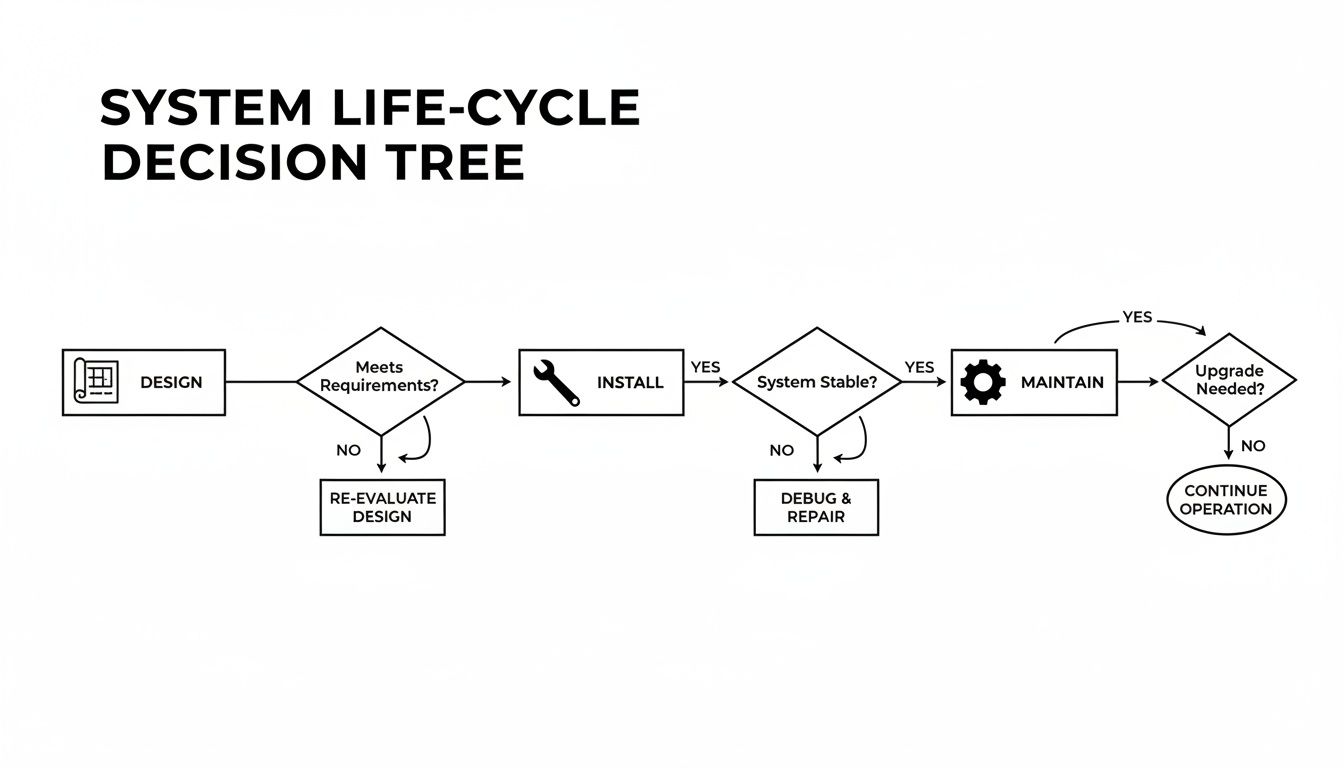
The flowchart really brings home the point that strategic decisions made at the design phase have a cascading effect on long-term operational efficiency and cost.
When you weigh all the factors, ammonia consistently emerges as the most strategic choice for industrial use. It combines top-tier energy efficiency with a perfect environmental profile (zero ODP and GWP), insulating facilities from regulatory changes and rising carbon taxes.
While it demands robust safety engineering, its stellar performance and low operating costs deliver a superior return on investment. For large-scale applications where long-term efficiency and future-proof compliance are non-negotiable, ammonia remains the undisputed champion. It offers a powerful, sustainable, and economically sound path forward.
When you’re looking into ammoniak als kältemittel, a few practical questions always come up for facility managers and engineers. Getting clear, straightforward answers is the best way to feel confident about making the right decision. Let's tackle some of the most common ones.
It's true that ammonia needs to be handled with respect due to its toxicity, but modern systems are built from the ground up with safety in mind. Today’s installations come with multiple layers of protection, including advanced gas detection sensors, powerful ventilation systems, and automated emergency shutdowns.
Everything is governed by rigorous standards like EN 378. When a system is designed by professionals and undergoes routine maintenance, the risks are managed effectively. It's a reliable choice that has been used safely in industry for over a hundred years.
Looking at the initial price tag, an ammonia system can be 10-20% higher. This is mostly down to the need for steel components and the mandatory safety equipment. However, the story completely changes when you look at the total cost of ownership.
Ammonia's outstanding energy efficiency can slash annual energy bills by 15-20%. Plus, ammonia isn't affected by the regulatory phase-downs and soaring costs hitting HFCs, which makes it a much smarter and more stable financial bet for the long run.
In a word, no. A direct retrofit isn't just impractical—it's unsafe. HFC systems typically rely on copper piping, which ammonia corrodes very quickly. Trying to convert one would mean replacing nearly every major component, from the pipes and valves right through to the compressors and heat exchangers.
The only proper way forward is to install a completely new system engineered specifically for ammonia's unique properties and strict safety demands. This ensures you get the efficiency, safety, and compliance you expect right from day one.
For robust cryogenic solutions that meet the highest safety and performance standards, trust the experts. Cryonos GmbH delivers state-of-the-art equipment for storing and transporting industrial gases and biological samples, ensuring reliability for your critical operations. Explore our full range of solutions at https://www.cryonos.shop.

