No Products in the Cart




At its heart, a CNG fuel tank is a highly engineered pressure vessel, purpose-built to safely store compressed natural gas on a vehicle. Think of it as the core component of any CNG-powered system. The tank's design directly dictates the vehicle's range, how much payload it can carry, and its overall operational safety. For any industrial or fleet application, understanding their construction is absolutely critical.
Compressed Natural Gas (CNG) is quickly becoming a go-to alternative fuel, especially for commercial fleets trying to get a handle on operating costs while shrinking their environmental footprint. Unlike petrol or diesel, natural gas has to be squeezed down to incredibly high pressures—often over 200 bar (around 3,000 psi)—to store enough energy for a decent driving range.
This single requirement is what makes cng fuel tanks such sophisticated pieces of equipment. They aren't just simple containers; they're advanced vessels engineered to handle immense internal forces while being as light and tough as possible.
The move to CNG is really being driven by two things: money and environmental stewardship. Natural gas is frequently cheaper and more price-stable than diesel, which can lead to major fuel cost savings over the long haul. On the green side of things, CNG burns much cleaner, drastically cutting down on nasty emissions.
This industry shift puts the cng fuel tank right in the spotlight. The efficiency, safety, and real-world usability of a CNG vehicle are all tied directly to the quality and design of its storage system. The tank itself determines how much fuel you can carry, which in turn sets the vehicle's working range between fill-ups.
Picking the right fuel tank is one of the most important decisions a fleet manager will make. It’s a classic balancing act between weight, capacity, and cost. A heavier, all-steel tank might be easier on the initial budget, but it can chip away at a truck’s maximum payload, hitting your profitability on every single run.
On the flip side, a cutting-edge, lightweight carbon fibre tank maximises that payload but comes with a much higher price tag upfront.
The entire viability of a CNG fleet conversion hinges on selecting the right tank technology. It's a balance of upfront capital expenditure against long-term operational gains and compliance with ever-stricter environmental regulations.
This guide is here to walk you through every aspect of this vital component. We’ll break down the different types of tanks, the materials they’re made from, and the rigorous safety standards they have to meet. By the end, you'll have the ground-up knowledge needed to make smart decisions that line up perfectly with your fleet’s financial and environmental goals.
When you're looking at CNG fuel tanks, it's not a one-size-fits-all situation. Not even close. Technology has come a long way, and today's tanks have evolved through four distinct generations. Getting to grips with the differences between Type I, II, III, and IV tanks is absolutely essential for any fleet manager trying to balance performance, payload, and the bottom line.
Think of it like the evolution of a professional backpack. The first ones were basically heavy canvas sacks—tough, but a real pain to carry. Then came external frames for better support, followed by lighter synthetic fabrics, and finally the ultra-light, ergonomic designs you see climbers use today. CNG tanks have followed that same journey, moving from hulking steel cylinders to sleek, advanced composites.
This diagram shows you the simple hierarchy of a CNG system, starting from the gas source and ending with the vehicle it powers.
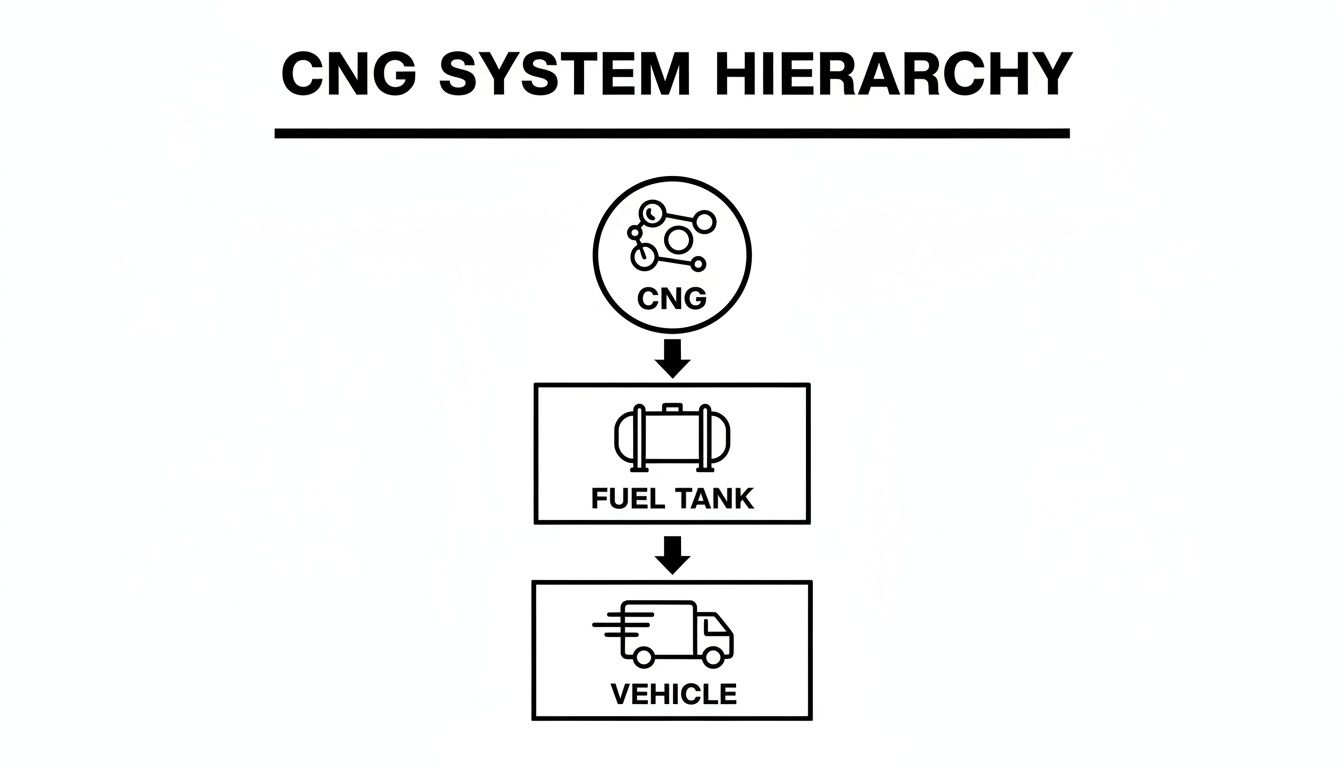
As you can see, the tank is the critical link between the fuel (CNG) and the engine. Its design and construction have a massive impact on the entire system's efficiency and practicality.
To help you decide which tank is right for your needs, here is a quick side-by-side comparison of the four main types. We'll break down the key differences in their construction, materials, weight, and cost.
| Tank Type | Construction | Primary Materials | Relative Weight | Relative Cost |
|---|---|---|---|---|
| Type I | All-metal, single piece | Steel | Heaviest | Lowest |
| Type II | Metal liner, composite hoop-wrap | Steel or Aluminium liner, Glass fibre wrap | Heavy | Low-Moderate |
| Type III | Metal liner, full composite wrap | Aluminium liner, Carbon fibre wrap | Light | High |
| Type IV | Polymer liner, full composite wrap | Plastic liner, Carbon fibre wrap | Lightest | Highest |
Each type offers a distinct trade-off between weight, durability, and price. Choosing the right one depends entirely on your specific application, whether it's a city bus where weight isn't a huge issue or a long-haul truck where every kilogramme counts. Now let's dive into the details of each one.
The Type I tank is the old guard, the original workhorse of the CNG world. It’s made entirely from steel, which makes it incredibly tough and durable. If you can picture a classic scuba tank, you’ve got the right idea—it's thick, heavy, and built like a fortress to handle immense pressure.
Because steel is cheap and well-understood, Type I tanks are the most cost-effective option out there. This makes them a go-to choice when the vehicle's total weight isn't the main concern. You’ll often see them in stationary storage set-ups or on certain types of buses where the tank's mass can be factored in without hurting performance.
But their biggest strength is also their main weakness. All that steel adds up, and the sheer weight can eat into a vehicle's available payload. For a long-haul lorry where every kilogramme of cargo is money in the bank, this weight penalty is a serious drawback.
Type II tanks were the first big step toward shedding some of that weight. They start with a thinner steel or aluminium liner to hold the gas, and then wrap the middle section (the "hoop") with a composite material—usually a glass fibre jacket. This wrapping adds strength, which allows the metal liner to be thinner and lighter than what you'd find in a Type I.
This hybrid build strikes a nice balance. It's a good deal lighter than an all-steel tank but keeps the cost down compared to the fully composite models that came later. It’s like reinforcing a concrete beam with lightweight carbon bands instead of making the whole thing out of solid, heavy steel.
For fleets that need to watch their weight but can't justify the price tag of the top-tier options, Type II tanks are a smart compromise. They're commonly used on medium-duty trucks and refuse collection vehicles, where you need a good mix of durability and moderate weight reduction.
With Type III tanks, we see a massive leap forward in materials. These tanks use a full metal liner, typically aluminium, which is then completely wrapped in a strong but light composite like carbon fibre. Here, the aluminium liner just acts as a gas-tight barrier, while the carbon fibre wrap does all the heavy lifting to contain the pressure.
This design slashes the tank's weight, often by more than 50% compared to a Type I. For any commercial vehicle, that saved weight can be converted directly into more payload capacity or better fuel efficiency. It’s the difference between riding a heavy steel-frame bike and a modern carbon fibre racer—the performance boost is immediate and obvious.
Of course, advanced materials don't come cheap. The extensive use of carbon fibre makes Type III tanks more expensive upfront. But for any operation where maximising payload and range is the name of the game, the long-term ROI from carrying more goods or travelling further on a single fill often makes the initial cost well worth it.
This shift to lighter materials is happening across the industry. The global CNG tanks market was valued at USD 2.87 billion in 2024 and is projected to more than double to USD 6.41 billion by 2034. A lot of that growth comes from the adoption of smarter, more efficient solutions like Type II tanks and composite materials. You can see the full market analysis of CNG tank growth on polarismarketresearch.com.
Type IV tanks are the top of the line in today's CNG storage tech. They are the lightest option you can get, built with a gas-tight polymer (plastic) liner that’s fully wrapped in carbon fibre or a mix of carbon and glass fibre. By getting rid of the metal liner completely, Type IV tanks achieve the lowest weight possible.
This all-composite construction gives you the biggest payload advantage, making it the clear choice for heavy-duty lorries, long-range buses, and any other vehicle where weight is the number one priority. The benefits are simple: more cargo, longer range, and better vehicle efficiency.
The trade-offs are cost and a perception of durability. Type IVs are the most expensive tanks because of the high price of carbon fibre and the complex manufacturing involved. And because the liner is plastic, some operators worry they are more vulnerable to impacts or scrapes than their metal-lined cousins, so they require careful handling and installation. Even so, for high-performance fleets, that weight advantage is often too good to pass up.
Storing any gas at high pressure demands an uncompromising approach to safety. For CNG fuel tanks, this isn't just a recommendation; it's a foundation built on layers of rigorous testing, international certifications, and smart engineering. Fleet managers can have complete confidence in this technology, but only by understanding the robust safety ecosystem that governs it.
This system is designed to protect vehicles, drivers, and the public under some pretty extreme conditions. These regulations aren't just paperwork—they represent a global consensus on what it takes to make high-pressure fuel storage exceptionally secure. Every tank has to meet a baseline of resilience and reliability before it ever hits the road.
Think of these certifications as the universal language of safety in the CNG world. They provide a clear, verifiable benchmark that a tank has passed a battery of demanding tests designed to simulate worst-case scenarios.
Around the globe, different regulatory bodies oversee the certification of CNG components. For fleets operating in Europe or sourcing European-made vehicles, the gold standard is ECE R110. In North America, the equivalent benchmark is typically ANSI/CSA NGV2.
While they come from different regions, their goals are identical: to guarantee that every tank can withstand incredible stress. A tank’s certification is its passport, proving it’s fit for duty.
To earn that passport, a tank must endure a series of gruelling trials:
Only tanks that survive this entire gauntlet get certified, giving operators peace of mind that their equipment is built to the highest possible safety specifications.
Beyond the inherent toughness of the cylinder, modern CNG fuel tanks are kitted out with critical safety components that act as intelligent failsafes. The most important of these is the Pressure Relief Device (PRD).
A PRD is a thermally activated valve. If a fire breaks out, the tank's internal temperature and pressure will rise to dangerous levels. Before that happens, the PRD automatically opens and vents the natural gas in a controlled way, preventing a catastrophic tank rupture. It’s an essential, non-negotiable feature on every certified tank.
Think of a PRD as an intelligent emergency valve. Its sole job is to spot an over-pressure situation caused by extreme heat and release the gas before the tank's structure can be compromised. This single component is a cornerstone of CNG system safety.
Other vital safety components include excess flow valves, which automatically shut off the gas supply if a fuel line is severed, preventing an uncontrolled leak. These devices all work together, creating a multi-layered safety net.
A perfectly engineered tank is only as safe as its installation. Getting the mounting, line routing, and valve integration right is absolutely essential to maintain the system's integrity. This is why installation must always be done by a certified technician who understands the unique demands of high-pressure gas systems.
These technicians are trained to follow precise protocols for securing the tank, ensuring it’s protected from road debris and potential impact zones. They also verify that all safety devices are functioning correctly. For more detailed guidance, you can learn about the correct transport of gas cylinders in our related article. Proper handling from the workshop to the vehicle is the first step in a long and safe operational life.

Unlike a standard diesel tank you can mostly forget about, a CNG fuel tank is a high-pressure vessel that demands a consistent maintenance schedule. This isn’t about big, expensive overhauls; it’s about simple, preventative care to guarantee safety and performance over its 15 to 20-year lifespan.
Think of it as a routine health check-up for a critical piece of equipment. Regular inspections form the bedrock of a safe and reliable CNG fleet, helping you catch minor issues long before they escalate. This proactive stance protects your assets, keeps your drivers safe, and ensures you remain compliant with all industry regulations.
While exact rules can differ based on manufacturer guidelines and local laws, the industry has a clear set of standards for visual checks.
A typical inspection timeline for CNG fuel tanks looks like this:
Sticking to this schedule is non-negotiable for safety and compliance. It’s a straightforward but vital process that every fleet manager needs to build into their operational routine.
When a certified technician inspects a tank, they’re doing more than just a quick walk-around. They are trained to spot subtle signs of damage that could compromise the tank's structural integrity, especially for composite Type II, III, and IV tanks where the outer layers are essential for containing the high-pressure gas.
Key areas they focus on include:
Even a flaw that looks minor can be a major red flag. A deep scratch on a carbon fibre tank, for example, could sever the load-bearing fibres and create a dangerous weak point. Simple preventative care, like using a protective cap for a gas cylinder, can go a long way in preventing this kind of damage. To learn more, take a look at our guide on protective caps for gas cylinders.
The visual inspection is the first line of defence in CNG tank safety. A certified inspector’s job is to assess not just visible damage but also the potential for hidden stress, ensuring the vessel remains safe to operate at over 200 bar of pressure.
Every CNG tank comes with a firm "best before" date stamped right on the label. This marks its certified service life, and once that date passes, the tank must be safely decommissioned. It cannot be re-certified or put back into service, period.
This strict lifespan is a core safety feature, built on the understanding that materials naturally degrade over time, even under perfect conditions. This commitment to uncompromising safety is why the industry continues to grow in mature markets like Germany. In fact, projections show the German CNG market expanding from USD 5,591.7 million in 2023 to USD 7,131.8 million by 2030, powered by strong decarbonisation policies and fleets that make these safety protocols a priority. You can learn more about Germany's strategic role in the CNG market from Grand View Research.
By following these essential maintenance steps, fleet managers can operate their CNG vehicles with confidence, enjoying the fuel savings and environmental benefits without ever compromising on safety.
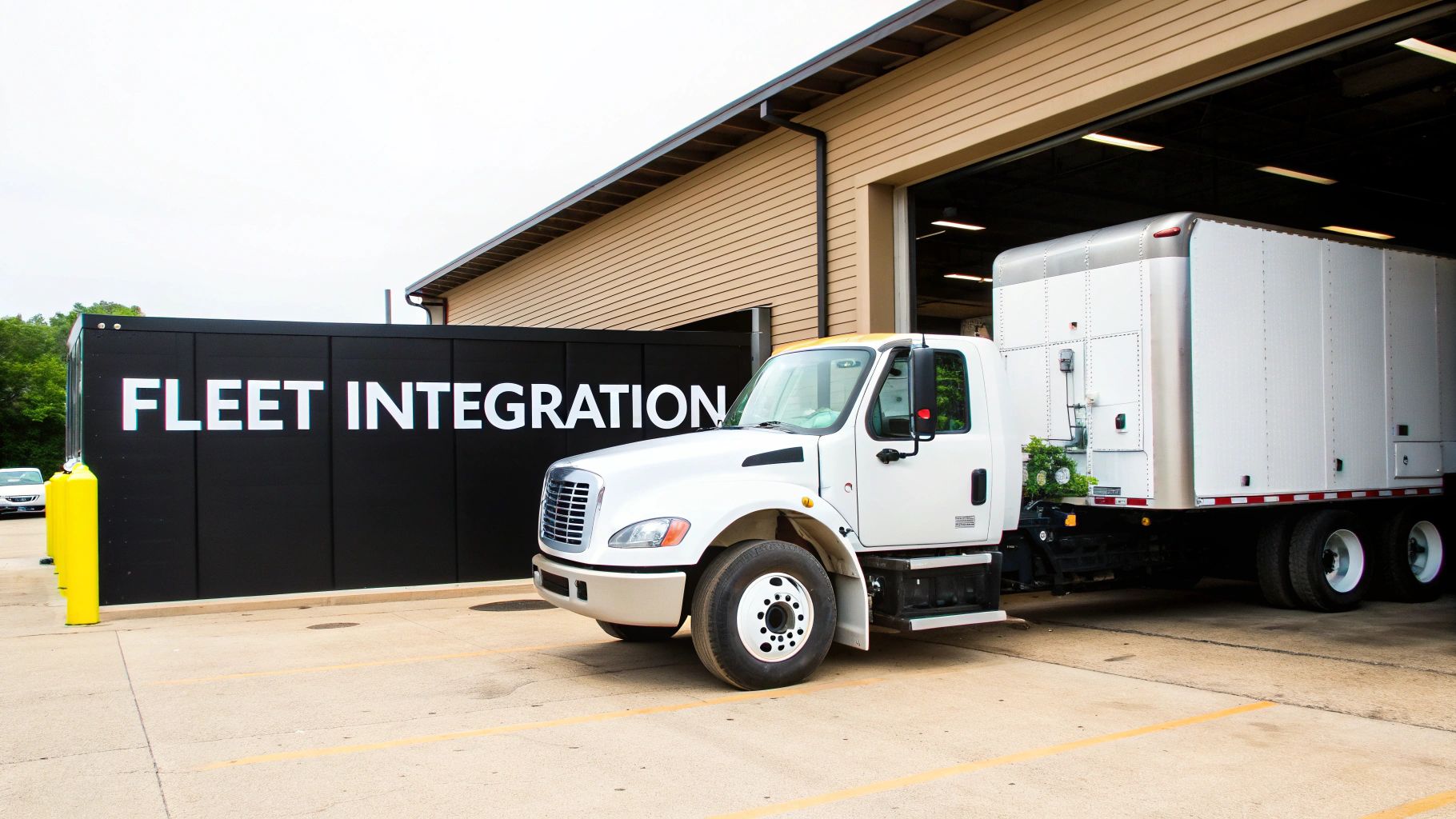
Making the jump to CNG is a major strategic call, whether you’re retrofitting your current vehicles or ordering new ones straight from the factory. A successful switch is about more than just picking a tank; it demands a hard look at your vehicle dynamics, daily operational needs, and the total cost of ownership (TCO).
The nuts and bolts of installing cng fuel tanks are at the heart of the matter. This isn't just about finding an empty spot on the chassis. Where and how you mount the tank system has a direct impact on the vehicle’s handling, stability, and, critically, its payload capacity. A poorly planned installation can hurt performance and chip away at your profits.
That’s why you need to look at the big picture. The endgame is to create a seamless system that fits your fleet's specific needs, striking the right balance between range, weight, and cost to deliver a real, measurable return on your investment.
One of the first puzzles to solve in any CNG conversion is figuring out where to mount the tanks. This decision is a careful balancing act, juggling the available space with the need to maintain the vehicle's original centre of gravity.
Getting the weight distribution right is absolutely vital for safe handling, especially in heavy-duty trucks. Technicians have to position the tanks to keep the vehicle stable while accelerating, braking, and turning. Bad placement can lead to steering problems and poor overall control, which is a serious safety risk.
On top of that, the extra weight from the cng fuel tanks and their mounting hardware has to be accounted for in the vehicle's Gross Vehicle Weight Rating (GVWR). Going over this limit is not only illegal but also dangerous. This is where your choice of tank type really matters; a lightweight Type IV tank might be the only way to save enough payload capacity to keep a route profitable.
There’s no one-size-fits-all solution here. The best tank setup depends entirely on the type of vehicle and what it’s used for. Every configuration is custom-built for specific jobs.
The core principle of integration is customisation. The tank system must support the vehicle’s primary function, not hinder it. A successful conversion makes the fuel source feel like an organic part of the vehicle's design, not an afterthought.
For many fleets, the most powerful argument for switching to CNG is the chance for big long-term savings. But to see that, you have to look beyond the initial conversion cost and dig into the Total Cost of Ownership (TCO).
A proper TCO analysis covers every cost over the vehicle's entire life:
By carefully modelling these factors, fleet managers can build a solid business case. The analysis will pinpoint the break-even point—when fuel savings have officially paid back the initial investment—and clearly show the long-term financial upside of adding cng fuel tanks to your fleet. For more on handling fuel sources safely, take a look at our guide on the proper transport of gas cylinders in a vehicle, which outlines essential safety rules.
Even after getting your head around the tech, it’s the practical, real-world questions that pop up when you're seriously considering a switch to CNG. So, let's tackle the most common queries we hear from fleet managers and operators. We'll give you clear, straightforward answers to help you make confident decisions about bringing CNG fuel tanks into your operation.
Think of this as clearing up any lingering doubts. We’ll get straight to the point on the questions likely on your mind.
This is a big one, especially when you're calculating long-term value. Most CNG fuel tanks have a certified service life of 15 to 20 years, starting from the day they were made. This isn't a suggestion; it’s a hard deadline set by the manufacturer, and you'll find it printed right on the tank's data label.
Once a tank hits that expiry date, it’s out of service for good. For safety reasons, it can’t be re-inspected or re-certified for a second life. This strict lifecycle ensures that after two decades of high-pressure cycles, material fatigue and natural wear and tear never become a risk.
Absolutely. In fact, they are engineered to be incredibly tough. CNG fuel tanks go through a whole battery of extreme tests that are far more brutal than most real-world collisions. These tests are mandatory to meet strict international safety standards, like ECE R110.
Just look at the trials these tanks have to survive:
Thanks to their tough, seamless construction and cylindrical shape, they are often structurally stronger than the typical rectangular diesel or petrol tank they replace.
This is a critical point for any commercial fleet because payload is money. The weight of CNG fuel tanks can definitely make a difference, but just how much depends entirely on the type of tank you choose.
Your basic Type I all-steel tanks are heavy, and they can take a serious bite out of a vehicle's legal payload. For a long-haul lorry where every kilo counts, that can be a deal-breaker. This is exactly why the industry pushed for lighter, more advanced options.
The choice between tank types boils down to a classic trade-off: upfront cost versus long-term operational efficiency. Heavier steel tanks are cheaper to buy, but the payload you lose could cost you far more in the long run from reduced revenue on every single trip.
This is where the lightweight Type III and Type IV composite tanks really prove their worth. Yes, they cost more initially, but for any job where maximising payload is the name of the game, they are the smart choice. They let you get all the fuel-cost savings of CNG without having to sacrifice valuable cargo capacity.
Not quite. While the network is definitely growing, CNG refuelling stations aren't on every corner like petrol or diesel just yet. Before you commit to a fleet conversion, you absolutely must map out your typical routes to make sure public or private refuelling points are available where you need them.
Many fleets get around this by installing their own private, time-fill refuelling stations right at their depot. This setup allows vehicles to be refuelled slowly overnight, so they’re topped up and ready to roll every morning. It’s a great approach that gives you full control over costs and reliability.
For state-of-the-art solutions in storing and transporting industrial gases, Cryonos GmbH offers a comprehensive portfolio of cryogenic equipment backed by decades of technical expertise. Explore our reliable, compliant systems designed for maximum safety and efficiency.
Find the right cryogenic solution for your needs at https://www.cryonos.shop.

