No Products in the Cart




Moving gas cylinders in a car around Germany is perfectly manageable, but it's a task that demands your full attention. If you get two things right, you’re most of the way there: making sure the cylinder is rock-solid secure and keeping the vehicle well-ventilated at all times. Nail these, and you turn a potentially risky job into a straightforward, safe procedure.
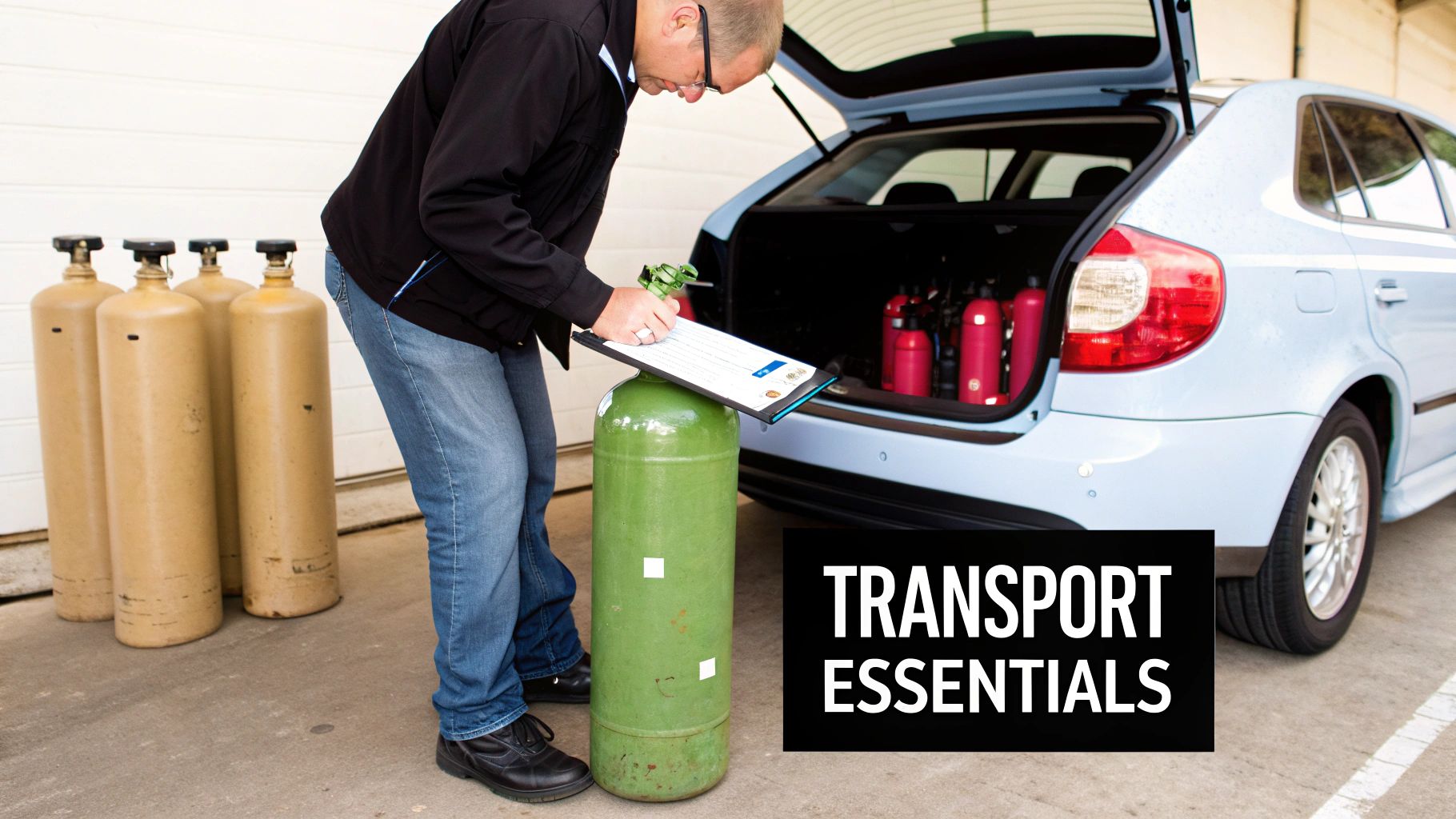
The moment you place a gas cylinder in your vehicle, your responsibility shifts. It's no longer just about driving from point A to point B; it’s about managing risk. Whether you’re a private individual with a propane tank for a weekend barbecue or a technician moving specialised gases between sites, the core safety principles don't change.
The official rulebook for this is the ADR (Accord européen relatif au transport international des marchandises Dangereuses par Route), which is the European agreement for moving dangerous goods by road. While the full regulations can look intimidating, many common scenarios—like moving a single cylinder—often fall under exemptions. The most relevant one is often the "1000-point rule," which we'll break down later.
Even when an exemption applies, the fundamental safety rules are non-negotiable. They’re just common sense.
It’s crucial to know exactly what you’re carrying because not all gases present the same risk. The type of gas dictates your primary safety focus. For instance, with a flammable gas like propane, your biggest concern is preventing any spark or flame. But with an inert gas like nitrogen, the invisible danger is asphyxiation if it leaks into a confined space.
I’ve seen it time and again: the biggest risks often come from complacency, not equipment failure. A hot car, a loose cylinder, or a closed window can quickly escalate a simple transport into a high-stakes emergency. Treat every single trip with the same level of respect and caution.
This focus on safety is deeply embedded in German transport culture. The country’s road transport sector is one of the most strictly regulated in Europe. With the transport industry responsible for around 146.08 million tons of greenhouse gas emissions in 2023, the government maintains a robust framework that covers everything, including the movement of dangerous goods.
Knowing your equipment inside and out is a massive part of this. For those using LPG, for example, getting a good grasp on understanding the function of LPG cylinder regulators and over-pressure shut-off (OPSO) devices is time well spent.
To help you focus on what matters most for the gas you're transporting, it helps to categorise the risks. Each gas type has a primary hazard that you absolutely must control for.
This table gives a quick rundown of the main gas types, their biggest threats during transport, and the number one thing you need to do to stay safe.
| Gas Type Category | Primary Hazard | Essential Safety Precaution |
|---|---|---|
| Flammable Gases (e.g., Propane, Butane) | Fire or Explosion | Eliminate all ignition sources (smoking, sparks) and ensure maximum ventilation. |
| Inert Gases (e.g., Nitrogen, Argon) | Asphyxiation (Oxygen Displacement) | Ensure constant fresh air supply; never transport in the passenger cabin. |
| Oxidising Gases (e.g., Oxygen) | Intensifies Fires | Keep away from oils, grease, and other flammable materials. |
| Toxic Gases (e.g., Ammonia) | Poisoning/Chemical Burns | Requires specialised handling; avoid private transport if possible. |
Ultimately, a quick check of this table before you load up can serve as a vital mental checklist, ensuring you’ve covered the most critical safety point for your specific situation.
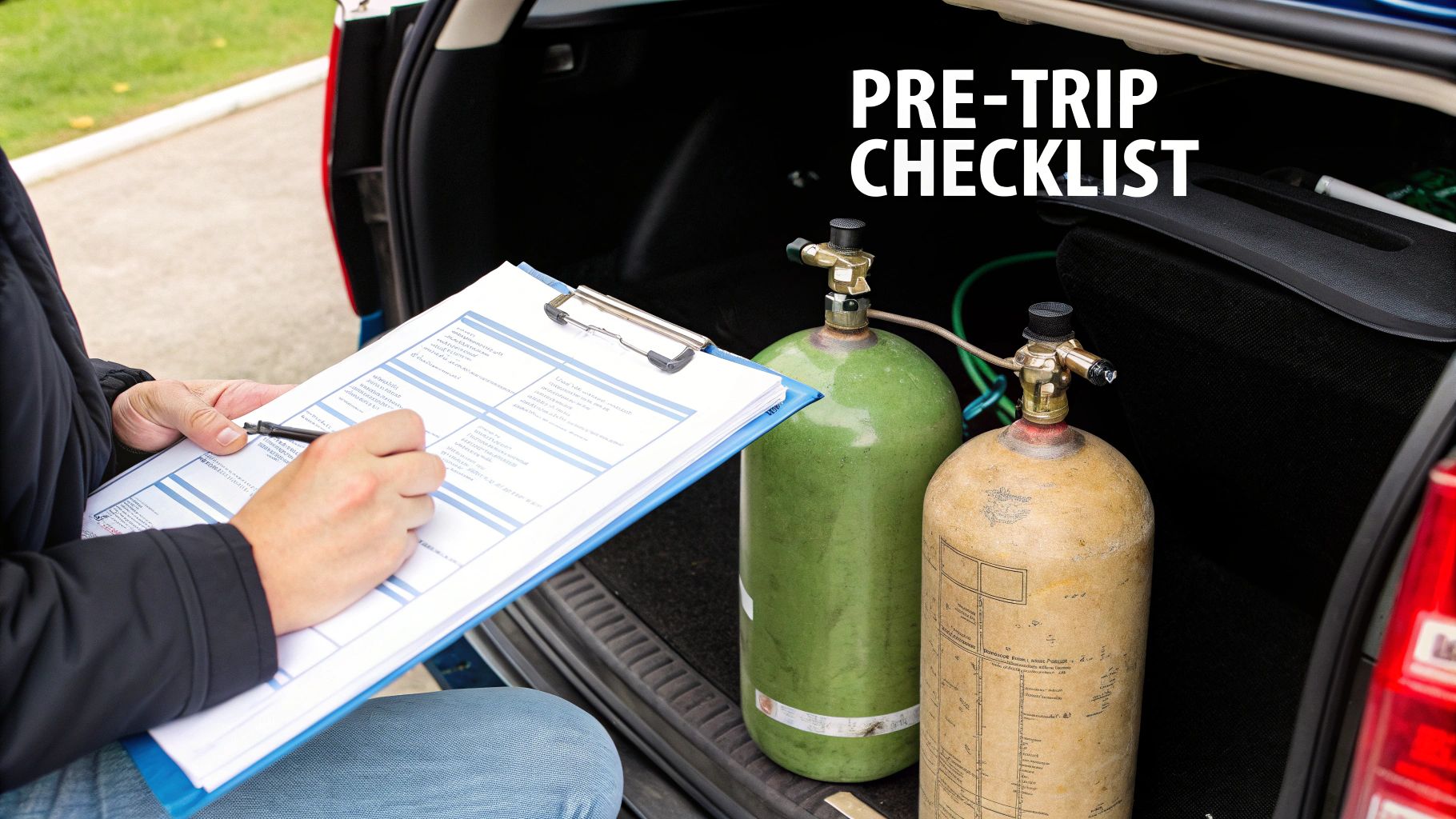
Successfully and safely moving a gas cylinder from A to B starts long before you turn the ignition key. Taking just a few minutes for a pre-trip check can head off nearly every common accident I've seen in the field. Think of it as your first line of defence—a simple routine that turns a potentially risky job into a managed, low-risk task.
This process breaks down into two key parts: inspecting the cylinder itself, and then prepping your vehicle.
First things first, let's look at the cylinder. Before you even think about loading it, give it a quick but thorough once-over. You’re not doing a forensic analysis, just a common-sense check for obvious red flags.
Your main goal here is to spot any signs of damage or serious neglect that could compromise its integrity. Even small issues can become big problems under the stress of a journey.
Here's what to look for:
Once you've confirmed the valve is shut tight, check the protective cap. This isn't just a dust cover; it's a heavy-duty piece of safety gear designed to shield the fragile valve from a direct hit. Make sure it's screwed on properly.
A loose valve cap is one of the most common oversights I see. People forget that in a sudden stop, an unsecured cylinder can tip over. If that unprotected valve shears off, the cylinder instantly becomes an unguided missile. Always, always double-check the cap.
With the cylinder checked out, it's time to get your vehicle ready. Where you put the cylinder is just as important as the condition of the cylinder itself. You need to create a stable, clean, and safe space for the trip.
Start by clearing out the cargo area completely. Get rid of any loose items—tools, luggage, even shopping bags—that could roll around and strike the cylinder. You want a clean, flat surface to work with.
Next, eliminate potential ignition sources. This is non-negotiable for flammable gases like propane, but it's a smart habit for any gas transport. That means absolutely no smoking in the vehicle and making sure nothing inside could create a spark.
Finally, give a moment's thought to your route. For someone taking a single barbecue cylinder home, this isn't a huge deal. But for lab technicians, clinic staff, or industrial users moving larger quantities under ADR regulations, it’s vital. Many tunnels in Germany have strict restrictions on transporting dangerous goods. A quick check of your planned route can save you from legal trouble and long detours.
Properly handling gasflaschen im auto transportieren is all about this combination of careful checks and smart preparation. It’s what ensures every trip is a safe one.
Getting a gas cylinder safely from A to B isn't a one-size-fits-all job. The right way to secure it depends entirely on the type of cylinder you have and the vehicle you're driving. The main goal is simple: prevent any movement. No rolling, no sliding, and definitely no tipping over. A sudden stop can turn an 11 kg propane tank into a dangerous projectile in your boot.
The most common mistake people make is laying a cylinder down flat. While it might feel more stable, you should always transport standard gas cylinders upright. This keeps the pressure relief valve in contact with the vapour at the top, not the liquid at the bottom—a critical safety feature. If the valve activates, it will release gas, not a powerful jet of flammable or cryogenic liquid.
For anyone wondering how to handle gasflaschen im auto transportieren (transporting gas cylinders in a car), the boot is the only safe place. Never put a cylinder in the passenger cabin. A small leak there could have immediate, disastrous consequences.
Your best friends for this job are high-quality tension belts or ratchet straps. Don't even think about using flimsy bungee cords; they just don't have the strength to hold a heavy steel cylinder during a collision or a sudden swerve.
Here’s a practical approach that works every time:
Here’s a pro tip from experience: stick a non-slip rubber mat under the cylinder before you strap it in. It’s a small detail, but it dramatically increases friction and provides an extra layer of security, especially on those smooth plastic boot liners.
For professionals working in labs, clinics, or industrial sites, the rules are stricter for a reason. Commercial vans should be fitted with purpose-built racks or fixed brackets designed specifically for gas cylinders. These systems are bolted directly to the vehicle's frame, offering the best security possible.
Heavy-duty ratchet straps are the norm here, often used together with these racks. When you're carrying multiple cylinders, load distribution becomes crucial. You need to arrange them to keep the vehicle’s centre of gravity stable, securing them together as a single, immovable block.
This is all part of a much bigger picture in freight logistics. While a van might carry a handful of cylinders, lorries move them by the tonne. The current total weight limit for lorries in Germany is 40 tonnes, a figure that helps ensure heavy industrial gas loads are transported safely. With around 13,000 heavy lorries on German federal roads daily, secure transport is a massive part of overall road safety. For those interested in the logistics, you can find more details in Germany's economic and environmental transport framework.
Choosing the right securing method is crucial and varies significantly depending on your vehicle and the number of cylinders you're transporting. Here’s a quick comparison to help you make the right choice.
| Vehicle Type | Recommended Securing Method | Tools Required | Key Consideration |
|---|---|---|---|
| Passenger Car | Upright against a solid surface in the boot | 2+ tension belts or ratchet straps, non-slip mat | Passenger safety is paramount; never transport inside the cabin. Use vehicle anchor points. |
| Estate/SUV | Upright in the rear cargo area, braced | 2+ heavy-duty ratchet straps, cargo barriers/nets | Larger space means more potential for movement. Cargo barriers add an extra layer of protection. |
| Commercial Van | Dedicated, bolted-in cylinder racks or cradles | Heavy-duty ratchet straps, fixed racks | Professional standard. Racks must be secured to the vehicle chassis for maximum safety. |
| Lorry/HGV | Palletised and secured with industrial strapping | Pallet restraints, industrial-grade straps, chains | Load distribution is critical. Secure the entire pallet as one unit to prevent shifting. |
This table shows that as the vehicle and load size increase, so does the need for more robust and specialised securing equipment. Always match your method to the task at hand.
Your securing strategy has to change when you're dealing with cryogenic vessels, like a liquid nitrogen dewar for a fertility clinic. These are built differently from standard compressed gas cylinders.
A standard propane or nitrogen cylinder is tall and slim with a high centre of gravity, making it easy to tip. A cryogenic dewar, on the other hand, is usually shorter, wider, and much heavier, giving it a lower centre of gravity. It's less likely to tip, but its immense weight makes sliding a huge risk.
Let's look at two scenarios:
No matter what kind of cylinder you’re transporting, always double-check that the Schutzkappe (protective valve cap) is screwed on tight. It’s the only thing protecting the valve from a damaging impact. If you need a reminder on why it’s so important, have a look at our guide on the use of a protective cap for gas cylinders. This simple part is absolutely non-negotiable for safe transport.
When you properly secure a gas cylinder, you’ve neutralised the risk of it becoming a projectile. That’s a crucial first step. But there's an equally dangerous—and completely invisible—threat you still need to manage: a slow, silent leak. This is precisely why constant, adequate ventilation isn't just a good idea; it's a non-negotiable safety rule.
Many people think the biggest danger comes from flammable gases like propane. While the fire risk is absolutely real, an odourless, inert gas like nitrogen or argon poses a more subtle but equally lethal threat. If a gas like this leaks into the confined space of your car, it starts displacing the oxygen. There's no smell, no warning sign—just a gradual, silent reduction of breathable air that can lead to confusion, unconsciousness, and ultimately, asphyxiation.
Fortunately, ensuring you have enough ventilation is straightforward and doesn't require any special equipment. The whole point is to create a continuous exchange of air, moving stale air out of your vehicle and pulling fresh air in. Just hoping your car's seals are "good enough" is a dangerous gamble.
Here’s how to do it right:
The infographic below shows the physical steps for securing a cylinder, which should always be done before you focus on ventilating the vehicle.
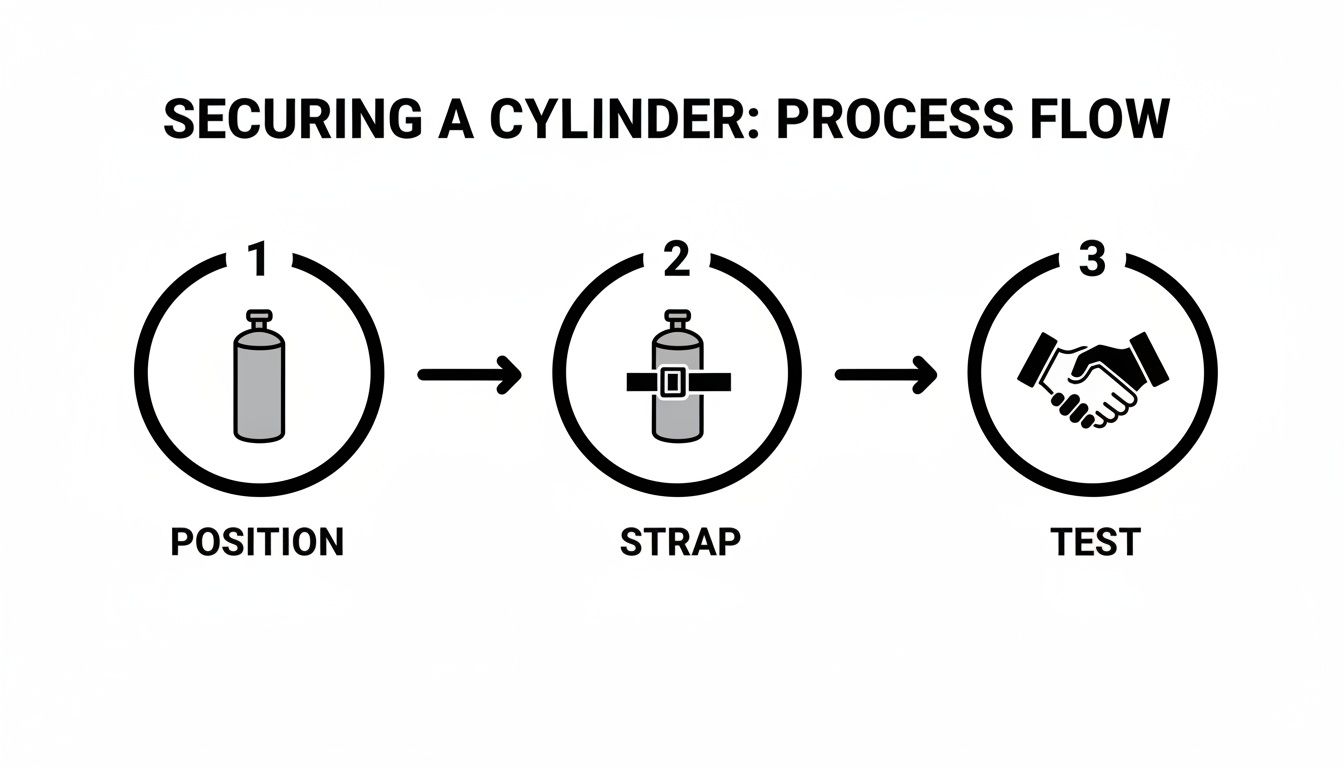
Following this simple process—position, strap, and test—prevents the cylinder from moving. This is key, as movement is a leading cause of valve damage and subsequent leaks.
Even with the best preparation, you need to be ready to act instantly if you suspect a leak. Knowing the signs is the first part of your mini-emergency plan.
Key Takeaway: The moment you suspect a leak, your only priority is to get yourself and any passengers to a safe area with fresh air. Don't waste time trying to figure out the problem inside the vehicle. The situation can become critical in seconds.
Keep your senses sharp for these warning signs:
If you notice any of these signs, here's what to do immediately:
When you start moving gas cylinders, particularly for work here in Germany, you inevitably run into ADR regulations. It sounds intimidating, but for most everyday situations involving a car, there's a key exemption that makes life much simpler. This is the "1000-point rule" under ADR 1.1.3.6, and it's essential to get your head around it.
This rule is a practical solution that allows private individuals and businesses to transport smaller quantities of dangerous goods without jumping through all the hoops of full ADR compliance. In many cases, it means you can skip the orange vehicle placards, the full dangerous goods driver’s licence, and the mountain of paperwork.
So, how does it work? The system assigns points to different gases based on how hazardous they are. Every gas falls into a "Transport Category" from 0 (the most dangerous) to 4 (the least). As long as the total points for your entire load stay below 1000, you’re operating under this handy exemption.
Calculating your total is just a bit of simple multiplication: you take the quantity of the gas (in kilograms or litres) and multiply it by a factor that corresponds to its Transport Category.
Here's a quick look at the categories and their multipliers:
Let's walk through a real-world scenario. A lab technician needs to pick up a 50-litre cylinder of nitrogen. Nitrogen falls into Transport Category 3. If that cylinder contains roughly 10 kg of gas, the maths is simply 10 kg x 1 = 10 points. That’s miles away from the 1000-point limit, so the transport is exempt from the full set of ADR rules.
Things can change in a hurry depending on the gas you're carrying. If that same technician was transporting a 10 kg cylinder of propane (a flammable gas in Category 2), the calculation becomes 10 kg x 3 = 30 points. Again, still well within the safe zone.
The contrast becomes really stark in industrial settings. For instance, insulating gases like UN1080 (new) and UN3163 (used) can be transported in quantities up to 1,000 kilograms without needing a dangerous goods licence or vehicle markings. Under Germany's points system, each kilogram is just one point. But for reused gases like UN3162 and UN3308, the rules are far tighter—only 20 kilograms are allowed, and each kilogram is worth a hefty 50 points.
The 1000-point rule is your best friend for small-scale transport, but it demands you know exactly what you're carrying. Misidentifying a gas or miscalculating its points can instantly put you in violation, leading to serious fines. Always check the safety data sheet for the correct UN number and Transport Category.
The moment your calculation tips over that 1000-point mark, the game changes entirely. The exemption is gone, and a strict set of ADR requirements immediately applies. For anyone in industry or making frequent commercial transports, this threshold is something you have to watch like a hawk.
If you exceed the 1000-point limit, you absolutely must have:
For a deeper dive into the specific regulations that apply to various transport scenarios, you might be interested in our detailed overview of the rules for transporting gas cylinders.
Ultimately, mastering the legal side of how you gasflaschen im auto transportieren boils down to understanding this points system. Whether you're in a lab, clinic, or industrial workshop, knowing where you stand with the 1000-point threshold is the key to making sure every trip is not just safe, but fully compliant with German law.
Even with the best guidance, a few practical questions always seem to pop up right when you’re about to load a gas cylinder into your car. The whole business of gasflaschen im auto transportieren is a mix of physics, regulations, and good old common sense. Let's tackle some of the most frequent queries to clear up any doubts before you hit the road.
This is easily one of the most common questions we hear, and the answer is a hard "no." You must always transport standard compressed gas cylinders, like propane, in a secure, upright position. The reason comes down to a critical safety feature: the pressure relief valve.
When the cylinder is standing up, this valve sits in the vapour space at the top of the tank. If the internal pressure gets too high, it’s designed to release a controlled amount of gas vapour to stabilise things. But if you lay the cylinder on its side, the valve is suddenly in direct contact with the liquid propane.
Should it activate in this position, it won’t vent vapour. It will shoot out a jet of highly flammable liquid. Since liquid propane expands to 270 times its volume as it turns to gas, this could instantly create a massive, incredibly dangerous fuel-air cloud. Always secure your cylinder upright in the boot—never inside the passenger cabin.
Think of your car strictly as transport, not a mobile storage unit. You should never leave a gas cylinder in a vehicle for any longer than absolutely necessary.
The inside of a car, especially on a sunny day, can heat up frighteningly fast, with temperatures easily soaring above 60°C. This intense heat causes the pressure inside the cylinder to climb dramatically. While the relief valve is there as a failsafe, you never want to push it to its limit.
Once you’ve arrived, your very first job should be to unload the cylinder and move it to a proper storage area—somewhere cool, dry, well-ventilated, and well away from any heat sources or open flames.
A car parked in the sun is an oven. Leaving a gas cylinder inside is taking a completely unnecessary risk. Make unloading the cylinder your top priority upon arrival, every single time. It's a simple habit that prevents a world of potential trouble.
If you're only transporting a single cylinder of an inert gas like nitrogen for personal or limited professional use, you most likely fall under the ADR's "1000-point rule" exemption. This means you don't need a full, formal ADR driver's licence.
However, "exempt" doesn't mean "unprepared." This rule doesn't remove your responsibility to be competent. You are still legally required to understand the risks and follow all the essential safety procedures. This includes:
Your employer has a duty to make sure you have this fundamental safety knowledge. So, while it’s not a formal licence, it is a form of essential safety training you must have.
The 1000-point rule, found in ADR 1.1.3.6, is a practical exemption designed to make transporting smaller quantities of dangerous goods less burdensome. The easiest way to think of it is as a "risk budget" for your journey. As long as your total "risk points" are under 1000, you’re exempt from the most demanding ADR requirements, like putting placards on your vehicle or needing a specialised driver's licence.
Every hazardous substance is assigned to a Transport Category based on how dangerous it is, and each category has a multiplier.
To work out your total, you just multiply the quantity of the gas (in kg) by its assigned multiplier. If that final number is below 1000, you're good to go under the exemption.
At Cryonos GmbH, we know that transporting sensitive materials demands equipment you can absolutely trust. Our ADR-compliant transport vessels and storage solutions are engineered for maximum safety and reliability, ensuring you meet regulatory standards while protecting your valuable samples. Explore our state-of-the-art cryogenic solutions and transport with complete confidence.

