No Products in the Cart




Think of the colours on gas cylinders, or farben von gasflaschen as they're known in German, as a crucial safety language. It’s a bit like a traffic light system for industrial and medical environments. Specific colours painted on the cylinder's shoulder immediately signal the primary risk, whether it's flammability, toxicity, or something else entirely.
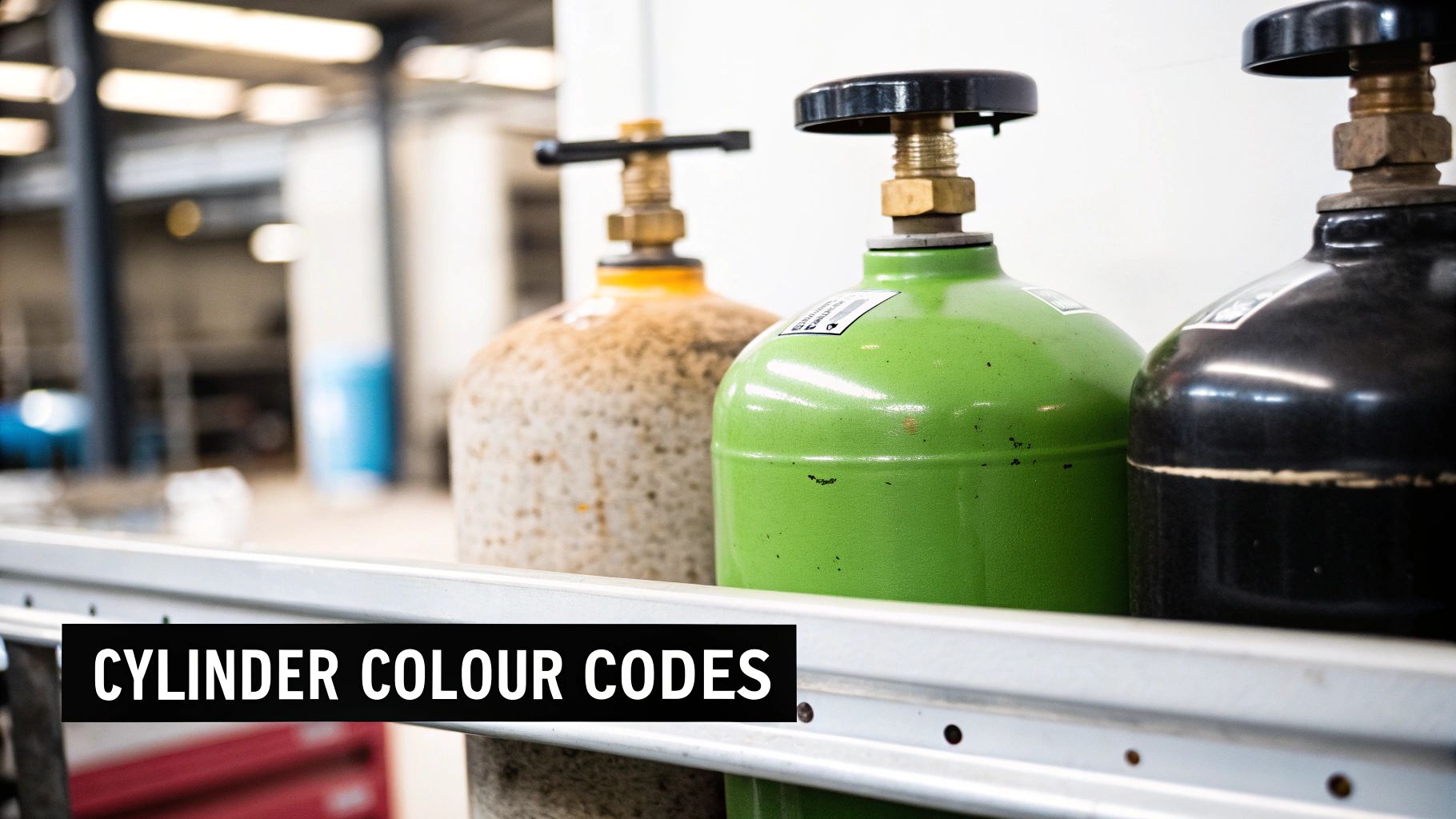
The colour scheme on a gas cylinder is anything but decorative; it’s a highly standardised system designed to prevent accidents before they happen. Here in Germany and across the European Union, this visual language is governed by the European standard EN 1089-3. This regulation ensures everyone is speaking the same colour language, creating a clear, unified way to identify hazards at a glance.
Picture yourself on a busy factory floor or in a fast-paced lab. You need to know, instantly, what potential danger a nearby cylinder poses. Instead of squinting to read fine print on a label, the colour of the cylinder's shoulder gives you that immediate clue.
The shoulder colour is the single most important visual cue for identifying a gas cylinder's primary hazard. It acts as the first line of defence in preventing handling errors and keeping people safe.
This system makes safety protocols simpler for everyone involved, from highly trained lab technicians to the logistics staff transporting the cylinders. The principle is refreshingly straightforward: the colour on the shoulder tells you the main risk. A bright red shoulder, for instance, is an unmistakable warning that the contents are flammable. A yellow shoulder tells you the gas is toxic or corrosive.
The EN 1089-3 standard assigns specific RAL colours to different hazard classes, making identification consistent across Europe. Here’s a quick rundown of the most common ones you’ll see.
| Shoulder Colour | RAL Code | Primary Hazard | Example Gases |
|---|---|---|---|
| Yellow | RAL 1018 | Toxic and/or Corrosive | Ammonia, Chlorine, Carbon Monoxide |
| Red | RAL 3000 | Flammable | Hydrogen, Propane, Methane |
| Light Blue | RAL 5012 | Oxidising | Oxygen, Nitrous Oxide |
| Bright Green | RAL 6018 | Inert | Nitrogen, Argon, Helium |
This simple, four-colour system covers the vast majority of gases you'll encounter, providing an essential, immediate layer of safety information.
Bringing in EN 1089-3 was a huge step forward for workplace safety, replacing the confusing patchwork of different national standards that existed before. The regulation mandates specific shoulder colours based on the gas's risk category, like the ones in the table above. This uniformity has been incredibly effective, contributing to a 30% reduction in reported identification errors across EU logistics between 2000 and 2015, according to data from industry leaders like the Messer Group.
Getting to know these colour codes is the first, most critical step in preventing serious accidents. It empowers your team to make safer decisions when handling, storing, and transporting compressed gases—a topic we delve into deeper in our guide to 20 kg gas cylinders.
Believe it or not, identifying gas cylinders across Europe used to be a confusing, and frankly, dangerous business. Before the EN 1089-3 standard came along, every country had its own system for the farben von gasflaschen (colours of gas cylinders). This created a real risk of mix-ups whenever cylinders crossed a border. The new standard thankfully replaced this patchwork of rules with a single, harmonised system based on one simple idea: hazard identification.
This regulation makes things much safer by focusing on just one part of the cylinder: the shoulder. It's a common mistake to think the colour of the entire cylinder body tells you what's inside. While gas companies often use the body for branding or to identify a specific gas, it's the shoulder colour that is legally required to communicate the primary risk.
This is a crucial distinction. A cylinder’s body might be grey, black, or any other colour the manufacturer fancies, but its shoulder colour must strictly follow the EN 1089-3 rules.
The standard neatly groups gases into four main hazard categories, each with a distinct, easy-to-spot colour. This simple logic means that even from a distance, your team can make a quick initial safety assessment.
This system is an intuitive visual shortcut, and it drastically cuts down the chances of mishandling a cylinder. But it's important to be realistic about its limitations. Colours can fade, get covered in grime, or be mistaken in poor lighting.
The colour code on a gas cylinder is a secondary safety feature. The label is, and always will be, the primary and definitive source of information about the cylinder's contents.
Always, always treat the label as the final word on the gas's identity and its hazards. Reading that label should be an absolute, non-negotiable step in your safety protocol before you handle any cylinder. By combining a quick check of the shoulder colour with a careful read of the label, you create a robust, two-tiered safety check that protects your team and your facility from completely preventable accidents.
Putting the theory of the EN 1089-3 standard into practice is where safety really clicks. When you see the actual farben von gasflaschen (colours of gas cylinders), you start to understand how this visual language works in real-world settings, from advanced biobanks to busy industrial workshops. This immediate visual link is what makes safe handling protocols stick.
Let's start with inert gases, which are the backbone of many cryogenic storage and lab applications. Because they're non-reactive, these gases are perfect for preserving delicate biological samples or creating a stable environment for sensitive experiments.
This quick concept map shows exactly how the shoulder colour and the label on a cylinder work together to communicate the risks involved.
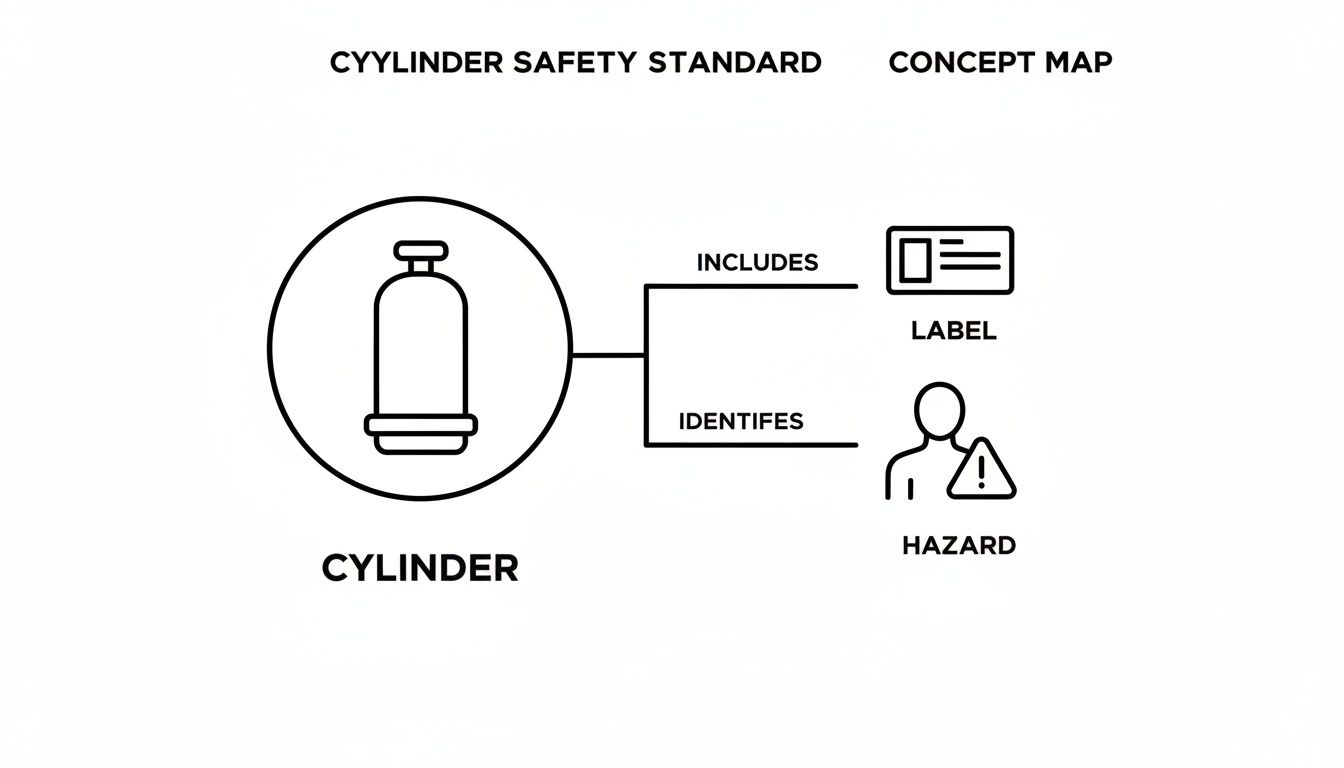
As you can see, the shoulder colour gives you that instant heads-up about the primary hazard, but it's the label that gives you the final, definitive word on what's inside.
When we move on to more reactive gases, these colour codes become even more critical for keeping people safe. Oxidising and flammable gases must be kept strictly separate and handled with extreme care, and their distinctive colours act as an immediate, unmissable warning.
Knowing the difference between a light blue shoulder and a red one is non-negotiable. Mistaking an oxidiser for a flammable gas can lead to catastrophic failures in both storage and handling.
In Germany, for instance, flammable gas cylinders have red (RAL 3000) shoulders and oxidising ones have light blue shoulders under EN 1089-3. This clear system has dramatically cut down on accidents. In fact, analysis shows a 35% decrease in combustion-related incidents between 2000 and 2020 among biotech and industrial users. A staggering 60% of that improvement is credited to the high visibility of this colour-coding system. You can dig deeper into these safety stats over at Messer Group.
Here are two of the most common reactive gases you'll encounter:
For gas mixtures, like the Argon/CO₂ blends used in welding, the shoulder is often split into different coloured segments. Each colour represents a component gas, communicating the properties of the whole mixture at a glance. This dual-colouring approach helps prevent mix-ups and ensures the right gas is used for the right job, boosting both safety and the quality of the work.
Here is a quick-reference table showing the shoulder and typical body colours for some of the most frequently used gases in laboratory and industrial settings.
| Gas Name | Chemical Formula | Shoulder Colour (Hazard) | Typical Body Colour | Common Use Case |
|---|---|---|---|---|
| Nitrogen | N₂ | Bright Green (RAL 6018) | Black | Cryopreservation, inerting |
| Argon | Ar | Bright Green (RAL 6018) | Dark Green | Welding, inert atmosphere |
| Oxygen | O₂ | Light Blue (RAL 5012) | White | Medical breathing, combustion |
| Acetylene | C₂H₂ | Red (RAL 3000) | Maroon | Welding and cutting |
| Carbon Dioxide | CO₂ | Grey (RAL 7037) | Grey | Beverage carbonation, fire extinguishers |
| Helium | He | Brown (RAL 8008) | Brown | Cryogenics, leak detection |
This table serves as a handy guide, but always remember the golden rule: the label is the ultimate source of truth. The colours provide a quick visual cue, but you must read the label to be 100% certain of the cylinder's contents before use.
While the EN 1089-3 standard brings some much-needed order to the world of farben von gasflaschen, it’s not a completely rigid, one-size-fits-all system. You'll find that certain applications and regions have their own specific rules, creating some important exceptions to the general guidelines.
Getting a handle on these special cases is absolutely crucial for anyone working in specialised fields or dealing with international supply chains.
One of the biggest and most important exceptions you'll encounter is for medical gases. Within the European Union, any gas cylinder intended for medical use must have a pure white body (RAL 9010). This rule is absolute, no matter what gas is inside.
The thinking here is simple and vital: it makes medical cylinders instantly identifiable in high-stakes environments like hospitals, operating theatres, and ambulances. It’s all about preventing any possibility of an industrial-grade cylinder being accidentally used on a patient.
The shoulder colour, however, still follows the standard hazard system. For instance, a medical oxygen cylinder will have that white body but with a light blue (oxidising) shoulder. This smart dual-colour system gives you two layers of vital information at a glance: the white body confirms its medical grade, while the shoulder immediately signals the inherent risk of the gas itself.
Gas mixtures are another area where things get a bit more nuanced. When a cylinder holds a blend of gases with different hazards, how do you communicate that visually? The standard has a clever solution for this: segmented shoulder colours.
For example, a mixture that is both flammable and toxic might have a shoulder that is divided into red and yellow sections. This allows for a much more detailed hazard assessment right from the first look, adapting the core principles of the system to more complex contents.
It's also worth remembering that while EN 1089-3 is the law of the land across Europe today, you might occasionally bump into older cylinders still wearing historical or national colour schemes. Before the standard was fully rolled out, Germany and other nations had their own systems. A classic example is older German nitrogen cylinders, which were painted entirely grey.
Always be mindful that older, non-standardised cylinders might still be in circulation. This makes the habit of reading the label every single time a non-negotiable safety practice.
If you ever come across a cylinder with colours you don't recognise, don't guess. Stop what you're doing, isolate the cylinder if possible, and check the label and consult your supplier for a definitive identification.
This is especially true when dealing with international shipments, as standards outside the EU—like those in the United States—can be completely different. For professionals managing logistics, our guide on the safe transport of gas cylinders offers more detailed compliance information you might be interested in: Regulations for Transporting Gas Cylinders. Being aware of these regional differences and special cases ensures that your safety protocols are robust enough to handle any cylinder that comes through your facility doors.
Knowing the colour codes is a great start, but it's putting that knowledge into practice that makes a workplace truly safe. Whether you're in a busy lab, on an industrial site, or in a medical facility, handling compressed gas demands a healthy respect for procedure. These tips will help you turn theory into life-saving habits.
The most critical rule is also the simplest: always read the label. Think of the shoulder colour as a quick heads-up about the hazard, but the label is the absolute source of truth. It confirms the exact contents, purity level, and gives you critical safety warnings. If a cylinder’s label is missing, unreadable, or looks like it's been messed with, don't use it.
Every new delivery of gas cylinders should start with a thorough inspection. Give each cylinder a once-over, looking for any obvious signs of damage like dents, deep rust spots, or problems with the valve. A damaged cylinder is a serious risk and should be immediately rejected and sent back to your supplier. To learn more about protective equipment that maintains cylinder integrity, our guide on gas cylinder protective caps has some helpful details.
Storing cylinders correctly is just as vital as handling them correctly. You absolutely must keep cylinders separated based on their hazard class to prevent dangerous reactions.
Segregating incompatible gases isn’t just a "nice-to-have"—it's a fundamental requirement for preventing catastrophic fires or explosions. A simple storage mistake can turn a small incident into a full-blown disaster.
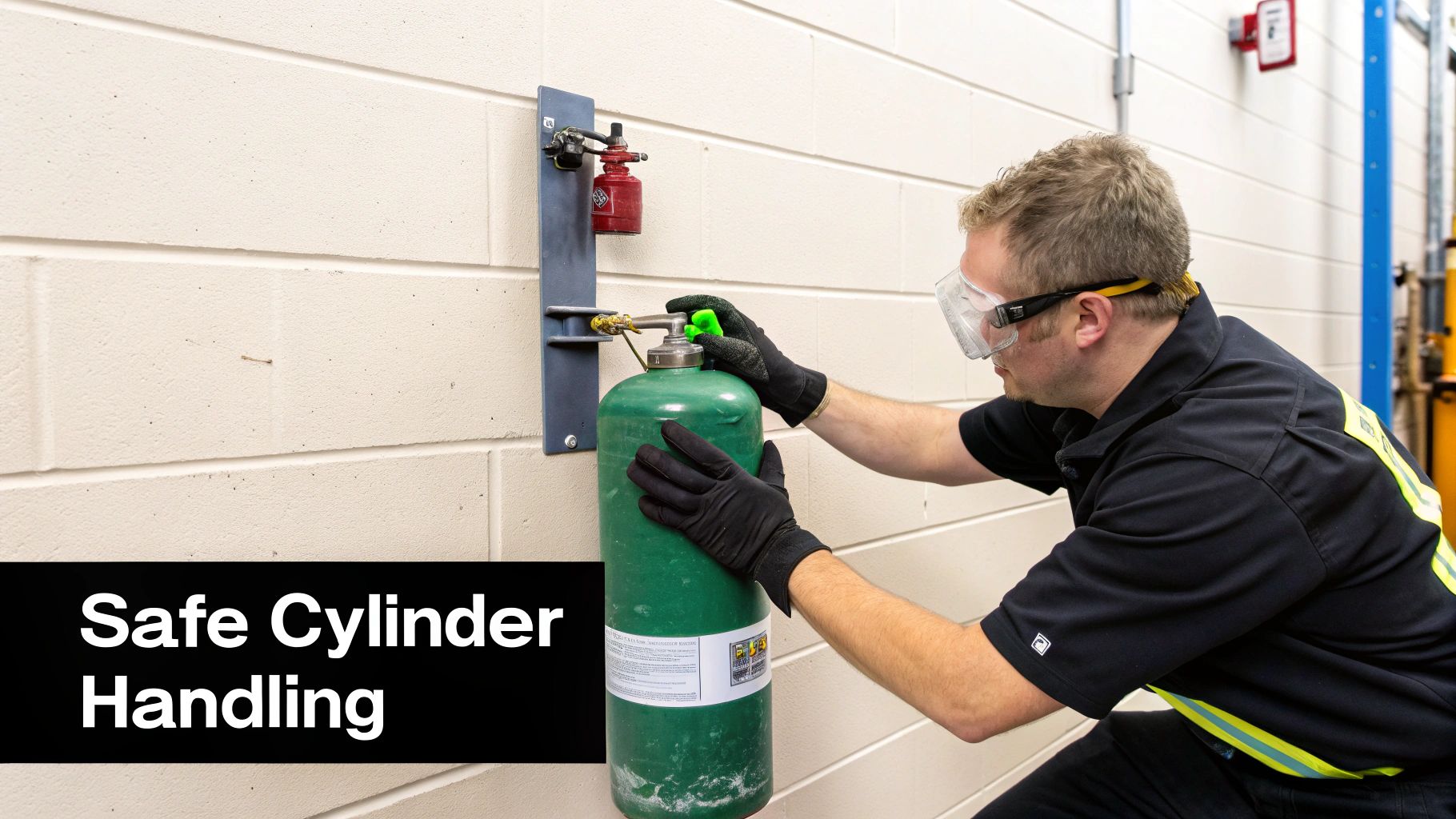
Every single compressed gas cylinder, whether it’s full or empty, must be secured at all times to prevent it from tipping over. A falling cylinder can cause horrific injuries or damage the valve, which could lead to a rapid, uncontrolled release of high-pressure gas.
Always use chains, sturdy straps, or approved cylinder stands to secure each cylinder upright against a wall or another solid, fixed object. When you need to move them, use a proper trolley or cart built for the job. Never, ever roll, drag, or slide them across the floor. By treating every cylinder with respect and sticking to these protocols, you build a resilient safety culture that protects your team and your entire facility.
Even with a good grasp of the basics, navigating the world of farben von gasflaschen can bring up some tricky questions. Let's tackle a few of the most common queries to clear up any lingering confusion.
While the shoulder colour is a great first-glance indicator of a gas's primary hazard, the single most important identifier is the permanent label or tag. Always.
Think of the colour as a quick warning sign, but the label is the definitive legal document. It contains the non-negotiable details: the exact gas name, its purity, and crucial safety warnings. Always trust the label over the colour, as paint can get scuffed, faded, or even be incorrect.
In the European Union, there's a special rule for medical gas cylinders outlined in the EN 1089-3 standard: they must have a white body (specifically, RAL 9010). This makes them instantly recognisable in places where a mix-up could be disastrous, like hospitals and clinics.
The white body tells you the gas is for medical use. The shoulder colour still follows the standard hazard system (e.g., light blue for an oxidising gas like oxygen). This dual-colour system is a brilliant safety feature, preventing someone from accidentally grabbing an industrial-grade gas for a patient.
This clear visual separation is a vital safeguard, protecting patients from what could be a catastrophic mistake.
Not at all. The EN 1089-3 standard is a European system. While there's a global push towards harmonising these kinds of safety standards, we're not there yet, and major regional differences still exist.
For instance, the United States uses a completely different system managed by the Compressed Gas Association (CGA), which is not based on hazard classes in the same way. For any organisation operating internationally, it's absolutely critical to know and follow the specific regulations for the country where the cylinders are being used. Assuming one system applies everywhere is a recipe for serious safety risks and compliance headaches.
For state-of-the-art cryogenic solutions and expert guidance on gas handling and storage, trust Cryonos GmbH. Explore our compliant and reliable equipment at https://www.cryonos.shop.

