No Products in the Cart




An ISO tank container is essentially a specialised vessel housed within a standardised frame, built to move bulk liquids, gases, and powders safely and efficiently across the globe. Think of it as a mobile thermos for international trade. This design allows sensitive cargo to travel seamlessly between trucks, trains, and ships without ever being transferred or exposed, a feature known as intermodal design.
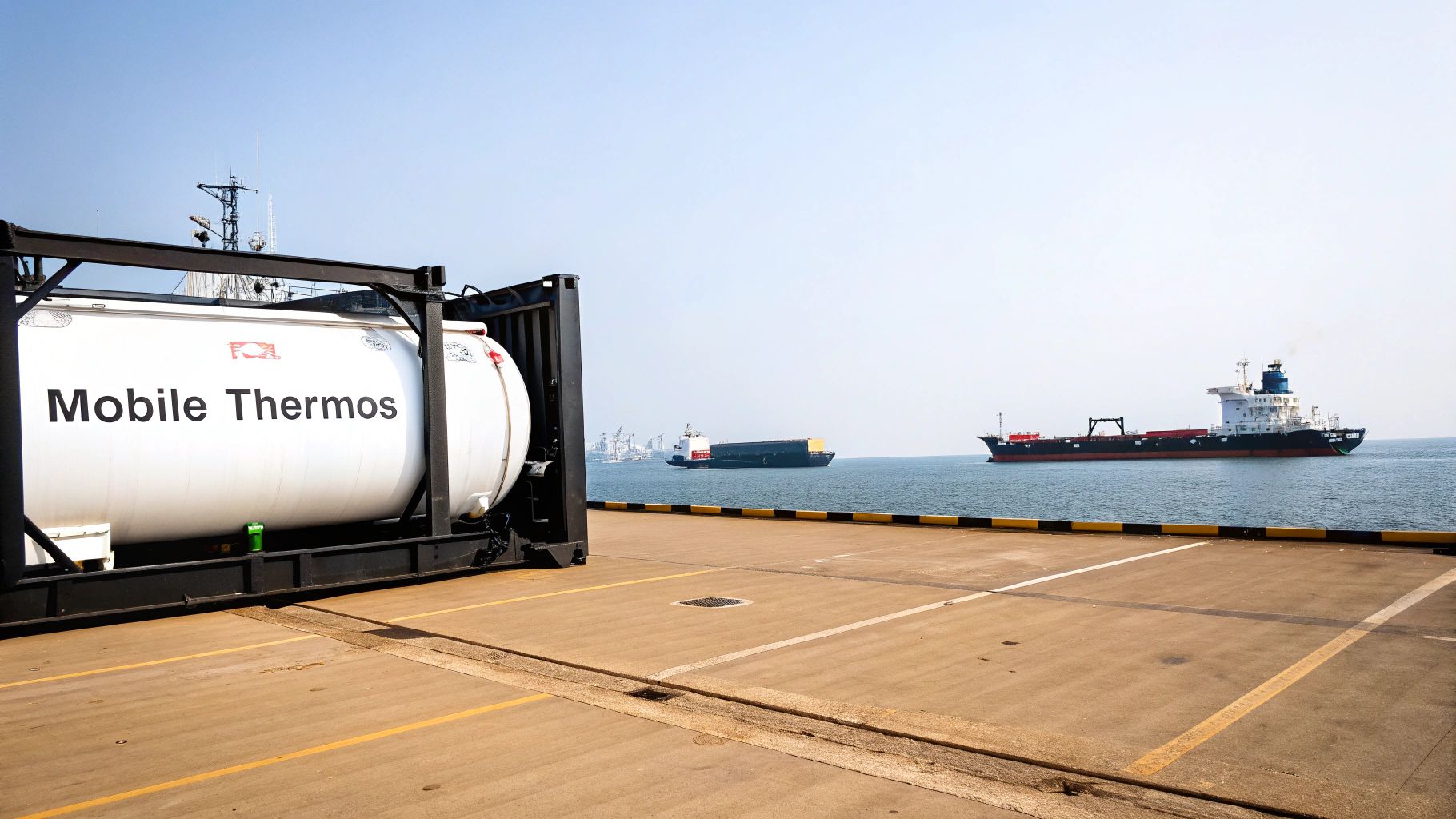
At its core, an ISO tank container tackles a massive logistics headache: how to move large volumes of non-solid goods without contamination, loss, or wasted effort. Before these tanks became common, bulk liquids were lugged around in barrels, drums, or intermediate bulk containers (IBCs). Each of these required multiple handling stages, introducing plenty of risk and delay into the supply chain.
The ISO tank completely changed the game by putting a tough cylindrical tank inside a standard steel frame. This frame is built to specifications from the International Organisation for Standardisation (ISO), making it a perfect fit for logistics equipment anywhere in the world. It shares this universal compatibility with the broader category of shipping containers.
This simple but brilliant concept delivers some major wins:
You can really see the importance of this technology in industries where there’s zero room for error. The German chemical sector, for example, pulls in a massive €200 billion in annual revenue but also faces €10 billion in logistics costs. This reality pushes companies to find smarter solutions like specialised ISO tanks. Add to that the strict ADR regulations for transporting dangerous goods, and you see why compliant, reliable containers for things like liquid nitrogen are so essential.
To get a quick overview, let’s break down the fundamentals.
This table provides a snapshot of the key features that define a standard ISO tank container.
| Feature | Description |
|---|---|
| Structure | A cylindrical pressure vessel (the "tank") made of stainless steel, mounted within a 20-foot rectangular steel frame. |
| Capacity | Typically ranges from 21,000 to 26,000 litres, though specialised models can hold up to 40,000 litres. |
| Intermodal Design | The frame dimensions are standardised, allowing it to be handled by the same equipment used for standard dry cargo containers across ships, trains, and trucks. |
| Cargo Types | Designed for hazardous and non-hazardous bulk liquids, powders, and gases (including cryogenic liquids like LIN, LOX, and LAR). |
| Regulations | Must comply with multiple international standards for safety and transport, including ISO, IMDG (sea), ADR (road), and RID (rail). |
| Materials | The inner shell is usually 316 stainless steel for its corrosion resistance and durability. The outer frame is made from carbon steel. |
| Safety Features | Includes pressure relief valves, burst discs, airline connections for pressurising/discharging, and top/bottom discharge valves, often with multiple closures for safety. |
This combination of features makes the ISO tank a highly versatile and dependable workhorse in global logistics.
An ISO tank container is more than just a steel box; it's a mobile, self-contained supply chain solution. It acts as transport, storage, and packaging all in one, providing a resilient and sustainable method for moving the world's most vital liquids and gases.
For biobanks protecting irreplaceable biological samples or industrial gas suppliers delivering cryogenic liquids, the ISO tank is the unsung hero of their operations. It guarantees that valuable cargo reaches its destination safely, securely, and with its integrity intact—a true cornerstone of modern global trade.
At first glance, an ISO tank might just look like a big tank sitting inside a metal frame. But that simple appearance hides some seriously clever engineering, all designed for maximum safety, durability, and efficiency. This "tank-within-a-frame" concept is precisely what makes it a powerhouse in global logistics.
The heart of the unit is the inner vessel, the cylindrical tank that actually holds the cargo. This is the part that comes into direct contact with whatever is being shipped, whether that's a delicate food-grade liquid, a reactive chemical, or an ultra-cold gas like liquid nitrogen.
Encasing this vessel is a tough outer frame, typically built from carbon steel. This frame isn't just for protection; its dimensions are set to a universal standard by the International Organisation for Standardisation (ISO). That standardisation is the magic ingredient that makes it 'intermodal'—it can be lifted, stacked, and moved using the same gear as regular shipping containers anywhere in the world.
When it comes to the inner vessel, the choice of material isn't just important—it's everything. The safety and purity of the product depend on it. That's why the overwhelming majority of ISO tanks are built using high-grade stainless steel, specifically type 316.
This particular alloy is the go-to choice for a few critical reasons:
The vessel itself is built from meticulously welded steel plates, with the interior surfaces polished to a smooth finish. This isn't just for looks; it makes cleaning a breeze and stops any residue from building up, which is crucial for preventing cross-contamination between different loads.
Beyond the tank and frame, an ISO tank is fitted out with a whole suite of essential components. Think of them as the unit's control panel and nervous system, each with a specific job related to safety and operation.
The real genius of the ISO tank isn't just the container itself. It's the whole ecosystem of valves, safety gear, and access points built around it. Every part works together to make sure the cargo gets loaded, moved, and unloaded safely, no matter where it is on the planet.
Let's break down the most critical parts.
These aren't just optional extras; they are fundamental to the safe and compliant operation of every single ISO tank. Together, they form a system that protects the product, the environment, and every person who handles it.
Not all ISO tanks are built the same. Choosing the right one is like picking the perfect tool for a very specific job, and getting it wrong can be costly and dangerous. If you move beyond the one-size-fits-all view, you’ll find a detailed classification system designed to perfectly match a tank's capabilities with the cargo it’s meant to carry. This system is what ensures safety, efficiency, and product integrity, whether you're transporting wine or highly volatile industrial gases.
At the heart of it all is the T-Code system. This is the international standard that sorts ISO tank containers based on their construction, pressure ratings, and the substances they are certified to handle. You can think of it as a shorthand that instantly tells a logistics pro everything they need to know about a tank's purpose and safety features.
The T-Code system is thankfully quite logical. It runs from T1 to T22 for most liquid and powder applications, with another special category just for gases. Essentially, the numbers tell you about the tank's shell thickness, its pressure rating, and how its outlet valves are set up. As a rule of thumb, a higher T-number means a tougher tank, built to handle more hazardous materials.
This system is broken down into a few key groups:
But for any organisation knee-deep in cryogenic logistics—from biobanks to industrial gas suppliers—one code stands out above the rest.
The T75 ISO tank container is a true marvel of specialised engineering. It’s built for one of the most demanding jobs in logistics: moving refrigerated liquefied gases at mind-bogglingly low temperatures. These are the tanks you absolutely need for substances like liquid nitrogen (LIN), which boils at -196°C, or liquid argon (LAR).
A T75 tank is fundamentally different from its cousins that operate at ambient temperatures. The best way to picture it is as a thermos on a massive, industrial scale.
A T75 tank uses a "tank-within-a-tank" design. An inner vessel made of stainless steel holds the cryogenic liquid, while an outer carbon steel shell creates a vacuum-sealed space in between. This vacuum is the ultimate insulator, minimising any heat getting in and stopping the liquid from boiling off too quickly.
This advanced insulation is non-negotiable for keeping gases in their liquid state during transport. Without it, the product would rapidly turn back into a gas, building up dangerous pressure inside the tank and leading to huge losses. It’s this design that makes the T75 indispensable for pharmaceutical companies, research labs, and industrial users who depend on a steady, pure supply of cryogenic gases.
The diagram below gives you a clear look at the fundamental components that make up a standard ISO tank.
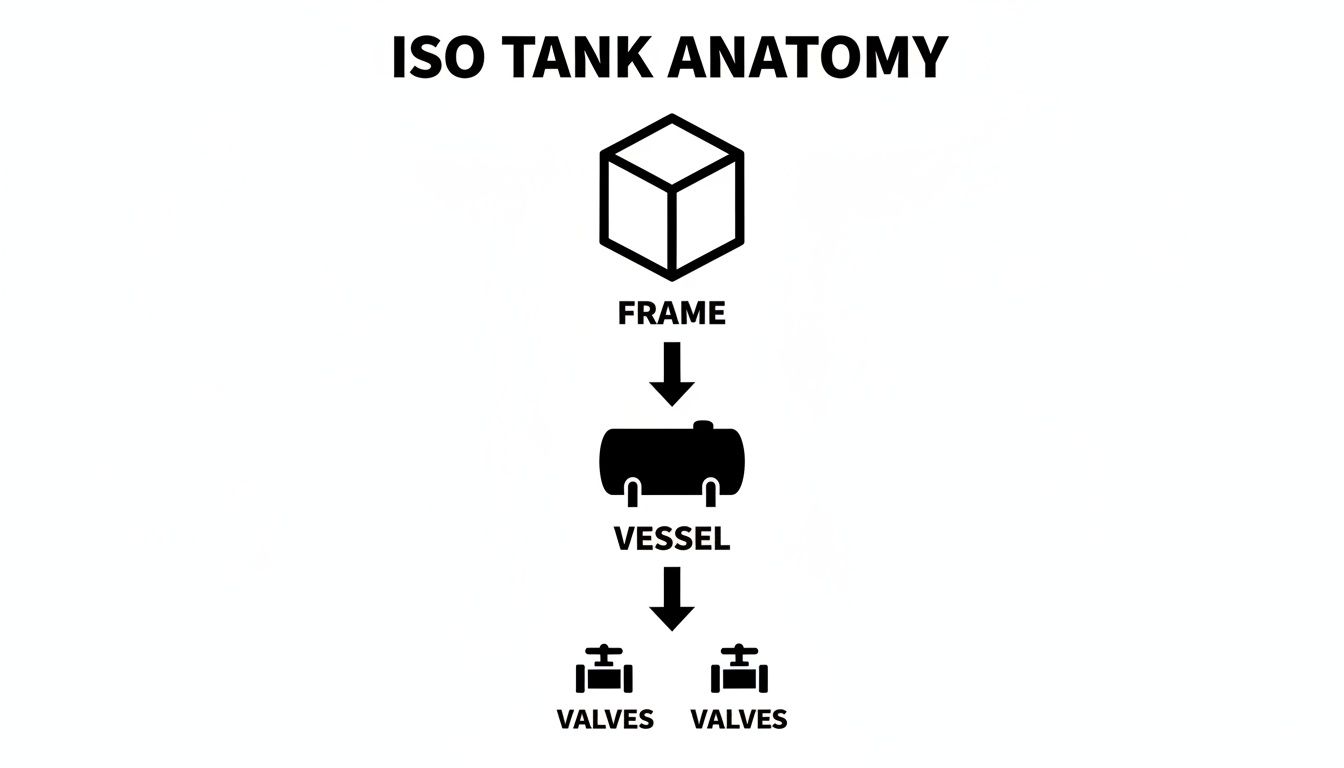
This simple breakdown shows how the protective frame, the core vessel, and all the essential valves work together to create a secure and road-ready intermodal unit.
To make things a bit clearer, here’s a quick comparison of the most common T-Codes you'll encounter.
| T-Code | Primary Use | Key Feature |
|---|---|---|
| T4 | Non-hazardous liquids (e.g., food-grade oils, juices) | Lower pressure rating, basic bottom discharge |
| T11 | Non-hazardous & hazardous chemicals | Higher pressure rating (4 bar), suitable for a wide range of chemicals |
| T14 | Corrosive & hazardous chemicals (e.g., acids) | Thicker shell, top discharge only for added safety |
| T50 | Non-refrigerated liquefied gases (e.g., LPG) | Very high pressure rating to keep gases liquefied under pressure |
| T75 | Cryogenic liquefied gases (e.g., LIN, LAR, LOX) | Vacuum-insulated "tank-within-a-tank" design for extreme cold |
This table highlights just how specialised the T75 is. While other tanks manage pressure, the T75 is engineered to manage extreme temperature, a completely different and far more complex challenge.
Beyond just the T-Code, a few other key specifications will tell you if an ISO tank container is the right fit for your product. Getting these details right is critical to ensure the container can safely and legally transport its contents.
The demand for these specialised containers is growing, and fast. Germany's ISO tank container market is expanding rapidly, which isn't surprising given its dominance in the wider shipping container industry, where ISO variants held a massive 98.31% revenue share back in 2020. Looking ahead, the Western European market, with Germany at the forefront, is projected to grow at a 9.89% CAGR from 2023 to 2033. This just goes to show the increasing reliance on these purpose-built containers across the continent. You can read more about the German shipping container market outlook for a deeper dive.
Moving bulk liquids and gases across borders isn't just about logistics; it’s about navigating a dense web of rules designed to keep the cargo, the public, and the environment safe. For an ISO tank container, compliance isn't an afterthought—it's baked into its very design. These regulations are what guarantee that every tank is built, tested, and handled to the highest possible safety standards, letting sensitive shipments travel the globe seamlessly and securely.
The entire system is built on the foundation laid by the International Organisation for Standardisation (ISO). These ISO standards dictate the core design, materials, and construction of both the tank and its frame. It’s what ensures every single container, no matter where in the world it was made, meets a universal benchmark for strength and durability.
But ISO standards are really just the starting point. Once a tank goes into service, it has to follow specific rules for every mode of transport it will use. Think of them as different rulebooks for the road, the railway, and the sea.
For any business operating in Europe, getting to know these three acronyms is non-negotiable. They are critical for ensuring your ISO tank container can legally and safely make its way to its destination. Each one tackles the unique risks of a specific transport mode.
This dedication to multimodal regulations is what gives the ISO tank container its incredible logistical flexibility. A single tank can be certified for ADR, RID, and IMDG, allowing it to travel from a factory in Germany by truck, get transferred to a train, and then be loaded onto a ship for global export—all without ever cutting a corner on safety.
A safety certificate isn't a lifetime pass. To keep its approvals active, every single ISO tank container has to go through a strict schedule of inspections and tests. This mandatory routine ensures the tank stays structurally sound and safe throughout its long life, which can often stretch beyond 30 years.
The two most important check-ups are:
Missing one of these inspections immediately invalidates a tank’s safety certification, effectively grounding it until it can be re-certified. This commitment to regular, documented maintenance is the bedrock of the system's reliability. The global fleet's growth and health depend on this rigour. Fleet data highlights Germany's TWS at 12,000 tanks and VTG at 4,000, part of a global total of 882,023 units. For Cryonos' clients, like fertility clinics and research institutes, this expansive and well-regulated network ensures dependable intermodal transport for sensitive cryogenic shipments. Discover more insights about the global tank container market on researchandmarkets.com.
By successfully navigating these standards, companies can confidently move high-value and sensitive products across the globe. You can explore more details on this topic in our article about the versatility of the ISO container tank. In the end, compliance is the passport that allows your cargo to travel safely and without delay.
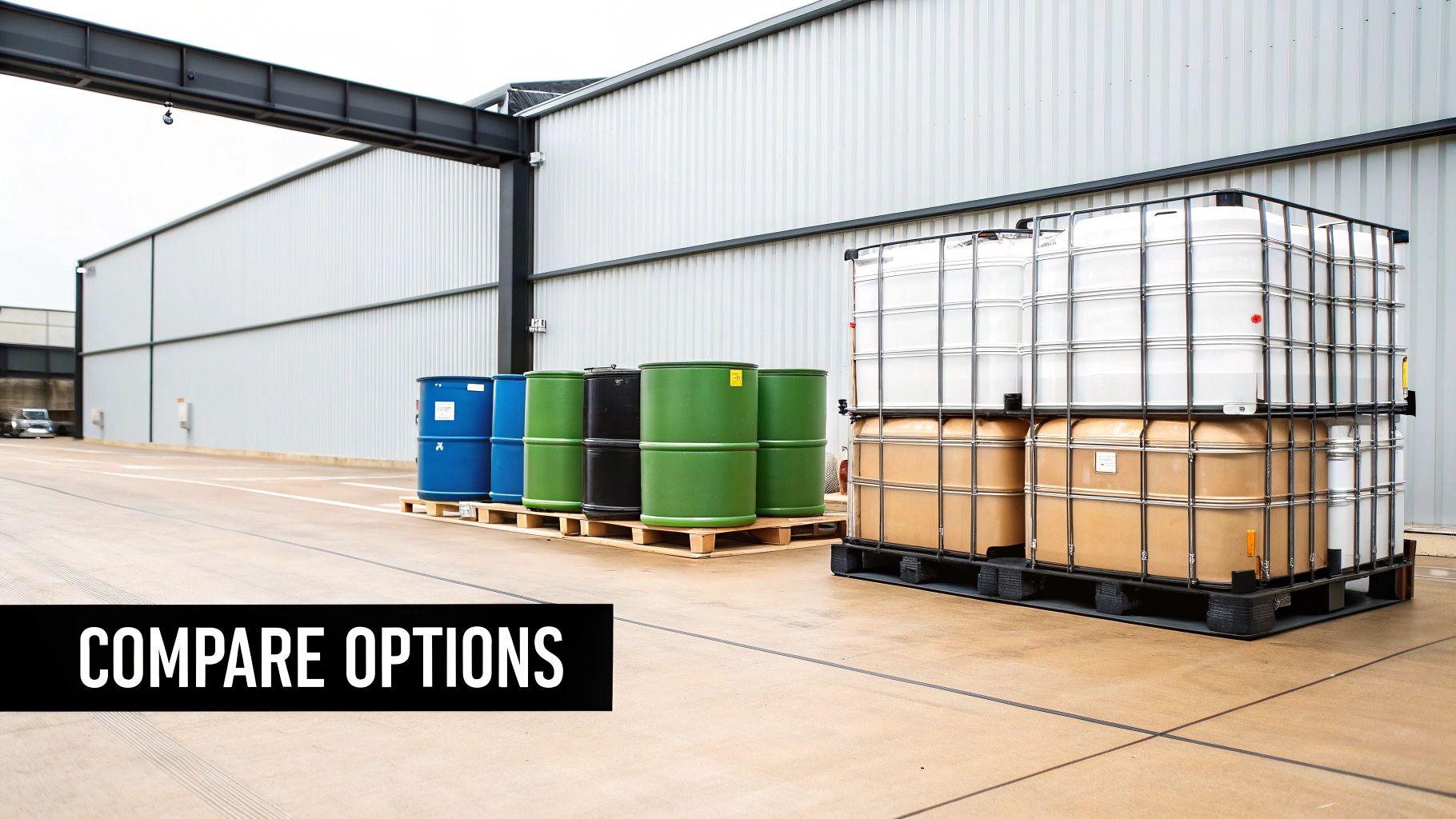
Choosing the right container for bulk liquids or gases isn't just a logistical detail—it’s a critical decision that directly impacts your bottom line, safety protocols, and operational efficiency. While an ISO tank container is a formidable tool for bulk transport, it’s not always the only answer. Knowing how it stacks up against the alternatives is the key to making the smartest choice for your specific needs.
For many operations handling ambient, non-hazardous, or even some hazardous liquids, traditional methods like steel drums, intermediate bulk containers (IBCs), or flexitanks are common. Each has its place, but they all come with trade-offs, especially when you start talking about true bulk efficiency.
Steel drums are fine for small quantities, and IBCs offer a nice step up, usually holding around 1,000 litres. Then you have flexitanks—essentially large, disposable bladders fitted inside a standard dry shipping container for non-hazardous liquids.
But here’s where the complexity kicks in. A single 24,000-litre ISO tank container can replace roughly 115 steel drums or 24 IBCs. Think about what that means on the ground: you’re drastically cutting down on loading and unloading times, slashing labour costs, and minimising the risk of spills that comes with managing dozens of connection points.
Plus, the robust, reusable design of an ISO tank offers a far more sustainable model than single-use flexitanks or the headache of cleaning and disposing of drums.
The core advantage of an ISO tank lies in its economy of scale and product security. It transforms dozens of individual handling operations into a single, secure, and sealed movement, safeguarding product integrity from origin to destination.
This is a game-changer for industrial suppliers moving serious volume, where the cost-per-litre savings really start to add up.
In the specialised world of cryogenics, we’re dealing with a different set of alternatives, but the core principles of scalability and efficiency hold true. Labs, clinics, and smaller industrial users often depend on smaller containers for liquid nitrogen (LIN) and other cryogenic gases.
The most common alternatives to a cryogenic ISO tank container are:
Making the leap to a T75 cryogenic ISO tank is a strategic move, and it all comes down to volume. One 20,000-litre ISO tank can hold the equivalent of more than 80 large liquid cylinders. For a biobank, a pharmaceutical manufacturer, or an industrial gas provider, this transition represents a shift from a piecemeal supply chain to a resilient, bulk logistics strategy.
A dewar might be perfect for a single bench, but an ISO tank can function as a mobile storage hub, supplying an entire campus or distribution network with incredible efficiency.
By understanding these comparisons, you can pinpoint the exact moment when scaling up becomes not just an option, but the most logical next step. For a closer look at the different types and their features, you might be interested in our detailed guide on ISO tanks containers.
This is about more than just getting a tank. It requires a hard look at your operational needs and, just as importantly, building a solid partnership with a supplier you can trust.
The first big question you'll need to answer is whether to buy or lease your ISO tanks. Each option has its own clear advantages, and the right call depends entirely on your company's financial picture, how often you'll be using the tanks, and your long-term ambitions.
Deciding between leasing and purchasing is a major financial and operational fork in the road. Leasing gives you flexibility and keeps upfront costs down, which is perfect for short-term projects or for businesses that want to avoid a massive capital outlay. Plus, maintenance is usually baked into the deal, taking that headache off your team's plate.
On the other hand, buying an ISO tank container is a long-term investment. Yes, it demands a significant chunk of capital at the start, but you get total control over the asset. Over a service life that often stretches beyond 30 years, ownership can prove to be the more cost-effective route, especially for companies with steady, high-volume transport needs.
To help you weigh your options, think about these points:
Choosing a reputable supplier is every bit as crucial as picking the right tank. A real partner does more than just sell you equipment; they provide the kind of comprehensive support that turns a simple purchase into a lasting logistical advantage.
Look for a turnkey provider who can offer expert technical advice, on-site maintenance, and invaluable help navigating customs and import procedures. For anyone looking to truly integrate ISO tanks, a deeper understanding of global trade can be gained by mastering the import-export business, which gets into the nuts and bolts of logistics and financial strategy.
Once the ISO tank is officially part of your fleet, sticking to best practices for handling and transport is non-negotiable for safety and compliance. This means making sure all your personnel are properly trained on loading and unloading, understand the specific safety features of your tank, and follow all ADR, RID, and IMDG regulations to the letter.
An ISO tank is not merely a piece of hardware; it is a strategic asset. When integrated correctly with the support of a knowledgeable supplier, it builds a resilient, efficient, and secure supply chain for your most valuable cryogenic materials.
When you start seeing the ISO tank as a core piece of your operational puzzle, you can unlock some serious efficiencies. For a deeper dive into making the right choice, feel free to explore our detailed analysis of the benefits of a container ISO tank for your business. This partnership-first approach ensures your cryogenic logistics aren't just working, but are truly optimised for success.
Even after getting the full rundown, it's natural to have a few practical questions when you're thinking about bringing an ISO tank container into your operations. We get it. Here are the answers to the questions we hear most often, designed to give you the clarity you need to move forward.
Think of a well-maintained ISO tank as a long-term workhorse. With proper care and by sticking to the required inspection schedules, it's not unusual for a tank to stay in service for 30 years or even longer.
This incredible durability comes down to their smart, tough construction, usually from high-grade stainless steel that stands up to corrosion and daily wear. This isn't just a container; it's a solid investment that pays for itself over decades, offering a far more sustainable and reliable solution than disposable options like drums or flexitanks.
The rule is simple and strict: an ISO tank must be cleaned inside and out after every single use. The only exception is if you're loading the exact same product again immediately. This isn't just good practice; it's essential for preventing any chance of cross-contamination.
For anyone in the pharmaceutical, biobanking, or food-grade industries, this is non-negotiable. Product purity is everything. Specialised cleaning depots use a combination of high-pressure steam, detergents, and occasionally solvents to make sure the tank's interior is completely sterile and free from any leftover residue before it heads out for its next job.
The core principle is simple: a clean tank guarantees product integrity. This non-negotiable step ensures that every shipment, from sensitive biological samples to industrial chemicals, arrives in its purest form, free from any contaminants from previous cargo.
Absolutely, and this is one of their biggest advantages. An ISO tank container is a true multi-tasker, seamlessly shifting from a transport vessel to a temporary, mobile storage unit. This dual-purpose nature is a game-changer for building a resilient supply chain.
Imagine this: a T75 cryogenic tank is delivered right to your customer's facility. It can then function as their on-site liquid nitrogen supply, eliminating the need for a separate, fixed storage tank. When it's empty, you just swap it for a full one. This creates a "just-in-time" inventory model that saves a huge amount of space and infrastructure costs, allowing businesses to buffer their stock and keep things running smoothly, even when demand spikes or supply chains get complicated.
At Cryonos GmbH, we don't just sell equipment; we deliver complete cryogenic solutions. Whether you're weighing the pros and cons of leasing versus buying, need a hand with import and customs, or just want some expert technical advice, our team is here to make your ISO tank integration a success. See our state-of-the-art cryogenic transport and storage options at https://www.cryonos.shop.

