No Products in the Cart




When you're dealing with compressed or cryogenic gases, understanding the markings on a gas cylinder – what we call Kennzeichnung von Gasflaschen in Germany – is an absolutely critical safety skill. These labels and stamps aren't just red tape; they provide instant, vital information about the cylinder's contents, its hazards, and its safety history.
Think of these markings not as a set of complicated rules, but as a universal language of safety. It’s a language designed specifically to protect you and your team.
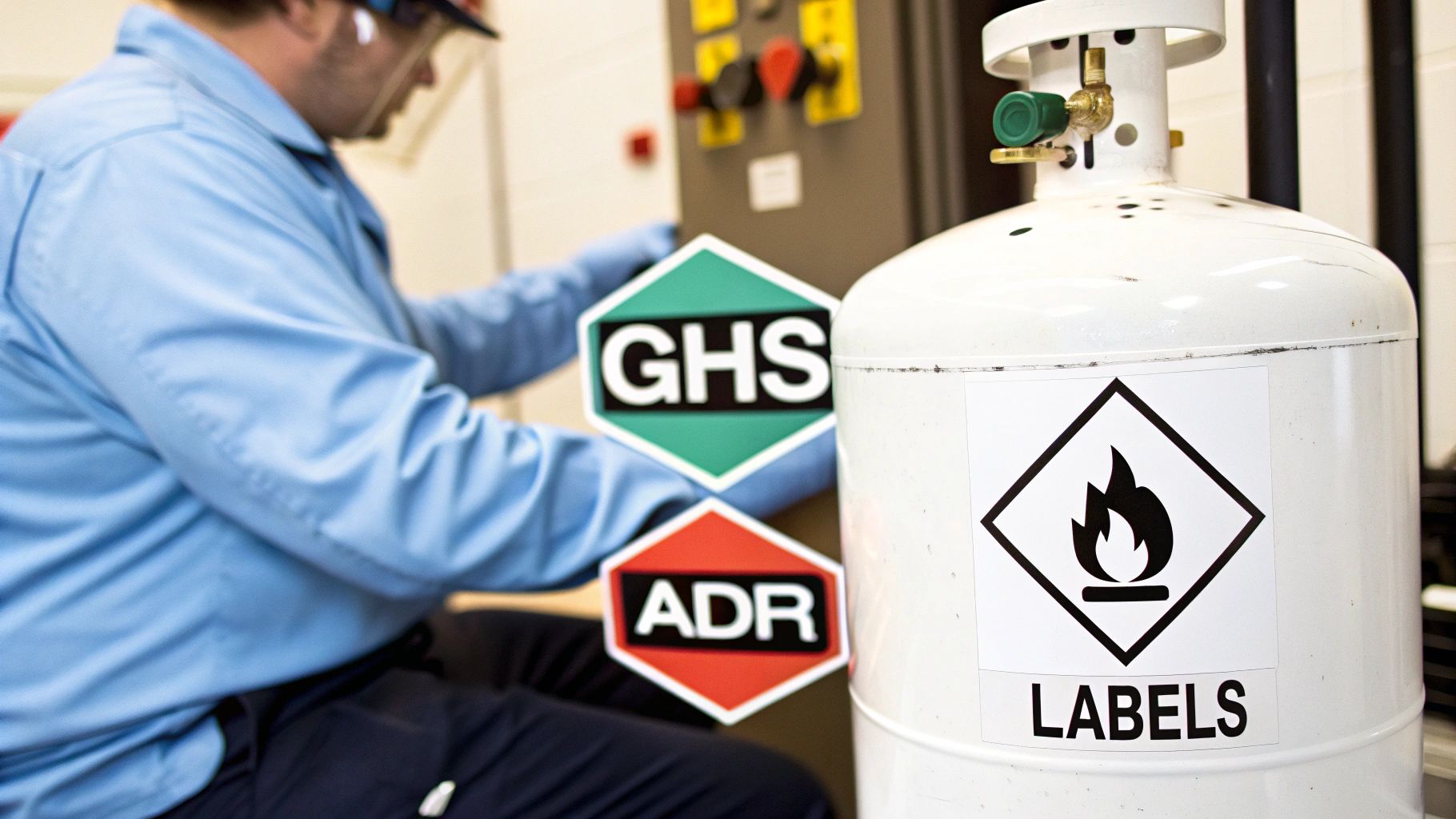
At first glance, a gas cylinder can look like a confusing mess of symbols, numbers, and colours. But once you know what you’re looking at, you’ll see it’s a highly organised system that tells a complete story about the gas inside. For any business working in labs, biobanks, or industrial settings, mastering this language is the first real step towards a safe work environment.
I like to think of the markings as a "traffic light" for safety. Some bits of information are an immediate red light, screaming "danger!" Others are more of a yellow light, giving you important context and urging caution. Then you have the green light elements, which confirm everything is compliant and ready to go. Every single piece serves a purpose, from guiding an emergency response to informing routine daily handling.
The Kennzeichnung von Gasflaschen can be broken down into three main categories. Once you understand these layers, a complex-looking cylinder becomes an open book.
A gas cylinder’s label tells you what is inside right now; its stamped markings tell you its entire life story and confirm its fitness for service. Both are essential for comprehensive safety.
For any professional handling gases—whether it's liquid nitrogen in a Cryonos storage vessel or industrial welding gases—being able to interpret these markings is non-negotiable. It allows for a rapid risk assessment from the moment a cylinder arrives at your facility.
This foundational knowledge prevents accidents, ensures you're compliant with German and European regulations, and protects both your people and your valuable equipment. By learning to read this language, you empower your team to handle every cylinder with the confidence and care it demands, turning potential risks into managed, understood, and safe procedures.
To make any sense of the markings on a gas cylinder, you first have to understand the rules that put them there. The Kennzeichnung von Gasflaschen (labelling of gas cylinders) in Germany isn't just one law; it's a web of interconnected European and international standards. Think of it like building a house: you need a solid foundation, sturdy walls, and a protective roof to make sure everything holds together safely.
These regulations are designed to work in concert, giving a complete safety picture that covers everything from the chemical hazards inside the cylinder to how it's transported and the technical specs of the cylinder itself. Getting your head around these three pillars is the key to understanding why every single marking is so important.
The first and broadest layer is the Globally Harmonized System of Classification and Labelling of Chemicals (GHS). Just like the name says, GHS is an international standard created to give the world a single, unified language for talking about chemical hazards.
Imagine trying to navigate traffic in a country where every town had its own unique symbols for "stop" or "danger." It would be chaos. GHS solves that exact problem for chemicals, standardising the hazard pictograms, signal words, and safety information that appear on labels worldwide.
When it comes to the Kennzeichnung von Gasflaschen, its main job is to give you an immediate, visual heads-up about the properties of the gas. Those familiar red-bordered diamond pictograms you see? That's GHS at work, making sure a user in Germany understands the same basic hazards as someone in Japan or Brazil.
While GHS tells you what the hazard is, the Accord Dangereux Routier (ADR) tells you how to handle it—specifically, when transporting hazardous goods by road. This European agreement is the reason cylinders have very specific transport labels and markings, which are often separate from the main GHS product label.
ADR is absolutely critical because the risks tied to a gas cylinder change the moment it's loaded onto a vehicle. It's built to address dangers like impacts, vibrations, and temperature swings during a journey.
The ADR ensures that everyone involved in the supply chain—from the person filling the cylinder to the driver and even emergency responders—has the information they need to handle it safely while it’s on the move.
This framework dictates the use of specific diamond-shaped transport labels (like the green one for non-flammable gas or the red one for flammable gas) and other markings that are essential for staying compliant. For anyone moving cylinders, even just across a large site, understanding ADR is not optional. If you want to dive deeper, you can learn more about the rules for the safe transport of gas cylinders in our detailed guide.
The final piece of the puzzle comes from national and European technical standards, especially those from the Deutsches Institut für Normung (DIN). These DIN standards, which are usually aligned with the broader EN (European Norm) standards, get into the nitty-gritty technical details of the cylinders themselves.
If GHS and ADR are focused on the gas and its journey, DIN standards are all about the physical integrity and specific features of the cylinder holding it.
A few key areas covered by DIN standards include:
Put them all together, and these three regulatory pillars—GHS for chemical hazards, ADR for safe transport, and DIN for technical specs—create a remarkably robust safety system. They ensure that every part of a gas cylinder's life, from manufacture to use and transport, is governed by clear, harmonised rules. This layered approach is what makes the Kennzeichnung von Gasflaschen so effective at preventing accidents and keeping people safe.
Okay, we've covered the regulatory side of things. Now let's get practical and look at the label on the cylinder itself. It's best not to think of this as just a sticker. A better analogy is a passport for the gas inside. Every single element is placed with a purpose: to give a clear, quick, and legally sound summary of the contents, the dangers, and what you need to do to stay safe. Getting to grips with this "passport" is fundamental for proper Kennzeichnung von gasflaschen (gas cylinder labelling).
Once you can read this information fluently, anyone—from a lab technician to a forklift driver—can interpret a cylinder's label with confidence. You’ll know exactly where to look and what each part means, allowing you to instantly size up the risks and use the right handling procedures. It's about turning a dense block of information into smart, actionable safety decisions.
First things first, any label needs to answer two basic questions: What is this stuff, and who's responsible for it? These details are the foundation of the label's identity.
These elements leave no room for guesswork. They establish clear accountability for the cylinder's contents and provide a critical lifeline in an emergency.
This is arguably the most important part of the label. Governed by the Globally Harmonized System (GHS), this section is designed to communicate danger quickly and universally.
A key piece of this is the signal word, which gives you an immediate sense of the hazard level. There are only two you'll see:
That one word alone tells you a lot before you even get into the details. Right after the signal word, you'll find specific phrases that spell out the risks and the safety measures you need to take.
Hazard statements (H-phrases) describe what the hazard actually is (e.g., "H280: Contains gas under pressure; may explode if heated"). In contrast, precautionary statements (P-phrases) give you advice on how to avoid harm (e.g., "P210: Keep away from heat, hot surfaces, sparks").
These phrases are standardised worldwide, which means the safety advice for handling a particular gas is the same no matter where you are. Think of them as the official instruction manual for safe handling, storage, and emergency response.
The most eye-catching feature of any modern gas cylinder label is the set of GHS pictograms. These are the bold, diamond-shaped symbols with a red border. They're designed to be instantly recognisable, cutting straight through language barriers to communicate specific dangers. They're like traffic signs for chemical safety—a quick visual warning.
Each pictogram flags a distinct type of hazard. On gas cylinders, you'll most often see symbols that warn you about physical, health, or environmental risks. Knowing what these mean is a core skill for anyone working with compressed or cryogenic gases.
Here’s a quick guide to the pictograms you’ll most likely encounter on gas cylinders. Understanding them is a crucial part of the Kennzeichnung von gasflaschen.
This table is a handy reference for the GHS hazard pictograms you'll frequently see on gas cylinder labels and what each symbol represents.
| Pictogram | Hazard Symbol Name | Meaning and Associated Risks |
|---|---|---|
| Gas Under Pressure | Contains gas under pressure. The cylinder may explode if heated, and cryogenic gases can cause severe cold burns. | |
| Flammable | The gas is flammable and may catch fire when exposed to an ignition source. | |
| Oxidising | The gas can cause or intensify a fire or cause an explosion. Oxygen is a primary example. | |
| Acute Toxicity (Fatal or Toxic) | The gas can cause death or severe toxicity if inhaled. | |
| Corrosive | May be corrosive to metals and can cause severe skin burns and eye damage. |
By breaking down the label into these clear sections—identification, hazard statements, and visual pictograms—you can systematically read and understand the story it tells. Taking this methodical approach ensures you never miss a critical piece of safety information.
While the label on a gas cylinder gives you the full story, the colour of its shoulder offers a vital, at-a-glance safety clue. Think of it as a traffic light system for compressed gases. This system is a critical part of the Kennzeichnung von Gasflaschen (labelling of gas cylinders) and allows anyone to quickly assess the primary hazard of a gas, even from a distance.
This visual shorthand is standardised across Europe under EN 1089-3, ensuring that a flammable gas cylinder in Germany has the same warning colour as one in Spain. It’s all about creating a universal language for safety.
A common point of confusion is the difference between the main body colour and the colour of the cylinder's curved top, known as the shoulder. It's simple, really: only the shoulder colour is regulated by EN 1089-3 to indicate the gas's primary hazard.
The colour of the main cylinder body, on the other hand, is up for grabs. Gas suppliers often use this space for their own branding—one company might use grey for all its cylinders, while another prefers white. This is why you should never rely on the body colour to identify a gas. Always look to the shoulder.
The system is designed to be straightforward. Each colour, or combination of colours, on the cylinder shoulder corresponds to a specific gas property or primary hazard. This allows for quick sorting and helps prevent dangerous mix-ups in busy industrial or lab environments.
The shoulder colour coding system acts as an initial safety filter. It doesn't replace the need to read the label, but it provides the first and fastest warning about the primary risk associated with the gas inside.
For instance, a bright red shoulder instantly screams flammability, telling you to keep that cylinder far away from ignition sources. This immediate visual cue is invaluable for daily handling and absolutely critical for emergency responders.
The diagram below breaks down all the essential information you'll find on a complete gas cylinder label.
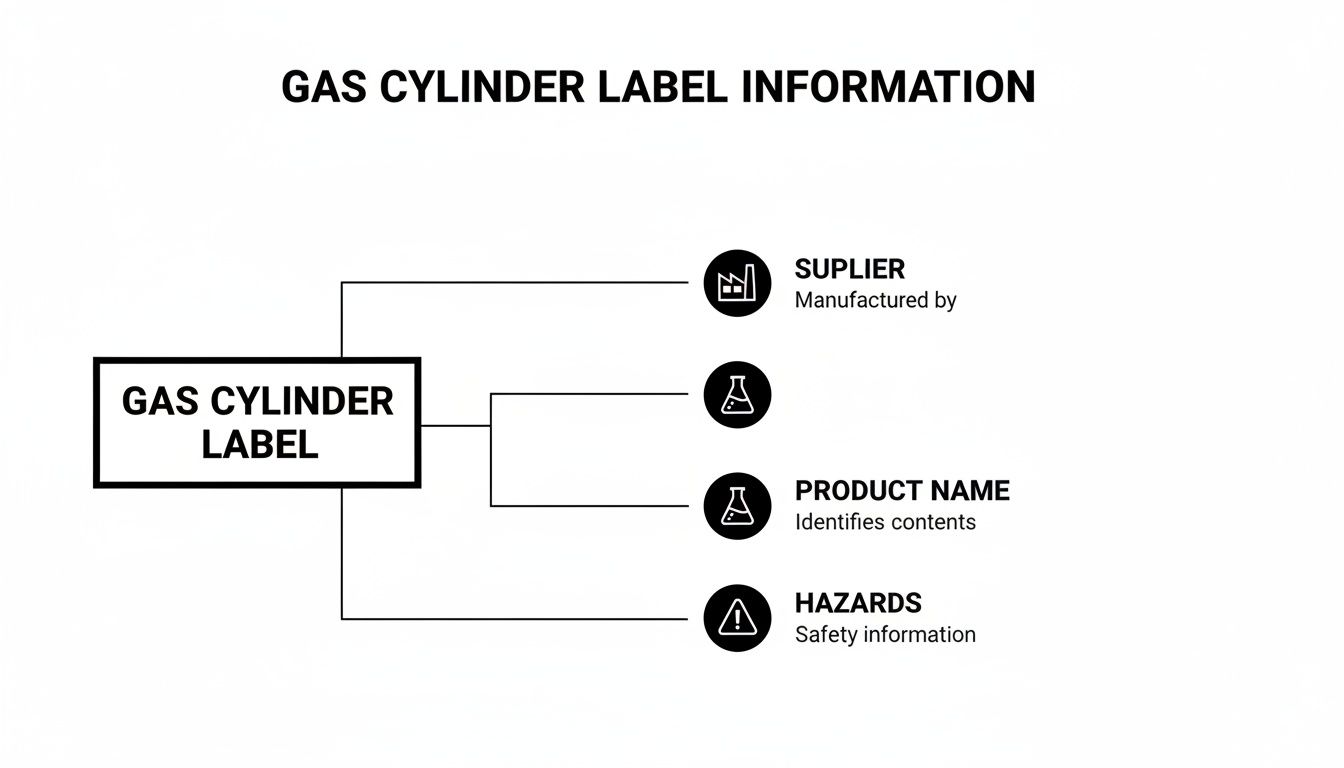
As you can see, the supplier's information, the product name, and its specific hazards all come together to form a complete safety profile. To dive even deeper into this topic, check out our detailed guide on the colour coding of gas cylinders.
While there are many specific colour combinations for mixtures, a few key colours cover the most common gases you're likely to encounter. Learning these is a fundamental step in mastering the Kennzeichnung von Gasflaschen.
Here’s a quick summary of the most common ones you’ll see.
| Shoulder Colour | Gas Property / Hazard | Example Gases |
|---|---|---|
| Yellow (RAL 1018) | Toxic and/or Corrosive | Ammonia, Chlorine |
| Red (RAL 3000) | Flammable | Hydrogen, Methane, Propane |
| Light Blue (RAL 5012) | Oxidising | Oxygen, Nitrous Oxide |
| Bright Green (RAL 6018) | Inert (Asphyxiant) | Argon, Nitrogen, Helium |
| Maroon (RAL 3007) | Acetylene (Highly Flammable) | Acetylene |
| Brown (RAL 8008) | Helium | Helium |
| Black (RAL 9005) | Nitrogen | Nitrogen |
| White (RAL 9010) | Oxygen (Medical/Technical) | Oxygen |
For gas mixtures, the shoulder is often marked with colours representing the individual components, though the primary hazard's colour should always be visible. For example, a non-flammable, non-toxic breathing gas mixture would have a shoulder indicating both oxygen (oxidising) and an inert gas.
Understanding these core colours is the first step to ensuring every interaction with a gas cylinder starts with a clear and immediate awareness of its potential dangers.
While colourful labels and shoulder rings give you a quick heads-up about the hazards, it’s the permanent, stamped markings on a gas cylinder’s shoulder that tell its complete life story. Think of these engravings not as random numbers, but as the cylinder's official birth certificate and service record, etched right into the steel or aluminium. Understanding this part of the Kennzeichnung von Gasflaschen is absolutely fundamental to verifying a cylinder's safety, compliance, and structural integrity.
These markings are indelible proof that the vessel was built to exacting standards and has passed its rigorous periodic inspections. For anyone managing a gas inventory, from a small workshop to a large industrial facility, knowing how to read these stamps is a non-negotiable skill. It’s how you confirm a cylinder is legally fit for service before it even comes through your door.
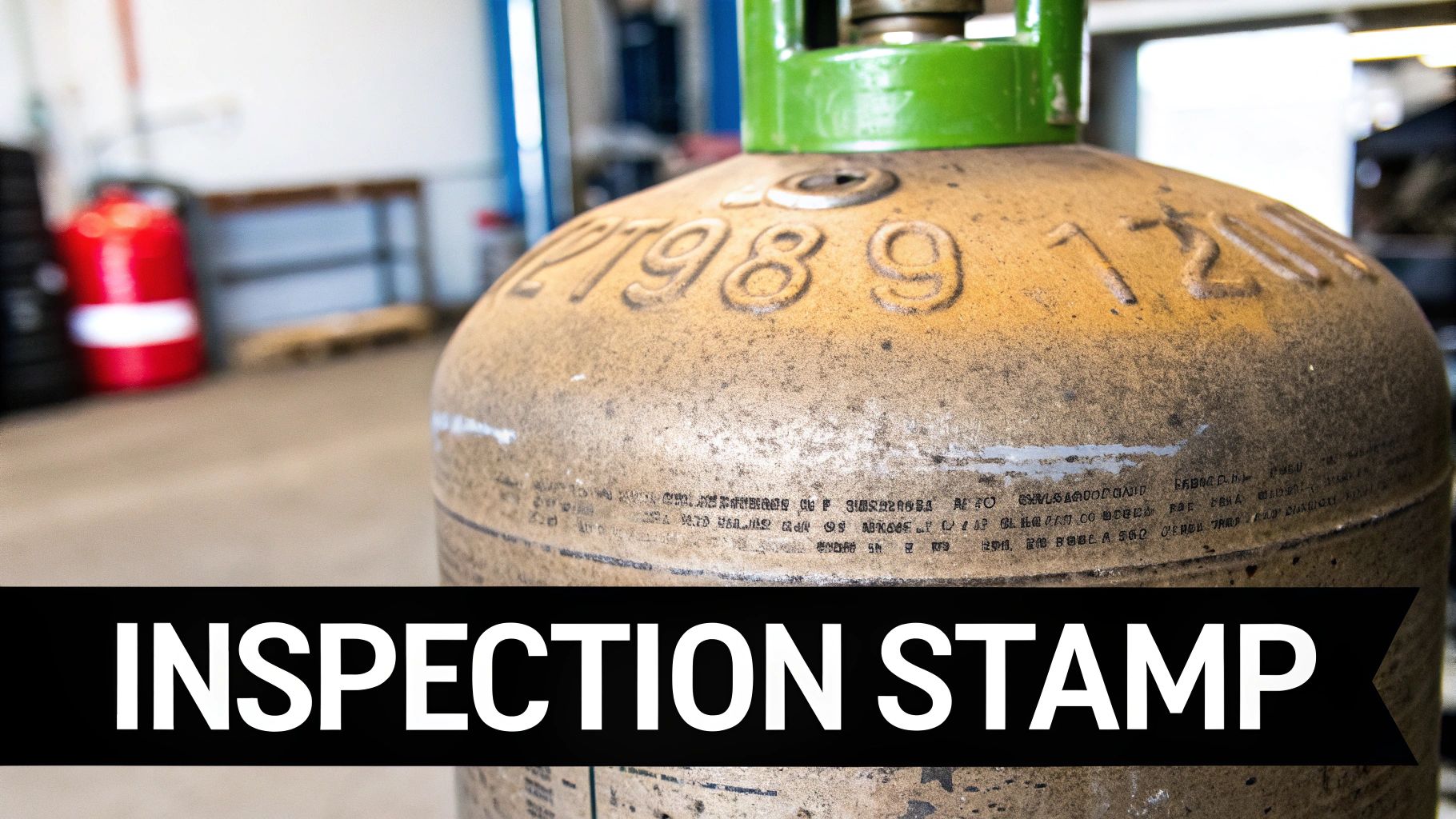
Unlike a paper label that can fade, peel, or get torn off, these markings are designed to last the entire lifespan of the cylinder, providing a permanent, traceable history. When you inspect the shoulder, you’ll find a series of codes that reveal a surprising amount of detail.
Here’s what you should be looking for:
This information creates a complete technical profile, ensuring the cylinder is only used within its designated safety limits. It’s the foundational data for every subsequent inspection and fill.
Perhaps the single most critical marking to find is the date of the last periodic inspection, which is always accompanied by the stamp of the approved inspection authority. This is your guarantee that the cylinder has been professionally checked and is safe to continue holding high-pressure gas. A cylinder without a valid, in-date inspection stamp is not legally compliant and must never be filled or used.
In Germany, the system for marking gas cylinders is tightly regulated, with bodies like the Technischer Überwachungs-Verein (TÜV) playing a central role for decades. In fact, there are over 150 distinct control marks from various approved German inspection authorities. These stamps, often featuring unique symbols like a hammer, provide an unbroken chain of accountability. For businesses like Cryonos GmbH, which supplies liquid nitrogen vessels for biobanks and cell therapy labs, recognising these marks is vital. It’s how we ensure ADR-compliant transport and maintain the integrity of highly sensitive biological samples. Proper vessel integrity, verified by these stamps, can cut evaporation risks by up to 20%, safeguarding incredibly valuable materials. You can explore a comprehensive EIGA catalogue to see the history of these inspection marks.
The inspection stamp is the ultimate seal of approval. It confirms that an expert has assessed the cylinder for corrosion, dents, and other defects, certifying it as safe for continued service until the next inspection is due.
The inspection mark will clearly show the date of the last test, usually in a month and year format. The time you have until the next inspection is due depends on the type of gas and the cylinder's material, but for many common industrial gases, the interval is 10 years.
Calculating the next due date is straightforward: just add the required inspection interval to the last stamped date.
For instance, a cylinder last tested in 05/2020 with a 10-year interval must be re-tested by May 2030. Any cylinder that is approaching or has passed its due date must be taken out of service immediately. Mastering this simple check is an essential part of maintaining a safe and compliant gas inventory, protecting both your people and your equipment from the serious risks of a compromised cylinder.
Stepping into the world of gas cylinders means getting familiar with their markings, and it’s natural to have a few questions. When you're dealing with something as critical as Kennzeichnung von Gasflaschen (gas cylinder labelling), clarity is key.
This section is designed to be your quick-reference guide. We’ll tackle some of the most common queries we hear, clearing up confusion and reinforcing the best practices for keeping everyone safe.
While every single mark on a cylinder has a purpose, the one you absolutely cannot ignore is the label identifying the gas inside. Think of it as the foundation for everything else. Get this wrong, and you could grab the wrong regulator, store incompatible gases next to each other, or create a truly dangerous situation.
A very close second is the last periodic inspection date, which is physically stamped into the cylinder's shoulder. This date, along with the inspector's official mark, is your only guarantee that the cylinder is structurally sound and safe to hold its contents under immense pressure. If that date is in the past, the cylinder is out of service. No exceptions.
This is a classic source of confusion, but the answer is simple once you know where to look. The EN 1089-3 standard is only concerned with the shoulder colour—that’s the curved, dome-shaped top part of the cylinder. This colour tells you the primary hazard of the gas. For instance, a red shoulder is a universal sign for a flammable gas.
The colour of the main body of the cylinder, on the other hand, is not standardised across the industry. Gas suppliers often use body colours for their own branding. One company might paint all its cylinders grey, while another prefers white.
The bottom line is this: Always trust the shoulder colour for hazard identification, not the body colour. The body colour tells you nothing reliable about what's inside.
If you come across a cylinder with a label that's missing, torn, or just too faded to read, you have to treat it as an unknown. And "unknown" in the world of compressed gases means "potentially very dangerous." Don't ever try to guess the contents based on the cylinder's size, shape, or colour.
Instead, follow these critical steps immediately:
Never take a chance on an unidentified cylinder. It's just not worth the risk. Always let your supplier handle it.
Inspection intervals aren't one-size-fits-all; they depend on the type of gas, what the cylinder is made of (steel or aluminium), and national rules. That said, for most common industrial gas cylinders here in Germany and across the EU, the standard interval is 10 years.
Some specific cases demand more frequent checks. Cylinders holding corrosive gases, for example, might need to be inspected every 2 to 5 years. The definitive answer is always stamped right there on the cylinder's shoulder. It's a fundamental part of your responsibility to check this date before you accept or use any cylinder. Gaining a better understanding of the different types of gas in cylinders can also help make sense of why these schedules vary.
Absolutely not. Trying to fill a cylinder that's past its inspection due date is not only illegal, but it's also incredibly dangerous. The whole point of the periodic inspection is to find hidden defects like internal corrosion, tiny cracks, or metal fatigue that could cause the cylinder to fail catastrophically under pressure.
Filling an expired cylinder is like driving a car with failed brakes—you're skipping a vital safety check. Any reputable gas supplier will flat-out refuse to fill a cylinder that isn't in date. If you have an expired cylinder, the only correct course of action is to send it to a certified facility to be properly tested and re-stamped before it can be put back into service.
At Cryonos GmbH, we know that handling gases safely and in full compliance with regulations is non-negotiable, particularly when you're working with precious biological samples or high-purity industrial processes. Our entire range of cryogenic storage and transport equipment is engineered to meet the most stringent safety standards, protecting your team and the integrity of your work. See our cutting-edge cryogenic solutions at https://www.cryonos.shop.

