No Products in the Cart




If you’ve ever worked in a high-throughput lab, you know the challenge: you have hundreds, sometimes thousands, of samples to analyse, and you need data that is fast, accurate, and reliable. This is where a microplate reader from Tecan becomes an indispensable part of your workflow.
Think of it as a high-speed scanner for molecular biology. It takes invisible biological reactions happening in tiny wells and translates them into hard, measurable data. These instruments are the workhorses in fields stretching from drug discovery to clinical diagnostics.
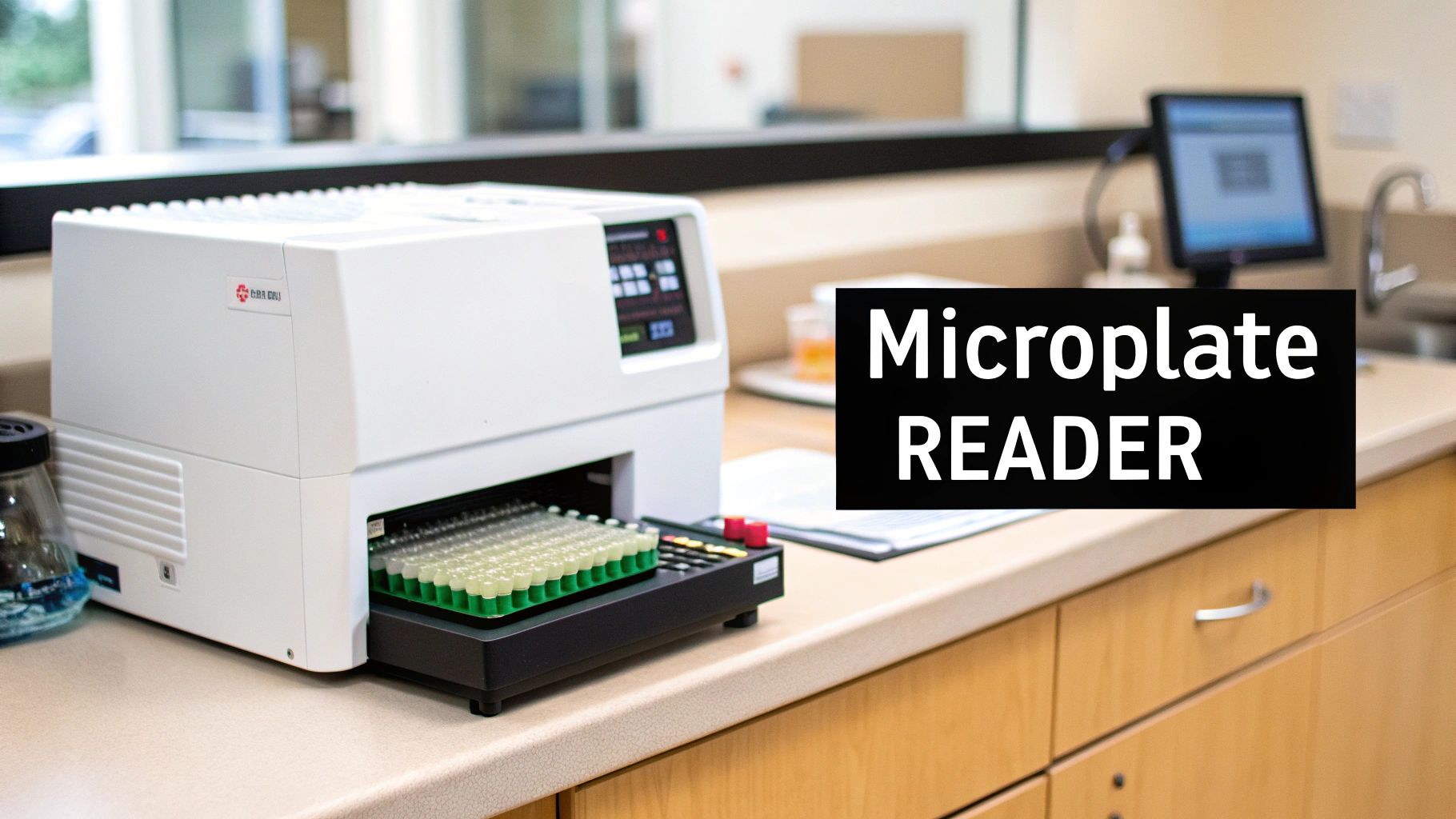
At its heart, a Tecan microplate reader is a sophisticated tool that automates the detection and quantification of light signals from samples in a microplate. Imagine trying to measure the colour change in 96 tiny test tubes just by eye—it would be painfully slow, completely subjective, and riddled with errors. A Tecan reader does the same job in seconds with incredible precision.
This is exactly why they are so crucial for modern research. Scientists need to analyse huge numbers of samples at once, and these readers make it possible. The instrument shines light of a specific wavelength into each well and then measures what happens next. Does the sample absorb the light? Does it emit new light in response? Or does it generate its own light through a chemical reaction?
This simple principle—measuring light—is the foundation for a massive range of scientific applications. By turning biological and chemical events into numerical data, these readers empower researchers to answer critical questions.
The core functions of a microplate reader tecan instrument really boil down to a few key tasks:
This versatility has made Tecan readers a cornerstone technology in academic labs, pharmaceutical companies, and clinical settings across the globe.
The global market for these instruments is competitive but also quite concentrated. Industry reports show that Tecan, along with giants like Thermo Fisher Scientific and PerkinElmer, commands over 45% of the global microplate reader market.
Tecan’s strong market position is especially clear in major European research hubs. The European microplate reader market was valued at roughly USD 154.66 million in 2023, with significant growth projected. Germany, a powerhouse in biotech and pharma, accounted for about 15% of that market alone.
In a critical region like this, Tecan’s reputation for innovation and sheer reliability makes their instruments highly sought after. You can read more about the European microplate reader market projections and key players to get a better sense of the landscape.
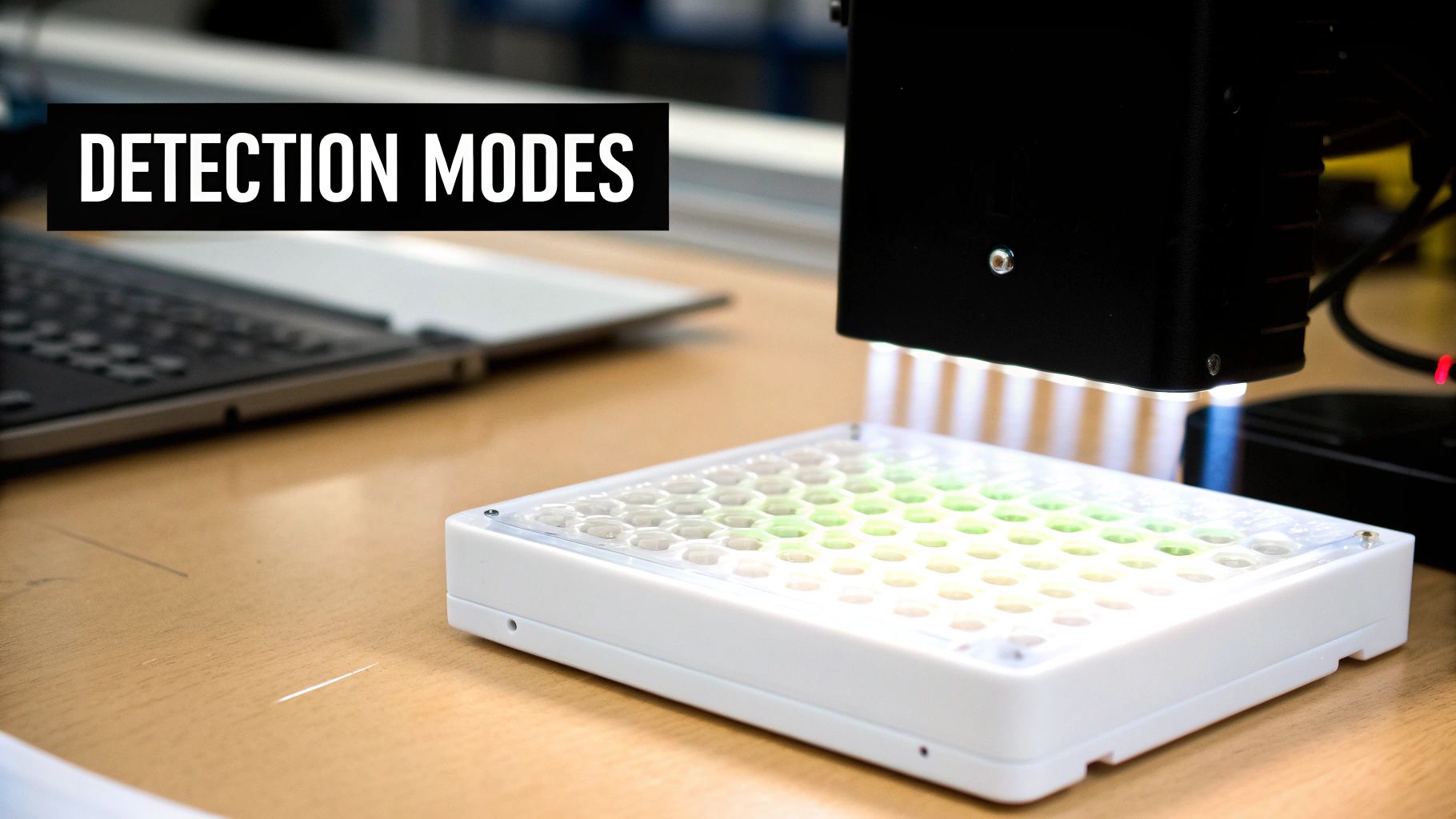
At the heart of every microplate reader from Tecan lies a set of powerful technologies designed to make sense of the invisible world inside each well. These instruments don't just "look" at samples; they measure incredibly specific interactions with light, turning biology into numbers. Getting your head around these fundamental detection modes is the first step to truly mastering your reader.
It helps to think of these modes as different tools in a toolbox—like having various flashlights and specialised cameras, each built to capture a unique type of information. When you pick the right one, you can translate complex biological events into clean, quantifiable data. The three workhorses of the lab are Absorbance, Fluorescence, and Luminescence.
Each method is suited to answering a different scientific question, which is what makes a multi-mode Tecan reader such a flexible and essential instrument for any modern lab.
Absorbance is probably the most straightforward detection method you'll come across. Picture shining a light through a glass of coloured liquid—the darker the liquid, the less light gets through to the other side. A Tecan reader in absorbance mode does exactly that, measuring how much light a sample blocks or absorbs.
This technique is a classic for figuring out the concentration of a substance. For instance, labs all over the world use absorbance at a specific wavelength (260 nm) to quantify the amount of DNA or RNA they've extracted. It's a foundational measurement that kicks off countless genetic and molecular biology workflows.
Fluorescence is a much more sensitive technique that relies on a two-step light show. Think of it like a fluorescent poster glowing under a blacklight. First, the reader hits the sample with a specific wavelength of light (the blacklight), which "excites" certain molecules, called fluorophores, making them absorb that energy.
Then, these excited molecules instantly release that energy by emitting light at a different, longer wavelength—that's the glow from the poster. The reader is set up to measure only this emitted light, which is directly proportional to how much of your target molecule is present. This approach is perfect for low-concentration samples and is the backbone of cell health assays, immunoassays, and reporter gene studies.
A key advantage of fluorescence is its high specificity and sensitivity. By choosing specific fluorescent dyes that bind only to the molecule of interest, scientists can accurately measure targets even in complex biological mixtures.
Luminescence is unique because, unlike the other modes, it doesn't need an external light source to kick things off. Instead, it measures light that is produced naturally by a chemical or biological reaction happening right inside the well.
The best analogy is a firefly's glow. The reader essentially becomes an extremely sensitive light detector, just waiting to capture the faint photons generated by the reaction. This makes it one of the most sensitive detection methods available, hands down. Luminescence is the go-to technique for things like reporter assays using luciferase and certain enzyme activity assays where even the tiniest glimmer of light is significant.
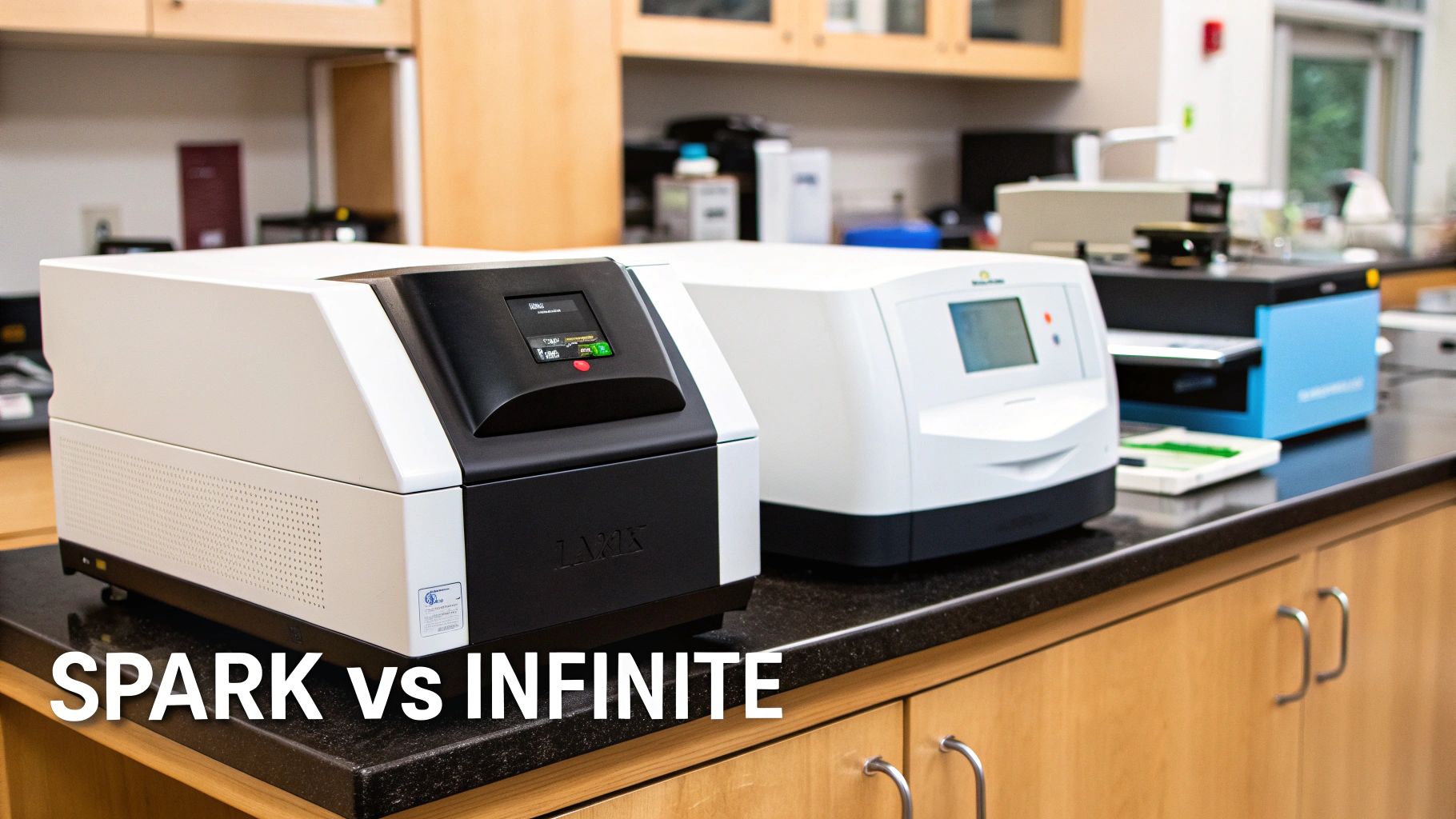
When you’re looking at getting a microplate reader from Tecan, the choice usually boils down to two of their flagship lines: Spark and Infinite. Both are exceptional machines, but they’re engineered to solve very different problems in the lab. The question isn't about which one is "better" — it's about finding the perfect tool for your specific research.
Think of the Tecan Spark series as the agile innovator, built for complex and cutting-edge research. It’s the go-to instrument for any lab working with cell-based assays, where keeping live cells happy and viable is paramount. With integrated features like temperature and gas control, it essentially becomes a self-contained lab environment for your microplates.
On the other hand, the Tecan Infinite series is the lab’s dependable workhorse. It’s built for one thing above all else: pure speed and rock-solid reliability. This makes it the champion of high-throughput screening (HTS) and routine quantitative assays. If your daily grind involves churning through stacks of plates without sacrificing an ounce of data quality, the Infinite was made for you.
So, what matters more to you? Is it the flexibility to tackle complex biological questions, or the streamlined efficiency needed for large-scale analysis?
The Spark series shines with its modular design and advanced capabilities like cell imaging and real-time monitoring. This makes it an invaluable partner for researchers developing novel assays or studying intricate cellular dynamics over time. You can adapt it as your research evolves.
The Infinite series, in contrast, is optimised for established, high-volume workflows. Its robust engineering guarantees consistent performance, day in and day out. That’s a non-negotiable requirement in diagnostic labs and quality control environments where reproducibility is everything.
This choice reflects a broader trend. In Germany, where the microplate reader market hit an estimated USD 23.65 million in 2024, many labs still rely on dedicated single-mode readers for routine work. However, the real growth is in multi-mode systems like the Spark, as more labs look to consolidate their workflows onto a single, powerful platform. You can read more about the growth of multi-mode readers in the global market on Grand View Research.
To put it all into perspective, let’s compare the core strengths and typical homes for each series. This table should help you match your lab's primary needs with the right Tecan instrument.
| Feature | Tecan Spark Series | Tecan Infinite Series |
|---|---|---|
| Primary Focus | Advanced research & assay development, especially live-cell work. | High-throughput screening (HTS) & routine quantitative assays. |
| Key Strengths | High modularity, integrated cell imaging, & environmental controls. | Exceptional speed, precision, & robust reliability for large batches. |
| Best For | Labs studying cell biology, genomics, & complex biological pathways. | Pharmaceutical screening, clinical diagnostics, & core lab facilities. |
| Modularity | Highly customisable with upgrades for new detection modes & features. | Focused on core detection modes with options for injectors & stackers. |
Ultimately, whether you choose the Spark or the Infinite comes down to your lab's mission. The Spark is your discovery engine, while the Infinite is your production powerhouse.
Technical specifications only tell you so much. The real story of a Tecan microplate reader unfolds in the lab, where it becomes the engine driving daily scientific breakthroughs. These instruments are far more than just machines; they're the bridge between complex biological questions and the clear, actionable data needed to answer them.
From pharmaceutical giants hunting for the next blockbuster drug to pioneering academic labs, researchers count on Tecan readers to solve tough problems. Whether it's screening thousands of compounds or watching the delicate dance of living cells, these readers deliver the speed and precision that science demands.
In the high-stakes game of pharmaceutical research, time is money. Labs often have to sift through enormous libraries—sometimes containing tens of thousands of chemical compounds—just to find a single promising candidate. This is where a Tecan reader, especially a workhorse from the Infinite series, proves its worth.
By automating the whole detection process, these instruments can chew through thousands of samples in a tiny fraction of the time it would take by hand. This high-throughput screening (HTS) capability lets scientists quickly spot the "hits"—those rare compounds showing the desired biological effect—and fast-track them into the development pipeline.
A Tecan reader can process a 384-well plate in just minutes, generating vast datasets that would be impossible to gather manually. This efficiency radically shortens the initial discovery phase, saving precious time and resources.
Modern genomics is built on a foundation of incredibly precise measurements. Before you can even think about sequencing a genome or running a PCR experiment, you have to know exactly how much DNA or RNA you're starting with. One small slip-up in quantification can send an entire experiment down the drain.
Tecan readers provide the rock-solid accuracy needed for these critical steps. Using simple absorbance-based methods, a scientist can quickly nail down the concentration and purity of their nucleic acids. This guarantees that downstream applications, which are incredibly sensitive to the starting amounts of genetic material, actually work. To see how this fits into the bigger picture, you can learn more about the vital role of PCR reaction tubes in this workflow. It's a simple but fundamental step that underpins so much of molecular biology.
Studying living cells is a whole different ballgame. You can't just measure them on a benchtop; you have to observe them in an environment that carefully mimics the conditions inside the human body. The Tecan Spark series was built from the ground up for exactly this challenge, with integrated controls for temperature, humidity, and atmospheric gases.
This lets researchers run long-term, live-cell assays where they can monitor processes like cell growth, death (apoptosis), and responses to different stimuli in real time. For example, a cancer lab could treat tumour cells with a new drug and watch over hours or even days to see if it successfully halts their proliferation—all from within the perfectly controlled environment of the reader.
Picking a new microplate reader from Tecan is a big deal. It’s an investment that will shape what your lab can achieve for years to come. The trick is to think beyond your current project list and choose an instrument that can grow with your research. Start by mapping out your must-have assays—both what you’re running today and what’s on the roadmap for tomorrow.
This kind of forward-thinking stops you from outgrowing your new kit in a year. You'll want to focus on a few core criteria that really define the user experience and, most importantly, the quality of your data. Think of it as a checklist to match your lab’s unique needs with the right Tecan system, preventing future headaches and making sure it's money well spent.
This decision tree gives you a visual on how your main research goal—whether that's drug discovery, genomics, or cell biology—points you toward specific features in a reader.
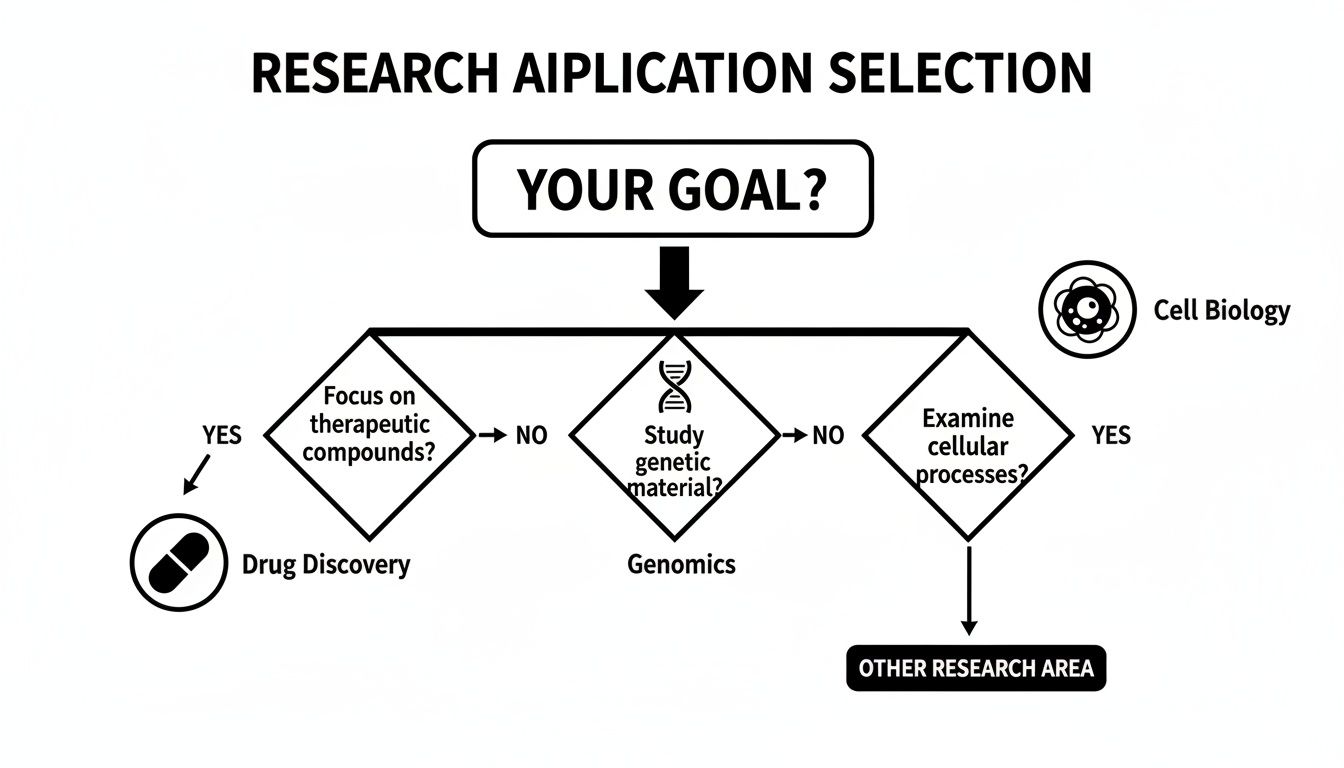
As you can see, a lab focused on drug discovery will lean heavily towards high throughput, while a cell biology lab needs precise environmental controls. These different priorities will guide you to very different models.
When you’re weighing up your options, three things usually rise to the top: sensitivity, throughput, and modularity. Each one tackles a different part of your lab’s day-to-day work and long-term ambitions.
Don’t just look at the hardware; consider the whole package. The software needs to be intuitive, and the instrument must play nicely with your existing Laboratory Information Management Systems (LIMS) and automation platforms to create a truly seamless workflow.
A Tecan reader rarely works in isolation. It’s usually part of a much larger ecosystem of lab equipment. Its ability to communicate with robotic arms, liquid handlers, and incubators is what makes a fully automated workflow possible. This is particularly critical for labs juggling huge sample volumes, where every manual step is a potential source of error and a massive time sink.
What's more, tying your reader into your sample management systems is key for data integrity, all the way from storage to final analysis. Many modern labs are built around meticulously organised sample archives. The role of the ultralow temperature freezer, for instance, is vital in keeping those samples viable before they ever see the inside of a reader. By planning for this kind of integration from the start, you build a robust, end-to-end process that boosts both your efficiency and the reliability of your data.
Bringing a microplate reader from Tecan into your lab is more than just a purchase; it's the beginning of a long-term partnership. To truly get the most out of this significant investment, you need to think beyond the initial price tag right from day one. It's smart to have conversations upfront about service contracts, software licences, and support packages that will keep your instrument running at peak performance for years to come.
Think of it this way: proactive maintenance is non-negotiable. It's the simple, consistent care that prevents a minor hiccup from snowballing into a major downtime event. This foundation of good upkeep is what transforms your reader from a piece of equipment into a reliable, powerhouse source of high-quality scientific data.
Regular maintenance and validation are the two pillars supporting reproducible, trustworthy science. These aren't just boxes to tick on a checklist; they're the essential practices that guarantee your results are solid. This is especially true in regulated fields like clinical diagnostics or pharmaceutical QC, where there's zero room for error.
Getting into a consistent rhythm with these tasks is key:
Think of validation not as a one-time event, but as an ongoing conversation with your instrument. It’s how you confirm it's still performing to the high standards you require for your research. Consistent quality control is your best insurance against questionable data.
This commitment is backed by Tecan’s considerable global presence. For example, in 2024, the company's worldwide sales of CHF 934 million help fund a solid service network in major markets. In Germany alone, the demand for microplate readers is projected to more than double by 2035. You can discover more about Tecan's operational resilience and market footing on their site.
Finally, don't forget the instrument's environment. Ensuring stability with supporting equipment, like a quality orbital shaker for your laboratory for consistent sample prep, plays a huge role in overall data quality. When you pair diligent maintenance with a stable lab setup, you're setting your Tecan reader up to deliver accurate, reliable results for years.
Even after getting a feel for the technology, a few practical questions always pop up when it's time to choose or start using a new instrument. This section dives into some of the most common things labs ask, giving you straight-up answers to help you sort through your options and get the most out of your microplate reader tecan system.
We've pulled these questions from the real-world sticking points we see labs run into, from figuring out the actual differences between models to planning for long-term care and automation.
Honestly, the best reader is the one that’s a perfect match for your science. If your lab is running a high volume of established protocols like ELISAs or nucleic acid quantification, the Tecan Infinite series is a real workhorse. It's often the top pick because it’s fast, reliable, and just gets the job done efficiently.
On the other hand, if your work is more about complex live-cell studies, developing new assays, or if you need advanced capabilities like imaging and tight environmental control, then the Tecan Spark series is built for you. Its modular design means you can adapt the instrument as your research evolves, which is a massive plus.
To keep your performance steady and your data accurate, Tecan generally recommends a preventative maintenance service at least once per year. Think of it as a crucial annual check-up. A qualified technician will maintain the instrument's calibration, give the sensitive optical components a deep clean, and spot potential problems before they ever lead to downtime.
Of course, if your lab is working under stricter regulatory guidelines like GLP or GMP, you might find that more frequent validation and servicing are needed to stay compliant.
Preventative maintenance is really just an insurance policy for your data. A small, scheduled investment in upkeep prevents costly delays and ensures your results remain reliable and reproducible over the instrument's entire lifespan.
Absolutely. Automation is baked into the design of both the Spark and Infinite series. They can be smoothly integrated with robotic arms, plate stackers, and liquid handlers to create a fully automated, walk-away workflow. This is a game-changer in high-throughput settings where loading plates by hand can quickly become a serious bottleneck.
Tecan's software is also built to talk to other lab automation systems. This allows the reader to act as a central hub in a bigger, interconnected process. Not only does this crank up your throughput, but it also dramatically cuts down on the risk of manual handling errors, leading to more consistent, trustworthy data.
At Cryonos GmbH, we know that groundbreaking research relies on a seamless workflow, from the moment a sample is stored to the final data point. Our state-of-the-art cryogenic solutions ensure your priceless biological samples are perfectly preserved, ready for analysis on high-performance instruments like a Tecan reader. Explore our comprehensive range of cryogenic storage and transport solutions to build a reliable foundation for your lab's success at https://www.cryonos.shop.

