No Products in the Cart




When you hear "carbon dioxide," you probably think of a waste product—something we exhale, or a gas contributing to climate change. But in the world of science and industry, CO₂ is an indispensable raw material, a true workhorse. The Verwendung von Kohlenstoffdioxid (use of carbon dioxide) is surprisingly diverse, from giving your favourite soda its fizz to enabling the ultra-cold storage that biobanks depend on.
For anyone working in these fields, a deep understanding of CO₂'s roles isn't just academic; it's a practical necessity.
The secret to carbon dioxide's versatility lies in its unique properties. It’s not just an atmospheric gas; it's a resource we can easily manage as a solid, liquid, or gas. Each state unlocks a different set of industrial superpowers. For professionals in cryogenic logistics, lab management, or industrial gas supply, mastering these applications is crucial for hitting targets in efficiency, safety, and innovation.
This guide isn't just a list. We'll connect the dots, showing you the "why" behind the "what." For example, we'll look at how its inert nature makes it a perfect protective blanket in welding and food packaging, stopping the oxidation that ruins products and weakens materials. We’ll also dive into its incredible cooling power as dry ice, which has become the backbone of cold-chain logistics for shipping sensitive pharmaceuticals and biological samples.
To give you a clearer picture, let's take a quick look at the main applications for carbon dioxide across various industries. The following table summarises where and how this versatile gas is put to work.
| Application Area | Primary Use | Typical CO₂ State (Gas, Liquid, Solid) | Key Industries |
|---|---|---|---|
| Food & Beverage | Carbonation, Modified Atmosphere Packaging (MAP) | Gas, Liquid | Beverage Production, Food Processing |
| Cryogenics & Refrigeration | Portable, residue-free cooling for transport | Solid (Dry Ice) | Pharmaceuticals, Biobanking, Logistics |
| Industrial Processes | Shielding gas, chemical feedstock, solvent | Gas, Liquid, Supercritical | Welding, Chemical Manufacturing, Food Tech |
| Medical & Laboratory | Surgical insufflation, cell culture pH control | Gas | Healthcare, Biotechnology, Research |
As you can see, the state of the CO₂—whether it's a gas, a dense liquid, or a super-cold solid—is what determines its ideal application.
Understanding these distinct uses allows organisations to better manage their supply chains, stay on top of regulatory compliance, and fine-tune their operational costs. The journey of CO₂ from a captured byproduct to a high-value industrial gas is a real testament to clever chemical engineering and logistical precision.
Think of this guide as your roadmap. We’ll connect the scientific principles of carbon dioxide to the real-world challenges and solutions that define its use today, covering everything from its core properties and handling protocols to the specific applications that are pushing industries forward.
To really get a grip on the diverse uses of carbon dioxide, we first need to dive into its core chemical and physical traits. These aren't just details for a textbook; they are the very reasons CO2 is so incredibly useful in everything from preserving food to fighting fires. Each characteristic is a key that unlocks a specific industrial application.
Think of carbon dioxide not just as a gas, but as a multi-tool with a unique set of features. How it behaves under different pressures and temperatures is what makes it so brilliantly adaptable.
One of the most practical properties of CO2 is its sheer weight. As a gas, carbon dioxide is roughly 1.5 times heavier than air. Picture pouring oil into water; the denser liquid sinks right to the bottom. It’s the same principle when CO2 is released from a fire extinguisher. It sinks, pushes the lighter oxygen gas up and out of the way, and effectively smothers the flames by cutting off their life source.
This "heavier than air" quality is absolutely fundamental to its role in fire suppression systems.
On top of that, CO2 is an inert gas. This simply means it doesn't like to react with other substances, which makes it a fantastic protective agent. In welding, for instance, it forms a stable, non-reactive shield around the molten metal. This keeps oxygen from getting in and contaminating the weld, which would create weak spots. The exact same property is at play in food packaging, where it displaces oxygen to keep products fresh and prevent spoilage.
Perhaps the most fascinating thing about carbon dioxide is how it changes states. Most substances we know go from solid to liquid to gas when you heat them up. But CO2 has a special trick up its sleeve.
Under normal atmospheric pressure, solid CO2—what we all know as dry ice—skips the liquid phase entirely and turns directly into a gas. This cool process is called sublimation.
This unique trait is the cornerstone of its use in cryogenics. Because it leaves no liquid residue, dry ice is the perfect refrigerant for shipping sensitive biological samples, pharmaceuticals, and gourmet foods. You get all the cold without the mess and water damage you'd get from traditional ice.
The following infographic gives a great overview of the major application areas that stem from these unique properties.
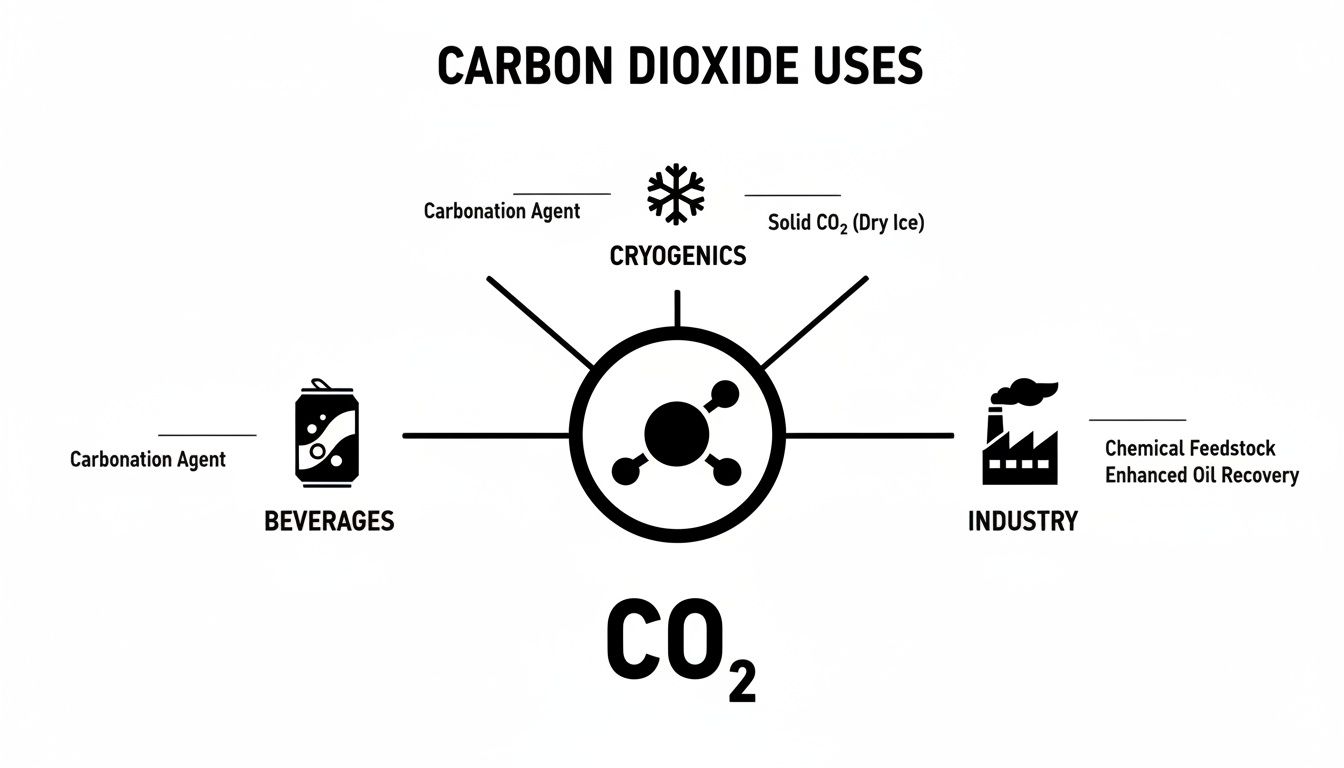
This visual really brings home how CO2's core properties enable its wide use across beverages, cryogenics, and other industrial sectors.
The reason CO2 behaves this way all comes down to its "triple point." The triple point is a very specific combination of temperature and pressure where a substance can exist as a solid, liquid, and gas all at the same time.
This relationship between pressure and state is absolutely critical for its safe storage and transport. Liquid CO2, for example, is kept at high pressures (above 5.1 atmospheres) in specially designed tanks. For anyone handling pressurised gas cylinders or managing cryogenic logistics, understanding these principles is essential for ensuring both safety and operational efficiency. Now, let's look at how these properties translate into specific applications, starting with cryogenics.
When you think about the many uses of carbon dioxide, its role in cryogenic cooling and refrigeration is probably one of the most visible and impressive. This is where CO₂ shifts from being an invisible gas to a potent, portable cooling agent in its solid form: dry ice.
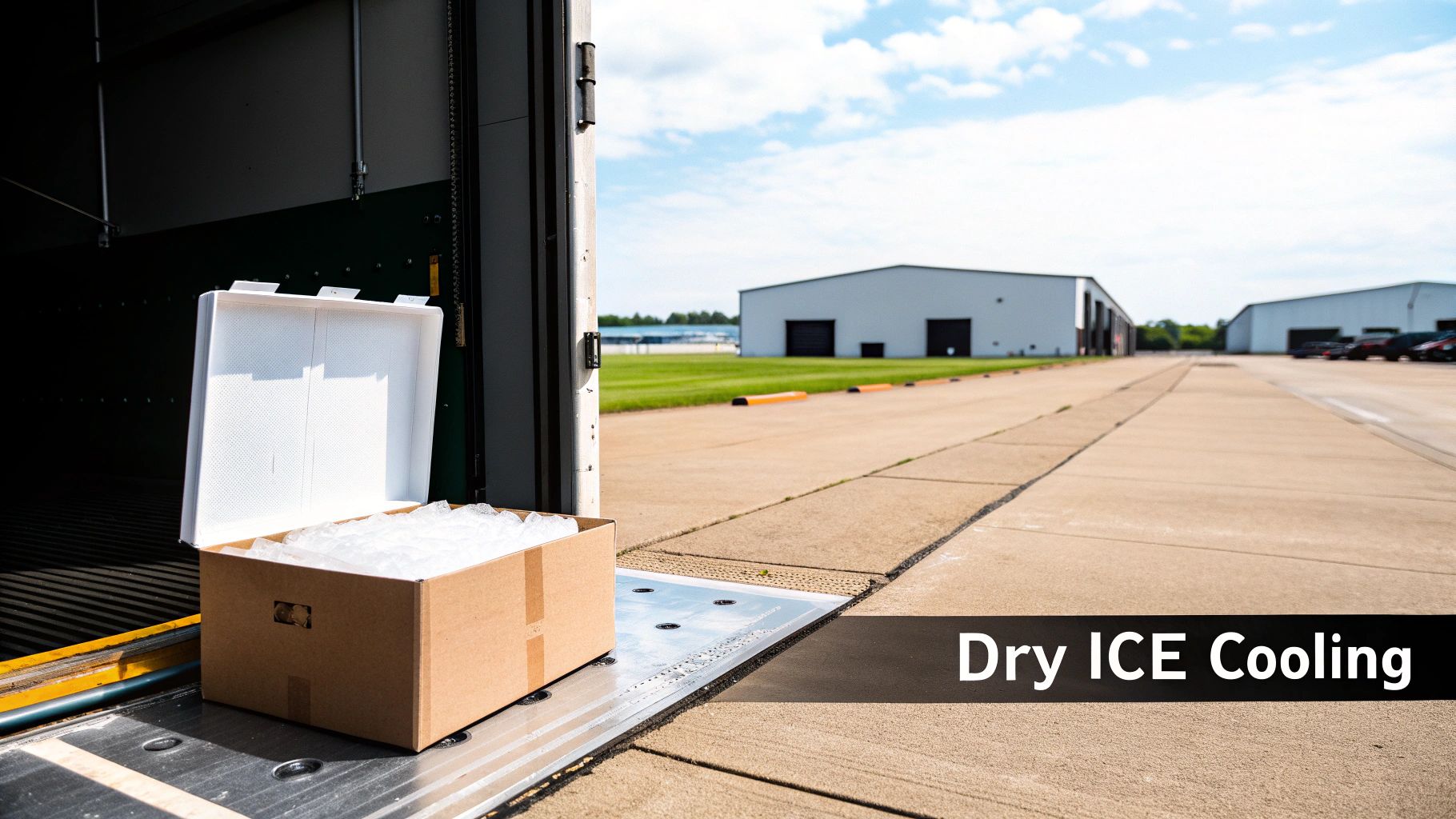
Dry ice is simply carbon dioxide frozen solid. What makes it so incredibly useful is a unique property called sublimation. At a bone-chilling -78.5°C (-109.3°F), it changes directly from a solid into a gas, skipping the liquid phase entirely. This single characteristic is its superpower in the world of cold chain logistics.
Imagine you're shipping a temperature-critical vaccine or precious biological samples. Regular water ice would eventually melt, creating a watery mess that could soak through packaging, ruin labels, and compromise the shipment. Dry ice neatly sidesteps all of that, delivering intense cold with zero liquid residue.
For anyone in logistics or running a biobank, this clean, residue-free cooling is a massive advantage. It means sensitive materials show up at their destination in perfect condition, maintaining both their physical integrity and temperature stability from start to finish. That "smoke" you see billowing off dry ice isn't actually smoke; it's the cold CO₂ gas mixing with moisture in the air, a constant visual reminder of its powerful cooling in action.
This makes dry ice the go-to solution for several critical sectors:
The real beauty of dry ice is its ability to pack a huge cooling punch into a small, lightweight package. It delivers more than double the cooling energy per kilogramme compared to water ice, making it incredibly efficient for air and ground transport where every bit of weight matters.
This efficiency is paramount for maintaining an unbroken cold chain. A single temperature fluctuation, even a brief one, can ruin an entire shipment of life-saving medicine or invaluable research samples. If you want to dive deeper into the science behind this, you can learn more about CO₂ as a refrigerant in our detailed article.
While big refrigerated trucks (often called "reefers") are the workhorses of large-scale cold transport, they aren't always the right tool for the job. They need a constant power supply, they can suffer mechanical breakdowns, and they're just not practical for small, last-mile deliveries or individual packages.
This is where dry ice really shines. It's a passive, self-contained cooling system that perfectly fills the gaps where mechanical refrigeration isn't feasible. Think about the complexity of sending individual biological samples to different labs all over the country. Using a separate refrigerated vehicle for each one would be a logistical and financial nightmare.
Instead, a well-insulated box packed with the correct amount of dry ice offers a reliable and affordable way to keep everything at the right temperature for days on end.
Let's break down the comparison:
| Feature | Dry Ice (Solid CO₂) | Mechanical Refrigeration |
|---|---|---|
| Power Source | None required (passive cooling) | Continuous power needed (fuel, electricity) |
| Portability | Excellent for small to medium packages | Best for large, bulk shipments (trucks) |
| Residue | None; sublimates into a harmless gas | Risk of condensation or fluid leaks |
| Failure Risk | Predictable sublimation rate | Potential for mechanical or electrical failure |
| Use Case | Last-mile delivery, sample transport | Long-haul freight, large-scale distribution |
At the end of the day, it's not a question of which is better. Dry ice and mechanical refrigeration are complementary technologies in the cold chain toolkit. Dry ice provides a flexible, powerful option for those specific jobs that demand portability and residue-free cooling, cementing its essential role in modern logistics.
When we think of CO₂, cryogenic cooling often comes to mind, but its role in industry goes much, much deeper. In the world of manufacturing and heavy industry, carbon dioxide is a real workhorse. It’s used as a raw material, a critical agent in complex processes, and a way to boost performance across the board. Its unique properties make it a quiet cornerstone of countless processes that define our modern world.
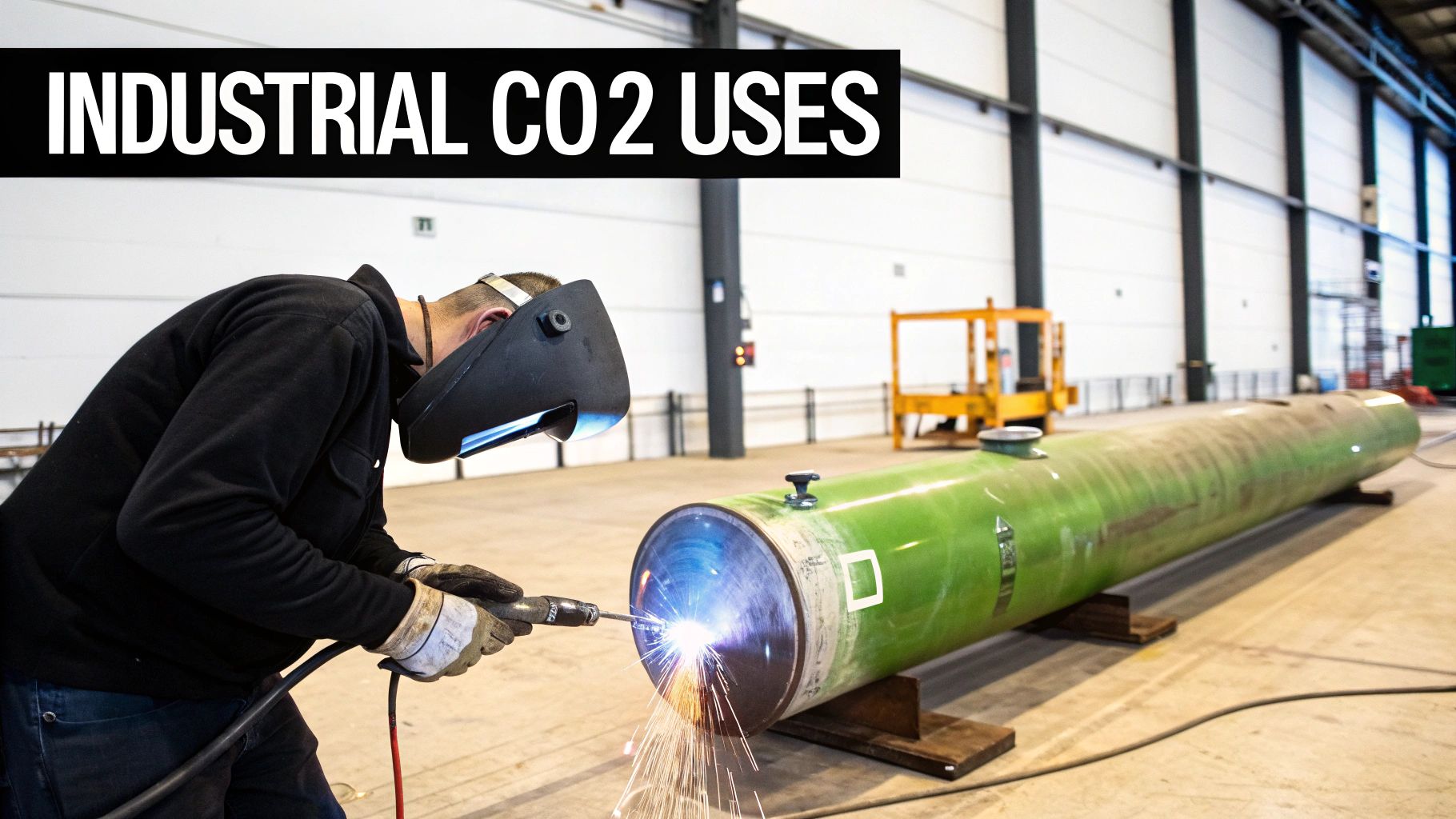
The widespread verwendung von kohlenstoffdioxid (use of carbon dioxide) in these sectors really drives home how vital a reliable supply chain is for both economic stability and innovation. From building materials to clean energy, CO₂ is an unseen but absolutely critical ingredient.
One of the most common places you’ll find carbon dioxide in an industrial setting is in welding, particularly Gas Metal Arc Welding (GMAW). In this application, it serves as a shielding gas, creating a protective, oxygen-free bubble around the molten weld pool. This step is absolutely critical for guaranteeing the structural integrity of the finished piece.
Without this gaseous shield, oxygen from the surrounding atmosphere would flood in and react with the hot metal, causing porosity (tiny bubbles) and oxidation. The result? A weak, brittle weld that could easily fail under pressure. CO₂ is often blended with argon to create a versatile shielding gas that offers deep weld penetration and a stable arc, making it perfect for fabricating everything from car frames to heavy industrial machinery. To get a better handle on this process, check out our guide on which gas to use for shielding gas welding.
Beyond its physical talents, carbon dioxide is also a valuable raw material—a fundamental building block for the chemical industry. It acts as a key input for synthesising several high-volume chemicals.
These applications completely transform CO₂ from a simple gas into a foundational component for agriculture and the wider chemical sector.
This is where CO₂ gets really interesting. When you pressurise and heat it beyond its "critical point" (31.1°C and 73.8 bar), carbon dioxide enters a strange state known as a supercritical fluid. It's not quite a liquid and not quite a gas, but it borrows the best properties from both.
A supercritical fluid has the density of a liquid but the viscosity and diffusion of a gas. This makes it an exceptionally effective and gentle solvent, capable of penetrating materials like a gas and dissolving compounds like a liquid.
This property is famously used for decaffeinating coffee beans. The supercritical CO₂ flows through the beans, selectively dissolving the caffeine while leaving all the delicate flavour and aroma compounds untouched. As soon as the pressure is released, the CO₂ instantly reverts to a gas and evaporates, leaving absolutely no chemical residue behind.
This remarkably clean and non-toxic extraction method is also used for:
Over in the energy sector, carbon dioxide plays a huge part in Enhanced Oil Recovery (EOR). After the primary and secondary extraction methods have pulled out all the easy-to-reach oil from a reservoir, a surprising amount often remains trapped deep underground.
Injecting CO₂ into these mature oil fields helps to squeeze out that trapped oil. The CO₂ works in two ways: first, it mixes with the oil, reducing its viscosity and making it flow more easily. Second, it re-pressurises the reservoir, effectively pushing the remaining oil toward the production wells. Using CO₂ for EOR can boost a well's total output by 10% to 25%, extending the life of existing fields and maximising the resources we can extract. It’s yet another critical economic use for captured carbon dioxide in heavy industry.
Before moving on, it’s helpful to see how carbon dioxide stacks up against another industrial gas workhorse: nitrogen. While they have some overlapping uses, their distinct properties make them better suited for different jobs.
| Application | Carbon Dioxide (CO₂) | Nitrogen (N₂) | Key Deciding Factor |
|---|---|---|---|
| Welding | Active gas; improves weld penetration and arc stability in GMAW. | Inert gas; prevents oxidation in TIG and MIG welding of non-ferrous metals. | CO₂ is reactive and cheaper; N₂ is inert and required for specific metals. |
| Food Packaging | Inhibits microbial growth (bacteriostatic). | Displaces oxygen to prevent oxidation and spoilage. | CO₂ actively protects against microbes; N₂ is better for preventing staleness. |
| Chemical Feedstock | Used to produce urea, methanol, and carbonates. | Used to produce ammonia via the Haber-Bosch process. | The desired end-product chemistry determines the choice. |
| Extraction | Supercritical CO₂ is a highly effective, tunable solvent. | Used primarily as a pressurising gas or for cryo-milling. | CO₂'s unique supercritical properties make it a superior solvent. |
| Fire Suppression | Displaces oxygen and provides some cooling. | Displaces oxygen; extremely effective for sensitive electronics. | N₂ is cleaner and leaves zero residue, making it ideal for high-value assets. |
Ultimately, the choice between CO₂ and N₂ comes down to the specific chemical and physical requirements of the process. Is reactivity a benefit or a hindrance? Is preventing oxidation the primary goal, or is microbial control more important? Answering these questions guides the decision for any given application.
Working with carbon dioxide, especially in its liquid and solid forms, isn't just about being cautious—it demands rigorous, well-practised safety protocols. The diverse uses of carbon dioxide introduce specific risks that must be actively managed to protect your team and maintain operational compliance. CO₂ is perfectly safe to handle, but only when you understand and respect its unique hazards.
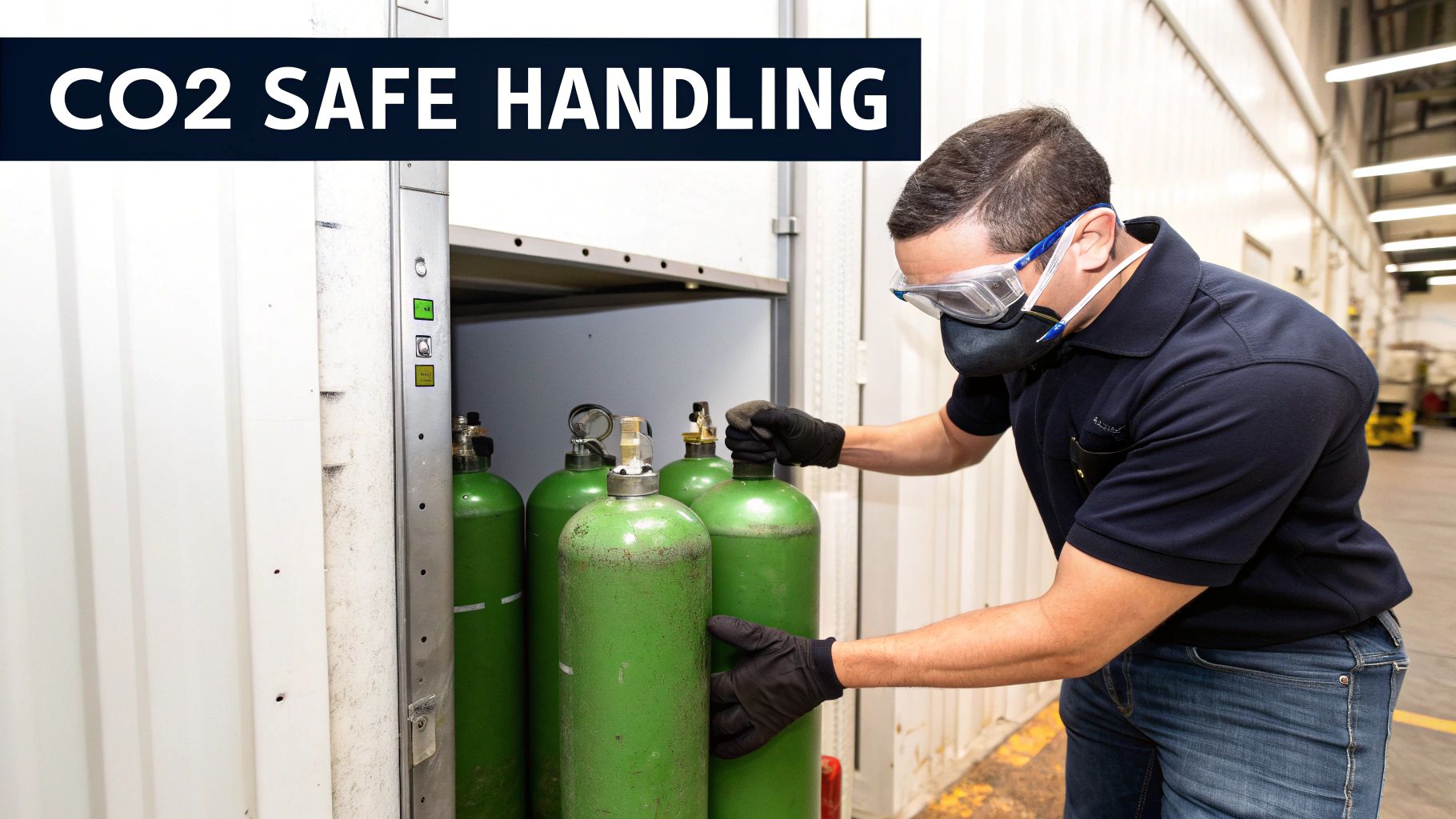
Two primary dangers stand out: asphyxiation and severe cold burns. Because CO₂ gas is 1.5 times heavier than air, it can silently pool in low-lying, poorly ventilated areas like basements or enclosed vehicles. This displaces oxygen, creating a serious suffocation hazard for anyone who enters the space.
On top of that, direct contact with liquid CO₂ or solid dry ice, which sits at a frigid -78.5°C, can cause immediate and severe frostbite, damaging skin and tissue almost instantly.
To counter these risks, the right Personal Protective Equipment (PPE) is non-negotiable. It's the first and most critical line of defence for anyone handling cryogenic materials.
Properly outfitting your team is a fundamental step in building a strong safety culture around CO₂.
Safe storage is just as crucial as safe handling. Whether you’re using small, high-pressure cylinders or large, insulated bulk tanks, the storage area must be carefully managed. The number one rule? Adequate ventilation. This simple measure prevents the dangerous build-up of CO₂ gas from slow leaks or sublimation.
All CO₂ storage areas, especially those indoors, should be equipped with oxygen monitors and alarms. These devices provide a critical early warning if oxygen levels drop to a dangerous threshold, giving personnel time to evacuate safely.
Furthermore, all pressurised containers must have functioning pressure relief valves to prevent catastrophic failure if internal pressure builds up from temperature changes. For more practical advice, check out our guide on the safety and handling of CO₂ tanks.
For logistics providers, transporting CO₂, whether as a compressed gas or dry ice, is governed by strict regulations. In Europe, the primary framework for road transport is the ADR (Agreement concerning the International Carriage of Dangerous Goods by Road).
Compliance isn't optional—it's mandatory. The ADR ensures that CO₂ is moved safely across borders, minimising risks to the public and the environment. It specifies everything from the type of placards required on a vehicle to the training drivers must receive.
Failing to comply can result in significant fines and operational delays. A thorough understanding of these rules is essential for any transport or logistics operation involving industrial gases.
Any real conversation about the verwendung von kohlenstoffdioxid (the use of carbon dioxide) has to tackle its role in the environment. We all know CO₂ as a primary greenhouse gas, but it's crucial to understand the context of its industrial applications.
The carbon dioxide used in cryogenics, beverage carbonation, or welding isn't just being created out of thin air. A huge portion of it is actually a captured byproduct, recovered from processes like ammonia production for fertilisers or from ethanol fermentation.
What this really means is that it’s being repurposed in a more circular system, not newly generated and pumped into the atmosphere. For any business trying to square its operations with sustainability goals, that’s a vital distinction. By capturing and reusing this CO₂, industries are turning a potential waste stream into a valuable resource—a practical step towards a circular economy where materials are kept in use for as long as possible.
Looking ahead, the technologies surrounding carbon dioxide are moving fast. The field with the most promise right now is Carbon Capture, Utilisation, and Storage (CCUS). This isn't just a futuristic concept; it’s a growing set of technologies designed to grab CO₂ emissions right at the source, like from power plants or heavy industrial sites.
It's a straightforward, three-step process:
This approach gives us two major benefits. It offers a way to decarbonise essential industries that are tough to electrify, while also creating a steady, reliable source of purified CO₂ for all sorts of commercial uses. It’s about turning a climate challenge into an economic opportunity.
One of the most exciting areas where CO₂ is being put to work is in creating synthetic, carbon-neutral fuels, often called e-fuels. The process, known as Power-to-X, uses renewable electricity to make green hydrogen. This green hydrogen is then combined with captured carbon dioxide to create liquid fuels like e-methanol or e-kerosene.
These e-fuels are chemically almost identical to their fossil-fuel cousins, meaning they can be used in existing engines and infrastructure. This makes them a critical piece of the puzzle for decarbonising long-haul transport sectors like aviation and shipping, where batteries just aren't a practical solution.
This isn't just a minor tweak; it's a fundamental shift in thinking. It reframes captured CO₂ from waste that needs to be buried into a key raw material for the future of clean energy. As these technologies grow, they will pull the uses of carbon dioxide even deeper into sustainable industrial cycles.
This push for sustainability is being backed by serious policy at both national and international levels. Germany, for example, is clearly committed to cutting greenhouse gas emissions. The latest data shows a massive drop from 1,252 million tonnes of CO₂ equivalents in 1990 down to 649 million tonnes—a 48.2 percent reduction in 34 years. The pace has picked up since 2018, thanks largely to the expansion of renewable energy.
Now, the targets are even more ambitious: at least a 65 percent reduction by 2030 and complete greenhouse gas neutrality by 2045. You can find more details about Germany's climate strategy on the Umweltbundesamt website.
This firm regulatory direction gives industries a stable and predictable path forward as they invest in cleaner tech. For sectors like biobanking and pharmaceuticals that depend on cryogenic solutions, aligning with these sustainability trends isn't just about ticking a compliance box. It’s about future-proofing their operations and gaining a real competitive edge in a world that puts a high price on environmental responsibility.
When you're working with carbon dioxide day in and day out, a few common questions always seem to pop up, especially around choosing the right grade or understanding the transport rules. Let's clear up some of the most frequent queries.
The real difference boils down to purity and the strictness of testing. Medical grade CO₂ has to meet incredibly high standards, usually over 99.5% purity. It goes through extensive testing to guarantee it's completely free of any contaminants that could be harmful in procedures like surgical insufflation.
Industrial grade CO₂, on the other hand, is the workhorse for applications like welding or putting the fizz in soft drinks. The purity standards are less stringent because trace impurities won't compromise the process or the final product. For sensitive work in a lab or biobank, the grade you need really depends on how sensitive your specific protocol is to potential contaminants.
Dry ice gets its "hazardous" classification because it sublimates—it turns directly from a solid into carbon dioxide gas, skipping the liquid phase entirely. If you seal it in an airtight container, that gas will build up a massive amount of pressure, creating a genuine risk of explosion.
Beyond that, as the gas expands, it pushes out oxygen. In a confined area like a vehicle's cabin or a plane's cargo hold, this can quickly create a serious asphyxiation hazard. This is exactly why regulations from authorities like ADR (for road) and IATA (for air) demand proper ventilation and specialised packaging that lets the gas escape safely.
In a word, no. You can't swap CO₂ for liquid nitrogen (LN₂) in every cryogenic situation, and the reason is simple: temperature. Dry ice gives you a respectable -78.5°C (-109.3°F), but liquid nitrogen is in another league entirely, boiling at a much, much colder -196°C (-320°F).
For many biological samples, especially those in long-term cryopreservation at biobanks, you need the extreme cold that only LN₂ can deliver to bring all biological activity to a dead stop. Dry ice is fantastic for short-term shipping and temporary cooling, but for applications that demand true, deep-freeze cryogenic temperatures, liquid nitrogen is still the undisputed king.
For state-of-the-art cryogenic solutions designed for the secure storage and transport of your most critical biological materials, trust Cryonos GmbH. Explore our compliant and reliable equipment at https://www.cryonos.shop.

